Search for what Google Antigravity costs and you get pages that disagree, and most of them were right on the day they published. Google has repriced the product once, and what the unpaid tier gets has moved at least once more. No single page carries both halves.
Google Antigravity costs $0 a month on its individual tier, which carries weekly rate limits and no published end date. Paid capacity comes from a Google AI subscription instead: Pro at $19.99 a month, Ultra starting at $99.99. Prices checked 16 August 2026.
Three Google pages hold the fragments, and this article pulls from all three as they stood on 16 August 2026: the Antigravity pricing page for the tiers, the Google AI subscriptions page for the money, and the Antigravity plans documentation for the quota rules. No paid account sits behind any of it, and the product was not run. The figures are US list prices. The subscriptions page changes currency by country, so a reader outside the US will see a local number that is not a straight conversion of these.
Is Google Antigravity free, and for how long?
Google Antigravity is free. The individual tier is listed at $0/month on Google’s pricing page as of 16 August 2026, with basic weekly rate limits and no published end date. The tier stands on its own with no trial clock attached, and nothing on the page counts down.
Google’s own words for that tier are “Experience Antigravity without a subscription plan”. The listed contents are the agent model, unlimited Tab completions, unlimited Command requests, and “Basic weekly rate limits”. The page asks for no card and shows no cutoff date. What shrank between launch and now was the unpaid quota, not the tier itself.
| Plan | US list price | Quota refresh | Third-party models | Buy overage credits |
|---|---|---|---|---|
| For Individuals, no subscription | $0/month | ”Meaningful quota, refreshed weekly” | Listed on the pricing page, not in the docs tier list | No |
| Google AI Plus | $4.99/month | No Antigravity line on the plan, so the unpaid weekly refresh | Same as unpaid | No |
| Google AI Pro | $19.99/month | ”High, generous quota, refreshed every five hours until weekly limit reached” | Not listed for this tier in the docs | Yes |
| Google AI Ultra 5x | $99.99/month | ”The highest, most generous quota, refreshed every five hours" | "Access to third-party models” | Yes |
| Google AI Ultra 20x | $199.99/month | Same five-hour refresh as Ultra 5x | ”Access to third-party models” | Yes |
| Organization plan, via Google Cloud | No list price published | Not documented as a tier | Not documented | Consumption-billed instead |
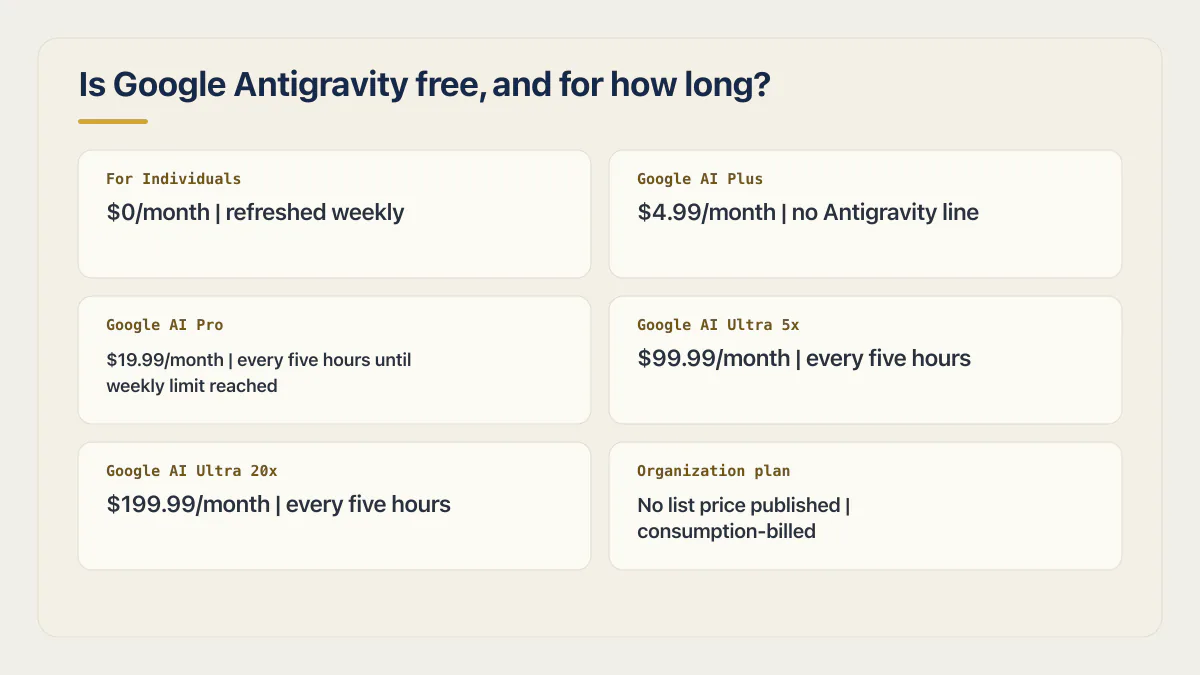
Prices checked 16 August 2026 on the Google AI subscriptions page with the US locale forced. The quota strings are quoted from the Antigravity plans documentation on the same day. What separates the two Ultra tiers is allowance, not cadence: Google’s May 2026 post sets them at five and twenty times the Pro token allowance.
The third-party model column is the one place Google’s two pages do not line up. The pricing page gives the free tier “access to Gemini 3.5 Flash, Gemini 3.1 Pro, Gemini 3 Flash, Claude Sonnet & Opus 4.6, gpt-oss-120b”, which includes models that are not Google’s. The plans documentation puts “Access to third-party models” only under what Ultra subscribers receive. Both were read on 16 August 2026 and both are current. Non-Google models have been in the free offer since the launch post promised “model optionality” in November 2025, so the pricing page has history behind it, but anyone planning free-tier work around a non-Gemini model is planning around a line only one of Google’s two pages carries.
What Google Antigravity costs once the free tier is not enough
Google Antigravity has no price of its own. Paid capacity comes with a Google AI subscription: $19.99 a month for AI Pro, $99.99 for Ultra 5x, $199.99 for Ultra 20x, checked 16 August 2026. The $4.99 AI Plus plan lists no Antigravity access at all.
The AI Plus gap is easy to miss, because $4.99 looks like the cheap way in. As of 16 August 2026, Google’s subscriptions page lists no Antigravity line under Google AI Plus. AI Pro carries “Entry rate limits to agent model in Google Antigravity, our agentic development platform”. Ultra carries two lines, one per price point: the 5x tier at $99.99 gets “Higher rate limits to agent model in Google Antigravity, our agentic development platform” and the 20x tier at $199.99 gets “Highest rate limits to agent model in Google Antigravity, our agentic development platform”. Plus carries nothing. That is what the page did not say on the day it was read, so check the plan page yourself before buying Plus for this purpose.
What the $19.99 buys, mechanically, is a faster clock and a larger allowance. Pro and Ultra refresh baseline quota every five hours, and both also have weekly limits. Google’s plans page gives Ultra the highest weekly rate limits and Pro a lower weekly limit.
People say “the Antigravity Pro plan” and everyone knows what they mean, but Google does not sell one. There is Google AI Pro and Google AI Ultra, and Antigravity capacity is one line item inside each, alongside storage, video generation and the rest.
The same naming point answers the developer-plan question. As of 17 August 2026, Google’s Antigravity pricing page names four options: For Individuals, Google AI Pro, Google AI Ultra, and an Organization plan via Google Cloud. None is called a developer plan. Google labels Ultra “For Developers.” Organization is a separate route under Google Cloud terms with consumption-based Gemini Enterprise Agent Platform pricing and no published monthly figure.
How Google Antigravity is billed: what counts against your quota
Google Antigravity bills nothing directly on the individual tiers. The quota tracks the amount of work the agent does, not the number of prompts, so two messages of the same length can cost very different amounts. Paid tiers refresh every five hours, the unpaid tier refreshes weekly, checked 16 August 2026.
Google states the mechanism plainly in its plans documentation: “Under the hood, the rate limits are correlated with the amount of work done by the agent, which can differ from prompt to prompt. Thus, you may get many more prompts if your tasks are more straightforward and the agent can complete the work quickly, and the opposite is also true.”
Read that back as a buyer. The thing you are paying for is measured in work you cannot see, reported in units Google does not name, against a ceiling Google does not publish.
That is why nobody can tell you how many prompts $19.99 buys, and Google’s phrasing is an honest description of an agent that plans, calls tools, retries and reasons for as long as a task needs. A three-word prompt that kicks off an hour of autonomous work costs more than a long prompt that produces one file.
Overage works one way and one way only. The documentation says users on Google AI Pro or Ultra plans “can utilize purchased AI credits (or any one-time promotional credits) for additional overage usage above the baseline provided quota”, and that “AI credits are consumed at standard Gemini Enterprise Agent Platform consumption pricing”. Whether that spend happens automatically is a setting called “AI Credit Overages”, which can be set to Never or Always. Never waits for the refresh. Always keeps working and spends credits until the quota comes back.
The unpaid tier has no equivalent. There is no buy-more button on $0/month, so hitting the weekly limit means waiting for the week to turn. The Organization plan through Google Cloud inverts the whole model: it is consumption-billed from the start, so there is no baseline to exhaust, and the bill scales with use instead of stopping.
Two documented limits close off the usual workarounds. There is no support for bring-your-own-key or bring-your-own-endpoint as a way to buy extra rate limit, and none for organizational tiers via contract. The same page adds that “Usage limits for this service are subject to modification.”
What changed since Antigravity launched free
Antigravity launched on 18 November 2025 as free with a five-hour refresh, and today’s unpaid tier is free with a weekly one. Both statements are true, both come from Google, and they are nine months apart. This is the whole reason the ranking pages disagree.
| Date | What was published | Source |
|---|---|---|
| 18 November 2025 | Antigravity is “available in public preview at no charge, with generous rate limits on Gemini 3 Pro usage”. A footnote adds that limits are “refreshed every five hours” | Google’s launch post |
| 13 March 2026 | Not Google. Mels Dees at Techzine reported that “Several users indicate that their available quota is no longer replenished every few hours, but only after a week” | Techzine |
| 19 May 2026 | Google introduces “a new $100/month Google AI Ultra plan” and reduces “the price of our top-tier AI Ultra plan from $250 to $200 per month”, setting the two Ultra tiers at 5X and 20X the Pro token allowance | Changes to Antigravity Plans |
| 16 August 2026 | The store prices those two tiers at $99.99 and $199.99, and the documentation gives the unpaid tier “Meaningful quota, refreshed weekly” | Subscriptions page and plans documentation |
Two things about that table are worth saying out loud. Google has not published a date for the unpaid tier’s move from a five-hour refresh to a weekly one, so the March row is a reader report and this page does not assert a change date Google never stated. And Google’s blog rounds its own prices while the store does not: the May post talks about $100 and $200 plans, the checkout says $99.99 and $199.99.
The May post also carried a promotion: “we’re offering new and existing Google AI Ultra subscribers USD $100 in bonus AI credits for Antigravity that will kick in if you hit your plan’s quota limit…” That offer expired on 25 May 2026, and is here only so nobody reading an old summary goes looking for it.
The practical consequence is easy to see in one example. XDA published a considered piece on Antigravity on 12 May 2026, by Anurag Singh, listing Google AI Pro at $19.99 per month and Google AI Ultra at $249.99 per month. Those were the correct US figures that week. Google repriced seven days later, and the article carries no updated date, so a reader landing on it today gets a $249.99 top tier that has not existed since 19 May 2026. That is what happens to any price written down in a product that repriced once and changed its free quota once inside nine months, which is why every figure here is stamped with the day it was read.
What a paid Antigravity plan does not promise
A subscription buys a larger quota. It does not buy guaranteed access to the model you picked, and it does not buy a published ceiling you can plan a week around.
The clearest illustration is on Google’s own developer forum. On 25 February 2026 a user posting as Wrapped described upgrading to Ultra and then hitting a wall: “After about 5 hours of development using a thinking model for complex math and geometry, I got rate limited and then effectively locked out from using the model I paid for.” What they objected to was the shape of the deal: “at $200 per month, this experience doesn’t match expectations”. A reply on 6 March 2026, from an account whose forum title reads Google, said: “Thank you for bringing these concerns to our attention. Please be assured that I have shared your feedback with our internal team for further review. We appreciate your continued patience as we work to enhance the Antigravity experience.” That reply states no policy, names no ceiling and corrects nothing. The thread is still open, and a different subscriber added the same complaint in June 2026.
The unpaid tier version of the same problem is sharper, because the wait is longer. Anurag Singh’s XDA piece put it this way: “There have been times when I was locked out of the platform for an entire week after just 20 to 30 minutes of active usage.” One person’s experience is one person’s experience, and yours may look nothing like it. What it shows is the shape of the risk on a weekly refresh. When the bucket empties, the wait is measured in days.
Geography adds a second gap between the sticker and the bill. Every figure here is a US list price, and a buyer elsewhere pays their country’s price, in their currency, plus whatever their bank charges to move the money. On the day this page was researched, the third-ranking result for the query was a non-US buyer doing exactly that arithmetic in public and landing well above the US number.
There is one more thing a plan tier says nothing about. How much of your machine the agent may touch, what Google keeps from a session, and what a prompt hidden in a web page can talk the agent into doing all belong to the security and privacy review of Antigravity, and no amount of quota changes any of those answers. Buying Ultra makes the agent run longer, which if anything makes those questions matter more.
Which Google AI plan do you actually need for Antigravity?
The right Google AI plan for Antigravity is the free one until a week of your own work proves otherwise. Move to Pro at $19.99 when the weekly wall arrives before your work does, more than once. Move to Ultra at $99.99 only when your measured work needs its larger documented allowance.
- Stay unpaid while the weekly quota outlasts your week. Nothing is forcing you off it as of 16 August 2026.
- Move to Google AI Pro at $19.99 when you hit the weekly wall regularly. Pro is where the five-hour refresh starts and where buying overage credits becomes possible at all.
- Take Google AI Ultra at $99.99 when Pro’s five-hour or weekly allowance is still too small for measured work. Ultra raises both limits but does not remove the weekly one.
- Take Ultra at $199.99 only after Ultra at $99.99 has genuinely run out. It is the same product with a twenty-times token allowance instead of five, so it answers a measured problem and makes a poor starting point.
- Go through Google Cloud when procurement owns the decision or the work belongs to a company account, and accept that the bill then moves with use instead of sitting at a figure you can predict.
The reason to measure first is that almost nobody can tell a normal AI tool bill from a runaway one. In a one-time read of 1,255 posts from AI-builder communities on 14 August 2026, 6 rows were people asking whether their own build bill was normal, usually by posting the number and asking strangers to react. That corpus leans toward people showing finished work more than complaining about money, so 6 says the situation recurs and nothing at all about how common it is. One of those six had spent a few months building an app on Replit, and posted the invoice with a question attached:
“This is my bill. What do you think? To high? Seems right?”
That bill came from Replit, so the numbers do not transfer to a Google AI subscription. It belongs here because Antigravity gives you even less to answer the same question with. The Replit builder at least had a dollar figure to hold up. Antigravity’s meter is not denominated in money at all, so the only baseline available to you is your own: one ordinary week of work, watched, before you decide which tier to pay for.
Two nearby questions sit outside what this page settles. Some people never reach a quota at all, and the sign-in error that reads your current account is not eligible for Antigravity is an eligibility problem rather than a billing one, so paying for a higher tier does not clear it. And if Antigravity is one of two or three agents you are pricing at the same time, what Claude Code costs on each plan and what Kiro costs are separate answers with their own tiers and their own refresh rules, and none of the three bills converts into the others.
Common questions about Google Antigravity pricing
Is Google Antigravity free?
Yes. Google’s pricing page lists a For Individuals tier at $0/month, described as “Experience Antigravity without a subscription plan”, with basic weekly rate limits, checked 16 August 2026. No card is required and no expiry is published on that page.
How long is Google Antigravity free?
There is no end date published for the free tier as of 16 August 2026. The pricing page presents $0/month as a standing option with no trial clock, and Google’s documentation describes the quota for users who are not on Pro or Ultra without any time limit attached. What has moved since launch is the size and refresh rate of that quota, not whether the tier exists.
How much is a Google Antigravity subscription?
Antigravity has no subscription of its own. Paid access comes through a Google AI plan: $19.99 a month for AI Pro, $99.99 for Ultra 5x, and $199.99 for Ultra 20x, all US list prices checked 16 August 2026 on Google’s subscriptions page. Prices differ by country.
Is there a Google Antigravity developer plan?
No plan by that name exists. As of 17 August 2026, Google’s pricing page labels Google AI Ultra “For Developers.” It lists Organization separately as a Google Cloud route with consumption-based Gemini Enterprise Agent Platform pricing instead of a published monthly tier.
Does the Google AI Plus plan include Antigravity?
As of 16 August 2026, Google’s subscriptions page lists no Antigravity access under Google AI Plus at $4.99 a month. AI Pro at $19.99 is the cheapest plan on that page carrying an Antigravity line. That is an absence on the page and not a stated exclusion, so check the plan page before buying Plus for this purpose.
How is Google Antigravity billed?
Antigravity usage is metered against a quota attached to your Google AI plan. Google’s documentation says the rate limits “are correlated with the amount of work done by the agent, which can differ from prompt to prompt”, so a short prompt that starts a long autonomous task consumes more than a long prompt that does not. The plan itself is billed monthly.
What happens when you hit the Antigravity rate limit?
You wait for the refresh, or you spend credits if your plan allows it. Ultra’s quota is documented as refreshed every five hours, Pro’s every five hours until a weekly limit is reached, and the unpaid tier’s weekly. Only Pro and Ultra subscribers can buy AI credits to keep going, so on the free tier hitting the weekly limit means waiting for the week to turn.
Can you buy more Antigravity usage without changing plans?
Only on Pro and Ultra. Google’s documentation says users on those plans can use purchased AI credits for overage above the baseline quota, consumed at standard Gemini Enterprise Agent Platform consumption pricing, and an “AI Credit Overages” setting controls whether that happens automatically or never. There is no credit purchase path on the $0/month tier.
Does paying for Google AI Ultra guarantee access to the model you picked?
No. Google’s documentation describes rate limits as primarily determined by available capacity and adds that usage limits “are subject to modification”. A subscriber posting on Google’s developer forum on 25 February 2026 described being downgraded to a faster, smaller model after roughly five hours of work and blocked from the higher tier for up to seven days. A tier buys a bigger allowance. Guaranteed availability is not something Google documents.
Built it with AI. Can’t get the last part right?
That’s the normal state of an AI-built app, and it’s fixable. I trace what the app actually does, explain what needs changing, and build it if you want me to.
Talk about your app →  Free 20-minute video call with Bilal.