A customer, a partner clinic or an investor has asked whether real patient records are allowed inside the app you already built on Lovable, meaning the prompt-driven app builder that lives at lovable.dev, rather than the home health care business or the healthcare company trading under the same word. The subject here is the US health-record regime as it reaches a company running software for a covered entity, or running it for somebody who is already that entity’s business associate. Nothing on this page concerns the rights a patient holds over a chart of their own.
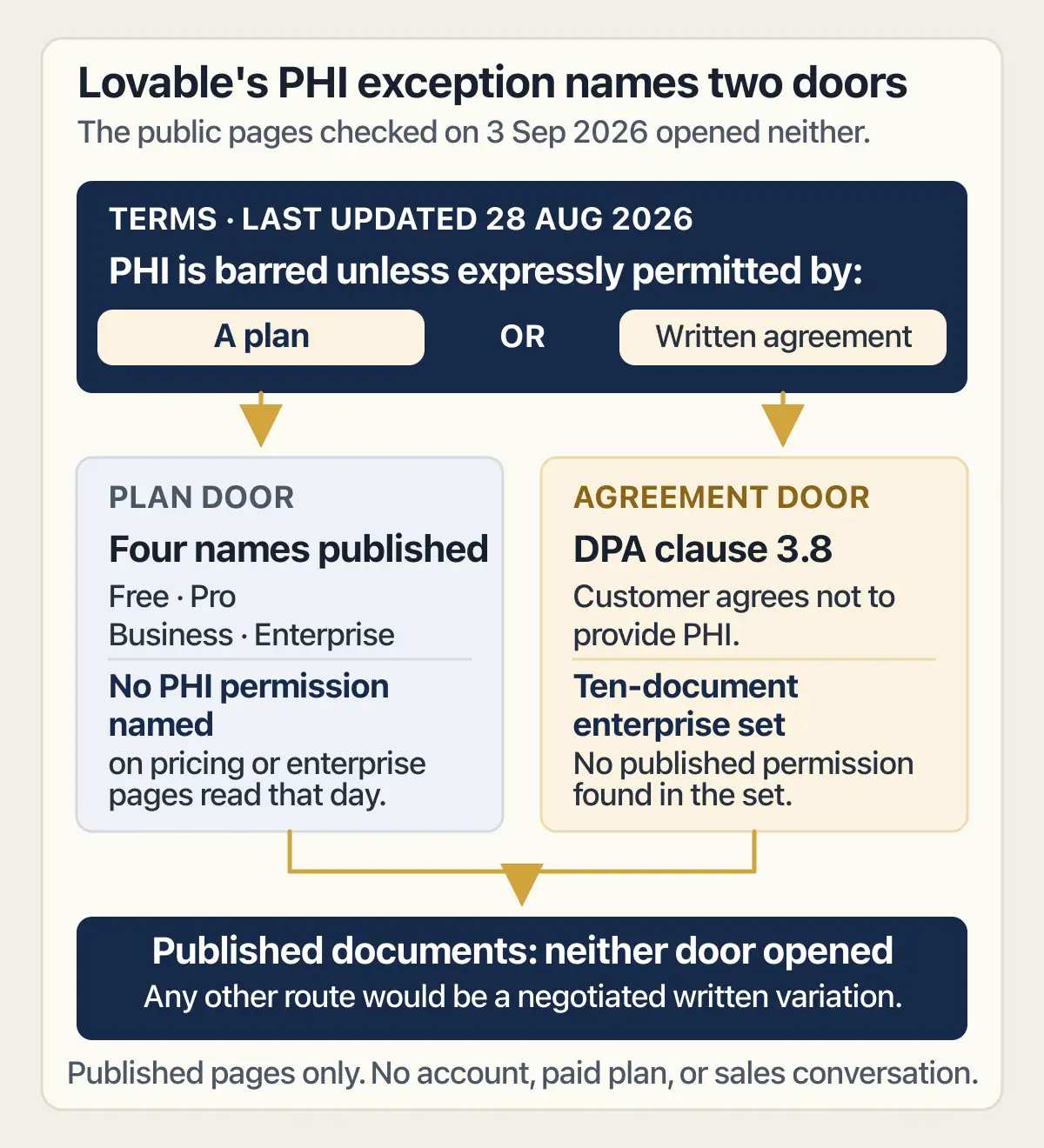
Lovable’s terms of service bar protected health information unless a plan or a separate written agreement expressly permits it. Both of those instruments are published, and read on 3 September 2026 neither one opens. The data processing agreement bars the same data outright, and no plan or enterprise document names a health path.
That is the short answer, and any reader can reproduce it in about ten minutes from four addresses on Lovable’s own domain. What takes longer is the part underneath: which of Lovable’s documents your customer will actually accept as an answer, which backend your project is on and therefore whose paperwork is even in play, and what to send Lovable in writing before anybody signs anything.
Every page named here was pulled twice on 3 September 2026, first with a bare request and then with one carrying a browser’s user agent string, and both copies came back identical byte for byte. Each was read as delivered markup, navigation menus and footer links included, so that a count of zero is a count taken over the whole file rather than over the part a reader happens to scroll past. Nothing here came from an account, a paid plan, a sales conversation or a document sent to this site by anybody. AxonBuild neither wrote, hosted, signed nor reviewed any of the material quoted below, and none of what follows is legal advice or a ruling on whether your app satisfies anything.
What do Lovable’s own documents say about patient data?
Three Lovable documents name health records, and they do not agree on the shape of the rule. Two state it flatly. One states it with an exception, and the exception is the reason this question keeps getting two different answers online.
| Document | What it says about health records | Date on the document |
|---|---|---|
| Terms of service | Barred, unless a plan or a separate written agreement permits them | 28 August 2026 |
| Privacy policy | Should not be uploaded, and the services are not built for it | 14 April 2026 |
| Data processing agreement | The customer promises not to provide them, with no exception attached | 6 November 2025 |
Lovable’s terms of service carry a version line reading “Last Updated: August 28, 2026”, an effective date given as 15 August 2026, and a footnote saying “Unless earlier expressly accepted”. That update landed shortly before this reading. The word HIPAA appears exactly once in everything that page renders as text, inside a section headed “No Sensitive Data”:
“Unless your plan or a separate written agreement with us (such as a data processing addendum or enterprise service agreement) expressly permits it, you agree not to upload, input, or otherwise provide through the Services any protected health information subject to HIPAA, or other special or sensitive categories of data (including financial account numbers, payment card data, government identifiers, or biometric data).”
The same section goes on to say that Lovable’s ordinary services were never built to be the authoritative record for data of that kind, or to carry the standard of safeguards a regulator expects around it.
Lovable’s privacy policy, headed “Last Updated: April 14th, 2026”, says the same thing twice and attaches no exception to either sentence. Under its sensitive-data definition it says Lovable “does not intentionally collect special-category or sensitive Personal Data, such as biometric identifiers, health information, or precise geolocation, and instructs customers not to upload such information”. In its list of personal-information categories it puts it plainly: “No sensitive data (e.g., HIPAA-protected health info, financial accounts) should be uploaded; our Services are not designed for it, and we disclaim responsibility if submitted.”
The third document is the one the ranking pages quote. Clause 3.8 of Lovable’s data processing agreement is a customer promise rather than a platform restriction, and it names the regime directly: “For the avoidance of doubt, the Customer agrees not to upload, input, or otherwise provide any protected health information under HIPAA”. No plan, agreement or negotiated variation is mentioned anywhere in the clause.
One oddity is worth writing down before you cite that agreement to anybody. It carries three dates on the agreement itself. The published web copy is headed “Last updated: November 6, 2025”. The signed copy Lovable links from the same page is a file whose seventeen numbered agreement pages run 1 (17) through 17 (17) and are followed by a signature audit page, which records the document as sent for signature on 21 November 2025 and completed on 24 November 2025, and whose header reads “DATA PROCESSING AGREEMENT LAST UPDATED: NOVEMBER 17, 2025”, and it is served at lovable.dev/documents/Lovable_DPA_17Nov2025_Signed.pdf. Lovable’s legal change log records one entry for the agreement in that month, dated 2025-11-08 and described as “Updated DPA with revised terms”. Clause 3.8 reads word for word the same in both copies, so nothing about the answer moves. What moves is which date you write in the email, and a customer’s reviewer who opens the other copy will notice.
The two doors the terms name, and what each one says today
The exception in the “No Sensitive Data” section names its instruments: a data processing addendum, an enterprise service agreement, or a plan that permits the data. Each of those is a published document or a published tier, so the exception can be checked rather than guessed at.
The plan door. Lovable’s pricing page names four plans in its own answers, Free, Pro, Business and Enterprise. Read end to end in its delivered markup on 3 September 2026, navigation and footer included, that page carries not one instance of the health regime’s initials, of the phrase business associate, or of the phrase protected health information. Its plan cards render no plan name and no price to an automated read at all. The marketing page at lovable.dev/enterprise counts zero on the same three, read the same way; the one time the word health occurs there, it occurs inside the alternative text of a customer logo image, which is a picture rather than a term. The product documentation is the same story, and the section below covers it.
The written agreement door. This one splits in two, and both halves are public.
The data processing addendum the clause points at is the agreement above. Its own opening line settles what it is: “This Data Processing Agreement (“DPA”) forms part of the Terms of Service ordered by the Customer under an Order Form (the “Agreement”) between Lovable and the Customer.” So the instrument the terms name as capable of permitting health records is the same instrument in which the customer promises, at clause 3.8, not to provide them.
The enterprise service agreement is published too. Lovable’s enterprise legal index lists ten documents: the General Terms and Conditions, the Product Terms, the data processing agreement, the Consultancy Services Terms, the Solution Partner Program Terms, the Expert Program Terms, the Definitions schedule, the Subprocessors List, the DORA Addendum and the change log. Each one was fetched at its own address and read end to end on 3 September 2026, navigation and footer included. Across the whole set of ten, those three phrases turn up in exactly one place: clause 3.8 of the data processing agreement, where they form a prohibition. The General Terms and Conditions, headed “Enterprise Agreement Effective: Feb 2026”, contain none of the three, and neither do the Definitions schedule or the DORA Addendum.
One naming trap catches people who do go and check. In that legal index the link labelled “Terms of Service” opens the page headed General Terms and Conditions, while the site footer’s link labelled “General terms” opens the page headed Terms of Service. The health-record clause lives in the second of those, and the agreement it points at as a way around the clause is the first. A founder told to check the enterprise agreement can open the wrong document and find nothing, which is a different result from finding a permission.
Set the two doors beside each other and the reading is plain. Both are public. Neither, as published on 3 September 2026, permits anything. Anything else would be a negotiated variation of a published document, which is a thing to ask for in writing and receive in writing, rather than a thing to assume from a sales call.
Is your app on Lovable Cloud or your own Supabase project?
Which backend the project uses decides whose paperwork is in play, and Lovable’s documentation draws that line itself rather than leaving anybody to infer it. On the built-in backend the only company with an agreement to offer is Lovable. Where the project runs on a Supabase organisation you hold, a second party enters, along with a second set of published documents.
The documentation for what Lovable calls the built-in backend, read 3 September 2026, names both options and keeps them apart by name throughout: the built-in backend, labelled Cloud, which runs on Supabase’s open-source foundation and arrives switched on, and an external backend a customer connects themselves, for which the page names Supabase as the example.
Those two look alike from inside the editor and are different in the only way that counts here, which is whose account the database sits in. On the built-in backend the instance belongs to Lovable, and who owns the Lovable Cloud instance works through what that means for keys, bills and exits. The consequence for this question follows from the same fact and is not drawn on that page: if the instance is not in an account you hold, you are not a party to anything covering it, and there is no database vendor for you to sign anything with, because you hold no account with one. The paperwork in play is Lovable’s, and Lovable’s is the paperwork above.
Connect an external Supabase project and the picture changes, because the organisation is yours. Supabase’s own published HIPAA path sets out what that route asks for and what it leaves sitting with the app, which is a separate question answered separately. It also leaves the Lovable layer exactly where it was: the editor, the agent that writes the code and the preview address are still Lovable’s, and the documents above are still the ones that govern what may be put through them.
Neither piece of documentation says anything about health data. Read end to end in delivered markup on 3 September 2026, with the documentation site’s own index of every page included, the Cloud page and the security page at docs.lovable.dev/features/security carry none of the three phrases used above. The only strings containing the word health on either are the search keywords attached to the project monitoring page, “health checks” and “app health”, which are about whether an app is running.
Is a health app against Lovable’s rules, or only the records inside it?
Lovable’s platform rules bar categories of content and conduct, and read on 3 September 2026 they say nothing about health care as a line of business. The restriction that reaches a health product sits in the data clauses instead, and it governs what goes into the database rather than what the product is for.
Lovable’s platform rules, headed “Last Updated: February 2026”, run to fourteen numbered rules. Two of them come near the subject. Rule 4, on discrimination and hate, names “health status” in its list of protected attributes. On deceptive media, rule 7 bars “Dangerous medical claims associated with fake treatments for chronic life-threatening diseases”. Rule 8 is where a founder building for clinics would expect to be caught. Its regulated goods and services paragraph bars selling or promoting “regulated services without required licenses or approvals, including gambling, financial services, weapons-related services, or controlled substances”. Health care and medical services are not among the four examples it gives, and the sentence reads as examples rather than as a complete list.
The terms come at the same subject from a different angle, twice, in the section governing what the model produces. They say a customer agrees not to “use AI Output without appropriate review in high-risk or sensitive contexts (including medical, legal, financial, or safety-critical uses)”, and separately that “You assume full responsibility for your use of AI Output and agree not to rely on it for critical or high-risk functions (including medical, legal, financial, or safety-related purposes) without appropriate safeguards.” Both are about generated code being reviewed before somebody depends on it, and neither says anything about the records.
So the documents divide the question in two. Whether you may build the thing, and whether you may put real records in it, have separate answers in separate places, and only the second one is closed.
Where the published answers to this question disagree
Two published answers on this query have done real document work, and each holds half of it. Neither is linked here.
Caspio, a low-code platform sold with its own health edition, publishes a page carrying the line “Last verified: July 16, 2026” and a note that it re-verifies quarterly. That page quotes clause 3(8) of the data processing agreement in full and dates the agreement to 6 November 2025. Read end to end on 3 September 2026, it carries not one instance of the phrase Terms of Service, and the exception does not appear on it in any form.
Specode, a healthcare software seller, publishes a post dated 6 May 2025 and marked “(reviewed July 2026)” whose answer is “No. Lovable does not offer a standard BAA and its terms don’t support PHI”. It reads the terms accurately, including the exception, saying they instruct customers not to upload “any protected health information subject to HIPAA” unless a separate enterprise agreement expressly permits it. It then writes that the only hint of an exception is a negotiated Enterprise contract, “and good luck finding public proof one exists”. The post never names Lovable’s data processing agreement.
That second sentence is the gap this page exists to close. The enterprise agreement set is public, it runs to ten documents, and not one of them mentioned health data on the day they were read here. Vendor terms move, and Lovable’s own moved on 28 August 2026, which is why every reading above carries the date it was taken.
There is a separate half of Lovable’s paperwork that a customer usually asks for in the same email, covering its audit report, its certifications, the privacy regulation, where the data is hosted and what the data processing agreement does as a data-protection instrument rather than as a health-record rule. Lovable does publish claims about its own certifications, and those claims answer the second half of the email rather than the health question in it. Those documents are read through on a page of their own. For the older half of that boundary, which parts of a Lovable app the platform’s controls reach draws that line from the safety side.
What to ask Lovable in writing before any patient data goes near the app
Six questions are worth sending in writing and keeping the reply to. Each one names the document it comes from, so an answer can be checked against a page rather than against a recollection.
- Which of the two instruments named in the “No Sensitive Data” section of the terms are you offering, a data processing addendum or an enterprise service agreement, and will you identify it by name?
- How does that instrument sit beside clause 3.8 of the published data processing agreement, given that the agreement’s own opening line makes it part of the terms ordered under an Order Form?
- Which plan does the permission attach to, by the name it carries on the pricing page, since none of the four named there mentions health records today?
- Is this project on the built-in backend or on a Supabase project in an organisation we hold, and if it is the built-in one, whose account holds the instance?
- What happens to records already sitting in the project while that answer is pending, and under which clause?
- If the answer is a negotiated variation, which published document does it amend, and will it appear in the legal change log that records every other change to the enterprise set?
Not one of the six has an answer that lives in a product setting, and no badge answers any of them either. Once the paperwork question has been answered, changing where an already running app puts and moves its records is work of a different kind, treated on its own page.
Common questions about Lovable and patient records
Does Lovable sign a business associate agreement?
No page of Lovable’s read on 3 September 2026 names one. The phrase business associate does not appear on the terms of service, the privacy policy, the pricing page, the platform rules, the Cloud or security documentation, or any of the ten documents in the enterprise legal index. Across the ten documents in the enterprise legal set, the only place the health regime is named at all is clause 3.8 of the data processing agreement, where it is a promise by the customer not to send such data; the terms of service and the privacy policy name it too, each as a bar on uploading such data.
What do Lovable’s terms of service say about patient data?
A section headed “No Sensitive Data” makes health records conditional on one of two things: a plan that expressly permits them, or a separate written agreement that does. Absent either, a customer undertakes to keep such records, and other specially protected categories, out of anything they put into the product. The same section adds that Lovable’s ordinary services were never built to be the authoritative record for data of that kind. Read 3 September 2026, on a page last updated 28 August 2026.
Can I build a health app in Lovable with fake data instead of real records?
The documents restrict the data rather than the subject. Lovable’s platform rules, read 3 September 2026, bar regulated services offered without required licences or approvals and give gambling, financial services, weapons-related services and controlled substances as examples; health care is not among the examples, and the same rules separately bar dangerous medical claims about fake treatments. The clauses that bar health records describe data uploaded, input or otherwise provided through the services, so a prototype carrying invented records is a different object from one carrying real ones.
Does Lovable Cloud run on Supabase, and does that change the answer?
It does, and Lovable’s own documentation for the built-in backend names Supabase’s open-source foundation as what it runs on, so the database engine underneath is the same one. What does not transfer is a relationship. The instance is provisioned inside Lovable’s own footprint rather than an account you hold, so there is no second vendor for you to hold an agreement with, and Lovable’s own published documents are the only ones that govern the data.
Would connecting my own Supabase project change the answer?
It changes who else is in the picture. A Supabase project created in your own organisation gives you a direct relationship with that vendor, and Supabase’s own published HIPAA path sets out what it requires. It does not change anything the Lovable documents say, because the tool you write in, the model that generates the code and the address the preview is served from all still belong to Lovable, and the terms still govern anything put through them.
Is an enterprise plan the way to get patient data approved?
The terms name an enterprise service agreement as one of the two instruments that could permit it, and that agreement is published. Read end to end on 3 September 2026, the ten documents in Lovable’s enterprise legal index mention health records nowhere except at clause 3.8 of the data processing agreement, where they are prohibited. What an enterprise contract would say beyond the published set is a question for Lovable, in writing.
Do Lovable’s rules stop me from building anything for a clinic?
Its platform rules, last updated February 2026, are about content and conduct: violence, child harm, harassment, discrimination, self-harm, adult content, deceptive media, illegal or restricted goods, private information, non-consensual imagery, security, deceptive behaviour, dangerous acts and copyright. Health appears as a protected attribute in the discrimination rule and inside a bar on dangerous medical claims about fake treatments. There is no rule barring a health product as such.
Do Lovable’s terms treat data my app displays differently from data it stores?
The clause describes data you “upload, input, or otherwise provide through the Services”, which is its own wording and covers more than a database write. Where the line falls between what an app renders, what it puts through a prompt and what it stores is a question for a lawyer reading your specific data flow, not one this page can answer for you.
Two questions next door to this one are answered elsewhere. How another builder’s terms gate the same data reads Base44’s paperwork against the same regime, and moving a Lovable app onto hardware you control covers the case where a customer wants the whole product somewhere else instead. The same question asked across every builder and platform a small app is assembled from, rather than one vendor’s documents, has a longer answer than any single page of terms can give.
The checks in this guide show you where the app is open. The sprint below closes those gaps, tests the result and writes the evidence down.
Built it with AI. Now it has to hold up for real customers.
The Production Hardening Sprint takes the app you already have and builds the production foundation underneath it. Authentication and access rules, payments that stay consistent, error handling, monitoring, backups, automated tests and a documented handover. Our engineers work inside your existing codebase for ten working days. All 123 deliverables are included, and you get the evidence for each one.
See the Production Hardening Sprint →  $2,500 fixed price · 10 working days · One codebase