Yes, with conditions: Lovable documents platform security controls, but neither the platform nor an app built on it is risk-free. Lovable AI writes the code, and the platform’s certifications cover Lovable’s own systems, not your app’s access rules, secrets, storage buckets, realtime channels, or edge functions.
Lovable has meaningful platform controls, third-party attestations, and built-in security scans. Those facts support using it as a builder, but they cannot establish that a particular generated app is safe. Your answer depends on three separate checks: Lovable’s platform controls, the authorization and secrets in your app, and whether your project fell inside a disclosed incident’s scope.
Treating those as separate questions avoids two bad conclusions. A vendor certification cannot certify your app, and an app-level RLS mistake does not establish that Lovable’s own infrastructure failed.
Is Lovable secure as a platform?
Lovable says it has SOC 2 Type 2 and Type 1 attestation and ISO 27001:2022 certification, with its SOC 2 Type 2 status effective August 13, 2025. Those are relevant controls for the systems and processes within the assessment scope. They do not test the ownership rule on your orders table or the server function your app generated yesterday.
The backend choice also matters. Lovable’s current Cloud documentation says its built-in backend uses Supabase’s open-source foundation for database, auth, storage, realtime, and functions. Existing and new projects can also use an external Supabase project. In either setup, platform services provide the primitives while your schema and application logic decide who may do what.
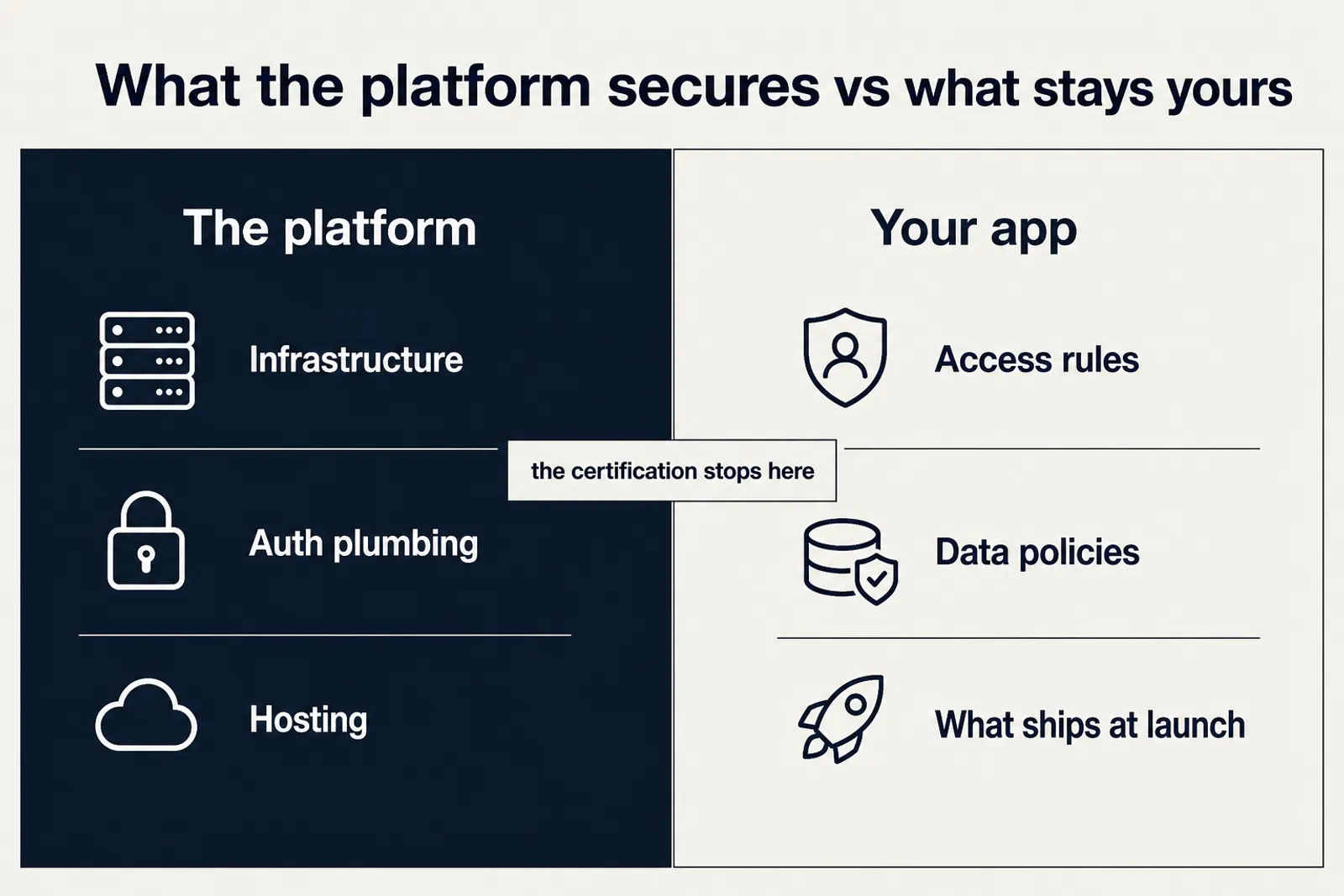
What Lovable secures vs what stays yours
Lovable’s security page names the controls it runs. Set them next to the work that never leaves your side of the line.
| What Lovable secures | What stays yours |
|---|---|
| Web application firewall (WAF) controls, network isolation, and adaptive rate limiting at the IP, user, and workspace level | The row-level policies on every table your app reads or writes |
| Secrets encrypted at rest and access-controlled by role, never shown in plaintext in logs or interfaces | Whether a server-only key reached the browser bundle, a public repo, or git history |
| Regional data hosting in the EU, US, and Asia Pacific, with data staying in the region you select | Which storage buckets are public and which need signed URLs |
| Model training excluded by default on Business and Enterprise plans, with a one-click training opt-out on Free and Pro | Whether realtime channels and edge functions check who is calling |
| Continuous monitoring for misuse, anomalous behavior, and compromise | Server-side input validation and the response headers your app sends |
| SOC 2 and ISO 27001 attestations, plus AI penetration testing that produces an audit-ready report for due diligence | Evidence that your current version denies a second account’s read, update, and delete |
| Basic and Deep security scans and dependency checks | Running those scans against the build you actually ship, then fixing what they return |
The left column is real and worth counting. It is also the column that stays true whether your orders table has a policy or not.
What Lovable’s security scans cover now
Lovable’s current security documentation describes two levels:
| Scan | Current documented scope | When it runs | How long it takes |
|---|---|---|---|
| Basic scan | RLS policy linting, database schema review, and dependency audit | Publish dialog for current RLS and schema checks; on demand for a full refresh | About 10 to 15 seconds |
| Deep scan | Application code, access-control logic, exposed credentials, database functions that bypass RLS, plus the Basic checks | On demand; the publish dialog offers it when Basic finds critical issues | About 3 minutes |
Those timings come from Lovable’s security page. They matter because the Deep scan is the one people skip, and three minutes is not a reason to ship without it.
The Basic scan can catch meaningful mistakes before publication. It does not analyze application code. The Deep scan covers more of the app, but Lovable’s documentation still describes both as tools that reduce common risks rather than a complete security guarantee. A project can also be published with unresolved critical findings unless workspace policy blocks that action.
This makes scan freshness part of the answer. Results tied to an older code version say nothing about a policy or function added afterward. Run both scans after significant changes and review their timestamps and findings rather than treating a green indicator as the whole test.
Lovable’s two pages disagree on one detail. The security page says dependency checks run continuously in the background. The security documentation says the dependency audit does not re-run on every change, and tells you to click Scan dependencies in the project security view to refresh it. Refresh it yourself before you publish instead of picking a side.
A scan can confirm a policy exists and flag the patterns it knows to look for. Whether the policy holds for your data is a different test, and the thing that runs it is a second account or a second query.
Seven app-level checks the platform evidence cannot settle
The fixed AxonBuild audit cohort included apps built with several tools, so it cannot produce a Lovable-specific failure rate. Across its 21 third-party apps, RLS gaps appeared in 9 and confirmed cross-user access appeared in 7. Six shipped or committed a real secret. These historical figures identify useful tests; they do not estimate the safety of all Lovable apps.
Seven surfaces decide the answer for one app, and each has a pass condition you can run against the build you plan to publish.
- Ownership rules that use the verified user. A policy can check that someone is signed in and still allow that person to read another customer’s row. Create two accounts, make a private record with account A, then repeat the read, update, and delete request as account B using A’s record ID. For the read, a denial comes back as 401 or 403, or as an empty result set with a 200; what it must never return is account A’s row with a 200. For the update and the delete, the response alone proves nothing, because a mutation can return no rows and still change or remove the record: after each attempt as account B, read the record back as account A and confirm it is still there and unchanged. Run it against the API as well as the visible interface, because hiding a button does not protect the endpoint behind it. The policy set underneath needs one rule per operation keyed on the verified user, with
with checkspelled out on the writes, since an update policy with onlyusinglets someone edit their own row and hand it to another owner on the way out. The failure class has a name: broken object level authorization, usually written BOLA and often called IDOR. - Server-only credentials that reached the browser or the repository history. Supabase’s API-key documentation treats publishable keys (and legacy
anonkeys) as safe to expose, with access guarded by the built-inanonandauthenticatedPostgres roles, while secret keys (and legacyservice_rolekeys) carry full access and belong only in backend components. Search the built output, the current source tree, and repository history for both shapes. If a real server credential appears, rotate it at the provider, deploy the replacement, verify the new path, then revoke the old value, because deleting the string from the latest commit does not revoke a copied key. - Views and elevated functions that cross the RLS boundary. Supabase’s RLS documentation says views bypass RLS by default because they are usually created with the
postgresuser, and that PostgreSQL 15 and above can make a view obey the underlying tables’ policies by settingsecurity_invoker = true. Functions markedSECURITY DEFINERrun with the function owner’s privileges for the same reason. In a B2B SaaS audit outside Lovable entirely, every table’s policy was correct and a reporting view joining across the boundary still exposed customer names, emails, and organization details to any signed-in account. Inventory both, then repeat the two-account tests through every exposed route. - Storage buckets that are public. Supabase’s download documentation says files in a public bucket are publicly accessible through a conventional URL, while assets in a non-public bucket are private and reachable only through a time-limited signed URL or an authenticated request. Its storage access-control guide adds that Storage allows no uploads to buckets without policies. Copy a file URL from your own app and open it in a logged-out private window. If invoices, ID photos, or customer uploads render, the RLS on your tables never had a say.
- Realtime channels that carry what RLS would block. Supabase’s realtime authorization guide says Postgres Changes on a table with RLS sends records only to clients allowed to read them, so a correct policy carries over. The gaps are the table where RLS was never enabled, and broadcast channels, which stay open until you disable public access in Realtime settings, set the channel’s
privateoption totrue, and write policies on therealtime.messagestable. Subscribe as account B and confirm nothing belonging to account A arrives in the stream. - Edge functions deployed with JWT verification off. Supabase’s edge function auth guide says to keep
verify_jwt = true, the default, so the platform validates the token before your handler runs. Settingverify_jwt = falseinconfig.toml, or deploying with the CLI’s--no-verify-jwtflag, makes the function reachable by anyone with the URL. Grep your config forverify_jwtand your deploy scripts for--no-verify-jwt, then call each function URL with noAuthorizationheader and expect a 401. Webhook receivers are the common legitimate exception, and they need their own signature check instead. - Validation that runs on the server, not only in the form. Generated apps validate in the browser because that is where the form is, and anyone can send the request straight to the API. Validate types, lengths, ranges, and enum values on the server or in the database with constraints, and reject what fails instead of coercing it. Response headers belong in the same pass: check for a content security policy,
Strict-Transport-Security,X-Content-Type-Options: nosniff, and a frame-ancestors rule, then runcurl -I https://yourapp.comand read what actually comes back rather than what the config claims.
Each item above is a summary. The five tests to run on your own Lovable app work the same ground one class at a time, with the commands and the fix written out for each.
What CVE-2025-48757 established
Researcher Matt Palmer reported a March 2025 scan of 1,645 Lovable-created projects. The published methodology and findings identified 303 endpoints across 170 projects with inadequate RLS settings. The scan examined homepage network requests and did not test login-protected areas, so its result describes that dated selection and method.
The endpoint count undersells what was reachable. The same report lists the data classes found exposed: email addresses, phone numbers, payment status and subscription details, usernames and profiles, home addresses, personal debt amounts, developer credentials, and third-party API keys including Gemini, Google Maps, and eBay tokens.
The sequence is public, and it explains what changed:
| Date | Event |
|---|---|
| March 20, 2025 | The first misconfigured project is found |
| March 21, 2025 | Researchers find the same RLS gap across multiple projects and email Lovable’s security team |
| March 24, 2025 | Lovable confirms receipt |
| April 14, 2025 | A Palantir engineer independently finds and publicly discloses the issue; researchers re-notify Lovable and start a 45-day disclosure window |
| April 24, 2025 | Lovable 2.0 ships with a security scan feature |
| May 29, 2025 | CVE-2025-48757 is published |
Read the April 24 row as the response rather than the resolution. The scanner that shipped ten days after public disclosure is the ancestor of today’s Basic and Deep scans, which is why the question “does a green scan prove correctness” has followed the product ever since. Palmer’s read of the scanner Lovable ran at the time was pointed: it “merely checks for the existence of any RLS policy, not its correctness or alignment with application logic.” That description is historical, aimed at the 2025 scanner rather than the current Basic and Deep scans, but the distinction it draws between existence and correctness still decides what a green result can prove.
The current NVD record describes insufficient RLS in Lovable-generated sites through April 15, 2025, allowing unauthenticated reads or writes, and records that Lovable disputes the CVE’s characterization because customers are responsible for their application data controls. MITRE scored it 9.3, critical. Both details matter. The incident is evidence that generated app policies failed in real deployments during that period. It is not a current prevalence estimate, and it does not describe Lovable’s newer Basic and Deep scans.
This CVE also concerned generated sites’ database access rules. The April 2026 breach concerned Lovable’s editor-side permissions for public-project source code and chat history during a specific window. They are different incidents with different affected surfaces and response steps.
The pre-launch Lovable safety check (about 30 minutes)
Run it against the exact build you plan to publish. A clean run proves that this version denied cross-account access on the routes you tested. It does not prove the next deploy will.
- 01 Run the Basic and Deep scans after the latest code and schema changes, manually refresh the dependency audit, then review every unresolved finding and timestamp
- 02 Create two accounts and test read, update, and delete operations across account boundaries through both the API and the interface
- 03 List database views and SECURITY DEFINER functions, then repeat the two-account tests through every exposed route
- 04 Open a file URL from a logged-out window, check every edge function for verify_jwt, and confirm realtime channels send account B nothing that belongs to account A
- 05 Search the built frontend and repository history for server-only credentials; rotate any real key that crossed that boundary
- 06 Check whether the project was public during a disclosed incident window and follow that incident’s specific evidence, rotation, and log-review steps
A clean run narrows uncertainty for the tested version. Re-run the relevant checks after auth, schema, server-function, dependency, or project-visibility changes. For a class-by-class app-level pass, the Lovable app security checklist covers RLS, cross-account access, exposed secrets, unprotected endpoints, and uncapped AI costs.
The Lovable safety verdict
Lovable’s platform evidence is substantial enough to support building on it: named attestations, a documented backend model, and current Basic and Deep security scans. The safety of one deployed app still depends on its exact access rules, code, secrets, dependencies, and incident history.
For a production decision, use this sequence:
- Review Lovable’s current platform evidence and incident record.
- Refresh both security scans against the version you intend to ship.
- Run two-account authorization tests against real API paths.
- Check elevated database objects and server-only credentials.
- Match the depth of review to what the app handles: public content, customer data, payments, or regulated information require different evidence.
Lovable production readiness covers the wider launch decision beyond security, and whether an AI-built app is ready to launch owns the full seven-gate readiness verdict. Whether paying someone to run these checks, versus running them yourself this afternoon, is covered in whether an AI app security audit is worth it. If the question underneath yours is which builder to use instead, the Lovable alternatives comparison owns that query.
Common questions about Lovable’s safety
Is Lovable safe for production?
Lovable provides useful platform controls and two levels of security scanning. Production evidence still has to come from the current app: refreshed scans, cross-account authorization tests, secret checks, dependency review, and tests of elevated database objects.
What is CVE-2025-48757?
It is a disputed vulnerability record about insufficient RLS in Lovable-generated sites through April 15, 2025. A researcher reported 303 exposed endpoints across 170 of 1,645 projects in a dated homepage scan. That historical result does not measure projects created under Lovable’s current scanner model.
Can attackers see my Supabase key?
Publishable and legacy anon keys are designed for browser use, with authorization enforced by RLS and grants. Secret and legacy service_role keys are server-side credentials with elevated access. Finding one of those server credentials in a browser bundle or shared history requires rotation and an access-log review.
Does Lovable scan application code before every publish?
The publish dialog automatically runs the Basic scan’s relevant RLS and schema checks. Lovable’s own pages disagree on whether the dependency audit re-runs by itself, so refresh it in the Security view before you publish. The Deep scan analyzes application code and broader access-control paths. It runs on demand and is offered in the publish dialog when Basic finds critical issues.
Is Lovable SOC 2 compliant?
Lovable says it holds SOC 2 Type 2 and Type 1 attestation plus ISO 27001:2022 certification, and its security page says it supports SOC 2 requirements and can produce audit-ready reports for due diligence. That covers Lovable’s own systems and processes, not your app. A buyer running vendor review on you will still ask for your access controls, your incident process, and your evidence, so your builder’s certificate answers one line of the questionnaire.
Is Lovable AI safe?
Lovable AI runs on a platform with real controls: WAF and adaptive rate limiting, network isolation, encrypted secrets, continuous abuse monitoring, and two levels of security scanning. The code it generates is a separate question. A model can write an access policy that looks correct and still lets one signed-in account read another’s rows, which is why a two-account test tells you more than the tool’s reputation does.
Does Lovable use my code or prompts to train its models?
It depends on your plan. Lovable’s security page says Business and Enterprise customers’ data is not used to train models, and that Free and Pro subscribers get a one-click training opt-out. It also says contracts with third-party AI providers restrict training and retention of customer data. On Free or Pro, set the opt-out yourself before you paste anything sensitive into a prompt.
The same page says secrets are encrypted at rest, access-controlled by role, and never shown in plaintext in logs or interfaces. If a customer contract needs any of this in writing, ask Lovable for it directly rather than citing a marketing page.
Where is my Lovable data stored, and is it GDPR ready?
Lovable offers regional data hosting in the EU, US, and Asia Pacific, and says customer data stays in the region you select and does not move across regions by default (security page read 5 September 2026). Its security page also says it supports GDPR requirements. Region pinning does not make your app compliant on its own: your lawful basis, retention periods, deletion path, and subprocessor list are still yours to build and document.
Is it safe to take payments in a Lovable app?
Keeping raw card details out of your app is the first condition, and a hosted payment page or embedded payment fields settle it by sending the card data straight to the processor. Stripe’s integration security guide says businesses that handle sensitive card data directly can face more than 300 PCI DSS controls, while low-risk integrations keep that data off your servers. Store only what the processor returns, such as card brand, last four digits, and expiry, and verify every webhook signature. That settles the card-data question and nothing else: whether the price came from your server, whether the webhook grants access exactly once, and whether a cancelled subscription is revoked are the payment checks that stay yours.
Is Lovable safer than Bolt, Replit, or v0?
No current dataset supports a security ranking among those builders. Compare them on four things you can check yourself: who owns the backend and its data, whether you can export the repository, whether security scans run before publish, and whether preview and production are separate environments. Then test the app you actually shipped, because the authorization and secret boundaries that decide the answer live in the shipped app rather than in the logo.
Whether Base44 is safe lands on the same answer from the other side: a certified platform and an unverified app. Base44 vs Lovable on repository sync and backend ownership is the two-builder comparison.
More on building with Lovable
The rest of this series separates related decisions: how Lovable credits are metered, what the Lovable free plan limits, what the Lovable Cloud export includes, and how to move off Lovable Cloud. Why AI coding tools miss cross-cutting security rules explains why a working single-user demo never exercises a second user’s authorization boundary.
Not sure your app is actually locked down?
I test it the way a stranger would, then fix what is open. Fixed quote after I have looked.
Talk about your app →  Free 20-minute video call with me.