Base44 vs Lovable splits on one question. Base44 fits an internal business app where the platform should own the backend, and Lovable fits a founder who wants React and TypeScript in a repository they control. That describes building. The difference that outlives the build is what each hands back, and on Base44 that starts at the $50 Builder plan.
Both vendors’ developer documentation was read for this page on 14 August 2026, and prices carry the date they were checked. Treat every plan name, credit grant and export behavior below as perishable. Base44 has been moving accounts onto a new workspace and credits model since March 2026, and Lovable switched new projects to a different framework on 13 May 2026, so anything written about either tool six months ago is worth rechecking before you act on it.
Search it as base44 vs lovable or lovable vs base44 and most of the top comparisons are published by a company selling one of the two tools or a rival to both, which is worth knowing before you weigh their verdicts.
What Base44 and Lovable each are
Base44 is an integrated business-app platform. Entities, authentication, backend functions, agents, connectors and hosting come from Base44 itself, and the app runs on Base44’s infrastructure. Wix has owned it since June 2025. Its permission model and platform boundaries are the subject of the Base44 safety analysis, which owns those questions rather than this page.
Lovable turns prompts into a React and TypeScript project, then asks a second question that Base44 never asks: which backend. Lovable’s Cloud documentation, checked 14 August 2026, describes Cloud as the built-in backend, as opposed to an external backend you connect yourself, such as Supabase. Cloud is built on Supabase’s open-source foundation and covers database, auth, storage, functions, secrets, logs and AI. Everything further down this page depends on which of those two setups a given Lovable project is using.
They do share one thing. Base44’s trust center lists SOC 2 Type II and ISO 27001, and Lovable says it holds SOC 2 Type 2 attestation and ISO 27001:2022 certification. Neither certificate reaches the app you build on top of the platform, and neither is evidence about your table rules. Base44’s compliance scope covers the certification detail for one side of that.
Base44 or Lovable: which is right for what you are building
Base44 suits an internal business app with roles, connectors and workflows, where having the platform run the backend is the point. Lovable suits a public web app whose owner wants the React and TypeScript in a repository. The plan gate decides more than the feature list does: two-way GitHub sync starts at Base44’s $50 Builder tier.
Three questions usually settle it faster than a feature comparison does. Will anyone on this project read code, or will nobody ever open the repository? Is the app an internal tool for people you already employ, or a product strangers will pay for? Does the code have to sit in a repository you control from day one, or only eventually?
| Criterion | Base44 | Lovable | What this row decides |
|---|---|---|---|
| What gets generated | An app inside Base44’s own runtime: entities, functions, agents, connectors, auth, hosting | A React and TypeScript project; projects created from 13 May 2026 use TanStack Start with SSR, older ones React and Vite | What source a later developer receives, and how tightly it stays tied to the vendor’s runtime |
| Where the backend runs | On Base44’s infrastructure | On Lovable Cloud, or on an external Supabase project you connect yourself | Who holds the database account |
| What syncs to a repository | Two-way GitHub sync from the Builder plan and above | Two-way Git sync on one active branch at a time, plus a codebase download on paid plans | Whether repository access sits behind a plan gate |
| What a local copy still needs | VITE_BASE44_APP_ID and VITE_BASE44_APP_BASE_URL to reach the app it was cloned from | Whatever the connected backend needs, which on external Supabase is an account you already hold | Whether the code can run without the vendor |
| What the documented export contains | Frontend code, entity schemas, functions and auth config, with data exported separately as CSV | Cloud database structure and data, with four documented exclusions | How much of a future migration is still manual work |
| Starting from an existing repository | Not documented | Documented as unavailable: an existing external GitHub repository cannot start a Lovable project | Whether either tool fits work already in flight |
If you have not narrowed the field to these two, ten Lovable alternatives compared on what each one hands you covers the wider set, including the no-repository options.
That table has two honest limits. It compares documented product boundaries rather than output quality, because no AxonBuild account has built the same app in both tools. Banani ran a prompt through both and reports Lovable ahead on interface polish and Base44 ahead on feature depth, which as of 14 August 2026 is the only side-by-side run among these results. That is their test and their result, not mine, and no row above is a speed claim.
What owning the code means on each platform
Code ownership means different things on each side. Base44’s CLI eject command pulls frontend code, entity schemas, functions and other backend resources into a separate local project, and that clone still calls Base44 for its app ID and backend URL.
Lovable’s Git sync moves the project code itself, on one active branch at a time, into a repository you already control.
The Base44 mechanics are short. Base44’s GitHub documentation, checked 14 August 2026, says two-way sync requires the Builder plan or higher, that local setup needs VITE_BASE44_APP_ID and VITE_BASE44_APP_BASE_URL, and that there is no option to manually push updates from the Base44 app to GitHub, so changes have to be committed to main to travel back. What you can export from Base44 owns the full export picture, including the CSV route for data.
What the repository actually holds is the part the comparison pages skip. Base44’s project-structure documentation places entities, functions, agents, connectors and auth configuration under a base44/ directory, with config.jsonc defining resource paths, .app.jsonc linking the local project to the Base44 app, and generated types in .types/types.d.ts. That is more than a frontend. Two of the pages ranking for this query still call the Base44 export frontend-only, which Base44’s own current documentation contradicts.
Neither vendor writes the next sentence, and none of the comparisons draw it. On both platforms the backend definitions travel and the backend runtime does not, for different reasons. Base44’s files describe entities and functions that Base44 continues to execute. Lovable’s files describe an application whose Cloud services were provisioned for it by Lovable. Owning a directory that names your backend is not the same as owning the thing answering the requests.
The backend question Lovable answers twice
This is where the published comparisons openly contradict each other, and both sides are half right. Zite’s comparison says Lovable gives you full stack, meaning code plus Supabase data you manage. Softr’s guide says Lovable abstracts its Supabase layer, so you do not have direct access to your database account. Those describe two different setups, and a reader who does not know that will pick the wrong one.
On Lovable Cloud you reach the database through Lovable’s own More tab, not a Supabase dashboard, so Softr’s description holds. On a project connected to an external Supabase account, the dashboard is yours and Zite’s description holds. Choosing between them at the start matters, because Lovable’s Supabase integration documentation, checked 14 August 2026, states there is no automatic migration between the built-in Cloud backend and your own Supabase project in either direction. The documented route is to export the data, connect the new backend, and ask Lovable to rebuild the schema. A project also connects to one Supabase project at a time.
Deleting Cloud is permanent, and Lovable’s own documentation tells you to export the database and download storage files first. Moving off Lovable Cloud covers what that migration involves as infrastructure work rather than a code export.
Permissions live in different places as a result. Base44’s rules apply per entity, set in the app dashboard, while a Lovable project on an external Supabase uses Postgres row-level security policies in a database you administer. Which arrangement is safer is not a question this page answers, and no dataset I have supports ranking the two on security. Whether Lovable is safe covers that side, including how its automatic publish scan behaves.
The r/vibecoding thread on this exact matchup lands somewhere similar from a practitioner’s seat: Lovable’s Supabase backend handles real-time and auth better at scale, and Base44 is still maturing there. That is one commenter on one thread, and it points at the same architectural fork rather than at a product verdict.
What the export actually contains
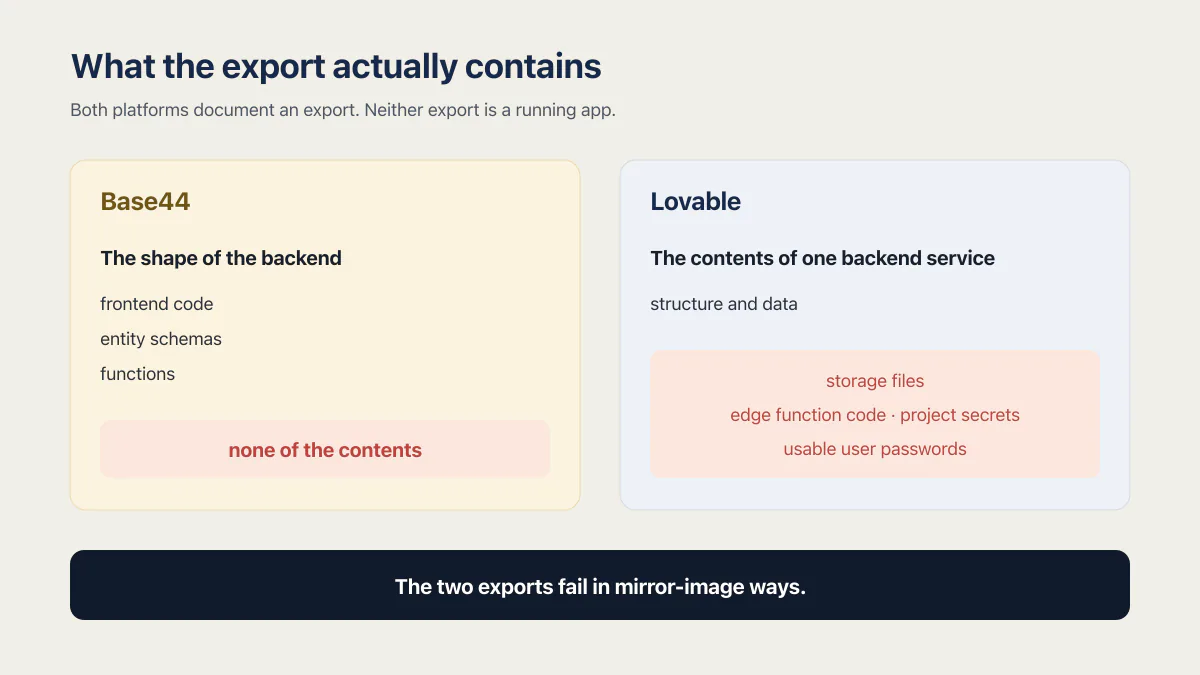
Both platforms document an export. Neither export is a running app, and the gaps are specific enough to plan around.
- Lovable Cloud’s database export carries structure and data, and documented exclusions are storage files, edge function code, project secrets, and usable user passwords, per Lovable’s advanced settings documentation checked 14 August 2026.
- Lovable secret values are write-only. The interface and the Security Center export expose names and metadata, not values, checked 2 August 2026.
- A Base44 eject starts with an empty database. The command downloads frontend code, entity schemas, functions and other backend resources into a local project, and data migration stays a separate job, per Base44’s CLI documentation checked 14 August 2026.
- Base44 data collections export separately as CSV, checked 2 August 2026 and re-confirmed 5 August 2026.
- A locally cloned Base44 frontend still calls the app it came from, through
VITE_BASE44_APP_IDandVITE_BASE44_APP_BASE_URL, per Base44’s GitHub documentation checked 14 August 2026.
Read those together and the two exports fail in mirror-image ways. Base44 gives you the shape of the backend with none of the contents. Lovable gives you the contents of one backend service with the files, functions and credentials around it left behind. In both cases the work after the download is where the real migration lives, and exporting a Lovable database walks through the procedure and the restore.
Base44’s eject hands you an empty database, and Lovable’s export hands you a full one with the storage files, the function code and the usable passwords left behind. Both are documented, and neither is a running app.
One thing the comparison pages guess at, Base44 now states itself. Base44’s entities documentation, checked 16 August 2026, describes each entity as a schema for documents in a collection in Base44’s NoSQL database and says that database is MongoDB-compatible, and the trust center, checked the same day, lists MongoDB as the subprocessor handling data storage and hosting. That is the store, on the vendor’s own authority. Anything beyond it that rival comparison pages assert about Base44’s internals still has no primary source, and this page will not repeat it.
Where Base44 and Lovable sit against Bolt, Replit, v0 and Cursor
People rarely shortlist exactly two tools, and the searches say so: base44 vs lovable vs bolt, base44 vs lovable vs replit, base44 vs lovable vs cursor. The axis that separated the two above separates all six. Each vendor’s documentation was read for this table on 16 August 2026.
| Tool | What it generates, and where the app runs | What travels out with you |
|---|---|---|
| Base44 | An app inside Base44’s own runtime, hosted by Base44 | Two-way GitHub sync from the $50 Builder plan, or a CLI eject that copies entity schemas and functions but starts with an empty database |
| Lovable | A React and TypeScript project, running on the built-in Lovable Cloud backend or an external Supabase project you connect yourself | Two-way Git sync on one branch at a time, plus a codebase download on paid plans; an existing GitHub repository cannot start a project |
| Bolt.new | A project built in the browser on StackBlitz WebContainers, published to Bolt Hosting against a managed Bolt Database, with Netlify as a separate hosting option | A GitHub repository Bolt commits to on every change that does not break the project; the database is a separate export |
| Replit | An app assembled by Replit’s Agent in a browser project editor, published on Replit’s own cloud against a fully managed SQL database | GitHub import and export both work, but the running app and its database stay Replit’s until you rebuild them elsewhere |
| v0 | Next.js, Tailwind and shadcn/ui code, deployed in one click to Vercel infrastructure | The GitHub repository is the source of truth: v0 commits to a working branch and opens a pull request into yours, and it can start from a repository you already have |
| Cursor | Edits inside an editor you download onto your own computer, against a repository that was already yours | Everything, because nothing moved. As of August 2026 Cursor’s documentation describes an editor and coding agent and names no hosting or managed database of its own |
Read down the last column and the six sort into three groups, not six. Base44 and Replit run the thing they built for you. Lovable and Bolt.new hand you a repository, while backend custody depends on whether you use their built-in service or an external provider account you control. v0 and Cursor never took custody of your code in the first place, which is also why neither of them saves you the backend work Base44 or Replit would have done.
That ordering is about custody, not quality. Nothing in the table says which tool writes better code, and no AxonBuild account has built the same app in all six. The Replit, v0 and Cursor rows are documented product boundaries read on one date, and all three vendors ship changes faster than a comparison page ages.
Base44 and Lovable pricing, kept short
This is the most perishable section on the page, so it stays a pointer. Figures come from Base44’s pricing page and Lovable’s subscription plans documentation, on the dates in the column headings.
| Base44, checked 14 August 2026 | Lovable, checked 14 August 2026 | |
|---|---|---|
| Free tier | 25 message credits a month, capped at 5 a day, plus 100 integration credits | 5 build credits a day, up to 30 a month, plus 20 Cloud credits |
| Entry paid plan | Starter $20 a month, $16 billed annually | Pro from $25 a month, from 100 credits a month |
| Tier that unlocks repository sync | Builder $50 a month, $40 billed annually | Two-way Git sync carries no documented plan gate; the codebase download is a paid-plan feature |
| Tiers above that | Pro $100, Elite from $200 a month | Business $50 a month |
| What gets metered | Message credits for editing, integration credits for what the published app does; nothing rolls over on any plan | Build, Cloud and AI usage all draw down one credit balance, topped up by separate monthly grants; free-tier grants do not roll over |
Both meter usage rather than seats, which means the bill tracks how much you build and how much the app does, not how many people log in to make it. The plan gate that decides anything here is Base44’s Builder tier, because repository sync is the whole ownership argument above. Base44 pricing, plan by plan, works through the credit arithmetic, and how Lovable credits are metered separates build credits from what the deployed app spends.
What neither choice buys you
The fixed June to July 2026 AxonBuild audit cohort covered 26 AI-built apps in three groups: 11 deep-audit third-party apps, 10 held-out third-party apps audited blind, and 5 of my own production apps. Scores ran 29 to 81 out of 100, mean 52.1, with 22 red bands, 4 amber and none green. Twenty-two of the 26 had at least one confirmed-critical finding, at least 23 of 26 had no working automated tests, and 17 of the 21 third-party apps recorded errors nowhere at all.
That cohort cannot grade either platform. The corpus contains no balanced number of apps per builder and was not designed as a head-to-head product test, so it cannot establish that Base44 or Lovable produces safer apps. What it does show is that the failure classes above turned up across the whole corpus regardless of how each app was built.
So the checks that matter afterwards are the same on either platform. Open the app with two accounts and have the second one try to read and change the first one’s records. Verify payments on the server instead of trusting what the browser reports. Make failures leave a record somewhere you will actually look. Restore a backup once before the day you need it. Whether your AI-built app is ready to launch owns that full test, and not one item on it is a builder feature on either side.
Common questions about Base44 and Lovable
Which is better, Lovable or Base44?
Neither is better in general, and the question resolves per project rather than per tool. Pick Lovable when the code has to sit in a repository someone can maintain without the vendor. Pick Base44 when you want the platform to run the backend and nobody on the project will ever open a repository.
What decides the answer is the plan gate and the backend fork: Base44 starts two-way GitHub sync at the $50 Builder tier, and a Lovable project is either on the built-in Cloud backend or on an external Supabase account you hold. Nothing in either vendor’s documentation supports ranking the two on security, and this page does not.
Is Base44 better than Lovable?
Not in general, and the comparison only resolves per project. Base44 is the better fit for an internal business app where entities, roles, workflows and connectors are the substance of the product and the platform running the backend is a feature.
Lovable is the better fit when the code needs to sit in a repository someone can maintain independently, or when you want an external Supabase project under your own account. Nothing in the documentation of either one supports a general winner. The question gets asked in both directions, base44 vs lovable and lovable vs base44, and the order does not change the answer.
Can you export your code from Base44?
Yes, by two routes with different gates. Two-way GitHub sync is documented from the Builder plan and above; Base44’s CLI documentation describes the eject command, which downloads frontend code, entity schemas, functions and other backend resources into a separate local project, without naming a plan. Data collections are exported separately as CSV.
Descriptions of Base44 as a frontend-only export are out of date. The clone still needs the app ID and backend URL of the app it came from, and it starts with an empty database.
Does Lovable give you access to your Supabase database?
It depends which backend the project uses, which is why published answers to this contradict each other. On Lovable Cloud, the built-in backend, you work through Lovable’s own interface and there is no separate Supabase dashboard for that project.
On a project connected to an external Supabase account, the dashboard and the database belong to you. Lovable documents no automatic migration between the two in either direction.
Is Base44 or Lovable cheaper?
Their entry paid plans are close, Base44’s Starter at $20 a month against Lovable’s Pro from $25, both checked in August 2026, so the answer turns on what you burn rather than the sticker.
Base44’s plan that matters for ownership is Builder at $50, since that is where GitHub sync starts. Both meter credits rather than seats, and both stop being cheap when an app you cannot fix keeps consuming credits.
Which one should you pick if you cannot code?
Base44 is the closer fit, because the platform supplies the backend and the app runs where it was built, so nothing about the setup expects you to open a repository. That convenience is exactly what makes the exit harder later.
Lovable also works for a non-technical owner while the managed Cloud backend fits, and its output is code a developer can pick up if you hire one, which is a real difference two years out.
If you have a working app built with these tools and need it ready for real customers, this is what we do.
Built it with AI. Now it has to hold up for real customers.
The Production Hardening Sprint takes the app you already have and builds the production foundation underneath it. Authentication and access rules, payments that stay consistent, error handling, monitoring, backups, automated tests and a documented handover. Our engineers work inside your existing codebase for ten working days. All 123 deliverables are included, and you get the evidence for each one.
See the Production Hardening Sprint →  $2,500 fixed price · 10 working days · One codebase