Base44 costs $0 a month on the Free plan, then $20, $50, $100, or $200 a month on the Starter, Builder, Pro, and Elite plans. Annual billing takes 20% off, which makes those same four paid tiers $16, $40, $80, and $160 a month. The other half of the price is that a published Base44 app can keep spending a second currency after you close the editor. Base44 calls it integration credits, and the people using your app can consume the workspace’s shared allowance.
Prices verified against Base44’s official public pricing page on 17 August 2026. Base44 says most app creators land on Starter. Builder is the first tier that gives you backend functions and GitHub sync. A custom domain arrives one tier earlier, on Starter.
How much does Base44 cost per month?
Base44 costs $0 a month for Free, $20 for Starter, $50 for Builder, $100 for Pro, and $200 for Elite. Billed annually, those four paid plans work out to $16, $40, $80, and $160 a month. Prices checked 2 August 2026. What changes most between tiers is the size of the credit allowance rather than the feature list.
| Plan | Monthly | Annual, per month | Message credits/mo | Integration credits/mo |
|---|---|---|---|---|
| Free | $0 | $0 | 25, capped at 5 a day | 100 |
| Starter | $20 | $16 | 100 | 2,000 |
| Builder | $50 | $40 | 250 | 10,000 |
| Pro | $100 | $80 | 500 | 20,000 |
| Elite | $200 | $160 | 1,200 | 50,000 |
The prices and both credit columns are confirmed by two Base44 sources that agree: Base44’s pricing page and Base44’s own cost explainer, which states its prices were correct as of 26 July 2026. The 5-a-day ceiling on the Free plan’s message credits comes from Base44’s credits documentation. Annual billing is a flat 20% off. The $25 entry price still quoted on some comparison sites is stale; Starter is $20. (Base 44 is the spelling a lot of people search for. The product is written Base44.)
One limit does not fit neatly in that table. Base44’s current billing documentation says Elite has four selectable credit levels, while the public pricing page displays only the 1,200-message, 50,000-integration-credit level. Treat $200 as the public Elite price shown today, not a proven maximum for every Elite configuration. Elite is also the top self-serve plan on the public pricing page. Above it, Base44 offers an enterprise route with no published price: the pricing page points teams that need custom credits, SSO, advanced security controls, or a dedicated solutions architect to contact the company. Checked 5 August 2026.
Base44’s own two pages disagree about what the second currency costs, by a factor of fifteen. Both were live when I read them, and the gap between them is why a free plan that reads as generous can be empty by dinner.
There is an account-level rollout caveat. Base44 says its new workspace and credits model began rolling out gradually to some new accounts on 12 March 2026, so your account may not show it yet. The five-plan table above reflects Base44’s current public pricing pages. Use the billing dashboard inside your own account as the final source for the workspace model and credit presentation currently available to you.
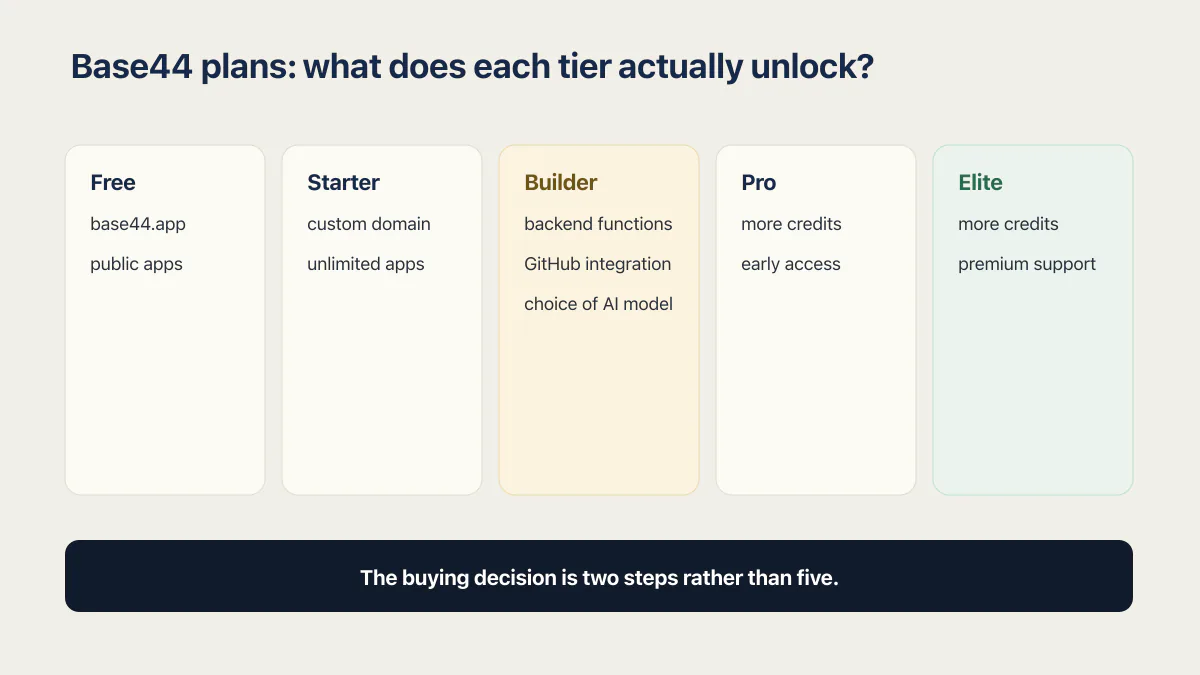
Base44 plans: what does each tier actually unlock?
Builder at $50 a month is the first tier that unlocks backend functions, GitHub integration, and your choice of AI model. Starter adds credits, unlimited apps, and a custom domain to the free feature set and stops there.
That makes the buying decision two steps rather than five. Free suits apps that live at a base44.app address, and Starter is where you can point your own domain at one. Builder is where the app becomes something you can sync to a repository and extend with your own code. Pro and Elite mainly expand the credit allowance; both also list early access to beta features, and Elite adds premium support.
So if a production capability is missing at Starter, Builder is where the documented core set appears. Above Builder, the public distinctions are primarily more credits, beta access, and support rather than another basic production unlock.
Free plan: $0 a month
Free gives you 25 message credits a month, capped at 5 a day, and 100 integration credits for everything your published app does. Up to 5 apps, all public, all on a base44.app address. No credit card is needed to start, and it is a plan rather than a trial, so it does not expire. It fits a demo or a personal tool with no AI feature and no email.
Starter plan: $20 a month, or $16 annually
Starter is $20 billed monthly, $16 a month billed annually. You get 100 message credits, 2,000 integration credits, and unlimited apps. The feature list adds a custom domain to the free one and stops there: still no backend functions, no GitHub sync. Buy it when the daily build cap is what is slowing you down, not when you need a production capability.
Builder plan: $50 a month, or $40 annually
Builder is the first production tier, at $50 monthly or $40 a month annually, with 250 message credits and 10,000 integration credits. It unlocks backend functions, GitHub integration, and your choice of AI model. If you are doing client work, or anything that needs server-side code and a repository, this is the floor rather than the upgrade.
Pro plan: $100 a month, or $80 annually
Pro is $100 monthly or $80 a month annually, with 500 message credits and 20,000 integration credits. Every Builder unlock carries over and it adds early access to beta features. You are buying headroom, not capability. Pick it when measured usage says Builder’s allowance runs out before the month does.
Elite plan: $200 a month, or $160 annually
Elite is $200 monthly or $160 a month annually, at the published level of 1,200 message credits and 50,000 integration credits. It adds premium support on top of everything in Pro. Base44’s billing documentation mentions further selectable credit levels on Elite, so read $200 as the price of the level shown publicly, not a ceiling.
What are Base44 integration credits, and what spends them at runtime?
Integration credits are the meter on your app’s live operations, charged whenever it calls one of Base44’s built-in services. Message credits are the separate meter on your editing, spent when you prompt the editor. A single LLM call costs roughly 1 to 15 integration credits depending on the model (docs checked 6 September 2026), which is why the runtime meter is the one that moves without you.
| Action your app performs | Integration credits |
|---|---|
| Send an email | 1 |
| Send an email from your own domain | 2 |
| Upload a file, or extract data from one | 1 |
| Generate an image | 1 |
| Generate video | 5 per second of video |
| Generate speech from text | 1 per 50 characters, capped at 100 per call |
| LLM call, Automatic model | ~1 |
| LLM call, Gemini 3 Flash | ~5 |
| LLM call, GPT-5.4 | ~15 |
| In-app agent message | From about 3 on Automatic, with other models costing multiples of that (docs checked 6 September 2026) |
| Generate a social content plan | 10 |
| Improve with AI, or regenerate an image, in social content | 1 |
| Automation run | 1, plus every action it triggers |
Those rates come from Base44’s credits documentation, checked 2 August 2026, where Base44 also notes the figures are estimates, calculated after an action runs and never quoted before it. Ordinary database reads and writes do not use integration credits, which narrows the whole question down to a short list of expensive verbs: send, generate, call a model.
It also means the cost explainer is off by more than a rounding error. That page says an integration action “spends one credit” and lists making an LLM request among its examples. The documentation prices that same request at up to 15. Both numbers are Base44’s.
The other detail worth pinning down early: nothing carries over. Unused credits expire at the end of your credit cycle on every plan and do not roll over to the next month, and there’s no way to preview what an integration action will cost before you run it. Base44’s own advice is to run the action once and read the execution logs afterward. These rates also only hold while you stay on Base44’s built-in services, and what the same features cost once you are paying a model provider directly is a different calculation.
What Base44’s price does not include
Four costs sit outside the number on the pricing page, and none of them show up until after you have picked a plan.
- The domain itself. Starter and up let you connect a custom domain; the plan does not buy you one. You either purchase a domain through Wix or point one you already own at the app, and the registrar keeps billing you for it every year after the first.
- Model and API spend outside Base44’s own integrations. The credit rates above only apply to Base44’s built-in services. Bring your own provider key and that provider bills you directly, on top of the subscription.
- Credits you did not use. Unused monthly credits expire at the end of the cycle and do not carry over, on every plan. A quiet month funds nothing.
- A published top-up price. Base44’s documentation names no standalone credit pack and no price for one, so you cannot budget for a mid-cycle refill in advance.
Is Base44 free?
Yes, Base44 has a free plan at $0 a month. It gives you 25 message credits a month capped at 5 a day, 100 integration credits, and up to 5 apps, all public and on a base44.app address. No credit card is needed to start, and it is a plan rather than a trial, so it does not expire.
Does the Base44 free plan survive real users?
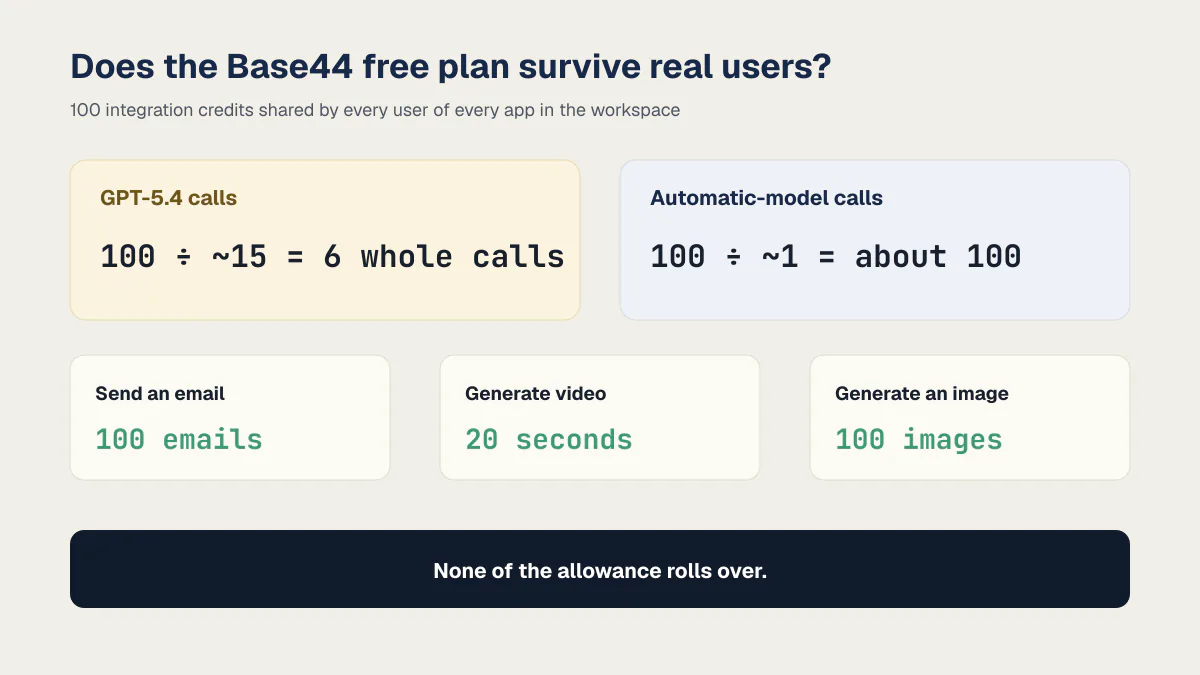
The Free plan is small where it counts, and the tight number is the runtime one. Using Base44’s published estimates, 100 integration credits cover six whole GPT-5.4 calls at roughly 15 credits each, or about 100 Automatic-model calls at roughly 1 credit each, across every user of every app in the workspace. Those are planning equivalents, not guaranteed capacity: Base44 calculates the actual cost after each call and says it may be higher or lower than the estimate. None of the allowance rolls over. That’s the whole monthly runtime budget, not a per-user allowance.
Run the same arithmetic across the other verbs and nothing improves. 100 credits is 100 emails, or 20 seconds of generated video, or 100 image generations, for the month, shared by everyone who visits. The build side is tighter than it first looks too: 25 message credits a month, capped at 5 a day, so a productive Saturday spends a fifth of the month.
One free-plan detail is easy to miss. Base44’s automatic error fixes consume message credits on Free, and those same automatic fixes are free on every paid plan. The plan with 25 monthly credits is the one that charges you when the AI corrects its own mistake.
What happens when Base44 integration credits run out for end users?
Base44 emails the owner when the month’s integration credits hit zero, all 100 of them on a free plan, and any action the owner takes then fails with an explicit credit error. Someone using your app gets a different answer: Base44’s documentation says they “receive a generic error message without any reference to integration credits.”
One of those two people is told what happened, and it isn’t the one who was trying to do something. Base44’s own worked example is a visitor subscribing to your app and triggering a confirmation email. The subscription fails. The visitor sees the generic error, tries once more, and leaves. Nothing they saw pointed at an empty balance, so nothing they do next points you at one either.
Whether it reaches you at all depends on something Base44 doesn’t supply: somewhere the failure gets written down. Of the 21 third-party apps in the AxonBuild audit corpus, 17 recorded errors nowhere at all. So you get an email about credits, your user gets a shrug, and the gap between the two is however long it takes someone to write in and complain.
An app that has gone quiet because its allowance is gone looks identical, from the outside, to an app that is broken. That is why the credit balance is the first thing to check when a published feature stops answering, not the last.
The bill your users can run up for you
A metered action that anyone can trigger is a budget anyone can spend. Of the 14 AI-featured apps in the AxonBuild corpus, 12 carried a confirmed route for someone other than the owner to fire the metered call, with every finding verified against the code rather than pattern-matched. On most platforms that shows up as a number on next month’s invoice. On Base44 it can exhaust the integration-credit pool and stop the affected feature from answering.
One audit outside Base44 shows how cheaply it happens, and the detail that stayed with me was the asymmetry. An AI content-management app I audited capped how often its analytics route could be called, and put no cap at all on the login route that emails a sign-in code to any address typed into it. Somebody had thought about the problem once, in one place. Price that login route at Base44’s 1 credit per email and a free plan’s entire monthly runtime budget is 100 requests, a slow afternoon for a script. Missing limits on the expensive route are the ordinary case, not the exception: 13 of the 21 apps in the corpus had no rate limit on their single most expensive endpoint. The longer version of that story is in what to do when your app goes viral.
Your plan caps the metered spend. The failure arrives as an unavailable integration rather than an unbounded bill. Preventing it still starts with a list of every route in your app that can trigger a paid action, who may call it, and how often.
What no Base44 plan buys you
Metering is not authorization. Every tier from Free to Elite decides how many paid actions your app may perform, and none of them decides who’s allowed to perform one. Those are two different questions, and only one of them appears on the pricing page.
| What the tier buys | What it still doesn't check |
|---|---|
| A monthly ceiling on paid actions, from 100 integration credits on Free to 50,000 on Elite | Whether the person triggering a paid action is signed in, or is allowed to trigger it at all |
| An email to you the moment integration credits hit zero | Whether the failure your user just hit is recorded anywhere a human will read |
| Row-level security settings, backend functions, and a GitHub sync from Builder up | Whether the entity holding your customers' data is actually scoped to its owner rather than left open |
Integration credits are the runtime meter. On the Free plan, 100 credits are shared across every app and user action that triggers a metered service.
Base44 is ordinary in this respect, and none of this is a knock on the platform. Its certifications are real, which whether Base44 is safe to build on works through, and what Base44’s SOC 2 and GDPR posture actually covers draws the same boundary from the compliance side. The split holds everywhere because it’s structural: a platform can meter its own services down to the credit and still have no opinion about who your users are.
Is Base44 worth it, and which plan does your app actually need?
Base44 is worth paying for at the tier where your app stops fitting the one below it. What sets that line is what your app does for strangers. After it is built, an app that only uses Base44’s included database and authentication can keep its integration-credit spend at zero. The Free plan still limits the workspace to five apps, 25 message credits a month, and public apps.
Building the thing is the other half of the bill, and it runs on the message meter. Base44’s own credits documentation says there is no set credit amount used per message, so treat one prompt costing one message credit as a planning estimate rather than a promise. On that estimate, two hundred prompts is two months of Starter’s 100 a month, or a comfortable single month of Builder’s 250. On Free the same build is not measured in months at all: 5 credits a day and 25 a month means you are waiting on the meter more than you are building.
A public app with an open AI feature is where tier and security stop being separable.
| What you are running | Cheapest plan that holds | What runs out first |
|---|---|---|
| Simple public app, no AI feature, no email | Free | Message credits when you return to edit it; database reads and writes use no integration credits |
| Personal project on a base44.app address | Free, then Starter when building slows you down | Message credits, at 5 a day |
| A product on your own domain with no custom backend code | Starter | Message or integration credits, depending on how it is built and used |
| Client work, or anything that needs backend functions or GitHub sync | Builder | Message or integration credits, depending on how it is built and used |
| Public app with an AI feature open to visitors | Builder at least, and only with a gate on the AI route | Integration credits, spent by whoever finds the route |
| App with paying customers depending on it | Builder or higher, sized from measured usage | Integration credits and the monitoring gap when an action fails |
Price is not what decides the last two rows. What decides them is that a stranger is doing the spending and the editor is closed the whole time. The Lovable free tier limits run into the same wall on a smaller monthly grant, and what a Lovable credit actually buys runs that cross-tool comparison. Strip the platform out and the same question is waiting underneath, which is where whether your app is ready to launch picks it up.
Base44’s current pages are unclear about mid-cycle relief. Its cost explainer says you can top up at any time without changing plans. The current credits documentation instead says to upgrade or adjust the plan from the billing dashboard, and the billing FAQ calls upgrading the fastest option after credits run out. Because the public documentation does not identify a standalone pack or price, confirm what your own billing dashboard offers before relying on a top-up.
How Base44’s entry price compares to other AI app builders
Base44’s cheapest paid plan sits at the low end of the category. What separates these tools is less the price than the meter each one runs.
| Tool | Entry paid plan | What the entry plan gets you |
|---|---|---|
| Base44 | Starter, $20 a month ($16 annually) | 100 message credits, 2,000 integration credits, unlimited apps, a custom domain |
| Replit | Core, $20 a month, or $17 billed annually | $20 of monthly credits applied to agent use, publishing, and storage |
| Bolt | Pro, $25 a month | Starts at 10M tokens a month, and unused tokens roll over |
| Lovable | Pro, $25 a month | 100 credits a month, with larger credit tiers priced above it |
| v0 | Plus, $30 per user a month | $30 of included monthly credits per user, plus $2 of daily login credits |
| Bubble | Starter, $32 a month, web only | Custom domain and backend workflows, with workload metered separately |
Each figure comes from that vendor’s own pricing page or product documentation, checked 5 August 2026. The meters are not interchangeable: credits, tokens, dollars of usage, and workload units all measure different things, so read the last column as what the same money buys, not as an exchange rate.
Two rows deserve more than a line each. Base44 and Lovable are the pair people put side by side most often, and that head-to-head runs wider than the entry price: model choice, export, and what each meter charges once real users arrive. Bolt is the row where the meter itself changes the arithmetic, because unused tokens roll over there and credits on the other tools expire, so a Bolt month is worth pricing on its own terms before you compare it to a Base44 one.
Price is only half the answer once the meter is running the app rather than the editor. An empty balance is a billing event that behaves exactly like an outage, and the platforms differ in what they stop and in what they tell the person using your app. That side of the bill is covered in what happens when an app is paused for running out of credits.
Common questions about Base44 pricing
What is Base44 pricing in 2026?
Base44 pricing runs from $0 a month on Free to $20 for Starter, $50 for Builder, $100 for Pro and $200 for Elite, with annual billing taking 20% off ($16, $40, $80 and $160 a month), verified against Base44’s pricing page on 17 August 2026. The second half of the price is integration credits, which a published app keeps spending after you close the editor.
How much does Base44 cost per month in 2026 on the Builder plan?
Builder costs $50 a month billed monthly, or $40 a month billed annually. It includes 250 message credits and 10,000 integration credits per month, and it’s the first tier that unlocks backend functions, GitHub integration, and AI model selection. A custom domain is available from Starter up.
How much is Base 44 per month?
Base 44 (the product is written Base44) costs $0 a month on the Free plan and $20, $50, $100 or $200 a month on the four paid plans. Annual billing takes 20% off, which makes the same four tiers $16, $40, $80 and $160 a month. What changes most between tiers is the size of the monthly message and integration credit allowance, not the feature list.
Is Base44 completely free?
The Free plan costs nothing and includes Base44’s core features, up to 5 apps, 25 message credits a month capped at 5 per day, and 100 integration credits a month. It’s a real free tier rather than a time-limited trial. At Base44’s current estimates, that runtime allowance covers six whole GPT-5.4 calls at roughly 15 credits each or about 100 Automatic-model calls at roughly 1 credit each, shared across the workspace. Actual costs are calculated after each call and may be higher or lower. To get Base44 for free, sign up and stay on the Free tier: no card, no trial clock, and nothing to cancel later.
Do you need a credit card to use the Base44 free plan?
No. Base44 says its free plan needs no credit card to start, and it is a plan rather than a time-limited trial, so it does not expire. You get 25 message credits a month, capped at 5 a day, plus 100 integration credits. A card only comes into it when you move to a paid tier.
Does Base44 have a free trial?
No, and it does not need one. As of 16 August 2026, neither Base44’s pricing page nor its billing documentation names a trial or a trial period. The Free plan is what stands in for one: $0 a month, 25 message credits capped at 5 a day, 100 integration credits, up to 5 apps, and no expiry date, with Base44’s app builder page saying no credit card is needed to start. So the way to sample a paid tier is to buy the cheapest month that fits, $20 for Starter, and cancel before it renews if it does not earn the next one.
Do Base44 credits roll over to the next month?
No. Base44’s credits documentation says unused monthly credits expire at the end of your credit cycle and do not carry over to the next month. That applies on every plan, free and paid. A quiet month builds no balance to spend in a busy one.
Do Base44 credits reset daily or monthly?
Both, depending on your plan. The Free plan has a daily limit of 5 message credits on top of its monthly 25, so an unused day is gone at midnight. On paid plans, credits reset monthly on your subscription anniversary date in UTC.
What happens when Base44 integration credits run out?
Base44 emails you, and any action you take that needs integration credits fails with an explicit credit error. Anyone using your published app sees only a generic error message with no mention of credits, so the feature reads as broken instead of out of budget until the next monthly reset or an upgrade.
How much does Base44 Super Agent cost?
There is no separate price for it. Base44 writes the feature as Superagent, and its documentation says a Superagent spends message credits while it processes messages and runs automations, and integration credits for actions such as image generation, file processing, file upload, and creating download links. That means a Superagent costs whatever its own activity meters, out of the same two allowances your plan already grants. Checked 16 August 2026: Base44 publishes no Superagent-only plan, add-on, or per-agent fee, so the tier you are on is the whole price.
Can I cancel Base44 or switch from monthly to annual billing?
Yes to both. Base44’s billing documentation says you can cancel anytime and keep full access until the end of your billing period, though cancelling stops renewals rather than refunding the current period. Switching from monthly to yearly starts the new cycle immediately, with what you already paid for the current month credited against the yearly cost. Downgrades take effect at the end of the current billing period. Both changes are made in the same place: click your workspace name at the bottom left, click Settings, then Plan and billing.
Where do I find Base44 invoices and billing history?
In your workspace settings. Base44’s billing documentation says to click your workspace name at the bottom left, click Settings, then Plan and billing, where Billing History lists your invoices and a Download icon saves a copy of one. Only workspace owners can access invoices, so a collaborator will not see them. Two details catch people out: an invoice tied to a charge you disputed with your bank is marked Disputed in that history, and receipts for a subscription bought through the Apple App Store are kept by Apple rather than by Base44. Checked 16 August 2026.
Does Base44 have hidden costs?
The plan price does not cover the domain, outside model or API spend, or anything you lose to expiry. A custom domain is billed by your registrar every year, external providers bill you directly once you go past Base44’s built-in integrations, and unused credits expire at the end of each cycle. Base44 also publishes no standalone credit-pack price, so the documented route out of an empty balance is upgrading.
Do you own the code Base44 generates?
Yes. Base44 says you own the IP for the applications you build and keep full ownership of the output. From Builder up, the GitHub integration syncs the codebase to your own repository, so the code can leave the platform with you.
Did Base44 pricing change after Wix acquired the company in 2025?
Wix acquired Base44 in June 2025, for initial consideration of approximately $80 million plus earn-out payments running through 2029, per Wix’s own announcement. The current five-tier prices match between Base44’s public pricing page and its explainer dated 26 July 2026. Those sources establish today’s prices, but they do not establish that the acquisition caused a particular pricing change.
Is Base44 legit?
Yes. Base44 is a Wix subsidiary whose public trust center lists SOC 2 Type II and ISO 27001 certification. That covers the platform rather than the app you build on it, and whether Base44 is safe for your app specifically is the separate question worth reading before you launch. For a verdict on the product beyond its price, the Base44 review reads what the platform actually exports.
Built it with AI. Can’t get the last part right?
That’s the normal state of an AI-built app, and it’s fixable. I trace what the app actually does, explain what needs changing, and build it if you want me to.
Talk about your app →  Free 20-minute video call with me.