A paused app is almost never a broken app. Your builder stopped part of it on purpose because a workspace credit meter reached zero, so read the balance before you read the code. Five platforms do this, and each one stops something different.
That is the whole answer to the immediate question. The harder ones arrive a minute later. Which part of the app is down, what the person on the other end is seeing right now, and whether the app comes back on its own when the balance does.
This page answers those three for Lovable, Base44, Replit, Netlify and Vercel, from each vendor’s own documentation as read on 25 August 2026. Prices and credit arithmetic live elsewhere on this site. What is here is the outage: which surface stops, what your visitor gets instead of your app, and whether paying is enough to bring it back.
Is this a builder billing pause or a real fault? Four checks, cheapest first
Four checks tell a builder billing pause from a real fault, and the cheapest one settles it in about ten seconds: the workspace credit balance. A pause and a crash produce the same complaint from a customer, so the order you check in decides how much time you lose.
- 01 Read the workspace credit balance and any banner or dialog the builder is showing you. A blocking message about credits points at a billing block, and it does not yet tell you which surfaces stopped or what brings them back, so keep going.
- 02 Open the published URL in a private window. Pages that still render while their buttons, logins and saves fail point at a failure on the backend path, which a pause produces and a backend crash, an auth fault or a network fault can produce too, so read the billing state beside it.
- 03 Check the vendor status page for the builder and for anything the app depends on. A real platform incident and a deliberate pause look identical from a browser.
- 04 Check whether the trigger was a failed payment or an empty balance. On Replit those are two states with two recoveries, and only one of them clears when the money lands.
Two neighbouring situations belong to other pages. Checking whether the platform is down before assuming your own app broke is a short sequence of its own, most of which never touches your billing. And if you do not yet know why the app is down, what to do in the first hour of a down app starts earlier than this page, with the customer-facing side before the balance.
One more distinction. If the app stopped immediately after an edit and not at a balance of zero, the cause is an AI edit that broke something that was working, and the loop where each fix breaks something else is a different problem again.
What each builder stops when its credit meter hits zero
Every row below was read from the named vendor’s own current documentation on 25 August 2026. No app was put into a paused state to observe it, and where a vendor publishes no answer the cell says so with the date instead of guessing.
| Platform | What stops | What the person using your app sees | Does it come back by itself |
|---|---|---|---|
| Lovable | Building stops behind a blocking dialog, deployed AI features fail at zero, and Cloud database, storage and authentication “pause shortly after you run out of credits” | Not documented. Lovable names the state as a deployed app paused for want of credits, without saying what the visitor gets | No. Credits have to be available again |
| Base44 | Any owner action needing integration credits fails and says so. On the free plan, credit-backed features wait for the daily reset | ”a generic error message without any reference to integration credits” | Yes at the daily reset, which Base44 puts at midnight in the workspace owner’s local timezone and at midnight UTC when the workspace has no recorded timezone, or sooner by changing plan from the billing dashboard |
| Replit | A usage limit means “usage-based services are blocked until the next billing cycle or until you increase the limit”. A billing hold can leave a published app offline | Not documented by Replit on any of the five pages checked on 25 August 2026 | No. “Deployments don’t restart automatically after a hold is lifted” |
| Netlify | Per Netlify’s how credits work page, “all of your web projects (sites/apps) are paused” across the entire team account | A Site not available page at every project URL, which says the site is paused | Yes. Projects “automatically resume” at the start of the next billing cycle |
| Vercel | Nothing, unless a Pro team switched on Spend Management’s pause action. Then every project’s production deployment pauses at the spend amount | A 503 DEPLOYMENT_PAUSED error | No. Each project is resumed individually, and raising the spend amount does not unpause anything |
The last two columns decide your afternoon. One is what your customer is experiencing while you read this, the other is whether paying is the whole fix or only the first half of it, and Lovable, Replit and Vercel all leave a step for you after the money lands.
Of the five platforms, only Netlify tells the person visiting your app that it was paused, and Replit and Vercel both say in writing that paying will not restart it by itself.
Vercel is the odd row because its pause is a ceiling you chose. Spend Management is a Pro feature, its pause action is off until someone enables it, and Vercel’s spend management documentation says plainly: “Setting a spend amount does not automatically stop usage.” It also warns the pause is not instantaneous: the check runs every few minutes, so a project keeps serving and spending for minutes past the amount.
The price side lives on other pages: what a Lovable credit actually buys, the Lovable free plan’s credit ceilings, and Base44’s plan prices and credit allowances, where the free plan’s 5 credits a day and 25 a month sit in context.
What your customers see while the app is paused
The information runs backwards. You get an email or a dialog naming credits. The person using the app gets something vague, and on two of these five platforms the vendor documents no visitor-facing message at all.
Base44’s credits documentation documents the asymmetry most clearly. The owner gets an email when integration credits run out, and any action needing credits “fails and shows an error that you have used all your integration credits”. The person using the app receives “a generic error message without any reference to integration credits”. Nobody reading that message will guess the cause, so nobody sends you the useful sentence.
Lovable’s shape is quieter and, for a live business, worse. It names a deployed app as paused when the workspace has no credits, and it describes the pause on the Cloud database, storage and authentication behind that app, without ever saying what the person in front of it sees. Lovable’s credits and usage documentation says it “shows an in-product message when a deployed app that relies on the built-in backend (Cloud) or AI features pauses”, so the owner is told. The visitor is not mentioned.
Netlify is the honest one. Its guide to resuming paused projects states that visitors “will find a message that says Site not available that mentions your site is paused”. A visitor who reads that at least knows it is not their browser.
One person on Reddit described the version that catches owners off guard:
Just got hit with the “Your projects are paused because your workspace is out of credits” wall. Here’s the best part: I haven’t touched the AI prompt box, I’m not generating code, and I’m not editing anything.
That is the vendor docs read from the other direction. The meter emptied while they were doing nothing, because a live app spends whether or not its owner is at the keyboard. Whether the failure reaches you at all depends on your own instrumentation, the same gap as a failure that hides behind a 200 OK: a failing request needs a place the failure gets recorded or the first report arrives as a complaint. That is also the moment this stops being a billing question and becomes an app that is broken in front of paying customers.
Does Replit have a daily limit, and what happened to Replit development time?
Replit’s current plan documentation says the free Starter plan comes with a daily Agent allowance and publishes no number for it. Nothing on its billing or plan pages mentions development time or a monthly minute cap. That absence is the answer, and it is dated to the day the pages were read.
Search results for replit development time, replit development time limit and replit free development time are full of a metric Replit’s own documentation no longer carries. Five Replit pages checked on 25 August 2026, its billing and refunds page, managing spend page, AI billing page, pricing and plans page and Starter plan page, contain no monthly minute allowance at all. The figures still circulating, 600 minutes a month, 1,200 minutes a month and 20 hours a month, come off community threads and third-party pages on a search result page.
| What people are searching for, from community and third-party pages | What Replit’s own documentation said on 25 August 2026 |
|---|---|
| 600 minutes of development time a month | No monthly minute allowance on any of the five pages checked |
| 1,200 minutes of development time a month | Same. Nothing describes an allowance measured in minutes |
| 20 hours of development time a month | Same. The word “development time” does not appear |
Replit now meters effort and spend instead of time. Its documentation describes credits consumed by the work an Agent request performs, plus a usage limit and a budget you set yourself. At that limit, “usage-based services are blocked until the next billing cycle or until you increase the limit”. A Core account sets it under Settings, then Account, then Billing.
The burn rate is what people are actually asking about. A keyword alert on 22 July 2026 surfaced an r/replit thread titled “Has anyone else noticed Replit credits disappearing much faster lately?”. Only the title was read for this page, and the thread sits unlinked at reddit.com/r/replit/comments/1v3a3rv/ because community material is cited here by text. A title is enough to make the point: the complaint is about how fast the balance moves.
What each Agent attempt costs, and why a failed attempt still costs it, belongs to a Replit app that keeps breaking and its per-attempt arithmetic.
Why the builder credit meter empties when you are not building
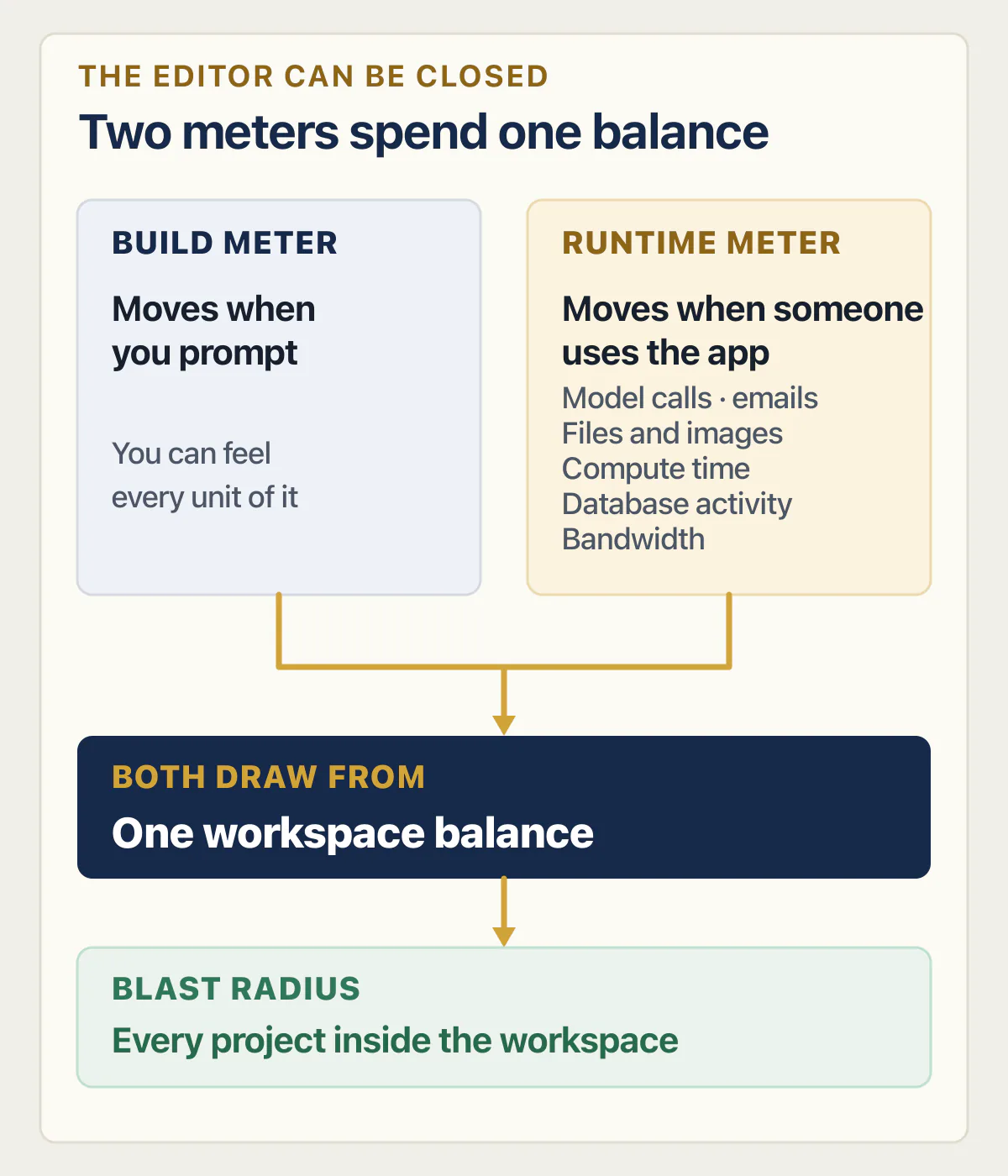
Two meters run on these platforms. The build meter moves when you prompt, and you can feel every unit of it. The runtime meter moves when someone uses the app, and it keeps moving with the editor closed, the laptop shut and you asleep.
The runtime meter counts real work: model calls made by features in the live app, emails sent, files and images generated, compute time, database activity and bandwidth. Netlify prices that side openly, at 20 credits per GB of bandwidth and 180 per US dollar of AI inference. Whoever triggers the expensive one spends your balance, and on most AI-built apps that is not restricted to you.
13 of the 21 third-party apps in AxonBuild’s fixed June-July 2026 cohort had no rate limit on their most expensive endpoint, each finding verified against the code. The cohort definition and method behind that number are published separately. The consequence is short: if a stranger can trigger the expensive thing as often as they like, a stranger picks the date your app goes dark.
It does not stop at the route that spent the money:
Worst of all, if you run out of credits - they shut down all of your projects cloud and functionality… that never happened before.
That is one Lovable user describing the breadth of it, which is the part people underestimate. One unbounded route empties the whole workspace balance, and a workspace balance covers every project inside it. Telling deliberate abuse from ordinary success means splitting build spend from runtime spend, which is what a Lovable credit actually buys before it is ever a question about your code.
Not every paused project is about builder credits
Three other things pause an app, and none of them is fixed by adding credits. Inactivity pauses a free database. A failed payment puts a billing hold on the account. A host that stopped you because you crossed a usage line is a third case, with its own recovery.
Supabase pauses a free project after a stretch of low database activity, a schedule and not a balance, and it comes back when someone restores the project rather than when someone pays. If your app went quiet with no credit warning anywhere, a Supabase free project paused for inactivity is the likelier story, and Supabase’s own plan limits are a separate matter from any builder’s credit meter.
A Replit billing hold is the failed-payment case, and it recovers differently from an empty balance. Replit says holds “can take a short time to clear after a payment is confirmed”, and then the part people miss: “Deployments don’t restart automatically after a hold is lifted. If your app is still offline, open Publishing and select Publish to push it live again.” Paying is step one of two. If the hold itself will not clear and the account is stuck behind a ticket, that becomes a question about what to do when support does not answer.
Vercel gives the third case in two forms. On the free Hobby plan there is no billing cycle at all, and its Hobby plan documentation says that in most cases, exceeding a usage limit locks that feature for 30 days, with shorter pause periods on a few limits: Web Analytics collection pauses after the grace period and can resume after 7 days. On Pro, Spend Management is the ceiling described in the matrix above. Neither is a balance emptying, so neither is fixed by topping one up. Vercel’s included usage and what happens past it is its own pricing question, worth reading before you set a spend amount.
How to stop a builder billing outage happening again
Five things reduce the chance of the same outage, ordered by how much each one actually buys you. The first is the only one that stops somebody else spending your balance, which is why it sits above every platform setting.
- 01 Put a ceiling on the expensive route inside your own app: authentication in front of it, a per-caller limit, and a bounded request so one call cannot become a hundred.
- 02 Turn on the spend controls each platform does publish. Replit has a usage limit and a budget under Settings, then Account, then Billing. Netlify has auto recharge, off by default, at 500 credits for $5 on Personal and 1,500 for $10 on Pro. Lovable has auto top-up on paid plans, and Vercel Pro has Spend Management with its pause action off until you enable it.
- 03 Alert on the balance as well as on uptime. An uptime check passes happily while a paused backend rejects every save, because the page it fetched still returns.
- 04 Record failures where a person will actually read them, so a visitor hitting a paused service produces an alert on the day it happens instead of a complaint three days later.
- 05 Move the metered runtime off the builder meter once the app earns money. That is a migration rather than a setting, and it is the only item here that changes who owns the bill.
Item two deserves a second read for what is missing from it. Most of the controls on that list cap what the platform charges you or what it keeps running. Auto recharge and auto top-up do the opposite: they keep the app up by buying more credits when the balance empties, so pair them with a budget alert or a hard stop and set your own ceiling, since a top-up is a purchase rather than a cap. And none of the five billing pages read here offers a per-caller ceiling on a deployed feature; workspace spend controls do not know who is calling, so caller-aware protection has to come from your own code or from an edge or gateway product in front of the app, which these billing pages do not cover. That is why item one sits above the settings. Uptime checks you can set up yourself and recording failures where somebody reads them cover items three and four, and for item five, when it is time to move off the builder is the decision while what moving off Lovable Cloud leaves behind is the inventory.
One thing I could not settle from these five documentation sets: neither Replit nor Lovable publishes what a visitor sees when a published app stops for billing reasons. Base44, Netlify and Vercel each describe the visitor’s side, well or badly. Replit’s silence held across all five of its pages I read, and Lovable’s held across the page that documents running out of credits.
Common questions about an app paused for builder credits
Does Replit have a daily limit?
Yes, on the free Starter plan, and Replit publishes no number for it. Its plan documentation describes Starter as free “with a daily Agent allowance and limited monthly cloud credits”, and its Starter plan page says users “receive daily credits for Agent usage, up to a monthly cap” without stating either figure. Both checked 25 August 2026.
Do Netlify credits reset?
Yes, monthly, and most of them do not carry forward. Netlify’s documentation on how credits work says that in general monthly plan credits do not roll over, with one exception: a Pro plan with 5,000 monthly credits or higher can roll leftover credits over for one additional month. Credits bought in credit packs do roll over to future months. Verified 25 August 2026.
My app is down but my builder dashboard says I have credits left. What now?
Check which credit type the failing action needs before assuming the number in front of you covers it. Several of these platforms hold separate allowances for building, for runtime services and for integrations, so a healthy total can sit beside one exhausted allowance. Then check for a billing hold from a failed payment, then the vendor’s status page.
Will I lose my data while the project is paused?
No, on the platforms that document it. Lovable’s documentation says database, storage and authentication data “stays safe while the services are paused”, with the caveat that you “cannot access or export it until the services run again”. Netlify documents no deletion window for paused projects, and neither vendor publishes a point at which a paused project’s data is removed. Treat the pause as a lock on the data and not a loss of it.
Does the published site stay up when builder credits run out?
Two of the five vendors answer that outright, and the answer is no. Netlify replaces every project URL with a Site not available page, and Vercel serves a 503 DEPLOYMENT_PAUSED error once a Pro team’s pause action fires. Replit can leave a published app offline after a billing hold without documenting what a visitor gets, and Lovable documents the work behind the pages stopping, its Cloud database, storage and authentication, without saying what the page itself does.
How long until a paused app comes back?
It depends on the platform, and two of them will not come back without you. Netlify resumes automatically at the start of the next billing cycle. Base44 credit-backed features return at the daily reset, which Base44 documents as midnight in the workspace owner’s local timezone, or midnight UTC when the workspace has no recorded timezone, or sooner on a plan change. Lovable needs credits available again. Replit needs a manual publish after a hold clears, and a paused Vercel project is resumed one project at a time.
Is running out of builder credits my fault or the platform’s?
Neither, usually. It is the ordinary result of a metered runtime with no ceiling on the expensive route, which is the default state of most AI-built apps and not a mistake anyone made. What is inside your control is the cap on that route, the alert on the balance, and knowing which of these five platforms restarts itself.
Built it with AI. Can’t get the last part right?
That’s the normal state of an AI-built app, and it’s fixable. I trace what the app actually does, explain what needs changing, and build it if you want me to.
Talk about your app →  Free 20-minute video call with Bilal.