Something specific went wrong. The bill doubled with nothing new shipped, the app started timing out at a few hundred users, Google stopped picking up the page titles you set, or a customer’s security review asked for SOC 2 and servers in their own environment. Then somebody in a thread told you the platform is the problem and you should get out.
Sometimes that is right. It is right less often than the search results for when to migrate off Lovable suggest.
Five triggers send people looking for an exit from an AI builder: the bill, load, indexing, an enterprise demand, and ownership. Three of the five are usually fixable without moving. In one reading pass over 1,255 rows of public posts AxonBuild harvested on 14 August 2026 (a working dataset, not a published one), the bill matched the most rows of the five, at 23.
Every vendor fact below was read from the company’s own documentation or product pages, on the date given where it is used, and cited there. None of it is a hands-on test of a plan I do not hold.
Worth knowing who else writes about this. Search outgrown lovable and three of the nine first-page results are agencies selling the move. I read two on 15 August 2026. Fastdev lists weak architecture, performance bottlenecks, debugging blind spots and vendor lock-in, with no user threshold, no cost breakpoint and no timeline. Lowcode.agency lists seven reasons, also with no threshold. Both close on hiring them. Neither tells a reader with a working, growing app to stay; fastdev’s only concession is that Lovable suits validating an idea.
The five triggers, and which ones a move actually fixes
| Trigger | What it looks like | What is actually causing it | Does moving fix it | What settles it instead |
|---|---|---|---|---|
| The bill | The monthly total climbs while what you shipped stays the same | Two meters: what the builder charges you to build and host, and what your live app spends on model calls, email, storage and egress | Only the first meter. The second follows the app to any host that bills for the same things | Split the bill into platform spend and app spend before you price an exit |
| The app stalls under load | Slow pages or timeouts between a few hundred and a few thousand simultaneous users | Possible causes include query shape, indexes, per-row work, cache behavior, connection limits, external APIs, compute, locks, memory, network, and a documented platform ceiling | Only when measurements identify a platform limit that the current plan cannot raise | Measure request traces and resource ceilings before pricing an exit |
| Pages are not getting indexed | Crawlers ignore the titles and descriptions your app sets at runtime | A client-rendered single-page app, for anything built before 13 May 2026. Lovable’s SEO documentation, read 15 August 2026, says apps created from 13 May 2026 use TanStack Start with server-side rendering, and older React and Vite apps get on-request pre-rendering served to verified search and AI crawlers | Rarely, and much less often than in 2025. Both stacks return crawlable HTML per the same doc | Ask for your own page as a crawler and read the HTML that comes back. Sitemaps, robots.txt and metadata are still yours to set |
| An enterprise customer’s demands | A security review asks for SOC 2, single sign-on and servers inside the customer’s own environment | Two asks under one label. Lovable’s enterprise page, read 15 August 2026, states SOC 2 Type II and ISO 27001 with SSO/SAML, SCIM, role-based access and audit logs. Lovable’s deployment doc, same date, says the editor and AI agent cannot be self-hosted or deployed inside a customer VPC | For the customer-VPC half, yes, and it may be the only answer. For certification and SSO, no | Get the requirement in writing and split it. Certificates and SSO are purchasable. A builder inside the customer’s network is not |
| You want to own it outright | A fear of losing the thing you built, usually after reading about someone who lost access | The code was never the part being held. Lovable’s ownership doc, read 15 August 2026, says projects sync continuously to GitHub or GitLab and you can clone the repository, deploy it on your own infrastructure or fully self-host without restriction | Partly. A move removes the single-account risk and hands you the operations in exchange | Turn on Git sync, take a database export, read what the export leaves out, then decide |
Three of those five rows say a move does not fix the thing that sent you looking.
The counts here come from one reading pass over 1,255 rows of public posts AxonBuild harvested, read on 14 August 2026, matching patterns across the quote, wallet-signal and relevance fields. A row can match more than one pattern, so these numbers are never added together or turned into percentages.
The bill went up. Is that Lovable’s fault or your app’s?
Bills split into two meters. One is what the builder charges you for building and hosting. The other is what your live app spends on your behalf every time a user triggers a model call or an email. Only the first meter is the platform’s. In the 1,255-row corpus, 23 rows carried some form of the cost complaint.
The wording is consistent across tools. One row reads “I used to love Lovable but it has gotten too expensive.” Another, from Replit, reads “My usage of Replit hasn’t changed but the costs have ballooned to the point in the last 30 days that I need to find an alternative.” The second is the more useful one: usage that held steady while cost climbed means something automated moved, and automated things travel.
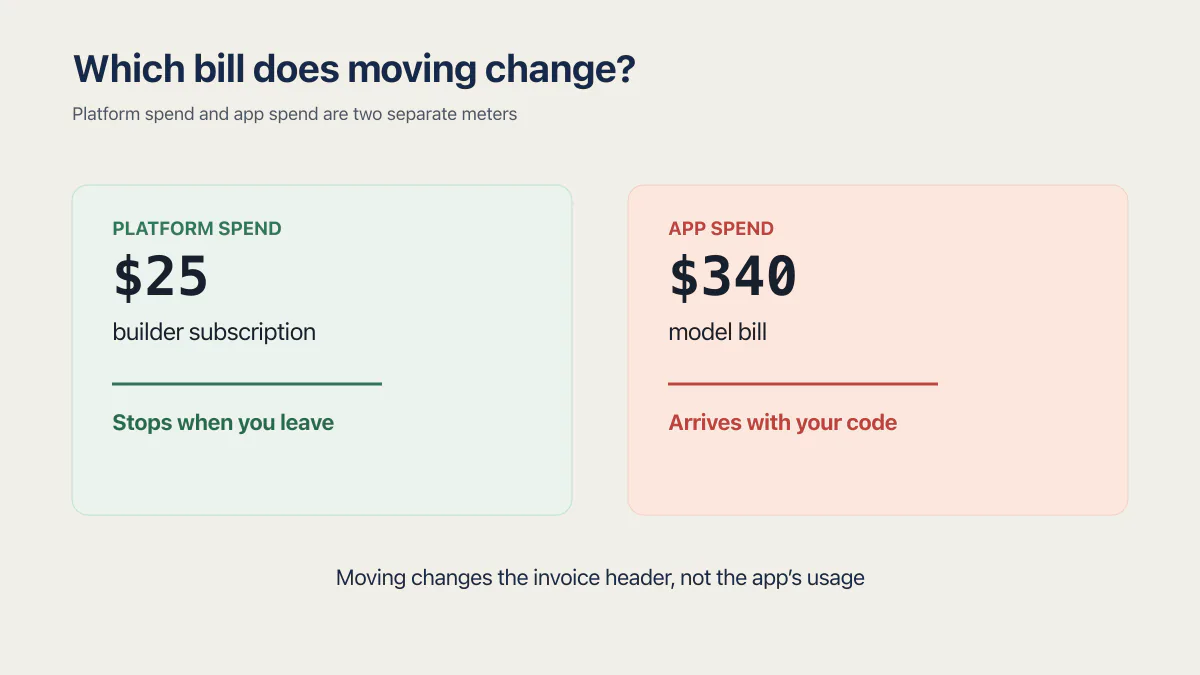
Platform spend is the subscription and the credits, and it does stop when you leave. App spend is every model call your live app makes, every transactional email, every gigabyte served. Your code creates that cost, so it arrives with your code, itemised differently and occasionally higher. If most of the increase sits there, moving changes the invoice header and little else on it.
One of the 26 production-readiness audits AxonBuild ran across June and July 2026, 21 of them on third-party apps, shows how far that goes. The app was an AI content system with passwordless sign-in. Its send-a-login-code route had no rate limit, no cooldown and no authentication, and it went around the auth library’s own limiter. A script pointed at that route bombs any inbox, burns the email quota and damages the sending domain’s reputation. A sibling analytics route in the same codebase did limit itself, so this was a miss rather than a house style. That bill was the app’s own doing, and it stays the app’s own doing on any host that charges for email.
The platform half is public. What a Lovable credit is worth and how to trace a spike covers the credit meter, and it is the faster read if your balance is what moved. On Replit, the pricing page lists Core at $20 a month with a $20 credit balance and Pro at $100 with a $100 balance, and annual billing drops the price to $17 and $95 a month. Prices checked 3 September 2026.
If your builder subscription is $25 and your model bill is $340, the builder is not your cost problem.
The app stalls under load. Does a new host raise the ceiling?
A new host can change the hardware or platform ceiling, but it can also carry the same code and dependencies with it. For an app struggling under load, treat unindexed queries, per-row work, cache behavior, connection limits, external APIs, compute, locks, memory, network, and platform limits as hypotheses. Measure request timing and the constrained resource before deciding which part would change after a move. Thirteen of the 1,255 corpus rows carried a scale worry; that count does not establish the cause.
A representative one: “my apps (I have several) meant to be large scale serious apps wouldn’t handle the anticipated number of users to be using it simultaneously.” Notice the tense. The load had not happened yet. This row shows anticipation rather than measurement. It does not establish how common that pattern is or how far away the ceiling may be. A move against an unmeasured ceiling spends real money before the constraint is known.
Find out which ceiling you actually hit first. Which ceiling your app hits first walks that diagnosis, and this page stops here rather than repeating it. If the answer is a query plan, no destination fixes it. If it is a platform limit you have measured and cannot raise, that is a real reason to look at exits.
Your pages are not getting indexed. Does that still mean leaving Lovable?
Indexing stopped being a good reason to leave Lovable in 2026. Apps created from 13 May 2026 render on the server, and older React and Vite apps get on-request pre-rendering for verified crawlers, so both stacks return crawlable HTML. Three of the 1,255 corpus rows raised the complaint.
Until this year it was one of the strongest reasons to go. One row reads “crawlers (Google, etc.) are not reliably picking up the dynamic title tags and meta descriptions I am setting”, which is what a client-rendered single-page app does to a crawler. That was correct when it was written. It is now a question about which stack your app is on, and the vendor answered both halves. Lovable’s SEO documentation, read 29 August 2026, says “New Lovable apps created from May 13, 2026 use TanStack Start with server-side rendering (SSR)”, with every request returning fully rendered HTML for humans and crawlers. For anything older, the same page says React and Vite apps use “on-request pre-rendering on deployed public URLs, served only to verified search and AI crawlers”, naming Google, Bing, social preview bots and AI engines including ChatGPT, Perplexity, Claude and Gemini. Its summary line: Lovable apps run on one of two stacks, “both of which return crawlable HTML to search engines and AI crawlers”.
Two things follow. A third-party SEO tool hitting your site is not a verified crawler, so a tool reporting an empty page is not evidence that Google sees one. Ask for your own URL the way a crawler does and read what comes back.
And the vendor drew a line around what it handles. The same documentation says “Sitemaps, robots.txt, metadata, and other SEO elements are not always generated up front.” Rendering is covered. The elements that tell a crawler what each page is stay your job, and no migration ever wrote a title tag for anyone.
An enterprise customer wants SOC 2 and local servers. Can Lovable do that?
Certification and running the builder inside a customer’s network are separate asks, and only one of them can be bought. Lovable’s enterprise page states SOC 2 Type II and ISO 27001 with SSO and SAML, so the certification half of a security review can be answered without a move; the report covers the vendor, and the customer will still ask how your own app meets its obligations, which no move answers either. Lovable’s documentation rules out the customer-VPC half, which a move does fix.
Three of the 1,255 corpus rows carried this shape. In the clearest of them a founder was in talks with a large enterprise buyer that wanted local servers, SOC 2 and zero data retention, and read all three as things Lovable could not do. One of the three was already wrong when it was posted, one was always a different question, and one is still open.
On certification, Lovable’s enterprise page states SOC 2 Type II and ISO 27001 alongside SSO/SAML, SCIM provisioning, role-based access control and audit logs. Lovable’s own security post dates the SOC 2 Type 2 milestone to 13 August 2025 and names the certificate as ISO 27001:2022. That is the vendor’s statement about itself, which is why enterprise buyers ask for the report rather than the badge. Lovable’s trust centre at trust.lovable.dev returned no readable text to an automated fetch on 15 August 2026, so nothing here rests on it.
On data location, Lovable’s security page says Lovable Cloud supports regional hosting in the EU, US and Asia Pacific, and that customer data stays in the region you select (read 5 September 2026). One catch, covered below: the region is fixed the moment Cloud is enabled.
On local servers the answer is flat. Lovable’s deployment and ownership documentation says the platform itself, meaning the editor and the AI agent, “cannot be self-hosted or deployed inside a customer VPC”, while the applications you build with it can be hosted anywhere. If the customer requires your app inside their environment, the app can go there and the builder cannot follow. That is a genuine exit, and running a Lovable app on infrastructure you control deserves its own page.
On zero data retention, be careful. As of 15 August 2026, Lovable’s public enterprise, security and deployment pages do not document a zero-data-retention option. That is a documented absence on a date, not a statement that Lovable cannot offer one. Ask their sales team in writing.
And a certificate certifies the vendor, not you. Base44 publishes SOC 2 Type II and ISO 27001 too, with EU or UK residency limited to Elite and Enterprise plans for apps created after 16 April 2026. What a platform’s SOC 2 certificate does and does not cover works through why a certified platform still leaves the application-level obligations with you. A customer asking for SOC 2 usually means “prove this system is safe”, a bigger question than the badge answers.
Have you outgrown Lovable, or do you just want to own the app you built?
Ownership of the code is already yours, and the vendor documents it plainly. The account, the region choice and the completeness of a database export are the parts that actually bind you, and they are worth checking before you decide you have outgrown the tool. Four of the 1,255 corpus rows raised ownership directly.
Another four used the word “outgrown” about a builder explicitly. The ownership rows sound like this one, written by an agency about a client: “It’s getting big, and he wants to make sure that he doesn’t lose everything he already built.” The outgrown rows sound like this: “I am canceling my Lovable subscription. It’s a great AI tool, I’ve just outgrown it.” Reasonable feelings, both. Neither is a technical finding yet.
Lovable’s ownership documentation says every project can be synced continuously to GitHub or GitLab using Git sync, and that you can “clone your repository, modify it outside Lovable, deploy it on your own infrastructure, or fully self-host without restriction”. Your database, storage and configuration are portable too. If Git sync is on, a copy of your application already sits somewhere you control, for free.
The account holds the running system; the code already syncs to Git.
Now the parts that do bind. Lovable’s advanced settings documentation, read 15 August 2026, says “The region is set when Cloud is enabled and cannot be changed afterwards”, so the residency answer above is a decision you make once. The same page says database exports are limited to 5 GB with one every 24 hours, and that an export excludes files in storage buckets, edge function code and your project’s secrets. User passwords are not exported in a usable form either, so a migrated app needs a password reset flow. None of that stops you leaving. All of it changes what “I have a backup” means.
A second worry sits under these rows. People write that a builder can suspend a project and take the code, database and users with it. That is reader vocabulary from community posts, not something I have checked against anyone’s terms, so it stays out of this page as a claim about vendor behaviour. The narrower version is enough: one account holds the running system, and an account is a single point of failure whatever the reason. Git sync plus a recent export removes most of that risk without a migration. A ticket that has stopped moving is another honest trigger, and the escalation routes before you decide to leave are worth exhausting first.
Backend choice changes the picture per tool. On Bolt.new the split is which database you picked. Connect your own Supabase project and, per Bolt’s integration guide, the data was never in Bolt’s custody. Use Bolt Database and the same guide documents a Claim flow that migrates the existing database into a Supabase organization you own. Bolt’s database documentation separately says Version History does not support database restores. A migration path and a missing restore feature are two different facts.
If the trigger is Lovable Cloud rather than Lovable, what removing Lovable Cloud actually does covers that narrower question, which gets conflated with leaving the builder constantly.
What moving does not fix
Whatever you carry out arrives with the same test coverage, the same absent error reporting and the same failure modes, plus the operational jobs the builder was doing for you: deployments, backups, certificate renewal and the pager, all yours on day one. The parts that were hard to change stay hard to change, and why an AI-built app gets harder to change every week is indifferent to hosting.
A lateral move deserves its own warning. Going from one AI builder to another feels like an exit while leaving you where you started: a new credit meter, a new export limit, a new region policy, and the same reasons to leave again in twelve months. If the tool genuinely is wrong for you, and sometimes it is, which builder fits if the tool itself is the problem is the comparison to run first, knowing the exit list changes names rather than shrinking.
Two questions worth waiting for rather than guessing at: what each builder actually lets you take out, and what a move costs once you count rebuilt hosting, reset passwords and the fortnight nobody ships anything. Neither answer replaces settling this page’s question first.
One loose end I cannot close: nobody publishes what happens six months after a migration. The agencies stop at go-live, the threads stop at the announcement, and the corpus rows are written by people on the way out rather than people a year down the road.
Common questions about moving off an AI builder
When should I migrate off Lovable?
Migrate when the platform causes the problem and no setting or plan fixes it. In practice that means two cases: a customer requires the builder itself to run inside their own environment, which Lovable’s deployment documentation rules out, or you have measured a platform limit you cannot raise. Cost, load and indexing complaints usually trace back to the app, and those travel with it.
Have I outgrown Lovable, or has my app just got bigger?
Name the specific thing you cannot do. If it is a capability the platform does not sell at any price, such as running inside a customer’s network, you have outgrown Lovable the tool. If it is “the app is slow”, “the bill is high” or “the code is hard to change”, the app got bigger and those problems wait at the destination.
Is it cheaper to run my app somewhere else?
Sometimes for the builder subscription, rarely for the total. Your bill has two meters: what the builder charges, and what the live app spends on model calls, email, storage and egress. Your code creates the second meter, so it arrives with your code. Read which meter moved before assuming a new host is cheaper.
When should I leave Replit?
Leave Replit when you have a requirement its platform cannot meet, not because a bill jumped. Replit’s pricing page listed Core at $20 a month and Pro at $100 on 3 September 2026, or $17 and $95 billed annually, each with a monthly credit balance. Rising consumption with no change in what you shipped usually means the app calls a model more than you think, and that bills you anywhere.
When should I move off Bolt.new?
It depends which backend you chose. If your data lives in a Supabase project you own, Bolt.new never held it and you can move on your own timetable. If you used Bolt Database, Bolt documents a Claim flow that migrates the existing database into a Supabase organization you own. Version History still does not restore database state, so do not treat a code rollback as database recovery.
Will moving make my app faster?
Not by itself. Response time can be spent in database queries, per-row work, repeated calls, external services, connection waits, compute, network, or a platform ceiling. Trace the request and measure the constrained resource first. A larger instance buys headroom only when the measured resource is the one it expands; code or dependency costs can travel unchanged.
Can I stay on the builder and still own my code?
Yes, and it is the cheapest thing on this list. Lovable’s ownership documentation says projects sync continuously to GitHub or GitLab and that you can clone the repository, modify it outside Lovable and deploy it on your own infrastructure without restriction. Turn on Git sync, take a database export, and read what the export leaves out: storage files, edge function code and secrets. That is most of a migration’s ownership benefit without the migration.
Fixing the bug in this guide gets you past today. If you would rather have the whole foundation checked and built in one go, that is what the sprint below is for.
Built it with AI. Now it has to hold up for real customers.
The Production Hardening Sprint takes the app you already have and builds the production foundation underneath it. Authentication and access rules, payments that stay consistent, error handling, monitoring, backups, automated tests and a documented handover. Our engineers work inside your existing codebase for ten working days. All 123 deliverables are included, and you get the evidence for each one.
See the Production Hardening Sprint →  $2,500 fixed price · 10 working days · One codebase