The first organic result for lovable agency is a page on lovable.dev, and the first line on that page says the thing it is named after has closed. The Lovable Experts program is no longer running. Anyone who wants to join is pointed at the Solution Partner Program instead. Of the other first-page results for that phrase that could be read on 29 August 2026, not one mentions it.
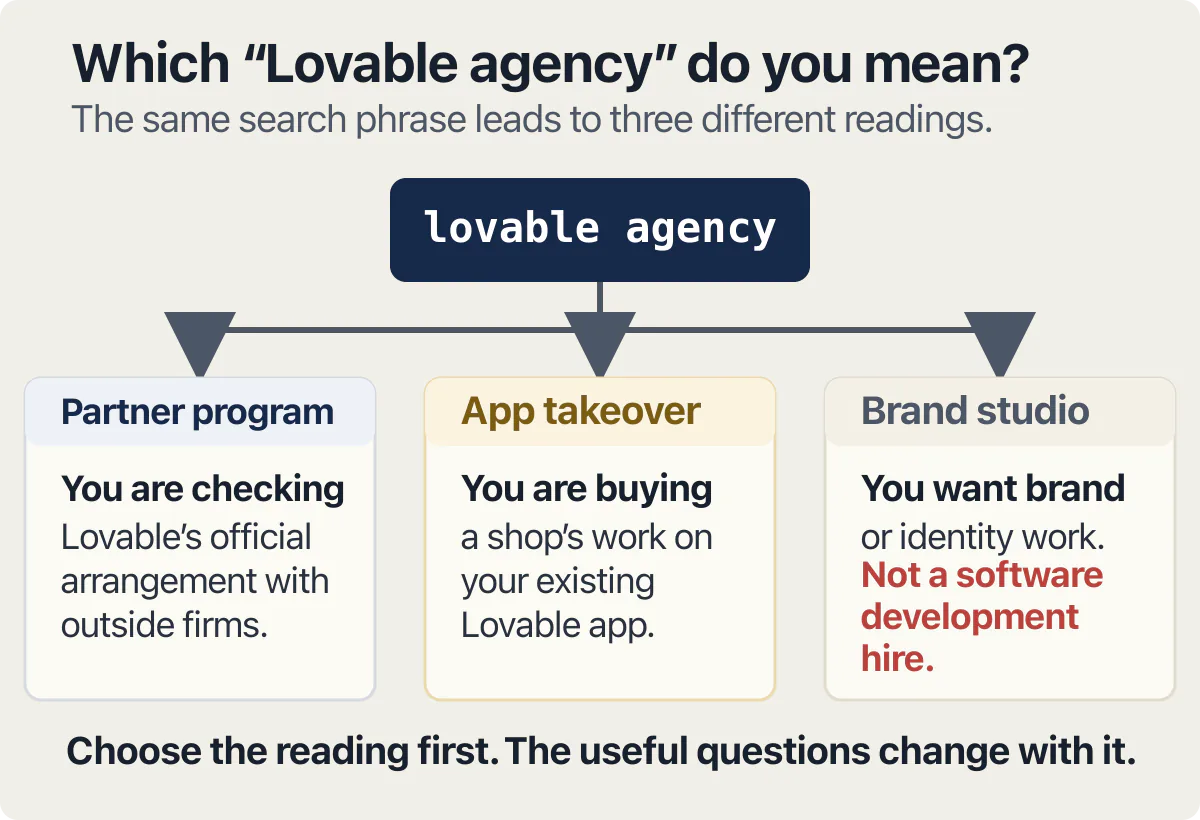
Lovable agency covers two purchases. One is Lovable’s own arrangement with outside firms, which today is a four tier Solution Partner Program. The other is a company you pay to take your own Lovable app to production. Which one you mean changes every question worth asking.
The phrase also collects a brand-name mix-up. One of the eight organic results for lovable agency on 29 August 2026 belongs to a studio called Primary, whose client was Lovable, and Google’s own autocomplete on the same stem offers lovable branding agency and lovable design agency, which are searches for somebody to design a brand rather than build software.
Lovable’s expert page and its solution partner page were read on 29 August 2026 for what Lovable itself says its partner arrangement is; the specialist shops and the ranked lists that hold the first page for this phrase and for its closest variant were read the same day for what they publish about themselves, and the lists were read to find out who wrote them rather than to rank anybody. The corpus numbers further down come from the audit ledger behind this blog, dated where they appear.
No account was opened, no shop was contacted, and nothing here was tested. If what you want is reading one, the partner arrangement, the next two sections are yours. If you have a Lovable app that works in the preview and falls over in real use, start at the section on what a shop is taking on.
Two separate purchases share the name Lovable agency
Reading one is about Lovable. Somebody wants to know whether the vendor runs an official program with outside firms, who is in it, and whether being in it means anything. That question has a documented answer, and the answer changed recently enough that most of the internet still describes the old one.
Reading two is about your app. You built something on Lovable, it demos well, and it does not survive contact with real users, real money or a real support inbox. You want a company to take it the rest of the way. That question has no documented answer anywhere, which is why the pages that rank for it are written by companies selling the service.
The two readings share almost no vocabulary once you get past the phrase. A partner tier tells you what a firm has sold for Lovable. It tells you nothing about whether that firm will put your database behind rules that stop one customer reading another customer’s rows. A specialist shop’s page tells you what it thinks the job is. It tells you nothing about who ends up owning the accounts when the work stops.
There is a third thing the phrase drags in, and it is worth naming once so you can stop chasing it. Some searches for lovable agency are looking for a design studio, either one whose work looks lovable or the studio behind Lovable’s own brand. On 29 August 2026 that reading is genuinely on the first page: the result at rank seven is a case study on primary.studio/work/lovable, published by a brand studio whose client was Lovable, describing an identity built for the platform. It is not a Lovable development shop and never claimed to be. If a brand studio is what you want, none of the rest of this page applies.
Everything below assumes you meant one of the first two.
What Lovable’s own partner arrangement actually is
Lovable runs one official program with outside firms, the Solution Partner Program. It has four tiers, published commission rates of 0, 10, 15 and 20 percent, and published revenue thresholds on the top two. The older Experts program is closed. Lovable states that its partners are independent businesses and that it is not responsible for their work.
Lovable’s expert page, read on 29 August 2026, opens by saying the Lovable Experts program is no longer active, that it has been replaced by the Solution Partner Program, and that anyone wanting to join should apply through that program. The page still displays partner profiles under the heading Our Expert Partners, so a reader who lands there from a search sees a working directory sitting under a notice that the program behind it has been retired.
Lovable’s solution partner page, read the same day, publishes the tiers and the numbers.
| Tier | Commission Lovable states | What Lovable states it requires |
|---|---|---|
| Registered, level 1 | 0 percent | The default tier on joining, after an agreement and certification |
| Select, level 2 | 10 percent | Certification, plus a first deal of any Enterprise size |
| Premier, level 3 | 15 percent | $120,000 Enterprise sold ARR, and $240,000 managed ARR |
| Elite, level 4 | 20 percent | $300,000 Enterprise sold ARR, and $600,000 managed ARR |
Every figure in that table is Lovable’s own, taken from the partner page as it read on 29 August 2026, and each tier also carries a credit award that is not reproduced here because it pays the partner rather than you. The same page says commission is a one-time payment per closed Enterprise deal, calculated on contractual ARR, with the rate fixed at the moment the deal closes rather than when the lead was registered.
Joining has no fee stated anywhere on the page. What it has instead is a subscription condition: Lovable’s own answer to what it costs to join is that partners keep an active Business plan or higher Lovable subscription to keep their status. Its answer to who the program is for names agencies, consultancies, system integrators and solo practitioners delivering AI transformation services to clients.
Lovable also publishes what a firm must have to qualify: a registered business with its own domain, a verified tax identifier, a company website and an active professional profile, a business email on the company domain rather than a free mailbox, an application that describes the services coherently, and not being a direct competitor. There is a list of countries and territories the program will not partner in. Read that list for what it is. Every item on it is about the firm’s paperwork and location. Not one is about the code.
That gap is the buyer’s whole problem with a vendor directory, and Lovable states the consequence itself, in a disclaimer at the foot of the expert page: partners are independent entities, they are not employees of Lovable, any services come directly from the partner, and Lovable takes no responsibility for them. In plain terms, the listing is not a guarantee and your contract is with the shop. If the work goes wrong, the vendor whose logo drew you in is not the counterparty.
The directory itself is shaped like a marketplace. Each profile shows a company name, a location, an hourly rate, a minimum budget, a count of how many times that partner has been hired, the month they became a partner, and category tags drawn from a fixed set: websites, ecom stores, web apps, mobile apps, custom backend, custom design, content and SEO, and marketing setup. Those listings are the partners’ own, so no company, rate or minimum from inside the directory appears on this page.
Two absences are worth recording as of 29 August 2026, because both are the kind of thing a buyer assumes is there. The expert page states no standard that a listed partner’s work was checked against. Neither page states a listing fee beyond the Business plan subscription the program already requires.
Why the ranked lists all disagree with each other
The two ranked lists in this territory, one on the first page for lovable agency and the other on the first page for lovable development agency, are both published by an agency that puts itself at the top of its own list. That is how the format pays for itself, and it explains why no two lists agree. Neither list publishes a price for any agency on it.
inceptmvp.com/blogs/best-lovable-development-agencies, read on 29 August 2026, is dated 13 June 2025 on the page and titled so that the publisher’s own name and its number one ranking are both in the title. Its first entry is the publisher. closefuture.io/blogs/top-lovable-development-agencies-usa, read the same day, is dated 21 February 2026 and bylined by CloseFuture’s founder; the publisher holds a featured slot above the numbered ranks in its own comparison table, and every row in that table shows a custom quote rather than a rate. The list describes itself, in its own words at the foot of the table, as editorially curated from public portfolios and platform presence.
The shops on those lists may well be good. The lists are still a poor instrument for the job readers reach for them to do, which is comparing one shop against another on evidence somebody neutral gathered.
The supply side underneath the lists is real and it is not shy about it. On 11 August 2026 an F5Bot alert fired on a comment inside an r/lovable thread titled Reality Check: Lovable to Build Client Websites?. A week later, on 18 August 2026, one in r/FreelanceProgramming ran under the title Using lovable, I vibe coded 25 websites for businesses and emailed them. Zero sale..., stored with that trailing ellipsis. People are trying to sell work built this way, and they are comparing notes on whether it holds up.
That calculation, of whether to deliver a client build on an AI builder at all, gets stated plainly across the whole category rather than on any one product. One person in the corpus behind this blog, writing about a different builder from the one this page is about, described the decision this way: “I run a small digital consultancy and a client asked us to build a custom inventory and reservation portal. We’re considering building it on Base44 to deliver it faster and under budget.” Faster and under budget is the shop’s reason for reaching for a builder. It is a seller’s calculation, and the buyer of that build rarely sees it made.
An agency choosing to deliver its own client work on Lovable is the other side of this, with its own margins and its own risks. This page stays on the buyer’s side of that table.
One more result deserves a label rather than a summary. Rank eight on 29 August 2026 is a thread in r/lovable about running an agency or selling builds on the platform. Reddit does not return its pages to an automated read, so all that exists here is the search snippet, which is evidence that the conversation happens and nothing more.
What a shop is actually taking on when it inherits a Lovable app
A shop taking over a working Lovable app inherits a build that demos well and a backend nobody adversarially checked. The Lovable-specialist pages that rank for this phrase and its closest variant describe the same four-part job: database rules, real authentication, payments and webhooks, and the integrations the builder does not produce.
The specialist shops are unusually clear about what the work is, because it is what they sell. ayautomate.com/agency/lovable-dev, read on 29 August 2026, names four things: a database schema redesigned with real relationships, indexes, constraints and row-level security, plus the existing data migrated onto it; authentication with roles, access control and session handling rather than a login screen; billing, subscriptions, usage metering and webhooks; and third-party integrations, background jobs and email, which it says sit outside what the builder reliably produces. It also sells picking up stalled Lovable builds. goodspeed.studio/lovable-agency, read the same day, describes the same territory in different words: work on the AI-generated code so it holds at scale, payment integrations, speed and stability, and API and workflow integrations. Both are named here as evidence of what the market says the job is. Neither is a recommendation, and neither is linked.
The audit ledger says the same thing from the other end. Across 26 real applications audited in June and July 2026 in three cohorts, the 21 third-party apps in that ledger produced 958 confirmed findings, an average near 46 each, with each finding adversarially verified in the code rather than matched by a pattern, and the 26 audits behind that number records the method and the cohorts. Of the 26, 22 had at least one confirmed critical finding. So the pile an inherited app arrives with runs to a few dozen items, of which a handful actually matter, and knowing which handful is most of the skill you are buying.
Under a Lovable app there is usually a Postgres database, and where it lives changes what can be handed to anybody. If the project runs on Lovable Cloud, the database is inside Lovable’s own arrangement; if it was connected to a Supabase project you created, the keys are yours. That single fact decides how much of a takeover is a transfer and how much is a rebuild, and what actually moves when you leave Lovable Cloud sets out which parts travel. The practical starting point for any shop is the data itself, and getting the database out is the first thing to ask them to demonstrate rather than describe. Whether the database sits in Lovable Cloud or in a Supabase project of your own changes who can be handed what.
Two of the questions a shop will meet in week one are already answered in public. What production ready means for a Lovable build covers what the builder’s own checks do and do not reach, and the permission questions a Lovable app raises covers the row-level rules that decide whether one signed-in customer can read another’s data. A shop that cannot talk about both without looking them up is going to learn them on your invoice.
The messy part is rarely the code. Somebody in the corpus built a site on Lovable for a client, decided to sell it to them, and then ran into a wall at the moment of transfer: what came out of the repository did not produce the files their ordinary web host wanted. Nothing about that is exotic. It is the ordinary shape of a build that was never asked to leave the environment it was born in, and it is the week that turns a fixed price into a conversation.
Nine questions to settle before a shop touches a working app
Nine questions decide whether a takeover goes well, and none of them is about the code. They are about who holds what. Settle them in writing before anybody starts, because every one of them is cheap to answer in advance and expensive to discover in the third week.
| What to settle | What a real answer names | Why it bites on a Lovable app |
|---|---|---|
| Whose Supabase project the data lives in | The account the project sits under, and the email address on that account | If the project was created inside the shop’s own account, your customer data lives somewhere you cannot reach without them |
| Whose GitHub organization holds the repository | The organization name, and who has admin on it | Lovable syncs to a repository. If it belongs to the shop, every future developer starts by asking them for access |
| Who holds the Lovable subscription after go live | The billing account, the plan, and the date it transfers | An app on somebody else’s subscription stops when their card does |
| What happens to the preview environment | Whether the Lovable preview stays live, and who can see it | Preview links are how demos leak. A working preview with real data in it outlives most working relationships |
| Who answers in the week after launch | A named person, a working day window, and how you reach them | Launch week is when the failures that never appeared in the preview arrive at once |
| What you will see working before money moves | The exact behavior they will demonstrate, in the running app, in front of you | A description of work done is not the same as watching the thing you paid for do its job |
| Whether changes are made in Lovable or in the code from then on | One of the two, plus what happens to the other one | A shop that moves the app into an editor may or may not leave you able to change things in Lovable afterwards, since Lovable’s two-way Git sync can keep the editor working when the changes stay compatible, so agree the editing workflow rather than let it happen by default |
| What the domain and DNS move looks like | Who owns the registrar account, and what changes on the day | The domain is the one asset a dispute can hold hostage, and it is usually the easiest to keep in your own name |
| What you keep if you stop working with them next quarter | The repository, the database, the environment values, and the accounts, named one by one | Ending well is a design decision made at the start or an argument had at the end |
Three of these open onto larger questions of their own. Which accounts have to be in your own name before anybody starts is a checklist of its own. Checking that a company is what its own page says it is, when you cannot read the code, is its own sitting, and the general list of questions to put to whoever answers is longer than the Lovable-specific ones here.
One rule holds the whole table together. Ask for a demonstration rather than a description. Every question above has an answer somebody can show you inside ten minutes, in a browser, with the real app: here is the repository, here is the database, here is the invoice, here is the DNS panel. A shop that would rather talk about it is telling you something.
What these shops publish about price, and what they do not
Almost nothing. Of the Lovable-specialist pages holding the first page for lovable agency and for lovable development agency, two publish no price at all to a plain read, and the only figure on either ranked list is a range in an FAQ answer. Every number you are given comes out of a conversation about your app.
Two of those pages were read on 29 August 2026 and returned no price for their own work. goodspeed.studio/lovable-agency lists what it builds and asks you to get in touch. ayautomate.com/agency/lovable-dev offers a free call and lists services without figures. That is what a read of the page returned on that date. It is not proof that no price exists, and either page could publish one tomorrow.
The one published figure sits in closefuture.io/blogs/top-lovable-development-agencies-usa, dated 21 February 2026, which answers its own question about what a Lovable project costs in the United States by saying most projects run from $5,000 to $150,000 and up. That is one agency’s account of its own market on one date, and the same page’s comparison table shows a custom quote against every agency it ranks, including itself.
For the money question underneath all of this, three pages already carry the numbers. The hiring routes and the bands people really pay are on what developers actually charge. For repair work on this builder specifically, what it costs to get a Lovable app fixed carries the published prices. What a move off Lovable costs covers the case where the answer is a migration rather than a takeover. How agency prices are put together in general, and what the money buys after a launch, is a wider question than the Lovable-specialist shops answer.
When you do not need any of this
One broken thing is not an agency purchase. If you can name the failure in a sentence, and the rest of the app works, you are buying one repair from one person, and a company with a partner tier and a minimum budget is the wrong shape of seller for it.
The test is whether you can finish this sentence: when a user does X, the app does Y, and it should do Z. If you can, that is a repair. If every attempt to finish it turns into a list, or the honest answer is that you no longer trust the app rather than that any one thing is broken, that is a bigger job, and a shop is a reasonable answer to it.
The other honest exit is leaving. Some owners arrive at this search because the builder has stopped fitting, and hiring a company to keep pushing the same app up the same hill is an expensive way to postpone that. Whether moving off is the right call at all settles that question before you pay anybody to act on it.
AxonBuild is not an agency and it is not a Lovable partner. Bilal works on apps people have built with Lovable and the other AI builders, and the way in is a free 20-minute video call: show him the app and what keeps breaking, and he will talk through what needs checking. If you want him to make the change, from one broken screen to finishing a half-built product, moving it off the builder or wiring up payments, he checks the app first and gives you a fixed quote. You pay after you see the change working.
Paying one person who knows Lovable, rather than a company, changes what you ask for and what you can check. Where a Lovable shop sits next to a marketplace freelancer and an offshore firm, and which of the three suits which job, is the wider map.
One thing this page cannot give you is a track record. Nobody publishes what a Lovable takeover looked like twelve months on. The partner tiers measure sales rather than outcomes, the ranked lists are marketing, and that leaves every buyer checking a shop with a browser and the nine questions above.
Common questions about Lovable agencies
Does Lovable have an official agency program?
Yes. It is called the Solution Partner Program, it has four tiers, and Lovable publishes its commission rates and revenue thresholds itself. The older Lovable Experts program is no longer active, and on 29 August 2026 Lovable’s expert page said so. Being in the program means a firm met Lovable’s business requirements and sold Lovable to enterprise customers.
Lovable also states that its partners are independent businesses and that it is not responsible for their services, so a tier is a sales record rather than a guarantee about the work.
What does the Lovable company itself do?
Lovable is an AI app builder. You describe an application in plain language and it generates a working web app, with a Postgres database, authentication and hosting attached. The company sells the builder rather than development services, which is why its partner program exists at all.
Lovable’s own partner pages describe partners delivering client work rather than Lovable doing it, so every firm listed under the program is a separate business, and so is every shop on the ranked lists.
Is a Lovable agency the same thing as a Lovable developer?
No, and the difference is what you can check. A company sells you a team, a process and continuity, and usually carries a minimum budget. One person sells you their own hands, and you can see exactly whose they are. For a single app that works and needs finishing, one person is often the cheaper shape.
The exception is continuity. If what you need is somebody reachable next year rather than next month, a company is easier to hold to that than an individual.
Do I need a company at all to take a Lovable app to production?
Not necessarily. The work an inherited app needs is usually a fixed pile of specific items: real database rules, real authentication, payments that survive a failed webhook, and somebody reachable when it breaks. A company earns its price when that pile is large or several parts of it have to move at once.
For one named failure in an app that otherwise runs, a company is overkill, and the minimum budgets make it an awkward purchase for both sides.
Who owns the code and the accounts if a shop builds on Lovable for me?
Whoever the accounts are registered to, which is why this gets settled before work starts. The Lovable project, the connected database, the GitHub repository, the domain registrar and the payment processor are five separate accounts, and a shop can end up holding all five simply because that was the fastest way to begin.
Ask for each one to be in your own name, or transferred on a named date, and get that in writing before anybody starts.
Why do the “best Lovable agency” lists disagree?
Because the agencies write them. The two ranked lists here, one holding the first page for lovable agency on 29 August 2026 and the other the first page for lovable development agency, are each published by an agency that appears at the top of its own list, one dated 13 June 2025 and one dated 21 February 2026. Neither is a survey and neither publishes prices.
Read them as a source of names to check yourself rather than as a ranking of anything.
What is a “lovable agency website” when the search is navigational?
Usually one of two sites. Either lovable.dev itself, where the partner program and the expert directory live, or the site of a specific shop somebody already heard about and is trying to find again. If you meant the vendor’s own arrangement, the partner program page carries the current terms.
The expert page now opens with a notice that the program it is named after has closed, so a search that lands there is landing on a page about a retired arrangement.
What if only one thing is broken rather than the whole build?
Then one repair is the purchase. Name the failure in one sentence, get somebody to reproduce it in front of you, and pay for that. Agencies are priced and staffed for multi-week work, and most carry a minimum budget that makes a single fix awkward for both sides.
The moment to widen the search is when the list of named failures stops fitting in a sentence.
Built it with AI. Can’t get the last part right?
That’s the normal state of an AI-built app, and it’s fixable. I trace what the app actually does, explain what needs changing, and build it if you want me to.
Talk about your app →  Free 20-minute video call with Bilal.