Your app was built with AI, it runs, and people depend on it. One thing is now broken, risky, or unfinished. Search “hire a developer to fix my app” and every page that comes back prices a different job: building an app that does not exist yet.
Hiring an app developer for an app that already runs is priced around the work, not the whole app. Published US rates run roughly $20 to $200 an hour for individual developers, with premium agencies above that. A single fix may take a few hours, so the useful comparison is what that repair costs through each hiring route.
Every figure below was checked on 2026-08-14, and each one is attributed to the company or agency that published it.
How much does it cost to hire an app developer?
US rates for individual app developers span roughly $20 to $200 an hour, with premium agencies above that. Tecla’s How Much Does It Cost to Hire an App Developer?, dated 3 February 2025 at tecla.io/blog/how-much-does-it-cost-to-hire-an-app-developer and checked 17 August 2026, puts its seniority grid at $25 to $200 an hour. The federal wage anchor is narrower: BLS OEWS 2025 data puts the median for US software developers at $65.38 an hour, or $135,980 a year.
| Source | What it publishes | Checked |
|---|---|---|
| O*NET OnLine, carrying BLS OEWS 2025 wage data | US software developers: median $65.38/hr and $135,980/yr; 10th percentile $39.64/hr, 90th percentile $103.21/hr | 2026-08-14 |
| Adalo, updated 2026-03-02 | Freelancers: junior $20-$40/hr, mid $40-$80/hr, senior $80-$150+/hr. US agencies $100-$200/hr, premium agencies $200-$400+/hr | 2026-08-14 |
| Tecla, How Much Does It Cost to Hire an App Developer?, dated 2025-02-03 | Junior $25-$50/hr, mid $50-$100/hr, senior $100-$200/hr; US average pay $132,270/yr | 2026-08-17 |
| Business of Apps, updated 2026-06-15 | Hiring a US app developer costs about $100,000-$133,000 a year; US hourly rates hover around $100/hr | 2026-08-14 |
One number in that table is not a marketing figure. O*NET OnLine publishes the BLS Occupational Employment and Wage Statistics figures for software developers, the US government’s own wage survey, and its spread is worth more than any single average: the 10th percentile earns $39.64 an hour and the 90th earns $103.21. Those are employee wages rather than contractor prices, so read them as the cost of a developer’s time before any seller’s overhead or estimating risk is added on top.
Project prices follow the same logic. Adalo’s band for a simple app is $10,000 to $60,000. It prices an app that has to be built from nothing.
Why an app developer hourly rate does not answer your question
An hourly rate prices an hour. It does not price your job, because nobody knows how many hours your job takes until someone has read your code. On a build, that uncertainty is spread across months and thousands of hours, so an average absorbs it. On one fix, the uncertainty is the whole estimate.
Three things change once the app already exists and works. The job is bounded: one flow, one screen, one payment path, not a product. The risk moves from “will this get built” to “will this change hold and not break the parts that already work”. And the hours are small enough that the difference between a good and bad guess is the entire bill.
That is why an hourly deal is the risky one at this size. If the developer needs three extra hours to understand code they have never seen, those hours are yours at $80 or $150 each. Whether anyone finds out how long it will take before the clock starts is something you have to ask for, because an hourly quote does not require it.
What you are actually buying: one defined result
Across 21 third-party AI-built apps AxonBuild audited in June and July 2026, the research recorded 958 confirmed findings, about 46 per app. Only 58 of those were critical. The corpus writeup that owns those figures carries the method, the cohort rules, and the limits. Across the wider 26-app set, 22 apps had at least one confirmed critical finding.
Those two numbers describe the buying decision. Paying someone to “fix the app” points them at the 46. Paying for a named result points them at the few that decide whether your business keeps working. Six percent of those findings were critical. The other 94 percent were real and mostly not urgent.
The count is high because generated code accumulates duplicated rules, half-connected controls, and dead configuration faster than anyone reads it, which is what measuring technical debt in AI-generated code looks like from the repository side. A developer paid by the hour can end up working through all of it. Whether you wanted to buy all of it is a separate question, and one to settle before the work starts.
Four hiring routes, and the real cost to hire an app developer
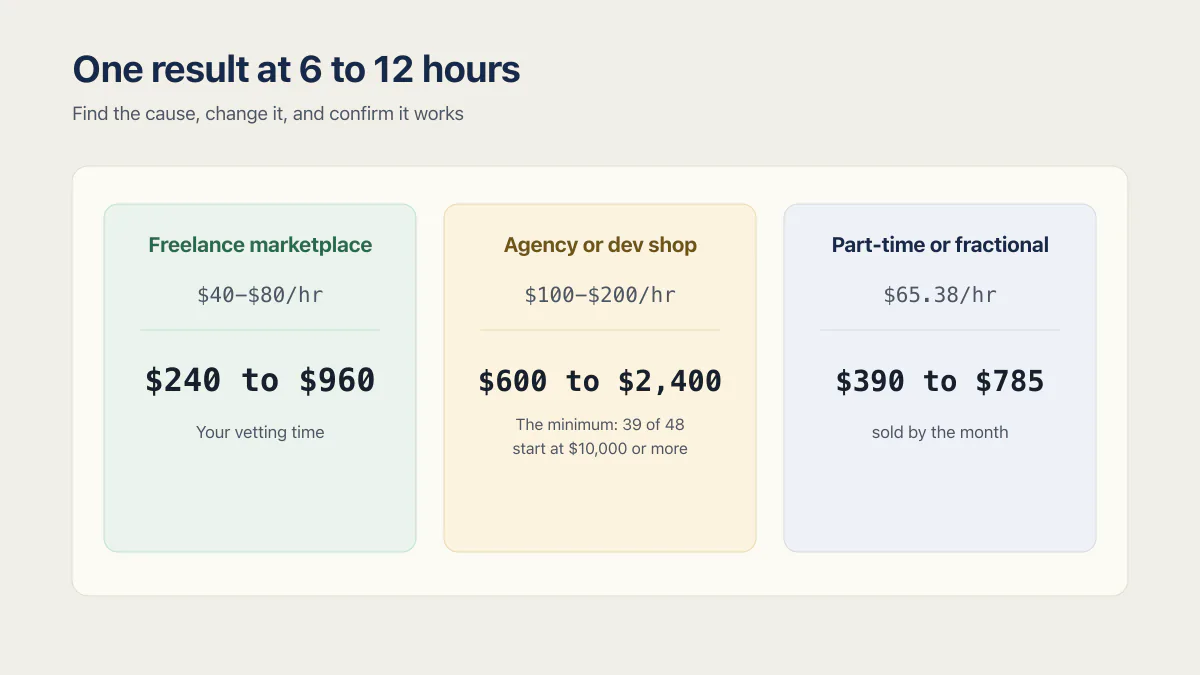
Take one defined result on a working app: find the cause of one broken flow, change it, and confirm it works in the live app. Assume 6 to 12 hours, including the time to read unfamiliar code. Your job may be smaller or larger, and the assumption is written down so you can redo the sum with your own number.
| Route | Published rate | One repair at 6-12 hours | What the rate hides | Who it fits |
|---|---|---|---|---|
| Freelance marketplace | Mid-level $40-$80/hr (Adalo, 2026-03-02) | About $240 to $960 | Your vetting time, and the hours nobody can estimate before reading the code | A small change you can describe in a sentence and judge yourself |
| Agency or dev shop | US $100-$200/hr, premium $200-$400+ (Adalo, 2026-03-02) | About $600 to $2,400 on paper | The seller may require more work than one small change | Ongoing work that fits the seller’s minimum |
| Part-time or fractional developer | Employee median $65.38/hr (BLS OEWS 2025, via O*NET), used here as a floor; fractional sellers publish their own rates | About $390 to $785 of time at that wage, sold by the month | A monthly commitment: 40 hours at that wage is about $2,600 before employer costs and before any seller’s margin | Continuous work over months, not one fix |
Among the three hourly routes, a marketplace freelancer is the cheapest row in that table, and for a change you can specify and check yourself, it is the right call. The fixed-quote row has no figure until the code has been read, so it sits outside that comparison. Paying a fixed price moves one risk rather than removing it: on an app nobody has read yet, the hour count is the part nobody can honestly promise, and an hourly deal leaves that part with you.
The agency row can fail for a different reason. Its hourly rate may fit a 10-hour job while its minimum does not. Ask for the minimum before comparing the hourly number with one broken checkout.
How I price the work, as one data point
The boundaries belong in the comparison rather than in fine print. This does not fit someone who only has an idea, anyone who wants the app rebuilt from scratch, or anyone who wants a developer available open-endedly by the hour. It is not a written review of the app, a penetration test, or a compliance certification, and no fixed-price fix makes an app safe, secure, or free of other issues. If a reviewed opinion on the whole app is what you want rather than one change, that is a different purchase from a different kind of provider.
Price bands for the work people actually buy
Almost nobody hiring a developer for an app that already runs wants “an app built”. They want one of a small set of specific things, and each one is priced on a different basis. The table below is that list, with what sets the price and what a fixed price looks like where one exists.
| The situation you are in | How the price is set |
|---|---|
| One thing in a live app is broken | For the agreed result, after someone has read the code |
| An app somebody left half-built | For the agreed remaining work, after someone has read the code |
| It runs, but it is not ready for real users | For the agreed boundaries, after someone has read the code |
| Generated code nobody can safely change any more | Per pass over the code |
| Deciding whether to clean it up or build it again | The decision itself, before any work is bought |
| Building the same app again from nothing | Priced as a new build, by complexity |
| A first app that does not exist yet | Priced as a new build, by complexity |
| A number to put in a plan before you commit | Priced as an estimate, not as work |
| Moving the app off the builder it was made on | Priced as a migration, per app |
| Somebody else carrying out that move for you | Priced as one job, start to finish |
| A Lovable or Base44 web app that needs a web developer | Per named result, the same as any other fix |
| Someone to read the code and then run the app month to month: releases, incidents, and the changes you ask for | Priced after the app and required work are understood |
| Paying by the hour instead of per result | You carry the hour count, whatever it turns out to be |
| Comparing freelance rates before you pick anyone | By seniority and by location |
| Hiring outside your own country | Geography changes the rate, not the job |
| Ongoing help every month | By the month, not by the result |
| More work than one person can carry | Per person, per month |
Which row you are on depends on whether the job is a build or a change to something that already runs, and the price follows from that. Build pricing answers what it will cost to make an app exist; every other row answers what it will cost to change one thing about an app that already does. A founder with one broken checkout reading a build estimate in the tens of thousands is reading the wrong row rather than being overcharged.
There is a name for that second kind of work. Someone who cleans up vibe-coded apps for a living prices by the result rather than by the hour, for the reason this page keeps returning to: reading code nobody documented is the part no honest hourly estimate can bound in advance.
One row is a different job altogether. Moving an app off the builder it was made on is a migration rather than a fix, so what it costs to move an app off Lovable depends on what the platform was quietly doing for you that you now have to run yourself, and paying somebody to carry out the whole move for you is priced as one job rather than by the hour.
What to ask before you agree to any price
These five questions work with any of the four routes, and the answers are more useful than the rate.
- 01 Name the result out loud: what will work after this that does not work now?
- 02 Ask what "done" looks like inside the running app, not in a written summary.
- 03 Ask what happens if it does not work: who pays, and who fixes it.
- 04 Ask what could change the price, and when you would find out.
- 05 Confirm you own the code afterwards and can hand it to anyone else.
A developer who answers all five in plain language is usually a better bet than one who is $20 an hour cheaper. Once you have picked someone, the next cost is access: accounts, repository, database, and deployment, which take longer to gather than most founders expect. If what you want is one person responsible for the running app month to month, releases, incidents, and the changes you ask for rather than one fixed thing, that is a different purchase.
Common questions about hiring a developer for an app
How much does it cost to hire a mobile app developer?
Published rates run $25 to $200 an hour by seniority in Tecla’s grid, dated 2025-02-03, and Adalo lists US agencies at $100 to $200 an hour, updated 2026-03-02. Tecla’s source was checked 17 August 2026. Fixing one thing in an app that already ships is a much smaller job than a new build.
How much does it cost to hire a developer for an app?
The price splits on whether the app already exists. A new build is a different purchase from changing one thing in an app that already runs.
Changing one thing in an app that already runs is often a few hours of work, so the useful number is those hours multiplied by the rate of the route you pick in the table above, and the question that decides the bill is whether the seller reads the code before naming the hours. AxonBuild names its figure only after checking the app.
How much does it cost to hire a developer?
The neutral anchor is the US government wage survey: BLS OEWS 2025 data, published through O*NET OnLine, puts the median software developer at $65.38 an hour and $135,980 a year, with a 10th to 90th percentile spread of $39.64 to $103.21 an hour (checked 2026-08-14). Those are employee wages; freelance and agency rates sit above and below that band depending on seniority, location, and overhead.
How much does it cost to fix an app?
Nobody can price a fix sight unseen, and any number given before someone reads the code is a guess. What can be priced is a named result: one broken flow working again, one risky part made safe, one unfinished feature finished. What a whole cleanup costs, worked out piece by piece, is the bigger calculation.
What is a normal app developer hourly rate?
Adalo lists junior freelancers at $20-$40, mid-level at $40-$80, and senior at $80-$150+ an hour, updated 2026-03-02. Tecla lists $25-$50, $50-$100, and $100-$200 for the same three bands, dated 2025-02-03.
What does a freelance app developer cost?
A mid-level freelancer at $40 to $80 an hour costs about $240 to $960 for a job that takes 6 to 12 hours, using Adalo’s published bands.
The rate is not the whole cost. Add your own time to write the brief, review candidates, and check the work, plus any hours the developer needs to understand code they have never seen.
What does it cost to finish an app someone else built?
Finishing an app usually costs less than rebuilding it when most of the existing code can be kept, and more than the original developer’s estimate when the unfinished part turns out to be bigger than it looked. The honest answer depends on whether the unfinished part is one feature or most of the product, which is why the price should follow a look at the code rather than a conversation about it.
The method side, how to finish a half-built app rather than what it costs, is its own page.
How much should I pay an app developer?
Pay for the result you want rather than for the hours it might take. On an app that already runs, name the behavior that must change: one broken flow working again, one permission problem corrected, or one failed integration restored.
If you would rather pay by the hour, judge the quote against the government wage anchor in the answer two questions above rather than against a seller’s own average. Those are employee wages rather than contractor prices, so a quoted rate above that band includes whatever the seller adds on top of a developer’s wage, and a rate far below it deserves a question about what is included and whether learning your code is on the clock.
Fixing the bug in this guide gets you past today. If you would rather have the whole foundation checked and built in one go, that is what the sprint below is for.
Built it with AI. Now it has to hold up for real customers.
The Production Hardening Sprint takes the app you already have and builds the production foundation underneath it. Authentication and access rules, payments that stay consistent, error handling, monitoring, backups, automated tests and a documented handover. Our engineers work inside your existing codebase for ten working days. All 123 deliverables are included, and you get the evidence for each one.
See the Production Hardening Sprint →  $2,500 fixed price · 10 working days · One codebase