This page is about the group of people who build or finish the first working version of a product, not about the award, the sports title, or the older screen-layout pattern that share the same three letters.
You have an app already. A builder tool produced most of the code, the thing is live, people are signing in, and you have written down what is wrong with it. So you go reading about MVP development teams, and every page hands you the same answer: a product manager, a designer, a solution architect, two or three developers, a quality assurance engineer. Roles in a column, with no number beside any of them.
One person, for a few weeks, is what a first version that already runs usually needs. The only worked headcount published anywhere on this search is six, and that six built an iOS app from nothing. An app that already works leaves a shorter list behind, and a shorter list does not need more people.
What follows is the working behind that number. What the sellers actually put in a team, how many people the work needs at each stage of an app’s life, and which of the advertised roles has a job rather than a task once the code already exists.
What the companies selling MVP teams put in one
The role lists agree with each other, which is the first thing worth noticing. DECODE’s MVP development team guide, an article dated 29 March 2024 at decode.agency/article/mvp-development-team-guide/, names a product manager, a solution architect, a UX and UI designer, a software engineer, a QA engineer and a project manager. Minimum Code’s guide at minimum-code.com/blog/mvp-development-team, dated 27 June 2026, states that a well-rounded team typically includes product managers, UI and UX designers, developers on the front end and the back end, and quality assurance specialists, then adds a sixth under a heading calling the DevOps engineer the optional role. Same six or seven job titles, two years apart, from two companies selling different things.
What none of them agrees on is the number, because none of them prints one. Minimum Code names the roles and, as of 1 September 2026, states no number of people. As of 1 September 2026, mvp-development.io’s own page about itself at mvp-development.io/about does not state how many people are in the team it describes, which is a striking silence on a page whose company name is the search phrase. As of 1 September 2026, leanware.co’s MVP development team guide at leanware.co/insights/mvp-development-team-guide returned an error to an automated read, so nothing here rests on what that page says.
One page does print a number, and it is the only one on the entire search that does. DECODE describes a team it assembled for a client, a startup that needed an MVP for an iOS app, and lists the structure it went with: 1 product manager, 1 UX/UI designer, 1 solution architect, 2 iOS engineers, 1 QA engineer. Six people. That is a real, dated, worked example rather than a role diagram, and it is worth taking seriously for exactly what it describes: a product development team assembled to build a native mobile app that did not exist yet.
The distance between that example and your situation is the whole subject of this page. Six people started from an empty repository. You are starting from an app that runs, that has users, and that is wrong in specific, listable ways.
Every page on this search that answered an automated read was opened as raw page source on 1 September 2026 and checked for one missing fact: how many people it says a first version takes. No estimator was filled in, no seller on the list was contacted, and no application was run for this page.
How many people a first version needs at each stage
Headcount for a first version follows the stage the app is in rather than the feature list. An empty repository is the expensive case, and it is the one the market prices for. An app that already runs, with a written list of faults, gives one person a few weeks of work.
| Where the app is | People it needs | What they are doing | What the market sells at this point |
|---|---|---|---|
| An idea and a document, nothing running | One, plus a builder tool | Getting a first version on a screen and in front of somebody | A full product development team, priced per person |
| A working app, first users on it, a written list of faults | One | Working down the named list, mostly connecting things the tool already wrote | A standing group by the month, on a rolling commitment |
| Real numbers arriving, things giving way under load | One, sometimes two for a short stretch | Limits, indexes, error recording, the parts that only show up with traffic | The same standing group, on a longer commitment |
| More than one product, or dated plans that outlive this list | More than one, and now the model fits | Parallel work that would collide if one person tried to hold all of it | The thing the market is actually built for, correctly sold |
The second row is where most people reading this actually are, and it is the row nobody publishes. The sellers all price the first row, because the first row is where their business is. Somebody who already has a working app is a smaller sale, so the pages that rank for team questions have no reason to describe them.
Here is the size of the first row, converted into people. Geniusee’s MVP services page at geniusee.com/mvp-startups answers its own cost question with an hours figure as well as a price, and the hours are between 800 and 1,000 for a typical web or mobile first version. That page carries no article date, and its site copyright reads 2026. The same page says that since 2017 the company has grown to 270+ software specialists, so the number comes from a company with a large bench rather than from a one-person shop guessing.
Divide those hours by a 160-hour working month and you get between five and six and a quarter months of one person’s full-time work. That is person-time, not a schedule, and it does not divide neatly across people either. It is also, and this matters more than the arithmetic, what a first version costs to make when none of it exists yet. If you already have one that runs, you are buying only whatever fraction of those hours the tool skipped.
One owner of a consumer app put the same point in plainer terms after their app found an audience: “I vibe-coded an entire app at 3 AM. A month later, it has 1K+ users … And yes, almost the entire thing was vibe coded. No massive engineering team. No months-long development cycle.”
Those last two sentences are the argument of this page, said by somebody who lived it rather than by somebody selling against it. The first version came out of a tool in one sitting. Whatever that app needs next is a finite list, and finite lists get finished by people, singular.
Getting the last part of a half-built app done, and how that job is priced from a named list, is worked through where that purchase is. If what pushed you into reading about teams was the app buckling once real numbers arrived, what gives way when more people arrive is worth reading before you count anybody. Calendar time is a different measure from headcount, and how long a first version takes is counted separately.
Role by role, what each one would still have to do
Every role on the sellers’ lists is real work on an empty repository. On an app that already runs, most of them shrink to a task somebody does once, because the decision the role exists to make has already been made by the tool that wrote the code.
The evidence for that sits in the code rather than in an opinion about team building. AxonBuild’s fixed June and July 2026 study covered 26 real AI-built applications in three cohorts, 21 of them third-party apps carried in a findings ledger whose entries were each confirmed by reading the code rather than produced by a scanner, and one shape recurs across them: a control that is present in the repository and connected to nothing that runs. A rate limiter sitting in a file that no route ever calls. A crash screen written properly and never put in the path of a crash. In one app, a written rulebook for the AI that no running code ever opens. The study records that shape example by example instead of counting it, so no denominator belongs in this sentence, and the cohort rules and the full findings behind it set out the method. What matters here is the kind of work it implies. Connecting a thing that already exists to the thing it was written for is one person with the repository open, not a design phase.
| Role the pages sell | What it would do on a first version that already runs | A role, or a task |
|---|---|---|
| Product manager | Read your list of faults and put it in order of what costs you money first | A task, and you can do it |
| UX and UI designer | Change screens that already exist and that users are already using | A role, but only if you have decided to redesign |
| Solution architect | Choose the stack and the shape of the system | Already decided, by the tool, months ago |
| Front-end and back-end developer | Fix what is broken, connect what was never connected, finish what was started | The role. This is the job |
| QA engineer | Check that the fixes hold and that nothing else moved | A task each time, attached to the fix |
| DevOps engineer | Get deploys, environments and error recording into a state you can trust | A task, then nothing until the deploy path changes |
Read the right-hand column as a whole and the six-person structure stops looking like a team and starts looking like one job with five advisers attached. A line by line account of what typically remains unfinished when a first version stops short is written out where that list belongs. What one person who finishes these applications actually does all day is described where that role is.
The honest exception is the designer row. If the reason you are unhappy is that the app looks like every other app that came out of the same tool, that is a genuine second person, and it is a different hire from the one who fixes the payment flow.
The dedicated development team model, read against one MVP that already runs
The dedicated development team model is a standing group of named people billed per person per month, working on your product and nobody else’s. As an arrangement for one MVP that already runs it is the wrong shape, because it prices a supply of hours against a list of work that ends.
Search the bare model phrase on its own, with no MVP wording anywhere in it, and the results come back as a wall of staffing sellers. That was true of every organic result on the dedicated development team search on 1 September 2026: eight results, eight companies selling development teams, and no MVP intent anywhere on the page. The dedicated software team, the dedicated team development arrangement, the dedicated development team services page and the software dedicated team offer are the same product under different word orders, and the market that ranks for them is a staffing market rather than a product market.
That matters because the words do not mean what a first-version buyer assumes. A dedicated team is defined by its billing arrangement rather than by what it finishes. What you buy is a period of several people’s time, renewing until you stop it, with the result left open. Buying a standing group of people by the month is a different purchase with its own market, and the companies selling one publish very little about what the entry level actually contains.
Outsourcing MVP development to such a group is a reasonable thing to do when the fourth row of the table above describes you. It is an expensive way to buy the second row. Whether the work is better bought from somewhere cheaper, and what that trade actually costs you, has an answer of its own.
There is a further version of the same purchase worth separating out, because people reach for the team model when what they actually want is to stop being responsible. Handing the whole thing to somebody who runs it from then on is a different arrangement with a different ending, and it is not solved by adding people to the current one.
Keeping it in house, when the in-house team is you and one tool
In house development software work used to mean employing developers. For most people reading this it now means you, a builder tool, and whatever you can get done between other jobs, which is a real in-house product development team of one and is worth counting honestly before you go outside.
The question that decides it is whether the remaining work is the kind you can check, rather than skill. You can describe a broken payment flow precisely, and you can tell whether it works afterwards by running it. You cannot tell, by looking at the running app, whether the rate limiter is connected, because a control that is present and doing nothing looks exactly like a control that is present and working. That is the class of work that has to leave the building, and it is a short class.
So the honest in-house split is this. Ordering the list, deciding what matters, writing down what “fixed” means for each item, and testing the result afterwards are all yours, and doing them well makes whoever you hire cheaper. Reading the code to find out which of the things that look finished are actually connected is not yours, and no amount of time in the tool will make it yours.
Some of the sellers on this search will tell you the same, and it is worth reading them for it. How this kind of work is bought at all, and what the sellers wrap around it before they quote, belongs to the buyer’s guide for the whole market.
Consultant, partner or studio: which word matches what you need
An MVP development consultant sells judgement about what to build and in what order. An MVP development studio or partner sells the building. The words are used loosely enough by sellers that the only reliable test is what the arrangement ends with, so ask that question rather than trusting the noun.
The consultant search returns the same buy-side market as the team search does, which tells you something about how the word is being used. On 1 September 2026, the results for mvp development consultant were development companies, staffing sellers and a top-ten listicle, with one page whose title asked when to hire a consultant at all. MVP product development consulting, on those pages, mostly means a company selling a build with a discovery stage in front of it.
That is not a criticism of the shape. Judgement genuinely helps when the question is which version of an idea to build. It helps much less when you already have the app, because the thing an MVP development consultant is best at, deciding what the first version should contain, is a decision your users have already made for you by using or ignoring what you shipped.
Two vocabularies are worth separating from this one. An MVP development partner and an MVP development program usually describe a continuing arrangement rather than a piece of work, which puts them back in the previous section. Whether what you want is one senior person part-time rather than any group at all is a question with its own answer. For anybody whose real gap is decision-making rather than hands, that shape fits better than a team.
The MVP development project framing is the useful one, because a project has an end. If a seller will not describe the end, the word on the tin is doing sales work. What building a first version involves from end to end, and the routes people take into it, sits above this page. Choosing between the companies that sell this, and the questions that separate a good one from a confident one, is a separate job from working out how many people the work needs.
Three questions that settle the number before you pay anybody
Three questions decide the headcount without any help from a sales page: whether the work has an end, whether two parts of it have to happen at the same time, and whether the supplier has to be a company rather than a person. Answer those honestly and the number falls out, usually at one.
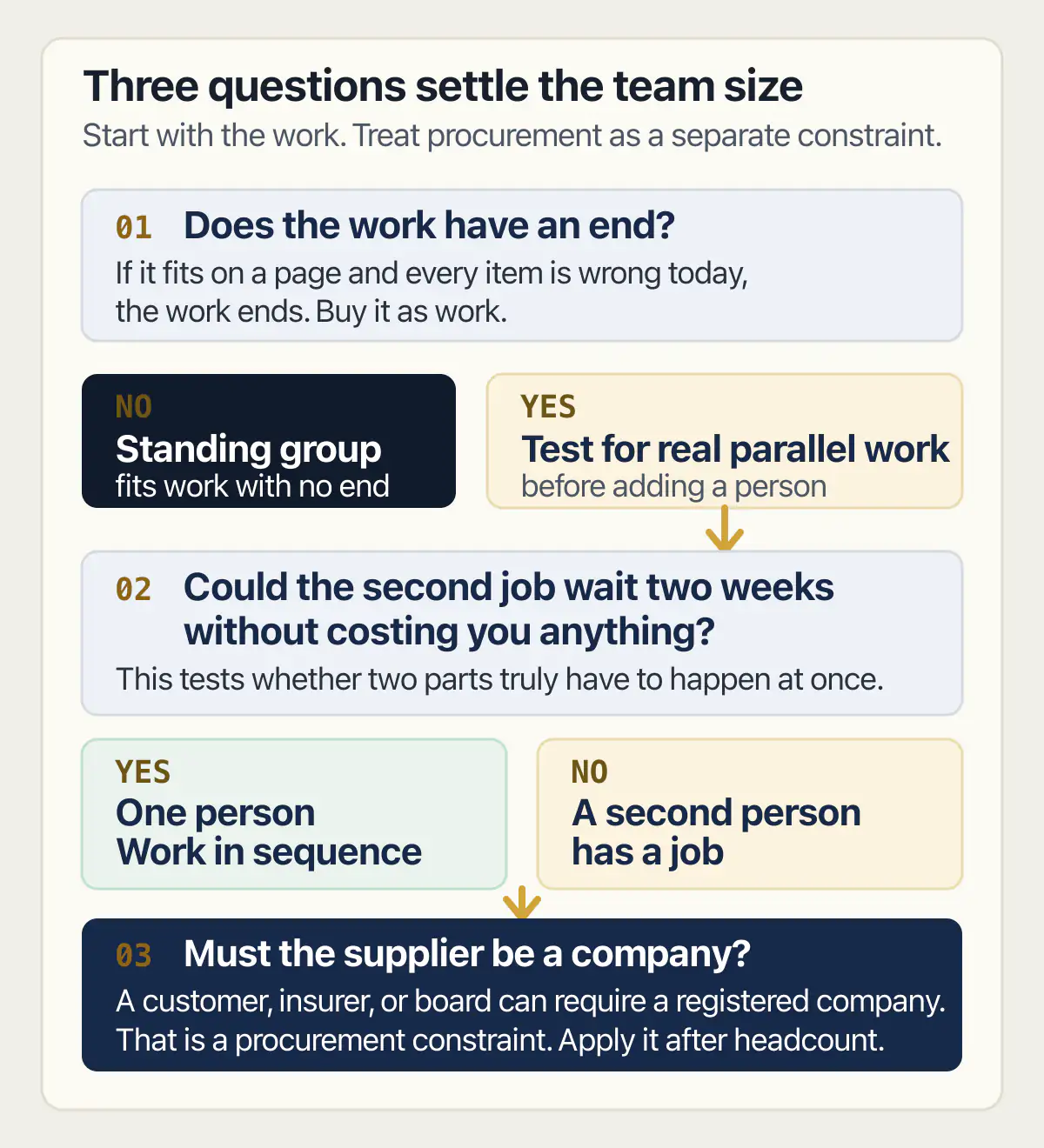
Does the work end? Write the list down, in one sitting, in plain words. If it fits on a page and every item is a thing that is wrong today, the work ends. Work with an end is bought as work. A standing group is bought against work with no end, which is a real thing to have, just not the thing most people holding a working app have.
Do two things have to happen at once? This is the only honest argument for a second person on a small app, and it is easy to test. Ask whether the second job could wait two weeks without costing you anything. If it could, it can wait, and one person can do both in sequence for less than two people doing them in parallel.
Does it have to be a company? Sometimes it does. A customer, an insurer or a board can insist that the supplier be a registered company rather than a person, and no argument moves that requirement. Notice that this is a procurement answer rather than a technical one, and price it as such.
If the answers come out at one person and a list, the smallest sensible first purchase is the first item on that list, at a price agreed before it starts. Nobody here is sold to you by the month, and no version of this page’s subject is on offer from AxonBuild. Further items on the list can follow the first.
Two limits are worth stating plainly. One change does not make an app finished, safe, or fit to launch, and nothing on offer is a security test against attack or a certificate of compliance with anything. If the answers to the three questions genuinely come out at four people for a year, buy that from one of the companies on this search, and use the second row of the stage table to check what they say you need against what your app actually has left.
The money side of this, and what changes about a quote once most of the work already exists, is counted on its own page. What one person’s time costs, hourly and per job, is collected in ranges elsewhere.
Common questions about MVP development teams
How many people does it take to build an MVP?
For a first version that does not exist yet, the only worked example published on this search is six: DECODE lists 1 product manager, 1 UX/UI designer, 1 solution architect, 2 iOS engineers and 1 QA engineer as the structure it went with for a client’s iOS app, in an article dated 29 March 2024. For a first version that already runs and has a written list of faults, one person for a few weeks is the realistic answer, because the remaining work is finishing and connecting rather than designing and building.
Can one developer finish an app an AI tool built?
Usually yes, and that is the normal case rather than the optimistic one. The work left in an AI-built app is mostly small, repeated and specific: things that were started and not connected, limits that were never applied, errors that go nowhere. One person who has read apps from the same tools before works down that list far faster than a group meeting the code for the first time, because most of the cost in a group is everybody’s first read.
What does an MVP development consultant actually do?
An MVP development consultant sells judgement about what to build, in what order, and what to leave out, usually before any code exists. Some sell that alone and some use it as the first stage of a build they also sell. It is most useful when the product question is genuinely open. It is least useful once you have a working app and real users, because those users have already answered the question the consultant is hired to answer.
Is the dedicated team model a good fit for one first version?
Rarely. The dedicated development team model bills named people per month and renews until you stop it, which fits work that continues and does not fit a list that ends. One MVP with a written list of faults is work that ends. The model earns its price when several parts of a product change at the same time, when a plan with dates runs past the current list, or when more than one product needs attention.
Do I need a product manager for a first version?
Not as a hire. The job a product manager would do on an app that already runs is putting your own list of faults in order of what is costing you money, and you are better placed to do that than somebody meeting your customers for the first time. Write the list, order it, and you have done the part of the role that matters at this size. The role becomes real when several people need to be pointed at the same product at once.
Does a first version need a QA engineer?
It needs testing, which is not the same as needing a person whose whole job is testing. On a small app, checking that a fix holds and that nothing else moved is a task attached to each fix, done by whoever made it, plus you running the thing the way a customer would. A dedicated QA engineer earns the seat when the number of changes per week outgrows the number of things one person can hold in their head.
Should the work stay in house or go outside?
Split it by what you can check. Ordering the work, defining what fixed means, and testing the result afterwards stay in house, and doing them well lowers what you pay outside. Reading the code to find out which parts that look finished are actually connected has to go outside, because a control that is present and doing nothing is indistinguishable from a working one when all you can see is the running app.
What is the difference between an MVP consultant and an MVP development partner?
A consultant sells an opinion and stops. A partner sells a continuing arrangement, usually billed monthly, and the word carries no promise about what gets finished or when. Neither term is standardised, so the reliable question is what the arrangement ends with and when you find out whether it worked. A consultant’s answer is a decision. A partner’s answer is often nothing more specific than the next invoice.
When does a first version actually need more than one person?
When two pieces of work genuinely have to happen at the same time, and waiting two weeks for the second one costs you something real. That is the whole test. Everything else that looks like a reason for more people, a longer list, a bigger idea, a nearer launch date, is a reason for one person to work in a better order, not a reason for a second person to start reading your code from the beginning.
If you have a working app built with these tools and need it ready for real customers, this is what we do.
Built it with AI. Now it has to hold up for real customers.
The Production Hardening Sprint takes the app you already have and builds the production foundation underneath it. Authentication and access rules, payments that stay consistent, error handling, monitoring, backups, automated tests and a documented handover. Our engineers work inside your existing codebase for ten working days. All 123 deliverables are included, and you get the evidence for each one.
See the Production Hardening Sprint →  $2,500 fixed price · 10 working days · One codebase