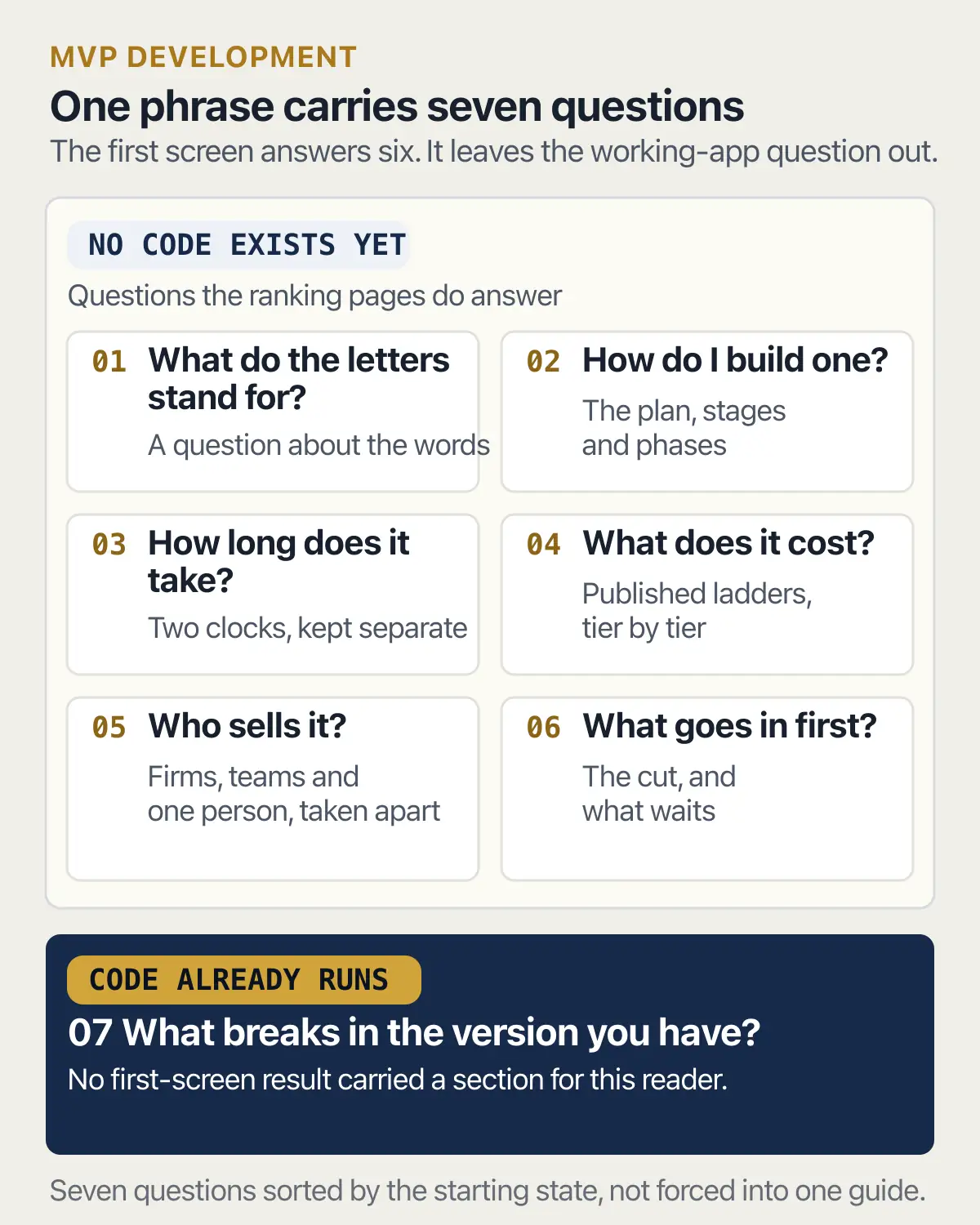
Somebody typing mvp development is usually holding one of seven questions, and the phrase does not say which. On 1 September 2026 the first screen of results for it carried a definition, a nine-step build sequence, a lean-startup explainer and a services page, sitting beside each other as though they answered the same thing. Each answers a different one.
MVP development covers seven separate questions, and which one you are holding depends on whether any code exists yet. If a builder already produced something that opens in a browser, most of what the ranking pages describe has happened to you, and your real question is the one none of them has a section for.
So this page sorts the seven and hands each one to the page that answers it. It does not define the term, does not set out the build in order, does not price anything, and does not put a length on anything. Those are four separate jobs and none of them is this one.
MVP development used to name a project somebody commissioned
For most of the time the phrase has been in use, MVP development named a project. Somebody had an idea. Somebody else was paid to build the smallest working version of it. The months in between were the development. That is still the sequence every guide on the first screen describes, and for plenty of people typing the phrase it is still the right sequence.
It stopped being the only one somewhere around the point where a paragraph typed into a tool started coming back as a running application. The order inverted. Code arrives first now, often before anybody has settled what the product is, and the work the old sequence put in front of the build either happens afterwards or does not happen. That single inversion is why one phrase has to carry seven questions instead of one.
You can watch the inversion happen in what people ask next. The old order produced questions about getting something built: who to hire, how long, how much. The new order produces questions about what you already have: whether it counts as an MVP at all, whether it is safe to show anybody, what is missing from it, and whether the thing you paid credits for is worth finishing or worth starting again. Both sets of questions arrive under the same three letters.
The word itself is a separate matter, and this page does not settle it. What the three letters actually stand for, and the two other things people mean by them, is a question about the words rather than about the work.
There is also a reading with no code in it at all. MVP in product development, or product development MVP depending on who is typing, belongs to product management rather than to engineering, and the argument inside it is about what the word ought to cover and which decisions it licenses. That argument gets settled with words, not with a build, and it is settled on the page that handles the term itself. When somebody says MVP in development terms they are almost always in that conversation rather than in this one.
The practical effect of the inversion is that the word “development” in the phrase is doing less work than it used to. It once meant the expensive middle of a project. For a growing share of the people typing it, the expensive middle is already behind them, and what they are calling MVP development is everything on either side of it: deciding what the thing is, and getting it fit for strangers.
The seven questions inside one phrase
Seven distinct questions arrive under this phrase. The table sets out what each one is, what the pages currently ranking for the phrase hand back when you ask it, and where the question genuinely gets answered. The third column names a subject rather than a link, because the point is the sorting, not the traffic.
| What people mean when they type it | What the ranking pages hand back | Where that question gets answered |
|---|---|---|
| What the three letters stand for | A definition, sometimes with a second acronym beside it | A question about the words |
| How you build one, step by step | A numbered sequence starting at an idea | The plan, stages and phases included |
| How long it takes | Lengths measured from an empty folder | Two clocks, measured separately |
| What it costs | A tier ladder, or a form that emails you | Published ladders, read tier by tier |
| Who sells it, and what each is selling | The seller’s own case for itself | Firms, teams and one person, taken apart |
| What goes in the first version | Feature lists written before code exists | The cut, and what waits |
| What breaks in the version you have | Nothing on the first screen | The rest of this page |
Two of those rows are worth naming precisely, because they are the ones most often collapsed into each other.
The second row is the plan. The plan itself, step by step and in the order the steps have to happen, is written out somewhere else, and it is the same place the stage and phase vocabulary is answered. Anybody searching for the stage an MVP gets created in, or for the phases of MVP development, is asking for that page and not for this one. There is no numbered sequence anywhere below.
The sixth row is the cut. Which parts of the product the first version has to carry, and which ones can wait, is decided on its own, and the decision changes shape entirely when a tool has already built most of them for you. Deciding what to leave out is a very different exercise from deciding what to take back out.
There is a second and independent way to see the same split, and checking it took one run. Google’s own completions for the phrase were pulled on 1 September 2026 across twelve seeds, returning 77 distinct suggestions. Nine of them attach to the bare phrase, and seven of those nine are somebody else’s question: services, meaning, company, full form, for startups, agency and process. The two left over are a search for an icon and a request for the meaning in another language, so not one of the nine is a question this page itself answers. The demand sitting around the head is therefore demand for the pages the head points at rather than for the head, which is an argument for sorting rather than for a longer guide.
Further out, the same pull returns completions that are not about software at all, including one from a sport. Three letters, several unrelated meanings, and a search box that treats them as one word.
The seventh row is the one this page is here for, and the reason it exists is in the next section.
What the pages ranking for this phrase take for granted
The sorting below comes from reading, on 1 September 2026, every page Google returned on the first screen for this phrase and for two of its common rewordings, and writing down which of the questions inside the phrase each one actually answers; six of those pages could be read in full from their own HTML, and one served a regional block to an automated read.
The addresses, recorded here and deliberately not linked, because every one of them is either a seller of the work this site also does or a page that answers the definition question this page hands over: scnsoft.com/software-development/mvp, en.wikipedia.org/wiki/Minimum_viable_product, atlassian.com/agile/product-management/minimum-viable-product, notionmind.com/blog/mvp-software-development-guide, weweb.io/blog/mvp-development-complete-guide-from-idea-to-launch, boldare.com/blog/mvp-what-why-how/ and sdsol.com/mvp-development-services/.
ScienceSoft, a software development firm that sells MVP development, holds the top organic slot with a guide running from what it calls the essence of the thing through a nine-step build sequence, sourcing models, its own team roles, case studies and a cost block at the end. Its own page data gives a publication date of 23 December 2020 and a last-modified stamp of 29 August 2026, three days before it was read. Step one is discovery and planning.
WeWeb, a no-code application platform, ranks with a guide carrying a visible “Updated on June 3, 2026” and nine sections running from the MVP philosophy through funding and cost. It is written for a founder who has not built anything, and its argument is that no-code removes the need for a development team.
Boldare, a product design and development company that sells outsourced product work, ranks with an eleven-section article answering what an MVP is and how to define one, ending on a case study. Its page data gives a publication date of 5 April 2023 and carries no modified date at all.
SDSol Technologies, a software development firm, ranks with a services page: fifteen sections, all of them seller-side, covering why to choose them, their process, their models, their industries, their technologies and their post-launch support. Its page metadata carries a last-modified stamp of 18 May 2021 and no publication date. It publishes no figure and names no length.
Atlassian, whose glossary entry sits sixth, defines the term, gives four common steps beginning with identifying customer pain points, works through three well-known products that started small, adds a section on the two labels that come after MVP, and closes on its own product. Its page data gives a publication date of 13 March 2026. The first extraction attempt on it returned navigation and no article, which is worth saying out loud, since that is the kind of read that gets written down as a refusal: the article body is in the page’s own HTML, and reading the raw bytes returned all of it.
Wikipedia’s entry sits fifth and is what it sounds like.
As of 1 September 2026, notionmind.com/blog/mvp-software-development-guide serves a regional access restriction to an automated read. The raw HTML was read first and runs 195 bytes: an HTTP 200 carrying the title “Access unavailable” and one sentence saying the website is not available in this region. That is a block rather than an absence, and nothing about the page’s contents is claimed here beyond the title and description the search returned.
Two further seller guides on the neighbouring phrasing were read the same day and land in the same place. Boldare’s second piece, boldare.com/blog/mvp-stage-in-startup/, published 8 December 2021 by its own page data, runs a five-step sequence beginning at market research. Unosquare’s unosquare.com/blog/what-is-the-mvp-process-in-software-development/ carries a visible byline dated 10 August 2021 and a modified stamp of 26 November 2025, and its three best practices begin at market research too.
Here is the finding, and it is the reason this page was written. Across seven pages on six domains, read on one day, not a single one carries a section for a reader who already owns a working application that a tool generated. Every one begins at an idea. Updated three days before the read, ScienceSoft’s guide still begins at an idea. The one updated in November 2025 begins at an idea. The phrase “MVP development” is being answered, on the whole first screen, as though the reader has nothing yet.
Two more things the same day’s pulls turned up, both of them about who is asking rather than who is answering. Ask the same question as mvp product development and the results change character completely: nine of the ten organic results are definition and glossary pages, which is a different search wearing similar words. Ask it as developing mvp and a community thread lands on page one alongside the sellers, which is what happens when the published answers are not answering.
What actually breaks in the version a builder produced
A person describing what their tool actually left them, in a builder community:
it is two single-file monoliths, one python backend that uses psycopg2 and fastapi, one frontend html with a massive script element at the very bottom. there is no ci/cd. no workflows. barely any unit tests.
None of that is a missing feature. The product works. What the description is short of sits underneath the product: a way to change the code without breaking it, a way to know when it broke, a way to ship a fix. Those are the things the old sequence bought quietly as part of the build, and they are the things the new order does not produce on its own, because nobody prompted for them.
That is the seventh question, and it is one route into the phrase that none of the seven pages serves, even though the completions pulled for it name no such head suggestion. Somebody types “MVP development” because they have an MVP and the development part is the bit they cannot see.
The pattern is not one person’s bad luck. AxonBuild’s fixed study of 26 real applications audited in June and July 2026, 21 of them built by people outside the company, was set up to find out what these builds have in common, and how each of the 26 audited applications scored, with every denominator sits on the page that holds the method, rather than being summarised here. The shorter version of the same ground, written without numbers, is what tends to be missing from a generated build.
Four questions come out of that gap, and they are four different purchases.
Paying somebody to close the gap on a first version that nearly works is one of those purchases, and its price turns entirely on which line you name as finished. Nobody can quote it from a description of the app.
Four sellers answer to this phrase
Type the phrase with a commercial word attached and you reach a market. Type it without one and you reach the same market’s content. Four shapes of seller stand behind it, and they sell four different things.
A firm sells a package. What a firm actually puts inside one purchase when it sells this, item by item, is read off what those firms publish, and it is worth reading before you assume a package starts where your application does.
One person sells their time. What one person hired under that job title actually spends the week doing is described where the role is the subject, and it turns out to be two fairly different jobs sharing one title.
A group sells capacity. How many people a nearly finished first version actually needs is counted elsewhere, role by role, and the counting is the useful part rather than the total.
And a company sells itself as a company, with a ranked-list place and a criteria page to match. Grading a firm against criteria drawn up for a build nobody has begun, when yours already runs, is a problem that has been worked through elsewhere, and what comes out of it is a shorter list of questions rather than a longer one.
There is a fifth thing sitting under all four, which is the decision about whether the no-code version you have should be replaced by code at all. The point where a first version built without code stops coping with what is being asked of it is a decision of its own, and it usually arrives as a specific limit rather than as a general feeling.
Now the part people came for, and the part this page will not give them.
This page names no figure for buying MVP development, and that is deliberate rather than coy. What the published ladders charge for it, tier by tier, is read there rather than summarised here, under the tier names the publishers themselves use, because a ladder summarised second-hand loses the only thing that makes it useful, which is which publisher said what. The same applies to the clock. How long each of the two clocks runs is measured on its own page, from what publishers state rather than from anything asserted here.
What is worth saying here, because it belongs to the sorting rather than to the pricing, is that every published ladder and every published length is measuring a build where nothing exists on the first day. If yours does not, you are reading a number for a different job, and the gap between the two is not a discount.
Which of the seven questions is yours
Three states, and they route differently.
If no code exists yet, you are in the old sequence and it still works. How the building itself goes when a tool is doing it, before any of this applies, is the earlier question, and it is the one worth answering first, because the answer changes what you buy later. Which parts of the product the first version has to carry is the decision that goes with it.
If something runs and you cannot tell what it counts as, the label is the blocker rather than the work. Whether what you are holding has earned a different label from the one you gave it is settled by a separate comparison, and it matters less than people think. What matters more is whether the thing is fit to put in front of strangers at all, and whether it is ready for people you do not know is a verdict you can reach from evidence rather than from opinion.
If people are already using it, the product may still be an experiment, but the obligations that come with users have started, and carrying on as if launch were still ahead will cost you. The questions that apply once somebody depends on the thing are about keeping it working as well as about what you are still learning.
The third state is the one people misread most often, so it is worth being blunt about the tell. If the thing has been called an MVP for a year, and people would notice if it went down for a morning, the label has become a way of postponing decisions rather than a description. Provisional choices about data, access and who is on call are cheap to make and expensive to undo, and they get made under that label without anybody deciding to make them.
Two side doors, because a lot of readers arrive through them. If the thing lives in a browser today and the next step is getting it onto a phone, turning a browser app into something people install is a decision with four real routes and very different prices behind them. And if what you have is a browser app that is staying a browser app, the store half of every guide simply does not apply to you.
There is one more question that hides inside all three states and gets skipped in every one of them. Finding out whether anybody outside actually wants the thing is separate work, with a method that belongs to it alone, and it is the only question on this page that a working application cannot answer for you.
Where AxonBuild sits in all of this
Seven questions, and this site answers a corner of one of them.
That keeps it off every list on this page. It does not define the term, does not sell the plan, does not sell a from-scratch build, publishes no ladder and runs no clock.
Nothing it does is sold as a package, by the month, or as a group of people put on your product.
That is the wrong door for most of the seven questions above. If you are holding an idea, one of the firms named further up is what you should be buying. If you are holding something that already works and a list of things that are broken or missing in it, spend the twenty minutes before writing to anybody selling a build.
One thing this page has not resolved, and cannot: none of the seven questions tells you whether the product is worth continuing. That answer does not live on a search results page in any form, and every page named here quietly assumes somebody else has already made the call.
Common questions about MVP development
Is MVP development the same thing as building an app?
Not quite, and the difference is the word minimum. Building an app has no end state built into the phrase, while an MVP is defined by what has been left out of it on purpose. In 2026 the practical difference has narrowed, because a tool will produce a working app whether or not anybody decided what the smallest useful version was, which means a lot of people now own an app and an unanswered MVP question at the same time.
What is the difference between MVP development and product development?
Product development is the whole life of a product, from the first idea through every version that follows. MVP development is one slice near the front of it: getting to the first thing real users can touch. The phrase MVP in product development usually signals that somebody is speaking product-management rather than engineering, and the two vocabularies disagree about where the slice ends.
Does using an AI builder count as MVP development?
Yes, for the part it covers. A builder produces the working version, which is what MVP development has always been about producing. It does not produce the deciding that comes before or the fitness for strangers that comes after, and those are the parts people are usually surprised to find they still own.
Who does MVP development now that a builder can produce the first version?
Increasingly the founder does the build and buys everything around it. The firms still selling full MVP builds are selling to people with no code and no intention of writing any, which remains a real market. The newer market is smaller pieces of work bought by people who already have something running and cannot get it the rest of the way.
Why does this page not print an MVP development cost?
Because the price question belongs to another page, and a second-hand summary of published ladders is worse than the ladders themselves. Prices for this work are published by the seller, tier by tier, under names those sellers choose, and the names matter as much as the numbers.
The page that reads those ladders, publisher by publisher, is the one to go to for a figure.
Where do the MVP stages and phases fit?
They belong to the plan rather than to the overview, so there is no stage list on this page. Anybody searching for the stage at which a minimum viable product gets created, or for the phases of MVP development, wants a page that walks the sequence in order.
That page exists and it starts where the sequence starts, which for a growing number of readers is later than step one.
Does MVP development include testing whether anybody wants it?
In the original meaning, that was the entire point: the version existed to produce the answer. In current usage the two have drifted apart, and plenty of people finish an MVP without ever running the test it was supposed to make possible.
Testing whether strangers actually want it is separate work with a method behind it, and it is worth booking on its own rather than assuming the build covered it.
Is MVP development still the right phrase once the app has users?
No, and keeping the phrase after that point is expensive. Once real people depend on the thing, decisions get made on the basis that it is still provisional, and provisional decisions about data, access and uptime cost more to undo than they did to make. The word to watch for is “still”, as in still an MVP, a year in.
Is “MVP dev” the same as MVP development?
Yes, it is a shortening and nothing more. MVP dev, mvp in development and development of mvp all reach the same seven questions, and the phrasing tells you nothing about which of the seven the person typing it is holding.
If you have a working app built with these tools and need it ready for real customers, this is what we do.
Built it with AI. Now it has to hold up for real customers.
The Production Hardening Sprint takes the app you already have and builds the production foundation underneath it. Authentication and access rules, payments that stay consistent, error handling, monitoring, backups, automated tests and a documented handover. Our engineers work inside your existing codebase for ten working days. All 123 deliverables are included, and you get the evidence for each one.
See the Production Hardening Sprint →  $2,500 fixed price · 10 working days · One codebase