An MVP website is the smallest version of something that lives at a web address, put in front of a stranger who has no instructions and no reason to be patient. That is the subject here: first versions of products people reach in a browser. Not the health insurer whose member site people search for with the same three letters, not a sports award or an airline tier, and not the screen-layout pattern that happens to share the initials.
The trouble is that the phrase covers two different products and hardly anybody says which of the two they have. One is a short site that explains a thing and asks you to do something about it. The other is a working web application that people sign into and use. Both get called an MVP website, both get the same advice, and the advice only fits one of them.
So this page separates the two, gives you a way to tell which one you are actually holding, and then answers the version that the guides on this search skip: the browser product that already runs, built by somebody who says outright they cannot code. It does not price anything, it does not put a duration on anything, and it hands the publishing steps, the search-engine question and the money to the pages that own them.
An MVP website is the smallest browser version a stranger can use and judge without help. The phrase covers two products: a short marketing site that sells an idea, and a working web application. They need different first versions and different checks, and the search does not tell them apart.
The four guides ranking across the phrasings behind this page were all read on 1 September 2026, against each page’s raw HTML as well as its rendered text, and what this page says about first versions rests on AxonBuild’s fixed review of 26 real applications across June and July 2026; no site was built or published for this article.
What MVP web development actually means for a browser product
The three letters stand for minimum viable product, and in web development the term keeps that meaning with one qualifier attached: the thing being kept small answers on a URL. That qualifier is the whole of the difference, and it is why MVP in web development is worth stating separately rather than borrowing the general definition wholesale.
Take the two halves of the phrase on the axis that matters here. “Minimum” is a decision you make: you leave things out deliberately, and you can put them back in the next release without asking anybody. “Viable” is a test somebody else runs on you, and on the web the somebody else is a person holding nothing but a link. No instructions, no walkthrough, no patience, and a back button one thumb away. A version that only holds up while its owner narrates it has not met that test, whatever it says in the page title.
That is a narrower claim than it looks. It rules out a surprising amount. A web development MVP has to survive a stranger arriving cold, finding the one thing the site is for, and either doing it or leaving. It does not have to be complete, attractive, fast, or finished in any sense a developer would recognise. Those are separate arguments, and confusing them with viability is how first versions grow.
Two boundaries, so this page does not quietly become another page. The plain meaning of the term, with no web qualifier and no second acronym standing next to it, is a definition question and belongs where definitions are answered properly; everything below stays inside the web-qualified version of it. And whether a product should be reached through a browser at all is a decision of its own, so whether the thing should stay in a browser is argued on the page written for that comparison rather than assumed here. If the answer turns out to be phones as well, what the routes out of the browser and onto phones cost you is set out route by route in one place.
The two different things called an MVP website
Read the pages ranking across those phrasings side by side and they split cleanly in half, with neither half acknowledging the other exists.
The first half is about a site that sells something. The lilbigthings post on the subject, at lilbigthings.com/post/what-is-an-mvp-website, read on 1 September 2026, defines an MVP website as “a stripped-down version of your full site” carrying “clear positioning, proof points, and conversion paths”, and its own section headings run from “Why Startups Build MVP Websites” to a section on knowing when you are ready to upgrade. Sagapixel’s post, at sagapixel.com/web-design/what-is-mvp-website/, read the same day, puts the same idea in a heading calling an MVP website an ongoing experiment, and traces it back to lean startup thinking with split testing attached. Webflow’s post, at webflow.com/blog/mvp-website, read the same day and carrying 24 October 2025 as its last update in its own page data, opens on the lean methodology and lists what it calls the basic features of an MVP website. None of the three addresses are links, because all three firms sell the work their posts describe.
The second half is about software. Netguru’s guide, at netguru.com/blog/mvp-web-development, read on 1 September 2026 and stating 25 March 2026 as its own update date, opens: “An MVP (Minimum Viable Product) in web development is the simplest version of a website or web app, focusing on core features that address user needs.” Its headings then run through categorising features, proof of concept, success criteria and common pitfalls. That is a product-build guide. Named, not linked, on the same reasoning as the other three.
So MVP website development means two things at once, and which answer you get depends on which phrasing you happened to type. This is the part worth holding on to:
| If you mean | What it actually is | What it can prove |
|---|---|---|
| A site that explains the product | A short marketing site: positioning, proof, one clear action | Whether the pitch lands, and whether strangers ask for the thing |
| A first version of the product | A working web application people sign into and use | Whether the thing is useful once somebody actually has it |
| Both at once | Two builds sharing one address | Very little, until you decide which question comes first |
MVP website design and MVP web design almost always mean the top row. Somebody wants a credible front for an idea, quickly, without committing to a full site. That is a genuine job with a genuine answer, and none of the four checks further down apply to it, because nobody signs in and nothing is stored.
There is one more thing all four guides have in common, and it is the reason this page exists. Netguru’s page was read against its raw HTML on 1 September 2026: it contains no mention of Lovable, Base44, Bolt, Replit or v0, none of rolling a release back, none of indexing or search engines, and none of error tracking, and every occurrence of the word deploy on it belongs either to a navigation link to one of its own service pages or to the page’s own configuration data, never to body text. Webflow’s post, read the same way on the same day, contains none of those builder names, nothing about undoing a release, and no occurrence of deploy at all. The lilbigthings and sagapixel posts carry none of the builder names either. Those are dated documented absences on four specific pages, not a claim about the whole subject, and what they add up to is simple: every one of these guides is written for a reader who has not built anything yet.
The landing page MVP, and what the test can still tell you
The oldest trick in this territory is the landing page MVP: instead of building the product, build one page that describes it, put a sign-up box on it, send people there, and count. If nobody signs up, you learned something cheaply. If people do, you have a list of names to build for.
The test is real and it still works. What has changed is the arithmetic underneath it, and almost nobody on this search has updated the argument.
A landing page MVP was worth running because the page was far smaller than the product it stood in for. That gap is what paid for the detour. In 2026 a founder who can write a prompt can often have the working version, or something close enough to show, without going through the stand-in at all. When the stand-in stops being much smaller than the thing itself, the reason for building it stops being economic and has to be something else.
There are two situations where it is still clearly the right move, and both are worth naming honestly rather than dismissing the whole idea.
The first is when the product is genuinely large. Some things cannot be produced by a builder in any form at all: anything that needs a partner to agree, a licence, a physical operation, a device, or a data set you do not have. When the real build is out of reach, a page describing it is the only version you can put in front of anybody, which makes it a genuine stand-in rather than a detour around one.
The second is when the question you need answered is about demand rather than about the build. A working product tells you whether people can use the thing. It does not tell you whether they wanted it, and it does not tell you what they would call it. A page with one headline and one action answers those two better than a working product does, because there is nothing else on it to blame.
What a landing page MVP cannot tell you is the part people forget. Sign-ups measure interest in a description. They do not measure whether the description was accurate, whether the thing can be built the way you imagined, or whether anybody would come back a second time. Treat the result as the answer to one narrow question, not as permission, and the test keeps its value.
An MVP landing page and an MVP site are also not competing choices in 2026. Plenty of people now have both, because neither one is the undertaking it used to be. If that is you, the useful question is which of the two you are currently asking strangers to judge you on, rather than which one to build.
What can a first web version leave out, and what can it not?
Features are the cheap thing to leave out, because the next release goes out as fast as you can make it. What a first web version cannot leave out is the machinery underneath: an address you own, a path a stranger completes alone, a way back to the previous version, and error reporting.
Everything a web MVP owes falls into four checks. They are checks rather than features because you run each one against the site as it stands today, and each one exists only because the product lives in a browser and nowhere else.
| The check | How you run it | What it usually turns up |
|---|---|---|
| Who can reach it | Open the address on a device with no session and no saved password | A preview link that only works while you are signed in, or an address that belongs to a builder rather than to you |
| Whether a stranger gets through | Make a new account from nothing and go the whole way to the end of the main path | A step that only works for the account you have been using since the start |
| Whether the last change can be undone | Find the previous version and confirm you know how to put it back | No previous version to go back to, and no record of what changed |
| Whether anything reports back | Cause a failure deliberately and see whether you hear about it | Silence, and the discovery that every error so far reached you because you were the one who hit it |
Read the last column and the rule states itself. The first two checks are about whether the product is reachable and usable at all. The last two are about whether you can find out that it broke and do something about it. A first version can be missing half its feature list and still be a fair test of the idea. A first version that fails checks three and four is not a first version of anything, because there is no dependable second one behind it.
That is the honest answer to what an MVP website should include: four properties rather than a list of pages, and the feature list underneath them can be as short as you like.
One consequence is worth stating plainly, because it runs against the usual advice. On the web, cutting features is nearly free and cutting the reporting is nearly fatal, and those two facts point in opposite directions from the standard MVP instruction to strip everything back to the core. What sits at the core of a web MVP is the small amount of machinery that buys you a second attempt, and the feature that makes the thing interesting sits above that rather than under it.
Where a builder’s preview stops being your website
If the same first version has to arrive through a store and be installed on somebody’s phone, a second set of requirements applies that never touches a browser. That comparison is worth holding for a moment, because the absence of those requirements is the web’s real hazard.
A phone release has a queue at the end of it. Somebody who does not work for you looks at the thing, and either it goes through or it comes back with a note. That queue is irritating, and it is also a forcing function: you cannot pretend to have shipped while it is still sitting there.
A browser product has nothing of the kind. There is no reviewer, no approval, no gate, and no moment where anybody external says this is finished or this is not. The consequence shows up constantly: a web first version can sit almost done indefinitely and still look completely live to the person who built it, because the preview link opens, the pages render, and nothing anywhere announces what is missing.
That is why the three routes below are separate pages rather than paragraphs here. Each of them is a state the site can be in that looks identical from the owner’s side.
The first is the difference between a preview and a site of your own. A builder’s preview address is a place your work happens to be visible, not a website you own, and the steps between the two are specific. What the Publish button actually does, and what your own address needs walks that sequence properly.
The second is being read rather than merely being live. A site that is live and a site a search engine has actually read are two different states, and the distance between them has an order to work through.
The third is being able to go backwards. Nothing about a browser product stops you shipping a change that makes things worse, and the only thing that makes that survivable is knowing in advance how to reverse it, which is why putting the previous version back is worth practising before you need it rather than during.
The first version that already runs, and what it still owes
Here is the reader this page was written for, in their own words, posted anonymously in a community for people building with these tools, and quoted here without a link:
… i literally have zero coding knowledge and just vibecoded the entire site using claude code
No store, no phone, no review queue. A working site at a public address, made by somebody who says outright they cannot code, and it evidently works well enough to be worth talking about. That position is now ordinary, and none of the guides ranking for this search has anything to say to it.
What such a site usually still owes is not visible from the front. AxonBuild’s fixed review covered 26 real applications across June and July 2026, and of the 21 in it that came from other people’s hands, one took the price of an order from the customer’s own browser and charged whatever it was handed. Nobody looking at it could have told: the pages rendered correctly, every run the owner made went through, and the trouble surfaced only when a value was edited on somebody else’s machine on the way back. Each finding in that review names the file and the exact line it was found on, and the review set and the method behind these numbers sets out the cohorts and how the reviews were run.
The shape of that is more useful than the specific fault. A browser product is half a program running on a machine you control and half a program running on a machine the user controls, and the second half can be edited by whoever is holding it. Anything the site decides in the browser and then trusts on the way back is a decision the user gets to make for you. The same trust boundary exists for a native or API client too, but a browser makes the request visible and editable to anyone with the developer tools open, which is why it bites web products first and why the general MVP guides do not mention it.
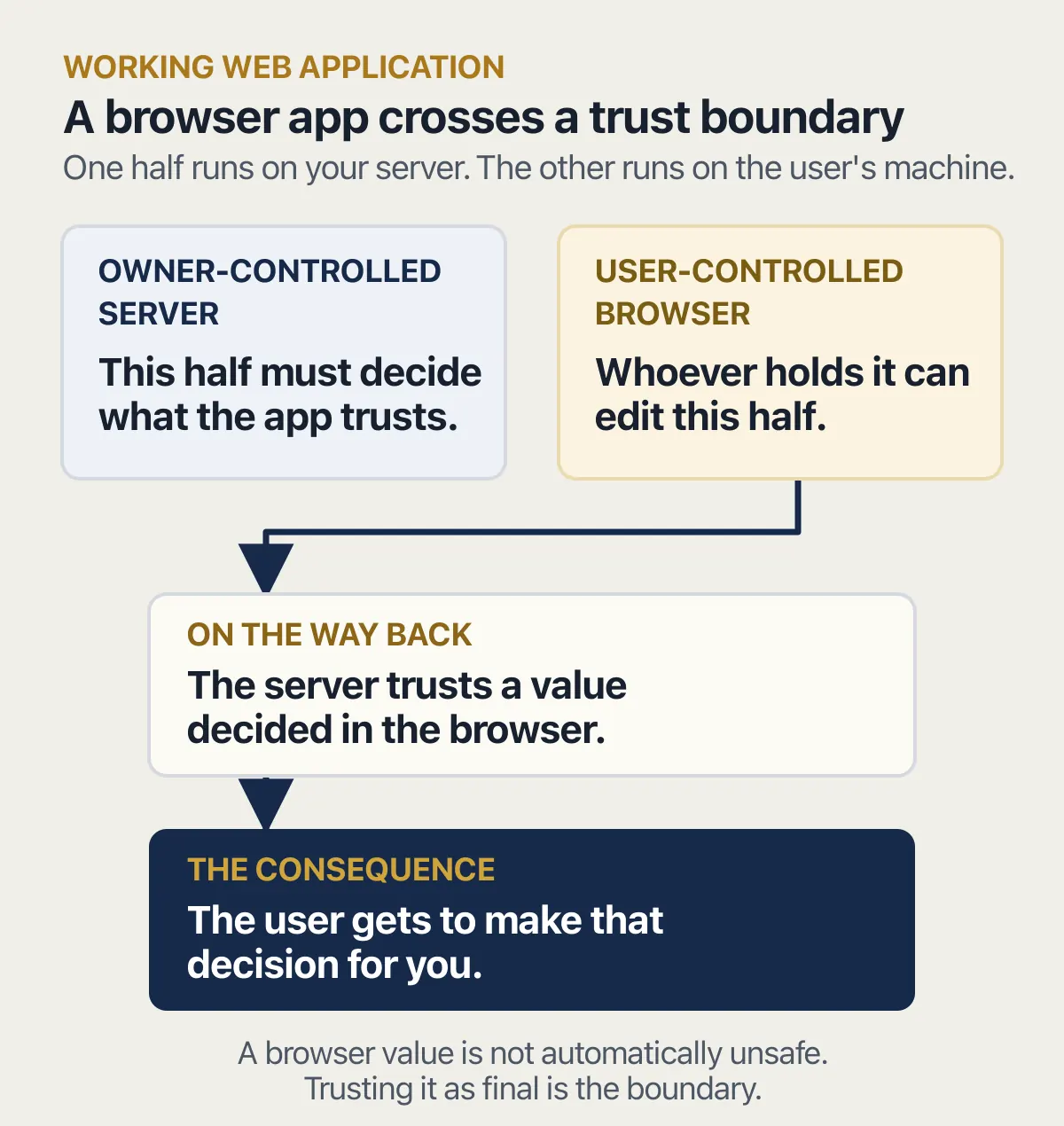
Neither of the two things worth doing before strangers arrive is a feature.
Sign up as a stranger. Open a private window, create an account that has never existed before, and go from the front page to the end of whatever the site is for without touching your usual login, your saved passwords or your own data. Almost every first version has one step that has only ever run for the account it was built with.
Then make something fail on purpose. Send a bad value, kill the connection halfway, ask for a record that does not exist, and watch what the site does about it. It will fail, which is the point of doing it. What matters is whether anything told you that it had.
Beyond those two, readiness is a longer conversation with a list attached, and it lives in one place instead of being restated here: what to check before strangers arrive covers the rest of it.
What is left to buy once the website already runs?
What is left to buy is a finish, not a build. The sellers ranking on this search price the job of producing a web product from nothing, and most readers of this page have already done that part themselves. The narrower question is what is missing.
Narrower, and harder to buy. What is missing sits between the site that runs and a site strangers can be sent to, and nobody can name it from a description. That gap matters commercially, because it changes what you are asking for. Somebody quoting to build an MVP website is quoting to produce the thing. Somebody quoting to finish one has to read what exists first, because the distance from a running site to a usable one depends entirely on which of the four checks above it already passes. A number offered before anybody has looked at the site is a number about the description you gave, not about the site.
Three decisions usually get folded together at this point, and each of them is answered properly somewhere else.
What any of this costs is answered where the published tiers are set out side by side, and no figure from them appears on this page. What a browser product costs to build from nothing, seller by seller, is a different question from what a running one costs to finish.
And if the thing you are short of is a person rather than a finished job, the title on the advert matters less than it looks. Whether the person you need is called a web developer or an app developer is a question about words more than skills, and it is settled elsewhere.
Common questions about MVP websites
What is an MVP website?
An MVP website is the smallest version of something at a web address that a stranger can use and form an opinion about without help. In practice the phrase covers two different products: a short marketing site that explains an idea and asks for one action, and a working web application that people sign into. Both are legitimate uses of the term, they answer different questions, and the advice written for one rarely fits the other, so the first useful step is deciding which of the two you are holding.
What does MVP mean in web development?
MVP means minimum viable product. In web development the meaning carries one qualifier: the thing being kept deliberately small is reached through a browser. Minimum is a decision you make about what to leave out, and you can add it back whenever you like, because the next release ships as soon as you make it. Viable is the test somebody else runs, and on the web that somebody arrives holding nothing but a link, with no instructions and no reason to persist if the first screen confuses them.
Is an MVP website the same as a landing page?
No, though the two overlap enough to cause real confusion. A landing page MVP is a description of a product used as a stand-in for the product, and what it measures is interest in the description. An MVP website in the other sense is the product itself, kept small, and what it measures is whether people can actually use the thing. Plenty of people now have one of each, in which case the thing worth working out is which of them strangers are actually being sent to.
What should an MVP website include?
Four properties, rather than a list of pages. An address that is public and belongs to you rather than to a builder. A path a stranger can complete from a fresh account with nobody helping them. A way to put the previous version back when a change makes things worse. And something that tells you when the site fails for somebody who is not you. Underneath those four, the feature list can be as short as you like, because features are the cheap thing to add later and the other four are not.
What is the difference between an MVP website and a prototype?
A prototype is driven by the person who made it, in the configuration where it works, with the awkward parts steered around. An MVP gets used without supervision, by people who had no hand in making it, were told nothing about it, and will not report anything back unless the site does that for them. That is the whole difference, and it is not about how finished either one looks. A polished site that only holds up while its owner narrates it is still a prototype, and a plain one that a stranger can complete alone is not.
Can an AI builder produce an MVP website on its own?
It can produce most of the visible half, and by 2026 that is genuinely routine: pages, navigation, a data model, sign-in, and the main path working end to end. What it does not dependably produce is the part that has no screen. Reporting when something fails for a user you cannot see, a way back to the previous version, and the checks that stop a browser deciding something the server should have decided are all things you have to ask for specifically, and most people do not know to ask.
How do I know my MVP website is ready for real users?
Run the four checks rather than judging by how it looks. Open the site with no session and confirm a stranger can reach it. Create a brand new account and complete the main path without using anything of your own. Confirm you know how to put the previous version back and have done it once. Then cause a failure deliberately and see whether you hear about it. Those four are the operating minimum, and a site that fails the last two is not ready however complete it looks. Passing them says nothing about whether one account can read another’s records, whether the server decides the price, or how other people’s information is kept, and those checks are needed before strangers arrive as well.
Do I need an MVP website before I build the product?
Usually not any more, and this is where the standard advice has aged. The landing page test made sense when the page was far smaller than the product it stood in for, and that gap has narrowed for most software products. It is still the right move when the real build is genuinely out of reach, or when the question you need answered is about demand rather than about whether the thing works. Otherwise you can often ask strangers the same question with something they can actually use.
Why does a search for MVP websites return an insurance company?
Because the three letters are heavily overloaded. MVP is a health insurer whose members search for its site, an award in several sports, an airline status tier, and a screen-layout pattern in software, all sharing the initials with minimum viable product. Search engines see the same three characters and hedge, which is why the results for this phrase are a mix of subjects that share nothing but three characters. The layout pattern in particular gets confused with the product term constantly, and it is explained properly on the page that defines the term itself.
If this checklist left you with more open items than you expected, the sprint below works through all of them in ten working days.
Built it with AI. Now it has to hold up for real customers.
The Production Hardening Sprint takes the app you already have and builds the production foundation underneath it. Authentication and access rules, payments that stay consistent, error handling, monitoring, backups, automated tests and a documented handover. Our engineers work inside your existing codebase for ten working days. All 123 deliverables are included, and you get the evidence for each one.
See the Production Hardening Sprint →  $2,500 fixed price · 10 working days · One codebase