Hiring a web developer for a site that is already live turns on access more than on job titles. The person you pay has to reach eight things: the domain, the hosting, the deploy path, the database, the login system, payments, email and the keys. Which of those you can hand over decides most of the rest.
The site is up. People reach it at an address you own, it takes their details, and it has been doing that for months. What you need now is somebody to change part of it without the rest falling over, and you are not the person who can do that.
Two phrasings carry almost all of this search. Hire web developer is the one people type when they have decided to pay somebody. Website developers is a much larger search that returns a completely different page, full of local businesses and career explainers. Both land you in the same place: lists of people, sorted by rating, with nothing about the situation you are actually in.
This page was written on 29 August 2026 by pulling the Google results for hire web developer, website developers and hire web app developer, opening the four ranking pages that allowed an automated read, recording what the two that refused would not show, and then setting what those pages sell against the data-safety findings in AxonBuild’s fixed study of 26 AI-built applications audited across June and July 2026. Nobody was hired to test it, no candidate was tried out, and no reader’s site was opened.
The starting position is worth saying out loud, because the ranking pages assume the opposite one. Somebody posting anonymously in a founders community described it in two sentences:
I got my product online with an ai website builder about four months ago. No code, live in a day.
Four months of a real thing running, built by somebody who does not write code. That is the person typing this search, and none of the nine results on page one is written for them.
Is what you have a web app?
A web app is software people use in a browser at an address you control, with no download from a store involved. If your customers reach it by typing a name or clicking a link, and nobody has ever installed anything, the answer is yes, and every hiring decision below applies.
That test settles it for most readers in about five seconds, and the two people it does not settle need different pages. The first is the reader who wants the same thing on phones as an icon rather than a bookmark. That is a separate build with its own price, and there are four real ways to get a web app onto phones, only one of which involves writing the whole thing again. The second is the reader wondering whether a proper store app is worth doing at all, which turns on push notifications, offline use and what the store rules force on you. That question has an honest answer about what going native actually buys you.
Whether the thing should also exist in the stores, and what that second version costs you in work, are decided before any of this and are settled elsewhere.
One more edge case is worth naming because the search does not distinguish it. A marketing site that only describes your business is a website, and work on it is cheap, quick and low risk. A site that holds customer accounts, takes money or stores anybody’s data is a web app wearing a website’s clothes, and everything after this point is written about that second thing. The giveaway is whether anything on it requires logging in.
Web developer or app developer, when the thing already answers on a URL
For a product that already runs in a browser, web developer and app developer describe nearly the same skill set. The one place they genuinely part company is store publishing, which involves accounts, signing, review rules and rejection reasons that browser work never touches. If nothing is going into a store, the two words are close to interchangeable.
The question people actually type is whether a web developer can build an app. For a product that lives at a URL, yes: the app is the thing they already work on every day. Anybody who can add a page, wire a form to a database and put a change live on a site is doing app development, whatever their profile says. The moment the answer changes is the moment an App Store or Google Play listing enters the conversation, and at that point you are buying a second thing, not a different flavour of the first.
That distinction is worth holding on to when you read profiles, because sellers use the two words as market positioning rather than as a description of skill. On the marketplaces, app developer usually signals mobile work and a higher advertised band. Web developer usually signals browser work and a lower one. Neither word tells you whether the person has ever opened a site somebody else built, which is the thing you need, and neither word appears in any filter that would surface it.
There is a practical version of this decision. Write down the next three changes you want. If all three happen inside the browser, hire on browser evidence and stop reading job titles. If one of them is an icon on a phone, hire for the browser work now and treat the store version as a separate purchase later, with a separate person if the first one has never been through review. Buying both at once from somebody who has only done one of them is how a two week job becomes a two month one.
Which parts of a running site they are allowed to touch
Eight surfaces make up a live web app, and a hired stranger needs a different level of reach into each. Some of them can be handed over and taken back cleanly. Others change what customers see the moment somebody touches them, and two of them, the database and anything that sends email, have no undo at all.
Nothing on page one of this search covers this, which is the reason for the table. Read it as a list of decisions you make before anybody starts, not as a security exercise. Most of it is about which door you open, in what order, and what happens in the ten minutes after you open it.
| The surface | What somebody needs to work on it | What your customers see while it is touched | Can it be put back |
|---|---|---|---|
| The domain and its DNS records | Login to the registrar, or one record changed for them | Nothing, until a record is wrong, and then the whole site is gone for anyone whose computer has cached the change | Yes, but slowly. Old records linger in caches for hours |
| The builder project or hosting account the site is served from | An invite to the project, ideally as a member rather than an owner | Nothing while they read. A bad publish shows everyone the new version at once | Usually. Most hosts keep previous versions and can put one back |
| The branch or deploy path that pushes changes live | Write access to the code, plus whatever button or push makes it live | Whatever was pushed, immediately, including the half finished parts | Only if the previous version was kept. Many AI-built sites keep none |
| The database that holds real customer rows | A connection string or dashboard login, usually with full rights | Nothing until a row changes, then it is simply true for everyone | No. A deleted row is gone unless a backup exists, and often none does |
| Whatever checks who is logged in | Admin rights in the login service, or the code that talks to it | Nothing, until a change locks people out or lets the wrong person in | Yes for settings, no for sessions. Everyone gets signed out |
| The payment processor | An account invite, at the lowest role that lets them read what failed | Nothing while reading. A live key change can stop payments going through | Yes for keys and settings, no for money that already moved |
| Whatever sends email to customers | Access to the sending service and the templates | Nothing, until a test run goes to a real list | No. A sent email cannot be recalled |
| The environment variables and API keys | The values themselves, or a way to set them without seeing them | Nothing directly. A wrong value takes a feature offline until it is fixed | The value, yes. The secret, no. A seen key is a shared key until you rotate it |
Three rows are worth spelling out, because they are the ones people get wrong in the first hour.
The deploy path is the row that surprises owners most. On a site built with an AI website builder, there is usually no gap between somebody making a change and your customers getting it. There is no staging copy, no review step and no button that says “show this to me first”. The person you hired presses publish and the change is live, half finished parts included. Before you give anybody that access, find out whether your setup can put the previous version back, and how. If the answer is no, the first job you give them should be creating that ability, not the change you actually wanted.
The database is the row with no undo. Almost every AI-built site runs one database, the live one, and it holds the only copy of your customers. A migration that renames a column, a cleanup query that deletes more than it meant to, or a test that runs against the wrong connection string all have the same result, and no version history will save you. Ask for a backup before the first change, then check that the backup can actually be restored rather than trusting that it exists.
Keys are the row people misunderstand. Handing over an API key copies a secret to somebody’s laptop, where it stays after the work ends, in their shell history and possibly in a note. Access you can revoke is an account invite. Access you cannot revoke is a key, unless you rotate it, which most owners never do. Where the choice exists, invite them to the account instead of pasting the key, and where it does not, write the key down as something to change on the day the work finishes.
Page one is a supply list
The search itself tells you something about the market. Checked on 28 August 2026, page one for hire web developer carried nine organic results spread across positions one to eleven, with two slots taken by blocks that are not organic listings. Eight of the nine were places to browse people rather than pages that answer a question.
| Rank | What holds the slot |
|---|---|
| 1 | A community thread in a web development forum asking where to hire a reliable web developer, about a year old, with more than 140 comments |
| 2 | A marketplace category page for web developers |
| 3 | A second marketplace’s technical category for web developers |
| 4 | A third marketplace’s category page |
| 5 | A website builder’s own marketplace of professionals |
| 6 | A vetted marketplace’s web developer page |
| 7 | A second vetted marketplace, with a long hiring guide attached |
| 8 | A creative portfolio directory’s hire section |
| 9 | A freelancer directory’s web developer category |
Not one of them is written for somebody whose site is already serving customers. The response also reported an AI Overview and a People Also Ask block on the same page, neither of which the tool returns, so what those say is not knowable from here.
The largest search in this family, website developers at 12,100 a month, returns something else entirely: a local pack at the top, with refinement chips for online appointments, open now, top rated and small business, plus a local services directory and a careers explainer among the organic results. That is a search by somebody looking for a firm nearby, not by somebody with a running product, which is why nothing on this page is written to it.
On 29 August 2026, four of the ranking pages let an automated read through. Two refused.
Arc’s hiring guide, at arc.dev/hire-developers/web-development, was the most substantial page on the search. Its own title is stamped Aug 2026. It publishes a band for its own freelancers, saying they “typically charge between $60-100+/hour (USD)”, and states “$0 until you hire” as its fee to the buyer. The page also repeats six figures from other organisations, including salary averages and a recruiting cost estimate, none of which are reproduced here because they are second hand.
Nimblechapps, a development shop, publishes actual prices at nimblechapps.com/services/hire-web-app-developer. As read on 29 August 2026, its three collaboration models, which is the label its own page uses, are hourly starting at $23.00 with a 40 hour minimum and work starting within 24 hours, monthly starting at $3200.00 for 160 hours a month with work starting within 72 hours, and quarterly starting at $8400.00 for 480 hours a quarter with work starting within 48 hours. The page carries no publication date; its footer copyright runs from 2014 to 2026. Its service list does include web app maintenance and support, upgrades and performance work, which makes it one of the few sellers on this search that even names the situation you are in. What it does not do is say anything different about a site that already has customers on it.
Toptal, at toptal.com/developers/web, publishes no rate of its own. It offers a trial period of up to two weeks, and where its own page asks how much it costs to hire a web developer, the answer it gives ends “To get started, schedule a call with us”. The phrase “talent matchers” appears separately on the same page, describing who does the pairing. The only figure on its page is a Glassdoor annual pay average dated June 2024, which belongs to Glassdoor and is not repeated here.
The Wix Marketplace page at wix.com/marketplace/hire/web-developer is a listings page: 233 professionals, filterable by service, location, language and budget, each with a published starting price attached to their own listing. Those prices belong to individual sellers rather than to Wix, so none of them appears here. The page instructs the buyer to hire a professional to work on their site and never distinguishes building a new one from changing one that already exists.
Two pages refused an automated read on 29 August 2026 and are named without any claim about what they contain. Upwork’s category page at upwork.com/hire/web-developers/ returned 403, and so nothing from it is quoted, including the band that shows in its search snippet. Mobilunity’s article at mobilunity.com/blog/hire-web-app-developers/ returned 403 as well. The remaining slots belong to pro.fiverr.com, freelancer.com, behance.net and contra.com, with thumbtack.com appearing on the website developers search, and none of them is linked here because every one of them sells what this site sells. The community results sit at reddit.com and are cited by their titles only.
Both sides of this market are visible in public every week. A post title in r/freelancing on 27 August 2026 reads Looking for a professional web developer, which is the demand side saying it plainly. A post title in r/devjobs on 20 August 2026 reads [For Hire] Full stack web developer, which is the supply side doing the same. Neither says anything about a running site, and that is the point: the whole market is organised around matching people, and none of it around the state your product is in.
What a company charges to build a website, and how that number is put together on the seller’s side, is answered from their end rather than from your site’s. Firms that advertise AI app development are organised around new builds, and what a site an AI already built needs next is a different purchase entirely.
What a stranger walks into on a site an AI built
The reason access matters more than the job title is what the code usually looks like underneath. In AxonBuild’s fixed study of 26 AI-built applications audited across June and July 2026, one app in the group had a leftover endpoint sitting in the code where a single web request would drop the entire production database. Nobody put it there maliciously. The study does not record why it survived, and the dull reading is the likely one: a tool wrote it during setup, it worked, and no prompt ever said to delete it. It is described in the study that recorded it and how it was run, and the person who eventually finds it is whoever you hire.
A second app in the same study had every change tested straight against the live database, because no separate copy of it existed anywhere. Every experiment ran on the real customer rows. That app was working the whole time, and its owner had no reason to suspect anything, which is the part worth sitting with: a site can serve customers correctly for a year with nothing between a developer’s first afternoon and the only copy of the business.
Those two are single apps rather than a trend, and the patterns index says as much. The counted line that supports them is about deploy gates: across the 21 third-party applications in that study’s findings ledger, at least 17 had nothing checking a change before it reached production. The denominator is 21 because that is the number of third-party apps in the ledger, and the count is a lower bound because the ledger keeps notable findings rather than every one.
Put those together and the practical consequence is simple. A stranger’s first change on a site like this lands on live customers with no gate in front of it and no copy behind it. That is why a real price follows somebody reading the code rather than reading your description of the site: nobody can tell you what a change costs until they know what sits between them and the thing they are changing, and on an AI-built site the honest answer is often nothing at all. It says nothing about the person you hire, and it is no reason to put the hire off.
The five things somebody needs from you before the work can start
The full list of what to put in front of a stranger before a price means anything is set out on its own, and what follows here is only the part that changes because the site is already serving people.
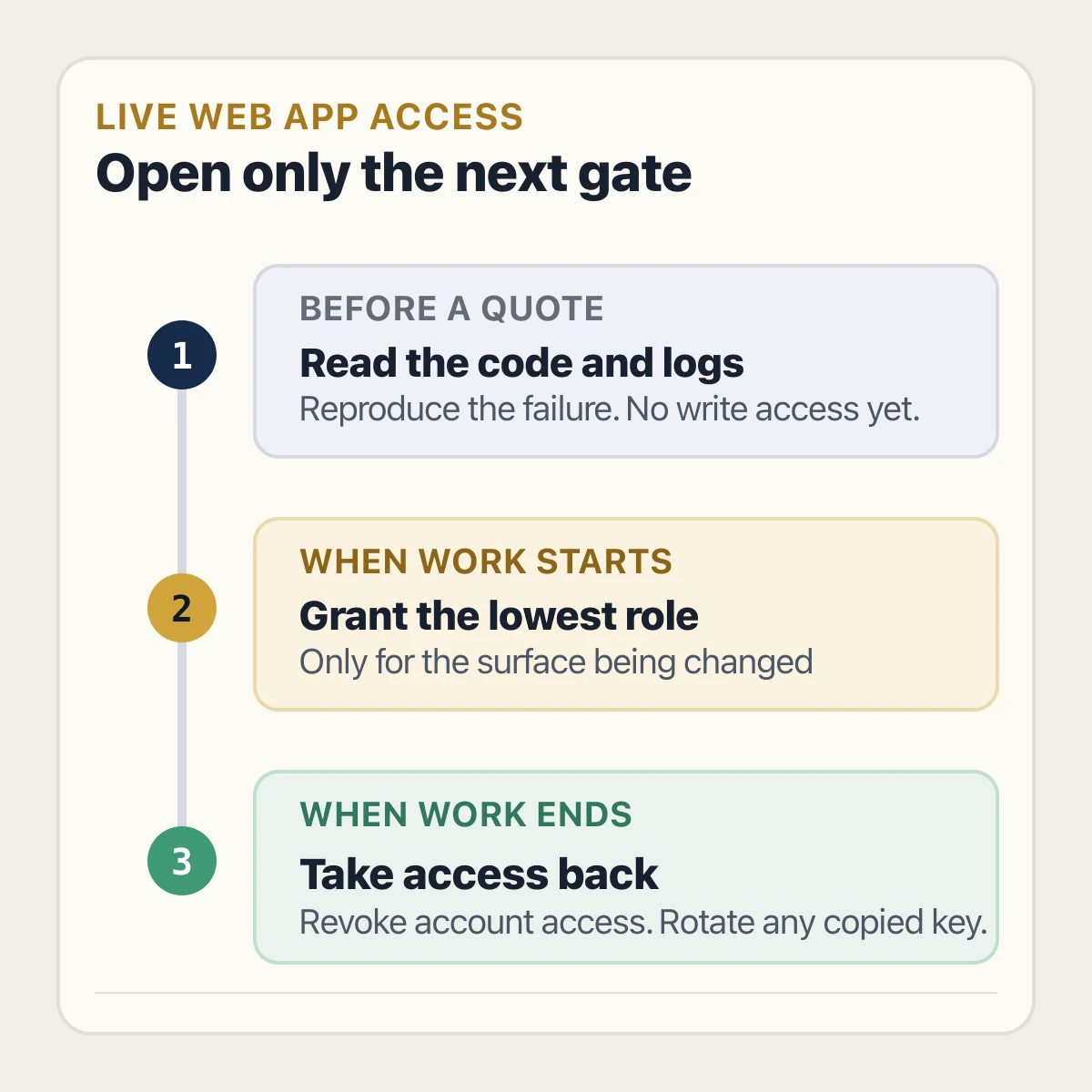
- 01 The address, and a login that is not yours. An owner account usually sees a different version of the site than a customer does, so a hired person looking at your account can miss the failure entirely.
- 02 Read access to the code or the builder project. Reading is a smaller grant than writing and it is enough to price the work. Give writing when the work starts, not when the conversation does.
- 03 A way to see the errors. Whatever your host or builder calls its logs, find out today whether you can open them, because on many AI-built sites nobody ever has.
- 04 Steps that reproduce the problem. What you clicked, what you expected, what happened instead, and whether it happens every time or sometimes.
- 05 One named person who can approve a change going live. On a site with customers on it, somebody has to say yes at a specific moment, and that person needs to be reachable that afternoon.
The fifth one is the one owners skip, and it is the one that turns a two hour job into a two day one. A change that is ready and unapproved sits there, and the person you are paying either waits or pushes it anyway.
Whether the domain, the hosting and the database are actually yours to hand to anybody is settled before the hire rather than in whatever gets signed after it. That is worth checking on a site built inside a website builder, where the address, the code and the data can each sit in a different place under a different account.
If the person is not fixing one thing but inheriting the whole product, the list gets much longer, and what to hand somebody who is taking the whole thing over covers it properly. That page is written for the person inheriting all of it; this one is about a person you are letting near a site that is still serving customers this afternoon.
Start with a job that can be undone
Whoever you hire, the first thing you pay them for should be something you can watch working and reverse if it does not. One named result, on the real site, that you can check yourself without taking anybody’s word for it. That gives you evidence about the person and it limits what a bad first day can cost you, which matters much more on a site with customers than on one nobody has found yet.
That is how AxonBuild works too. The 20-minute video call with Bilal is free, and it is where you show him the site and the one thing you want changed. If you want him to make the change, he checks the code and gives you a fixed quote, and you pay after you see it working on the real site. The next change can follow the first without a retainer.
Paying somebody every month to stay available for a site that is already up is a different arrangement from paying for one named job, and what a month of that actually buys is worked out separately. What belongs in a retainer agreement, and how many hours a month is honest for one site, is its own sitting and is not settled here.
The reversible first job also answers a question you cannot answer any other way. Marketplace profiles, portfolios and ratings all describe work somebody did on a site they built themselves. None of them tells you how a person behaves on somebody else’s code, at eleven at night, when the thing they changed took the checkout down. One small paid job on your actual site tells you that in an afternoon.
Common questions about hiring a web developer
What access does a web developer need to a site that is already live?
Enough to read the code, see the errors and reproduce the problem, which is a much smaller grant than the one most owners give on day one. Read access to the code or builder project, a login to the site that is not the owner account, and access to the logs will let almost anybody quote the work honestly. Write access to the deploy path, the database and the payment keys is granted when work starts, at the lowest role that lets them do the specific job, and taken back when it ends.
What happens to my customers while somebody works on the live site?
For most of the work, nothing at all. Reading code and reading logs are invisible from outside. Reproducing a problem is invisible only when it is done against a copy or test data; a reproduction that sends a real email, charges a real card or writes a real record is visible, so agree that side-effecting paths are exercised in an isolated copy. Customers notice at exactly one moment, which is when something is published, and on a site with no separate copy that moment is instant and total. Agree in advance when publishing happens, whether anybody is watching when it does, and what the plan is if the new version is worse than the old one.
Do I need a full stack web developer, or just a front end one?
If the change touches anything stored, hire a full stack web developer. Front end work covers what people see and click. Anything that saves, loads, charges, emails or checks who somebody is happens on the other side, and on an AI-built site those two halves are usually tangled together in the same files anyway. A front end only hire fits when the job is genuinely cosmetic: layout, wording, colours, a page that displays what is already there.
Can a web developer work on a site an AI website builder made?
Yes, and the ones who have done it before are meaningfully faster at it than the ones who have not. What differs is the shape of what they find: generated code with no tests around it, no separate copy of the database, settings held in a dashboard rather than in files, and parts of the app that only exist inside the builder’s own account. A developer meeting that for the first time spends their first hours orienting. One who has seen it before starts by asking which builder, which is a good sign in a first conversation.
Do I keep the domain and the accounts if I hire somebody?
You keep them if they were in your name to begin with, and that is worth verifying before anybody starts rather than afterwards. The pattern that causes trouble is an account created by a previous helper using their own email, which then holds your domain, your hosting or your database. Invite people into accounts you own instead of letting them create accounts for you, and where somebody already holds one, moving it into your name is a job in itself and should happen before the work does.
How much does it cost to hire a web developer?
It depends far more on what the job is than on who does it, and the honest range for one change on a running site is wide enough to be useless without knowing which change. The figures, from a marketplace’s advertised band to the cost of one repair, live on the page that prices this territory rather than here. If you want the figures, what a developer charges for an app that already runs has them with dates attached.
Is a monthly arrangement better than paying for each job?
Paying per job suits an owner with a list of specific changes and no expectation of emergencies. A monthly arrangement suits a site where something goes wrong often enough that finding somebody each time is itself the cost. The question to ask yourself is how many times in the last three months you needed somebody at short notice. Under two, pay per job. Over four, you are already paying for availability, in your own time rather than in money.
Can the same person put a mobile version in the stores later?
Sometimes, and it is worth asking early rather than assuming. Publishing to the App Store or Google Play brings accounts, signing, review rules and rejection reasons that a browser-only developer has never met, and the skill does not transfer from one to the other. Ask directly whether they have taken an app through review, and how many times it came back. If the answer is never, hire them for the site and treat the store version as a separate purchase with a separate person.
Built it with AI. Can’t get the last part right?
That’s the normal state of an AI-built app, and it’s fixable. I trace what the app actually does, explain what needs changing, and build it if you want me to.
Talk about your app →  Free 20-minute video call with Bilal.