Open one of the pages that rank for this phrase and the same object comes back every time: a catalogue. Twelve numbered service categories on one of them, seven on another, running through chatbots, agents, computer vision, predictive analytics, integration and the modernising of something older. Near the bottom there is usually a contact form asking which band your budget falls into. All of it is written for software that has not been built yet, which is fine unless the reason you went looking is that the software already exists, an AI tool wrote it, and strangers are using it today.
An AI app development company sells a build: AI capabilities added to software that does not exist yet. Of six such pages read on 29 August 2026, two published a price, and the lower starts at $10,000. Finishing an app an AI tool already wrote is a different purchase, and none of the six lists it as a service.
On 29 August 2026 AxonBuild ran the Google results for the three phrasings this page is written for, read six of the seller pages that came back in full, wrote down what each one lists as a service and what each one says about a price, and set that list against the 26 real applications AxonBuild audited in June and July 2026; two more pages are named here with no claim attached to them, one because it refused an automated read and one because it is a third party’s ranked list rather than a seller’s own page.
None of the six is linked from this page. They sell services next to the ones AxonBuild sells, so they are named and their addresses are printed as plain text. None of them shows a reader a publication date either, and only two carry one in their markup: ScienceSoft’s page was last changed on 18 August 2026 and LeewayHertz’s on 15 July 2026. Every fact below is still dated by the day it was read, not by the page.
What is an AI app development company selling you?
An AI app development company sells a build. The six pages read for this article list AI capabilities to be added to software: models, chatbots, agents, computer vision, integrations, and the modernising of older products. Every one of them is written for AI work that has not been done yet, and that includes putting a model into software you already run; none of them is written for the generated code an AI tool left behind.
The catalogues are long and they overlap heavily. LeewayHertz, at leewayhertz.com/ai-app-development-company/, lists custom AI-powered mobile app development, AI consulting and strategy, integration of AI into an existing app, predictive analytics apps, virtual assistants and chatbots, generative AI apps, and a maintenance line. Appinventiv, at appinventiv.com/ai-development-services/, runs twelve numbered service categories, from AI consulting and product engineering through generative AI, agents, assistants, voice agents, robotic process automation and copilots. Damco, at damcogroup.com/ai-application-development, sells custom AI app development, large language model and generative apps, edge AI, integration into an app you already have, and modernisation of older applications. Concetto Labs, at concettolabs.com/ai-app-development, adds computer vision and named commercial models to the same shape.
Three of them in a row show the same pattern. The unit on sale is a capability. You arrive with a business problem, they attach a model to it, and the price and the timeline both depend on how much model there is.
That works when the thing you want does not exist yet. It fits badly when what you have is an application that already serves real people and has eleven ordinary things wrong with it, because none of the eleven is a capability anybody sells. Which shapes of seller take on work an AI tool started, and what each shape is genuinely good at, is mapped in one place.
The word AI is doing two jobs on these pages
Google is not sure what this phrase means, and the results give it away. Of the nine organic results returned for ai app development company on 29 August 2026, three were not companies at all: two listicles of AI web app builders and one product homepage belonging to an AI app builder. All three answered a tool question that nobody running this search had asked.
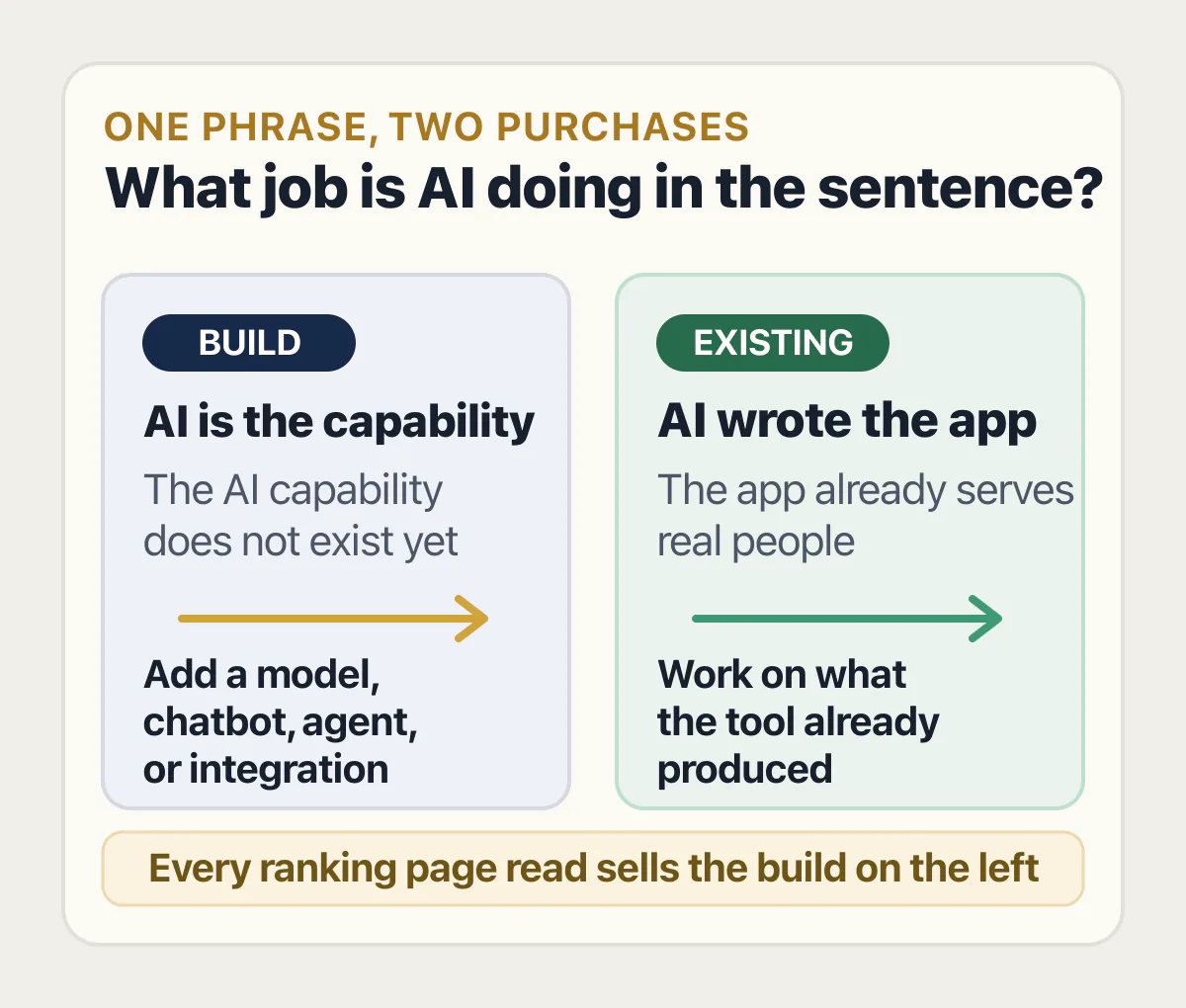
That confusion sits on top of a real one. The phrase carries a build meaning and a repair meaning. Under the build meaning, AI is the thing being added, and the company is whoever adds it, which is the catalogue in the section above. Under the repair meaning, AI is the thing that already wrote the app, and the company is whoever will now work on what it produced. Every page that ranks is selling the first. This page is written for the reader who arrives with the second, and with a live app.
The second phrasing hedges differently. On the same day, six of the nine organic results for ai development agency were about AI agents rather than about apps: agent services pages and seller-published rankings of agent companies. If you searched that phrase looking for somebody to work on your app, most of page one was answering a different question. Wiring an agent or a chatbot into a business that already runs is a different build, with its own questions about accounts and bills, and it is answered separately.
One builder posting in 2026 put the survival rate of the first reading plainly:
I vibe coded 30+ apps in 2 years. 6 are still in production with real users.
Six out of more than thirty, by their own count. That gap is the whole subject of this page. The catalogue sells the making of the thing. What decides whether it is still running in a year is everything after, and nobody on that search sells it as a line item. Hiring one person who can read what a generator wrote is a different purchase from buying a company, and it has its own page.
What did six of these pages publish about price?
Two of the six pages read on 29 August 2026 published a price. ScienceSoft prints ranges for AI software development that start at $10,000 and run past $1,000,000. Appinventiv answers the cost question in its FAQ. The other four publish none, and two of those four ask your budget in a form instead.
| Company and page | What it lists as its service | Price printed on the page, 29 Aug 2026 | What it says about after the launch |
|---|---|---|---|
LeewayHertz, leewayhertz.com/ai-app-development-company/ | Custom AI-powered mobile apps, AI consulting, integration into an existing app, chatbots, generative AI apps | None found anywhere on the page | Its own service line: ongoing support and maintenance covering bug fixing, performance optimisation, security updates and regular feature updates |
Concetto Labs, concettolabs.com/ai-app-development | AI and machine learning development, apps on named commercial models, chatbots, computer vision, agents, plus mobile, web and QA work | None. The only figures are budget bands in its own contact form, from “Below $10K” through “$100K and more” | Advertised as “24*7 support for app maintenance & upgrades” |
Geniusee, geniusee.com/ai-powered-app-development | AI-powered app development, custom language model work, integration, chatbots, retrieval systems, plus general engineering and DevOps | None. The contact form offers three bands, “30k - 100k”, “100k - 200k” and ”> 200k”, plus an N/A option | Monitoring model performance against real usage, retraining when accuracy drops below agreed thresholds, and managing version updates |
Appinventiv, appinventiv.com/ai-development-services/ | Twelve numbered categories: consulting, product engineering, generative AI, agents, assistants, integration, AI security, voice agents, AIOps, AI as a service, process automation, copilots | Yes, in the FAQ: “The cost of developing an AI app can range anywhere between $40,000 to $300,000” | A numbered step of its own, monitoring, support and continuous improvement, described as watching production models for performance drift |
ScienceSoft, scnsoft.com/artificial-intelligence/software-development | End-to-end AI software development, generative AI, chatbots and voice assistants, multi-agent systems, agentic quality assurance | Yes: “AI software development costs can range from $10,000 to $1,000,000+”, with three sample bands underneath it | No line about running somebody else’s finished application. Monitoring appears inside the AI work itself |
Damco, damcogroup.com/ai-application-development | Custom AI app development, generative apps, edge AI, integration and enhancement, modernisation of older apps, predictive analytics | None found anywhere on the page | The most specific of the six: continuous monitoring of deployments, tuning, retraining, and a final phase covering usage tracking, model optimisation, repairs and enhancements |
ScienceSoft’s ranges are worth reading closely, because they are the only published bands on any of the three result sets; Appinventiv’s single range is the other printed price. The page attributes the spread to model type, autonomy level, integrations, data readiness and security requirements, and it prints three sample bands underneath: $10,000 to $100,000 for a chatbot or a lightly autonomous assistant, $50,000 to $150,000 and above for an agent that connects to other systems and acts on its own, and $300,000 to $1,000,000 and above for a system with several AI components in it. Appinventiv’s FAQ answer sits inside that spread. Both were read on 29 August 2026 and neither page shows a date of its own, so treat both as current only to that day.
The budget bands in the other two forms are a different kind of object. A form that asks you to pick a budget band is asking you a question. It is not an offer, it does not commit the seller to anything, and the lowest band on the list is not the same thing as a starting price. Concetto Labs answers the cost question directly on the page and says that the cost depends on the complexity of the application, and that you should tell them your requirements to find out. That is honest, and it is also not a number.
Two more pages on the primary result set are named here and used for nothing. TechAhead’s AI development services page at techaheadcorp.com/services/ai-development/ refused an automated read on 29 August 2026 with an HTTP 403, and nothing about what it sells, charges or promises appears here. Business of Apps’ AI app developers listing at businessofapps.com/app-developers/artificial-intelligence/ is a ranked list of sellers published by a third party rather than a seller’s own page, so nothing inside it is used either. How an agency arrives at the number on a build quote, and what the parts of that number are, is set out on its own page. What building an app with these tools costs before anybody is hired is a separate count.
The aftercare column is the one that repays a slow read. Five of the six list something after launch. Three describe it as care for the AI part: Geniusee watches the model against real usage and retrains it when accuracy falls, Damco tunes and retrains and tracks usage, and Appinventiv watches production models for performance drift. Two describe care for the whole app: LeewayHertz promises bug fixing, performance work, security updates and feature updates on the app it built, and Concetto Labs advertises round-the-clock maintenance and upgrades. Not one of those lines is written for an application somebody else’s generator produced.
The work that starts after the AI build works
Somebody posting about their own app in 2026 wrote the sentence this whole section is about:
Vibe coding is insanely fun until 200 strangers start using what you built. I learned this the hard way.
Two hundred strangers is where the second job begins, and it is not the job the catalogues describe. AxonBuild audited 26 real applications across June and July 2026 in three fixed groups: eleven third-party apps audited in depth, ten more held out and audited blind, and five of the founder’s own. Of the third-party applications in that cohort, the 14 with an AI or model surface at all scored an average of 38.4 out of 100 on the AI risk pillar, the fourth-worst of the twelve pillars measured, and what those 26 audits found is published in full with the method behind it.
Fourth-worst is the interesting part. The AI layer is not the worst thing about an AI-built app. Three ordinary pillars score below it, and the ordinary ones are what a running application trips over first.
Start with tests. Of the 21 third-party applications in that cohort, 18 had no working automated test anywhere, which means nothing in the codebase can tell you whether a change you paid for broke something you were not looking at. Then severity. Of the full 26 applications, 22 had at least one confirmed critical finding; four had none, and none came out clean. Volume next: the ledger for those 21 third-party applications carries 958 confirmed findings in all, an average of about 46 each, of which 58 were critical, and every one of them evidenced against the file it sits in rather than matched to a pattern. Most of what an audit turns up on an AI-built app is not an emergency. Knowing which handful is takes somebody reading the code.
And then the one that costs money directly. In 13 of those same 21 third-party applications, nothing capped how often the most expensive endpoint could be called. On an app with a model behind it, the most expensive endpoint is usually the one that calls the model, and it will happily accept as many calls as anybody sends it.
Put in buyer words, the list an AI build tends to leave behind reads like this. Errors go unrecorded, so when a customer says it broke you have nothing to look at. Nothing limits the expensive endpoint, so one script can spend a month of model budget in an afternoon. No test runs the payment path, which means no change to the app can be shown to have left it working. And nobody is watching, so the app tells you it is unwell only when a user does. What changes when real users arrive is a separate set of ceilings again, on connections, queries and reads.
Read that list back against the six catalogues. Not one item on it is an AI capability. There is no model to attach, no chatbot to build, no computer vision to add. That is exactly why none of the six pages has a row for any of it: the companies are not hiding this work, they are selling something else, and they say so in their own service lists.
When to buy this, and what to buy instead
One of these companies is the right purchase when you want AI put into software, you have a build ahead of you rather than behind you, and the numbers on the published ranges are inside what you were expecting to spend. If the thing you want is an assistant trained on your documents, or a model that scores your leads, or an agent doing work in your systems, that is what this market makes and the sellers are good at it.
It is the wrong purchase when your situation is one working app and a written list of unfinished things. The list is short, each item is nameable, and none of the items is a model. Buying a build for that means paying for a shape of work you do not need, and starting a conversation about capabilities when your questions are about errors, limits and tests.
AxonBuild does not do the job these six pages sell. It works on apps that AI tools already built: the errors, the unfinished features, the parts that behave differently for a customer than they do for you. Show Bilal the app and the list on a free 20-minute video call. He will talk through what needs checking and, if the cause is not clear on screen, explain which part of the code he needs to look at afterwards. If you want him to make the changes, he checks the app and gives you a fixed quote. You agree what the app should do, he builds and tests it, and you pay after you see it working. The call is a discussion, not a template or a written verdict.
Building an agent from nothing, or a model trained on your documents, is what the six companies above sell, not AxonBuild. Finishing an app, wiring up app-store billing or moving it off a builder are changes to an app that exists, and each is quoted after Bilal has checked the code.
Three neighbouring decisions come up constantly at this point and each has its own answer. Which job you are actually hiring for, once you have an app that already runs, is worked through separately. Whether one working application needs a standing team of any size is a question with its own answer. Whether an app that already runs needs a supplier in another country is answered on its own page. If what you want is somebody to take the whole thing off your hands rather than fix one part of it, handing a working app to somebody else is a different arrangement with its own conditions.
Six questions to put to one of these companies
The generic vetting questions apply here as they do to any seller, and they are worth running. Checking that a seller has actually done what its own page claims, when you cannot read the code yourself, is a set of checks somebody already wrote down. The six below are the ones specific to this purchase, because they are about the AI framing rather than about competence.
-
Which items on your service list does my app actually need? A twelve-category catalogue is not a recommendation. Make them cross out the eleven that do not apply before anybody talks about money.
-
Who owns the model account and who gets the bill? If a company builds on its own OpenAI or Anthropic account, the running cost, the rate limits and the ability to switch models all sit with them and not with you. Get the answer in writing before work starts.
-
What happens to the parts a generator wrote that you did not touch? Most AI-built apps are mostly generated code. A company adding a model to one corner of it is not thereby responsible for the other corners, and you want to know which corners those are.
-
Who is watching it after the build is signed off? Ask what “monitoring” means in their words. On three of the six pages read for this article it meant watching the model for accuracy drift, which is not the same as noticing that your signup page has been throwing errors since Tuesday.
-
What does support actually cover, in plain words? Bug fixing on their code, or on any code? During business hours in which country? For how long after the last invoice?
-
What do you need from me before you can give me a price? A company that can quote from a two-paragraph description is quoting a category, not your app. Having the code read before anybody quotes is the step that turns a category price into a real one.
The fourth question is the one that separates these sellers fastest, and it is the one people forget to ask because the word “support” sounds like it means the same thing everywhere.
Common questions about AI app development companies
What is an AI app development company?
An AI app development company builds software with artificial intelligence inside it, usually as a project with a start and an end. On the six pages read on 29 August 2026, the service lists covered custom AI apps, integration of models into software that already exists, chatbots and assistants, agents, computer vision, predictive analytics and modernisation of older applications. The unit on sale is a build. None of the six describes itself as a place to take an application that somebody else’s tool already finished.
What are AI application development services?
AI application development services is the phrase most of these sellers use for the same catalogue, and it usually appears on a services page rather than a company page. In practice it covers consulting about what to build, the model work itself, integration into your existing systems, and deployment. Several of the pages read for this article also list staff augmentation under the same heading, which means renting you developers by the month instead of selling a finished result.
Is an AI development agency the same thing as an AI agent development company?
Not usually, although the search results blur them. On 29 August 2026, six of the nine organic results for ai development agency were about AI agents rather than about apps. An agent build is its own trade, with its own questions about which systems the agent may touch, which data it can see and who pays for the calls it makes. Those questions are answered separately from this page, and mixing the two is the fastest way to buy the wrong thing.
Why do most of these companies not publish a price?
Four of the six pages read on 29 August 2026 published no price at all. Two of those four ask for a budget band in a contact form instead, which is a question rather than an offer, and Concetto Labs states on the page that the cost depends on the complexity of the application. The honest reading is that these are project builds with no fixed unit, so a number would be meaningless until somebody has looked. On the AxonBuild side of that market, what the different kinds of help actually cost is set out by route.
Do I need one if my app already works?
Usually not. These companies sell the making of AI features, and an app that already works and already has AI in it has passed that stage. What such an app tends to need instead is ordinary engineering: tests that run, limits on the expensive endpoints, error recording, and somebody who reads the generated code. Of the 21 third-party applications in AxonBuild’s 26-app audit cohort, 18 had no working automated test anywhere, and no catalogue on this search sells one.
Can one of these companies take over an app an AI tool already built?
Some will and some will not, and the page will not tell you which. Five of the six read on 29 August 2026 advertise post-launch support; three describe it as care for the AI part, such as retraining a model when its accuracy drops, and two describe maintenance of the app they built themselves. Taking on somebody else’s generated codebase is a different commitment, so ask it directly and ask what happens to the parts of the code they did not write.
What is the difference between a company that builds AI features and one that builds using AI?
The first sells you a model inside your product. The second uses AI coding tools to write software faster and the finished product may contain no AI at all. Geniusee’s page is explicit about the second: it names the AI coding tools in its own workflow and advertises delivery up to 50 percent faster as a result, a claim read on its page on 29 August 2026 and reported here as the page’s own claim. Ask which of the two a seller means before you compare quotes, because the words are identical and the products are not.
What should I send a company before it can quote?
Enough that somebody can look at the actual code rather than guess from a description: read access to the repository, the name of the platform the app was built on, the name of every service it depends on, and a written list of what is failing in the order it bothers you. What to put in front of a company so it can give you a real number is a short list, and it is written out elsewhere.
Who keeps the app running once the build is signed off?
Whoever you have arranged, and on most build contracts that is nobody. Support on these pages is a separate line that starts when the build ends, and three of the six read on 29 August 2026 describe it as care for the model rather than for the running application, while the two that promise app-wide maintenance promise it for the app they built. Who keeps an AI-built app running once the build is signed off is its own question, and it outlasts every build contract.
Built it with AI. Can’t get the last part right?
That’s the normal state of an AI-built app, and it’s fixable. I trace what the app actually does, explain what needs changing, and build it if you want me to.
Talk about your app →  Free 20-minute video call with Bilal.