Somebody who runs a ten-person business wants the mail read, sorted and acted on rather than summarised into a digest nobody opens, so a quote request becomes a draft reply and a supplier invoice reaches the accounts system without anybody retyping it. They have already tried the assistant products in a browser tab. Those hold up until the thing has to touch a real system, and then somebody has to build it.
That is when people search for an AI agent developer, and page one hands them sellers describing themselves. Nine organic results on 29 August 2026, and not one tells the buyer what they end up owning.
Hiring an AI agent developer mostly buys wiring rather than model work. Five things stay with you afterwards: a model account, the connections the agent runs through, whatever data those connections expose, an approval setting on every tool that can change something, and a bill that arrives every month.
Every account, key, workspace, role and connection term on this page comes from the model vendors’ and the protocol’s own documentation, read on 29 August 2026: Anthropic’s workspaces page, Google’s Gemini API key page, OpenAI’s permissions guide, the Model Context Protocol introduction and OpenAI’s guide to building MCP servers. Nothing was installed, no agent was built and no account was opened; the four seller pages named further down were read the same day for what they publish, and where a page does not answer a question this page says so and dates the silence.
What you are paying for when you hire AI agent developers
An agent is a model with a credential attached and a list of things it may do. Take away the credential and it is a chat window. The credential and the list are the product, and they are what the seller pages talk about least.
Which means most of the build is plumbing. Somebody works out which system holds what the agent needs to read, gets a credential for it, decides what it may do in there, writes the instructions, then spends most of the time on cases where the answer was wrong and something happened anyway. The model is the part nobody has to build.
One person who put an agent into their own small business described its reach in a public builder community, in a sentence that names the job better than any services page:
… an agentic pipeline that swept our client Slack channels, email threads, and meeting transcripts, then scored each project.
They built it themselves rather than hiring anybody, so it shows the shape of the work rather than the shape of the hire. Read the nouns. Slack channels, email threads, meeting transcripts: three separate credentials, three separate sets of data, and a set of business judgements written into a prompt. Nothing in that sentence is about a model.
Half of what Google suggests underneath this phrase is written for people looking for the job rather than people looking to fill it, which is one reason the results feel off.
What AI agent development services build, and which five parts stay yours
Strip the vocabulary off any AI agent development service and the same five parts come out the other end. Each has an owner. The failure that costs money is rarely that a part was built badly, but that nobody said out loud whose name it goes in.
| The part | What it is | Whose name it should be in | What it costs you if nobody names it |
|---|---|---|---|
| The model account and its keys | The account at OpenAI, Anthropic or Google the agent authenticates to, and the keys made inside it | The business, as its own organisation account, with the developer added to it | Your traffic runs on somebody else’s account, and the keys, the usage history and the off switch leave when they do |
| The connections it runs through | Every credential that reaches mail, files, customer records or the accounting system | The business, one connection per system, each with a named person responsible | Nobody can list what the agent reaches, so nobody can switch off one thing without switching off all of it |
| The data those connections expose | Everything readable through each connection, not only what the agent read this week | Yours already, which is why it needs writing down | You learn what was readable on the day somebody reads it |
| The approval setting on each tool that can change something | Whether a tool that writes, sends, refunds or deletes runs alone or waits for a person | A decision you make per tool, settled before the build starts | A wrong instruction executes at the speed of the credential, with nothing pausing it |
| The monthly bill | Model usage, plus whatever each connected service charges | The business’s card on the business’s own account | The bill lands where you cannot see it, or lands on you with no way to tell which part the agent spent |
Row one is the one the vendors document most clearly. Google’s Gemini API key page, read on 29 August 2026, states that “Every Gemini API key is associated with a Google Cloud project” and that “Google Cloud projects manage billing, collaborators, and permissions.” The key hangs off a project that decides who gets paid, who gets in and what they may do, and whoever created it holds all three.
Rows two and three are one fact seen from both ends. A connection is granted once, to reach one thing, for one reason. What it exposes is everything the granting account could already reach in that system, which in a small business is usually most of it. What the agent can reach is never the same list as what it has used.
Row four is quoted further down in the vendor’s own words. Row five is the one nobody asks about before the build and everybody asks about in month four.
Small internal tools get built quickly now, they work, and nothing forces the ownership questions. One person watching this happen described the ending:
someone builds an ops tool with claude in an afternoon. it works. it’s genuinely better than the spreadsheet they were emailing around. and then it just… sits on their laptop.
They are describing a pattern they have watched rather than a purchase they made, and the last clause is the one that applies here. A thing that works and belongs to nobody in particular is parked.
Whose account it runs on, and what happens when the developer stops answering
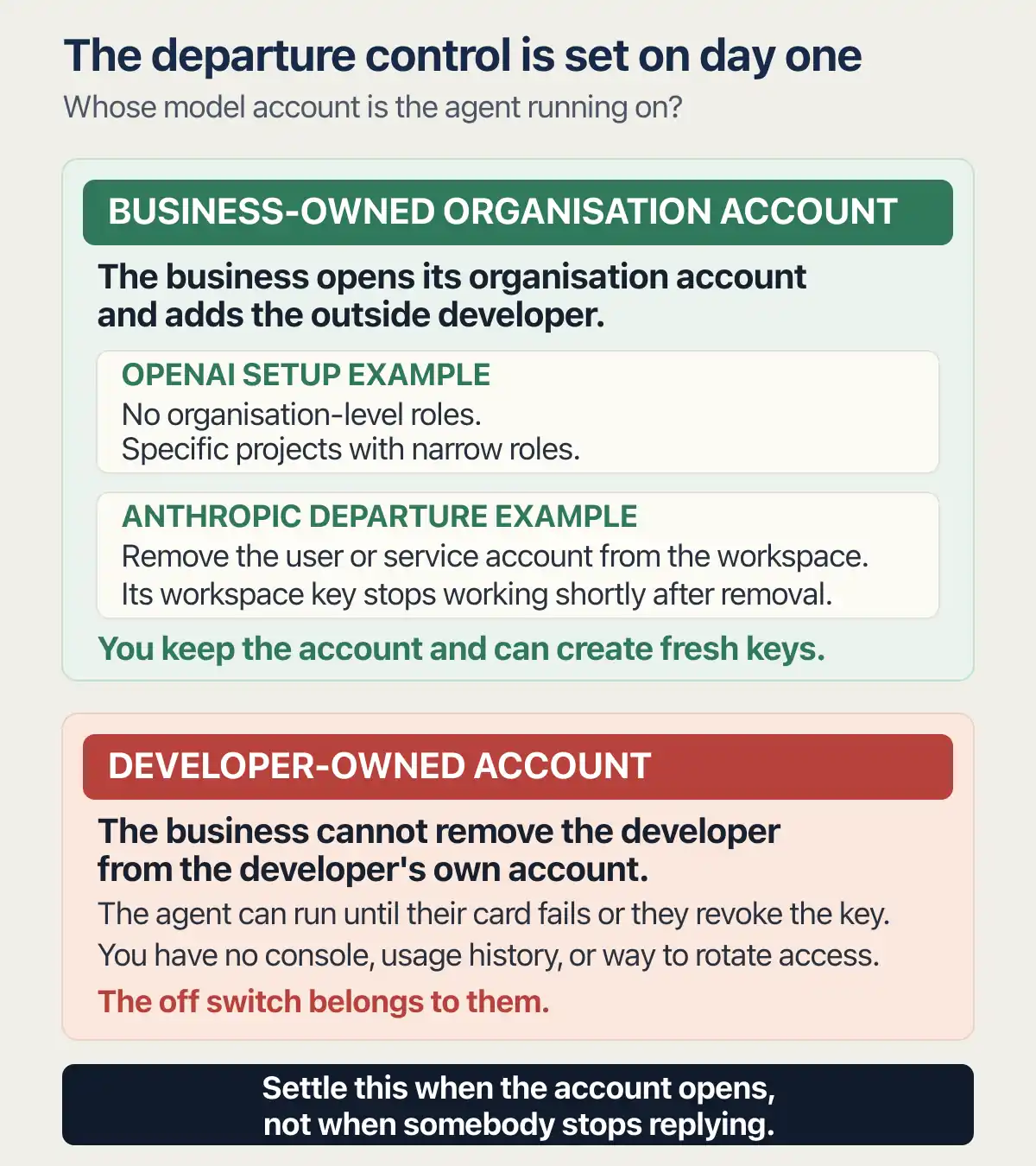
The account question has a boring right answer: the business opens its own organisation account with the model vendor, and the developer is added to it. Each vendor documents a different piece of why that matters.
OpenAI’s permissions guide, read on 29 August 2026, separates two levels. It defines an organisation as “Your top-level account” and says “Organization roles can grant access across all projects.” A project it defines as “A workspace for keys, files, and resources”, adding that “Project roles grant access within only that project.” Its advice for the exact arrangement in question is on the same page, under contractors and vendors: create a group without organisation-level roles, and add those people to specific projects with narrow project roles, read-only where that is enough. That is the vendor describing how to bring in an outside developer without handing over the company.
Anthropic’s workspaces page, read the same day, documents what happens when somebody goes. It states that “API keys can be scoped to a single workspace” and that then “they can only access resources within that workspace.” Its FAQ answers the departure question directly: “A personal or service account key stops working in a workspace shortly after its user or service account is removed from it,” and “Personal keys are archived when their user is removed from the organization.” A key created inside your organisation, by a contractor you later remove, stops being a live credential. A key created inside theirs does not, because you never had a way to remove them from it.
Google’s page adds the piece that expires soonest. It says “The Gemini API rejects requests from unrestricted standard keys”, that standard keys with explicit restrictions still work, and that on September 2026 the Gemini API will reject requests from standard keys, with migration to auth keys required before that date to avoid service interruption. The page carries a last-updated stamp of 2 September 2026. If an agent build quotes a Gemini key today, that deadline is inside the same month as the work.
One check a non-technical owner can run without any of this vocabulary takes about a minute. Anthropic’s workspaces page states that Claude API responses carry an anthropic-workspace-id header alongside request-id and anthropic-organization-id, and prints the shape:
HTTP/1.1 200 OK
request-id: req_018EeWyXxfu5pfWkrYcMdjWG
anthropic-organization-id: 0d0e7a3b-52f1-4c7e-9a51-3f6f2f7c1b9e
anthropic-workspace-id: wrkspc_01JwQvzr7rXLA5AGx3HKfFUJ
The page says that value is the ID of the workspace the request’s key or token resolved to, and that with it you can confirm which workspace’s usage, cost and rate limits the request counted toward. Ask whoever built the agent to show you that line from a live response and open the workspace in the console while you watch. Either it sits inside your organisation or it does not, and no explanation is needed either way.
Whose name the model account and the connected services are in is the same question people ask about the application itself, and it is answered in the billing screens rather than in an agreement. The accounts, keys and access somebody needs before they can start are already written out as a list, and the agent adds the model account to it.
What the agent is allowed to touch, and who writes that list
The list gets written before anybody starts, by you, in plain words, one system at a time. Mail: read, and draft replies into my drafts folder, never send. Accounting: read invoices, never create or edit one. Customer records: read, and add a note, never delete. That is an hour of work, and it decides more than any technical choice made later. A developer who writes the list for you will write the version that is easiest to build.
The plumbing under it usually has a name now. Read on 29 August 2026 at documentation version 2026-07-28, the Model Context Protocol introduction defines it in one line: “MCP (Model Context Protocol) is an open-source standard for connecting AI applications to external systems.” The same page says AI applications like Claude or ChatGPT can use it to reach data sources such as local files and databases, tools such as search engines and calculators, and workflows. When the person quoting you says MCP server, that is what they mean: software sitting between the model and one of your systems.
OpenAI’s guide to building MCP servers, read the same day, says that “Remote MCP servers can be used to connect models over the Internet to new data sources and capabilities”, and it carries the sentence that belongs in the agreement you make with whoever builds yours:
Keep approval enabled for tools that can modify data or take other consequential actions.
That is the vendor’s own rule, and it is row four of the table above in one line. The same guide is blunt about who stands behind a connector: custom MCP servers “are not developed or verified by OpenAI, and are third-party services that are subject to their own terms and conditions”, and on instructions hidden inside content the agent reads it says “For this to be safe you need to trust all content that can be accessed within the MCP.” Read that with your own inbox in mind. Anyone can put text into it.
That failure has a shape. In one of the 26 apps AxonBuild audited in June and July 2026, a compliance and incident tool ran a paid model behind three separate routes with no login in front of any of them, and a visitor could steer the model by feeding it text until it declared things compliant. Nothing was hacked. The tool read what it was given and did what the words said, which is the design. Every finding in that study was verified against the code it was reported in, not matched by a scanner.
The useful question at hiring time, then, is which tools on your list can change something, and what happens the day the model is wrong about one of them.
Which connectors are worth a standing credential at all is decided server by server before the wiring starts, not in the agreement afterwards. Once the agent is live, the list of what it can open and change sits on four screens you can read yourself, and reading them is a different afternoon from hiring the person who built it.
The bill an agent can run up while nobody is watching
An agent’s bill is a meter rather than a subscription. It runs whenever something triggers the agent, and the trigger is often not a person.
The pattern is well documented inside AI-built software generally. Of the 21 third-party applications in the fixed 26-application study AxonBuild audited in June and July 2026, 13 had no rate limiting on their most expensive endpoint, with every finding confirmed by reading the code it sat in rather than by a pattern match. That endpoint is almost always the one calling a model.
One application in that set showed the ceiling: a voice product whose token server would hand out paid model sessions to anybody on the internet who asked, with no account required and no record kept. The owner’s first notice would have been the invoice.
The vendors give you two controls, and both are set by whoever holds the account. Anthropic’s workspaces page describes per-workspace limits: monthly spend can be capped, requests and tokens per minute can be limited, and workspace limits can sit lower than the organisation’s but not higher, with organisation-wide limits applying regardless. Google’s page states the consequence of losing the key: “Treat your Gemini API key like a password. If compromised, others can consume your project’s quota, incur unexpected billing charges, and access private resources.” The same page says never to check keys into source control and never to put them in web or mobile app code, because code that ships to a browser or a phone can be read.
Two questions come out of that for anybody quoting an agent build. What is the monthly spend cap, and whose account is it set on. If the second answer is not your business, the first protects nothing.
The running cost has a page of its own: what the model bill works out to per customer per month. It keeps the providers’ current rates in one place and does the sums, so neither appears here.
Hire chatbot developers, agent developers, or somebody who already knows your app
Three different purchases arrive at these searches and only one is this page’s subject. Sorting yours out early saves a shortlist of people who cannot do it.
| What you want | Who you are actually hiring | What is different about the purchase |
|---|---|---|
| Something that reads your mail, tickets or records and then acts on what it read | Somebody who wires a model into systems you already run | You end up owning an account, a set of connections and a monthly bill, and none of it lives inside your app |
| One AI answer box inside an application you already run | Somebody who works on that application | A feature in your existing codebase, priced and checked like any other feature |
| Somebody to take over the application itself | A developer for the app, whatever built it | The work is reading and repairing generated code, and no model account is involved |
The chatbot phrasing sits in row one almost every time. A chatbot is one shape of agent: the shape with a text box in front of it. People searching for chatbot developers, chatbots developers, chatbot app development services or a chatbot app development company want a model connected to their own information with a way for a customer to type at it, and they own the same five things at the end.
Supply is forming fast. An alert on 27 July 2026 caught a thread in r/SaaS titled Whats the best way to get first few paying customers for the AI agents business?, which is somebody on the selling side working out how to find you. This market has more new sellers than settled ones.
What an AI agent development company sells, and what it leaves out
Four pages holding page one for these searches were read in full on 29 August 2026: Aalpha’s hiring guide at aalpha.net/articles/how-to-hire-ai-agent-developers/, Adsnipper’s at adsnipper.com/blog/hire-ai-agent-developer/, Dataforest’s hire page at dataforest.ai/services/generative-ai/hire-ai-agent-developers and LeewayHertz’s company page at leewayhertz.com/ai-agent-development-company/. None is linked, because all four sell in the same territory this site works in. They are credited by address instead.
What an AI agent development company sells is capability and staffing: engineers who know Python, API integration, an agent framework and vector storage, plus industry sections, architecture diagrams, and ways to buy, usually a dedicated team, an extension of yours, or a fixed project. What gets sold as custom AI agent development services is that list with a word in front, and a custom AI agent development company or an AI chatbot development company sells it again with the text box included. All of it is a real thing to buy and nothing about the presentation is dishonest.
Three of the four publish their own numbers. Dataforest’s hire page, read on 29 August 2026, answers the cost question in its FAQ by saying cost depends on location and skill level, that the hourly rate is typically between $50 and $250, and that a basic pilot project usually starts around $10,000. Those are one seller’s figures on that date, not a market rate. Aalpha’s guide publishes four project cost bands and Adsnipper’s publishes hourly and monthly ones, none of them printed here. LeewayHertz’s company page, read the same day, publishes no figure anywhere and routes to a form.
Then the part that matters more than the price. Across all four pages, on that date, not one says whose model account the agent runs on, whose name the API keys are in, or who pays the model bill in month four. Aalpha’s guide comes closest and deserves the credit: it tells the buyer to ask how the developer will manage authentication, role-based access, encryption, API keys, data retention, audit trails, logs and human approvals. Dataforest’s FAQ says to clarify data ownership in a contract first. Both stop one step short of the account itself, and which organisation the keys live inside decides what you can take back.
So ask the account question yourself. Four of them, and they work on a company, a freelancer or a friend who is good with this stuff:
- Whose account will this run on, and can I see it in my own browser before we start?
- What will it be allowed to touch, system by system, and which of those tools change something rather than only read?
- What happens to the keys and the connections the day we stop working together?
- What does it cost to run in a normal month, and where do I look to see that number myself?
The questions that apply to any developer you are about to pay, agents or not, are worth asking before the agent-specific four. Checking somebody’s work when you cannot read a line of it has its own method, and it applies to an agent build the same way it applies to an application.
One note about where this page is written from. AxonBuild does not build agents and is not an AI agent development company, a chatbot development company or an agency of any kind. It fixes and extends AI-built apps that already run: a free 20-minute video call with Bilal about the change you need, then a fixed quote after he checks the app if you want him to make it, paid after you see it working. An agent build from scratch is not something AxonBuild sells or quotes. If what you want is an agent wired into your business, the four questions above are more use to you than this paragraph.
Who watches the agent’s bill and its connections in the months after it works is a standing arrangement rather than part of the build.
The five vendor pages read for this one document the account, the key, the workspace and the role in detail. Not one describes the reverse direction: what an owner who is not a developer does, screen by screen, the day the person who set all of it up stops replying. The ownership list is worth writing before anybody starts partly because nobody has written the recovery version yet.
Common questions about hiring an AI agent developer
What does an AI agent developer do?
They connect a model to systems a business already runs, then write down what it may do inside each one. The work is credentials, connections, instructions and the cases where the model was wrong and something happened anyway. Very little is model work, which is why the parts you keep afterwards are an account, a set of connections and a bill.
Is a chatbot developer the same as an AI agent developer?
In practice, yes, with one difference in shape. A chatbot is an agent with a text box in front of it, so a chatbot developer and an agent developer wire the same parts: a model, credentials into your systems, and rules about what may be changed rather than only read. Chatbot development companies lead with the conversation surface and agent shops with automation. The five things you own at the end are identical.
Do I need an AI agent development company or one developer?
For one agent inside one business, one developer is usually enough, because the work is deciding and wiring rather than building at volume. A company earns its cost when the work has to survive one person leaving, when several systems are connected at once, or when the contract has to be signed by a company rather than a person. The ownership questions are the same either way, and nobody answers them unless you ask.
How much does it cost to hire an AI agent developer?
Published figures vary widely and almost all come from sellers pricing their own work. Dataforest’s hire page, read on 29 August 2026, puts hourly rates between $50 and $250 and a basic pilot project at around $10,000, which is one company’s position rather than a market rate. What developers charge for work on an app you already own is answered on its own page, where the figures are kept current rather than repeated here. Whatever the build costs, the running cost is separate and arrives monthly.
Whose OpenAI or Anthropic account should the agent run on?
Yours, opened by the business, with the developer added to it. OpenAI’s permissions guide describes this arrangement for outside developers: a group with no organisation-level roles, added to specific projects with narrow project roles. Anthropic’s workspaces page covers the departure side, stating that a personal or service account key stops working in a workspace shortly after its user is removed, and that personal keys are archived when their user leaves the organisation. Neither protection exists if the account belongs to the developer.
Who pays the model bill once the work is finished?
You do, every month, for as long as the agent runs. That means an account in the business’s name, a card the business controls and a spend cap set on it. Anthropic’s workspaces page documents monthly spend caps and rate limits per workspace, set no higher than the organisation’s limits. If the build leaves the bill on a developer’s account with an invoice passed to you, you are paying for something you cannot see, cap or switch off.
What should I give somebody before they can price an agent build?
The list of systems the agent needs to reach, what it should do in each one, which of those actions change something rather than only read it, and whether the accounts already exist and who holds them. What to put in front of somebody before they can price an agent build is a short list of specific things, and it is the same list any developer asks for before quoting. A quote produced without it is a guess about the plumbing, which is where the hours go.
Can the developer see my customer data?
Through the connections they set up, yes, in the ordinary course of building and testing. Rather than refusing that access, write down which systems are in play, use the narrowest role each connection needs, and remove access at the end rather than leave a working credential behind. OpenAI’s guidance for contractors is read-only project roles where read-only will do. An agent sees whatever the granting account could already see, which is usually more than the job requires.
What happens to the agent if the developer disappears?
It keeps running, and how much trouble that is depends on whose account it runs on. On your own organisation account you remove the person, their personal keys stop working and are archived, and somebody new creates fresh ones. On their account it runs until their card fails or they revoke the key, and you have no console, no usage history and no way to rotate anything. That is settled the day the account is opened, not the day they stop replying.
Built it with AI. Can’t get the last part right?
That’s the normal state of an AI-built app, and it’s fixable. I trace what the app actually does, explain what needs changing, and build it if you want me to.
Talk about your app →  Free 20-minute video call with Bilal.