A SaaS development company builds and sells software that customers pay for by subscription, and the phrase has nothing to do with property development, which borrows the same two words for another trade entirely. If you are reading this because you already own one of those subscription products, the search results are about to feel like they were written for somebody else.
They were. Nine organic results came back for this phrase on 2 September 2026: five seller pages and four ranked lists, all written around a product that does not exist yet, even where a page also lists modernisation or ongoing support; none publishes what happens to your subscriptions and account access during the work. Yours does. It takes money on a schedule, it holds records belonging to other companies, and somebody expects it to be working when they open it in the morning.
A SaaS development company sells the making of a subscription product. You own one that is already selling, and four things transfer with it: the subscriptions and the account that collects them, the customer data you hold for other companies, the uptime somebody is already paying for, and the accounts the whole thing runs on.
Everything below is read rather than done. On 2 September 2026 the Google results for this phrase and for the outsourced version of it were pulled, every seller page that opened to an automated read was read in its raw form, the one page that returns nothing readable is recorded as unreadable rather than described, and no company was contacted, bought from, tested or ranked. Nothing here rates anybody.
None of the companies below is linked. They sell the work this page is about, to the reader this page is written for, so each one is named and its address is printed as plain text instead. The four ranked lists were not opened at all: three are published by the development companies Blackthorn Vision, Diceus and Vivasoft, one was posted on a professional network by a technology company, and nothing here describes what any of them says. As of 2 September 2026, Radixweb’s SaaS development page at radixweb.com/services/saas-development renders no body copy to an automated read (a plain request and a browser-shaped request both returned a page with a title and a meta description and no body copy), so nothing is claimed about what it sells.
What do SaaS development services actually include?
The catalogue is the same object on every page that opened: five or six named lines running from advice at the start to keeping the thing alive at the end, sold to a reader who has an idea rather than a product.
Intellias, at intellias.com/saas-development/, lists SaaS consulting, prototyping and design, application development, SaaS migration, integration with third-party services, and support and maintenance. Itransition, at itransition.com/software-development/saas, splits the same territory five ways: consulting, development, migration, integration, and support and maintenance. ScienceSoft, at scnsoft.com/software-development/saas, runs a longer list including consulting, UX and UI design, architecture design, development, testing, support and maintenance, evolution, cloud migration and API development. Tech Formation, at techformation.io/software-services/saas-application-development, publishes four process stages instead: discovery and consultation, planning and design, development and testing, then deployment and ongoing support.
The phrasings you searched are one product with several names. SaaS development services, SaaS app development services, SaaS application development services, custom SaaS development and SaaS application development all resolve to that catalogue, and the SaaS development companies selling it do not distinguish between them. Which words a seller uses tells you about its copywriting, not about what it does.
Two of the catalogues include the shape of the work as well. Itransition’s consulting line selects a SaaS architecture from single-tenant, multi-tenant and hybrid-tenant options, and its development line runs analysis and planning, design, development, quality assurance and release. Intellias publishes a six-stage sequence: plan the project, design the solution, launch development, test, deploy, then maintain and support. Both describe a decision sequence that starts before any code exists, which is exactly the sequence a generated product skipped on your behalf.
Price is handled the same way almost everywhere: not at all, and then by form. Tech Formation’s own FAQ, read on 2 September 2026, answers the cost question by naming complexity, features and scale as the drivers, and offers tailored pricing rather than a figure. A number only exists once somebody reads what you already have.
| Seller, named not linked | What its list calls the SaaS work | What migration means on that page | What it says about a product that already has paying customers |
|---|---|---|---|
| Intellias | Consulting, prototyping and design, application development, migration, third-party integration, support and maintenance | Layer-to-layer move to a subscription business model, and on-premises infrastructure moved to the cloud | Covers planning a new product or guidance in managing an existing one. Nothing about existing customers |
| Itransition | Consulting, development, migration, integration, support and maintenance | An existing SaaS app moved to another service provider’s infrastructure | Support runs L1 to L3: monitoring, bug fixes, updates, new features. Nothing about existing customers |
| ScienceSoft | Consulting, design, architecture, development, testing, support and maintenance, evolution, cloud migration, API development | A SaaS moved to another cloud provider, or an on-premises app reshaped into SaaS | Sells modernisation and support: a full revamp of an existing SaaS, or regular support to keep it up to date |
| Tech Formation | Consulting, building the product, architecture design, app development, moving an existing system to the cloud, API development | An existing system moved to the cloud | Ongoing support after deployment. Nothing about existing customers |
| Radixweb | Not readable to an automated read on 2 September 2026 | Not readable | Not readable |
Two of the pages publish how long they think this takes, and both figures belong to the company that published them. Intellias answers in its own FAQ that a new basic SaaS application takes about six months to build, from planning to deployment, and that applications with advanced features and complex integrations may take longer. Tech Formation answers in its own FAQ that a typical SaaS development project can take anywhere from three to nine months to reach a fully functional stage. Both are timing the build you are not buying.
What the phrase itself covers, in the order the work happens, is defined on its own page. A company selling artificial intelligence features to put inside software that does not exist yet is a different catalogue with a different unit on it, and those pages are read elsewhere.
Migration on these pages does not mean what you mean by it
You have a product and a supplier, and one day you will want a different supplier. That is what you mean by moving, and it is not what any of these pages means. The word is on all four.
Intellias defines its migration line as layer-to-layer migration to a SaaS business model, and at the design stage as migration of on-premises infrastructure to a cloud environment. Itransition defines its migration line as moving your existing SaaS app to another service provider’s infrastructure, with steps that include examining the existing application, selecting the cloud architecture, planning the data move and testing after the move. ScienceSoft’s cloud migration line means migrating a SaaS to another cloud provider, or turning an on-premises app into SaaS by reshaping it for cloud infrastructure. Tech Formation’s equivalent is moving an existing system to the cloud.
Across the body copy of the four pages that opened to an automated read on 2 September 2026, migration never once means moving your product to a new supplier. Where each of the four defines its own migration line it means one of two things: turning something that is not yet a subscription product into one, or moving a product between infrastructure providers.
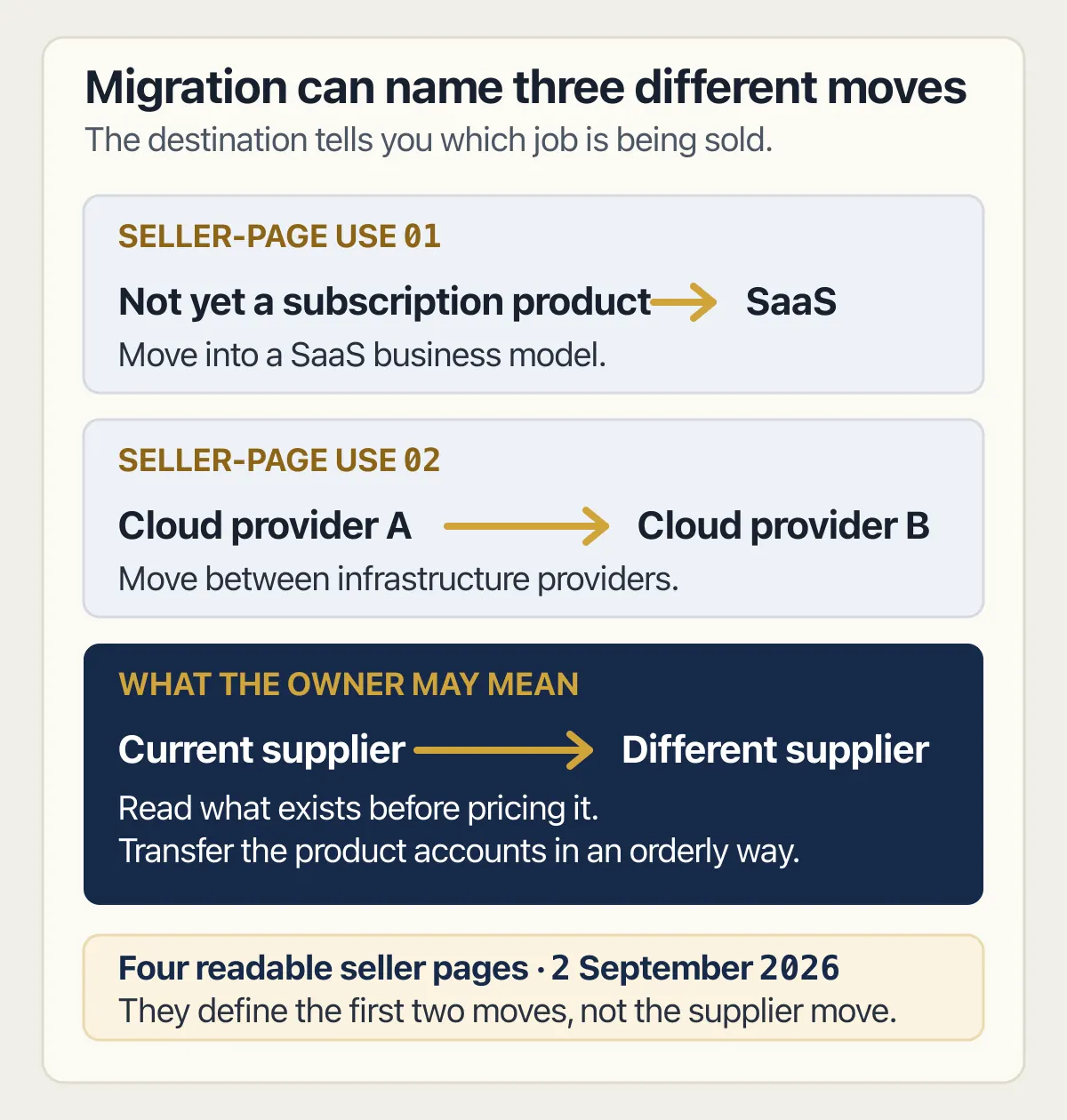
That gap matters because the second sense sounds close enough to the first to buy by accident. A company good at moving a database between two cloud providers has said nothing about whether it can inherit a product somebody else built, work out what that builder did, and keep the money arriving while it works. Different skills, one word.
The version you mean is somebody reading what exists before they price anything, and the accounts changing hands in an orderly way. Which accounts your product actually runs on, and the one-minute test that shows who each one belongs to, is already itemised.
Four things that transfer with a product that is already charging cards
An empty project has none of these. Yours has all four, and each has an owner today, which means each has a moment where it stops being yours alone. The seller pages are close to silent on all four, and the silence is consistent rather than sloppy: they are written for the build, and none of this exists during one.
| What transfers | What the seller pages say about it | What to settle before anybody starts |
|---|---|---|
| The subscriptions and the account that collects them | Nothing. On the two pages where the word subscription appears it names a business model to choose during a build, a checkbox on an intake form, or a case study about another company’s cloud bill | Whose name the payment processor account is in, who gets a login to it, and what happens to a customer halfway through a paid period |
| The customer data you hold for other companies | One asks on its intake form whether data must be moved from an existing system, and which compliance requirements apply | What your own customer agreements promise about who may see that data, answered before anybody gets access |
| The uptime somebody is paying for | One publishes a window covering the first one to three months after launch. None names who answers when it stops working | Who answers, in which working hours, and for how long after the last invoice |
| The accounts the product runs on | One outsourcing guide says to keep rights and credentials in company-owned repositories, and to make sure you own the source code and cloud accounts | Which accounts are in your name today, checked one at a time before access is granted |
Start with the money, because it is the one nobody raises. Across the body copy of the four readable SaaS development company pages, fetched on 2 September 2026, not one says what happens to subscriptions that already exist, and none mentions the payment processor account, whose name it is in, or who may reach it. The word subscription appears on two of them, and never once means subscriptions somebody already sells: Itransition’s own how-to section tells the reader to choose a monetisation model, naming subscription, per-user pricing and freemium, as a planning step before building, and its two other uses are a benefit of the model and the title of a case study about another company’s cloud bill.
That absence has a practical edge. If a company rebuilds a screen that touches billing, the customers already on a plan either keep billing correctly or they do not, and the answer sits in details nobody raises at the quoting stage. Settle it in writing: who holds the processor account, who is added to it, what happens to a customer halfway through a paid period, and what test proves it.
The second is the data, the item most likely to be promised away already. Your customers are companies, their records sit in your database, and your own terms already say something about who may touch them. ScienceSoft’s intake form is the only place in this set where any of it surfaces: it asks for expected user numbers, which capabilities the software will require, listing user accounts and authentication, payments or subscriptions, an admin panel and role-based access among them, whether data must be moved from an existing system into the new SaaS app, and which compliance requirements apply. That is a build questionnaire, not an answer to who is responsible for records you already hold. When the pressure comes from your own customer rather than from a supplier, the spreadsheet they send has its own answers.
The third is uptime, where the seller pages come closest without arriving. On the same four pages’ body copy, none states who is accountable when the product is down for a customer who is paying today, and none publishes a commitment to answer within any stated time. ScienceSoft publishes the nearest thing: during the first one to three months after launch its team answers questions, resolves user issues, and manages incidents, configuration changes and updates, with continuous maintenance available by agreement once that warranty support ends. That is a window measured from a launch, which is a different object from a promise about a product that launched two years ago and has been taking money since.
The fourth is the accounts, the only one the outsourcing guides handle head on. MindK, a development company publishing a guide on outsourcing SaaS development at mindk.com/blog/outsourcing-saas-development/, pairs loss of control with retaining ownership of product decisions and source code, and pairs ownership with making sure you own all the source code and the cloud accounts. It is also the easiest of the four to check yourself, one account at a time, before anybody is added to anything.
Paying somebody by the month to keep a subscription product standing is not the same thing as buying a build, and what a month of that contains is argued where that purchase is. What a monthly arrangement with somebody else covers, what it costs and who is on the other end of it are settled on the pages that read those terms. What one small subscription product costs to keep running once it has paying customers is the operating question rather than the buying one.
What each kind of company does with a product that already bills
Four shapes of seller answer this search, whether the page calls itself a SaaS software development company, a SaaS application development company or neither. The difference that matters is what each does when you say the product exists and has customers on it, more than size or country.
A large development company, the kind whose site carries an industries menu and a case study filter, is organised around planned work with a start and an end. Give it a subscription product that already runs and the first thing it proposes is the discovery stage its process begins with, because that is where its people find out what they are holding. A company that size cannot honestly price something it has not read, which is what the discovery stage is for. It fits when your list would keep several people busy for months, and fits badly when your list is four specific things you need done without a rebuild in between.
A smaller SaaS agency or studio, often five to twenty people, sells the same catalogue in fewer words and usually has one or two individuals who will actually read your code. Access to those individuals is what you are buying. The risk is that they are on two other products this month, and a subscription product with a billing failure does not wait politely. Sellers who advertise the builder your product came out of, and what that claim can and cannot carry, are sorted on their own page.
One freelancer is the shape most under-considered here, because the phrase development company sends people looking for a company. One person who reads your code can settle in an afternoon what a company takes a stage to establish. What one person cannot do is be awake when you are asleep, or absorb their own holiday. Buying one person’s time rather than a company’s, for a product with paying customers, is a narrower purchase with its own four routes. Renting named people by the month, and finding out how much of each one you actually get, is priced where that market is read.
The fourth shape is a small team that works only on applications built with AI tools, which exists because generated products break in particular repeating ways and reading them is a skill of its own. It is the narrowest of the four: if you want a new product, or capacity for a plan, this shape is the wrong purchase and the first two are the right ones.
Two neighbouring arrangements are worth naming so you do not buy one by accident. Giving the whole product to somebody who then runs it for you ends somewhere else entirely, and it is not what any of these four sells by default. What building and keeping one small subscription product looks like, when the owner cannot read the code, is set out separately, and it is the closer question if your list is mostly upkeep.
Outsourced SaaS development, and who those guides are written for
Search the outsourced version of this phrase and the result set changes character without changing sides. On 2 September 2026, eight of the nine organic results were guides published by companies that sell the thing being asked about, and the ninth was a forum thread of people asking each other, at reddit.com/r/SaaS/comments/1iscbew/have_you_outsourced_your_saas_development_i_need/. That thread returned HTTP 200 to both a plain and a browser-shaped request the same day and served no thread content to an automated read, so it counts here as snippet-only evidence used for one thing: the top slot on this query is people asking each other rather than anybody’s guide.
Read the guides and a shared assumption falls out. Outsourcing SaaS development, as written by the companies selling it, assumes a product owner already sits inside your business. Purrweb, a development company publishing at purrweb.com/blog/outsourcing-saas-development/, defines product development outsourcing as an arrangement where the external team takes responsibility for an agreed piece of delivery while ownership of the product stays inside the SaaS business, and states that the client remains responsible for priorities, access to decision-makers, customer insight and the standards used to approve the work. The same page states that outsourcing fits a defined outcome with internal product ownership, rather than an unclear plan.
Every one of those responsibilities belongs to a person who does not exist in a one-owner product. You are the priorities, the decision-maker, the customer insight and the standard, and you cannot read the code.
The benefits are published in the same voice. Intellias lists the advantages of outsourcing SaaS development in its own FAQ as a fast launch from quick team assembly, higher development quality from access to a large talent pool, reduced cost against building in-house because no infrastructure is provisioned, freedom to focus on business logic, and iterative response to change. Every item on that list is about starting something, and not one is about a product that is already earning.
One piece of their advice survives contact with a one-owner product, and it is the piece least likely to come up in the sales conversation. MindK’s guide says to write an exit clause into the contract covering timelines, documentation and the transfer of knowledge, to require the supplier to return API keys, database schemas and architecture details, and to keep all rights and credentials in repositories the company owns. That is worth doing on day one with any of the four shapes above. For a subscription product the account list matters most, because an API key can be rotated and a processor account cannot be reissued by anybody but its owner.
The decision to buy from an outside firm in the first place, and what a supplier several time zones away does to your working day, is settled on its own page. No rate by region is printed here and no country is named, because that argument is already written down and repeating it would only make it shorter.
Six questions that expose which purchase you are being sold
The generic vetting questions apply to any seller and are worth running separately. Each of the six below has an answer only if the person answering has understood that your product already has customers on it.
-
What does migration mean in your service list? The word is on almost every page in this market, and in every service list read here it meant moving to a subscription model or moving between infrastructure providers. If it does not mean inheriting a product from the people who built it, the rest of the conversation gets shorter.
-
Who will hold the payment processor account, and who on your side can reach it? Get the answer in writing before anything is granted. An account that collects your revenue is not a credential to be passed around, and the answer shows how this company thinks about money that is not its own.
-
What happens to customers partway through a paid period while you work? There is a right answer and it is boring: nothing happens to them, and here is the check that proves it. A company that has not thought about it will promise to be careful, which is not a check.
-
Who becomes a processor of my customers’ records, and what do you sign to say so? Your own customer agreements already promise something about this, and the company either knows what that sentence normally says or has never worked on a product holding other companies’ data.
-
Who answers when it is down for somebody who is paying today? Not who monitors it, and not what tooling they use. Who, in which working hours, and until when. On the four pages read here nobody publishes an answer, which makes it a negotiation rather than a policy.
-
Before you can put a number on a product that already runs, what do you need to see? A company that quotes from a paragraph of description is quoting a category. One paid reading of what is actually in the product, done before anybody names a number, is a purchase in itself, and without it the number you are given belongs to a category rather than to your product. The general version of that list, for software of any kind, is already written down.
The fifth question sorts this market quickest, and it is also the one most often skipped, because every seller’s page carries a support line. The hiring itself has its own order, and it starts after this decision rather than before it.
What I sell, and it is not this
Narrow, and wrong for most of what this page describes. A new subscription product, months of planned work, a rebuild, a supplier signing a contract because your buyer wants one signed: those are what the sellers above are for. Nothing here recommends any of them and nothing here ranks them, because ranking companies you have not bought from is advertising with a table around it.
What is worth carrying away is smaller than a choice of supplier. The subscriptions, the customer data, the uptime and the accounts are yours today, and every one of them is easier to settle before a stranger has access than after.
Common questions about SaaS development companies
What is a SaaS development company?
A SaaS development company is a firm that builds software sold by subscription and delivered over the internet, usually selling a catalogue that runs from consulting and design through development to support and maintenance. The four whose pages could be read for this article sell that same shape under slightly different names. The reader they write for has an idea; the reader searching the phrase often has a product already running.
What is the difference between SaaS development services and SaaS product development?
Nothing you can buy differently, on the seller pages that use both. SaaS product development, SaaS product development services and SaaS product development company sit alongside SaaS development services on the same pages and point at the same catalogue. Ask which sections of the catalogue a price covers rather than which phrase the page uses.
Do SaaS development companies take on a product that already has paying customers?
Some do, and none of the four readable pages says so plainly. ScienceSoft comes closest, selling modernisation and support described as a full revamp of an existing SaaS or regular support and maintenance. Intellias says its services cover both planning a new product and guidance in managing an existing solution. Neither mentions the customers on the product, so it is a question for the first conversation rather than something to infer from a service list.
What does SaaS migration mean when one of these companies offers it?
In the four migration lines read on 2 September 2026 it means one of two things. Either turning something that is not a subscription product into one, which is Intellias’s layer-to-layer move to a SaaS business model, or moving a product between infrastructure providers, which is Itransition’s move of an existing app to another service provider’s infrastructure and ScienceSoft’s move of a SaaS to another cloud provider. Moving your product from one supplier to another is a third thing, and not what the word sells here.
What is outsourced SaaS development?
SaaS development outsourcing is giving an outside company an agreed piece of the work while the product itself stays yours. Purrweb’s definition is that the external team takes responsibility for an agreed piece of delivery while product ownership stays inside the SaaS business, and that the client keeps priorities, access to decision-makers, customer insight and the standards used to approve the work. The published guides assume somebody inside your company is doing that job, which is the assumption to test first.
Who is responsible for my customers’ data while an outside company works on my product?
You are, to your customers, whatever the contract with the supplier says. The agreements you signed with your own customers usually name who may see their records and on what terms, and adding a supplier adds a party to that answer. None of the four seller pages read for this article addresses it; the nearest thing is an intake form asking which compliance requirements apply to a product being built. Get the supplier’s position in writing before any database access is granted.
What happens to my existing subscriptions if a company rebuilds the product?
Nothing should, and the only way to know is to make it a written condition rather than an assumption. Not one of the four readable pages says what happens to subscriptions that already exist, so there is no published practice to lean on. Ask what happens to a customer partway through a paid period, who holds the processor account throughout, and what test shows that billing still works after each release.
What should I have ready before a company can quote on a product that already runs?
Access to the code and the services it runs on, a list in plain words of the things you want changed, the account list showing what is in your name, and whatever your customer agreements say about who may see customer data. With those four, a quote is about your product. Without them, it is about a category. What each route ends up charging for the same result is collected in one place, with the published figures attached to the names that published them.
Is a SaaS development agency the same thing as a SaaS development company?
In this market the two words are used interchangeably, and the pages that rank call themselves company, agency, studio and partner within a few paragraphs of each other. The word tells you about the marketing rather than the size, the location or how people are assigned to your product. What separates sellers here is what each does when the product already exists, which no label on a homepage answers.
If you have a working app built with these tools and need it ready for real customers, this is what we do.
Built it with AI. Now it has to hold up for real customers.
The Production Hardening Sprint takes the app you already have and builds the production foundation underneath it. Authentication and access rules, payments that stay consistent, error handling, monitoring, backups, automated tests and a documented handover. Our engineers work inside your existing codebase for ten working days. All 123 deliverables are included, and you get the evidence for each one.
See the Production Hardening Sprint →  $2,500 fixed price · 10 working days · One codebase