A micro-SaaS here means one small subscription product, run by one owner, that already charges people every month, and SaaS here means a subscription software product with paying customers. Not the Scottish student awards agency, not a ticker on an exchange, not systems and application support, and not the genre of idea lists that this search is mostly made of.
Building one got cheap. Keeping one running costs what it always did, and most of that cost is your attention rather than your money. The work that starts the day the first card clears is what this page is about.
A micro-SaaS asks for the same handful of jobs every week, whoever built it: watching that it is up, releasing small changes, answering the people who pay, keeping billing honest, deleting data when somebody asks, and proving a backup actually restores. The building got cheaper. None of those did.
Nothing on this page was run. Every result ranking for this phrase was pulled on 2 September 2026 and the page behind it read as raw HTML the same day; anything that refused an automated request is described as refusing rather than filled in from memory. Owners appear only in their own published words, with no name, handle or company attached to them. Any job, bill or breakage with a page of its own is linked instead of retold here. Nothing on this page was built, kept running, hosted, billed, integrated or tested by AxonBuild, and no product, vendor or stack is recommended.
What a micro SaaS business is, and what the definitions leave out
The pages on that results page that define it at all define it the same way: one product, one narrow job, one small group of buyers, usually one person behind the whole thing. All true, and none of it describes a Tuesday.
The version that matters after launch is shorter. A micro-SaaS is a login, a database with other people’s records in it, a recurring charge, and one person who answers for all three. That last clause is the whole difference between this and a side project. A side project that breaks is an annoyance. A product that breaks is money you are holding on somebody else’s behalf while the thing they bought does not work.
The pages ranking for this phrase mostly stop before that. The directory sitting near the top of the results, microsaasexamples.com, presents itself as a browsable set of more than four hundred micro-SaaS products across thirty-seven categories, offered as ideas you can build (read on 2 September 2026, and given here as an address rather than as a link, because it is a listings page competing for this phrase). Most of the rest of the first page is the same genre in article form: weekend builds, ranked idea lists, categories to pick from.
An idea is the cheap half now. Anyone reading this already has the expensive half, which is a live thing with strangers inside it.
The two definition pages on that first page do define the category honestly, and both are given here as addresses rather than as links because both compete for this phrase. One of them, payproglobal.com/answers/what-is-micro-saas/, a merchant-of-record seller’s answers page carrying its own “Updated on: March 23, 2026” stamp and read on 2 September 2026, characterises micro-SaaS by three things: solving one focused problem, being built by small teams or indie developers, and being shaped around what its users ask for, with the whole model scoped to niche industries or user segments. Read the same page for what happens next and you get two lines in a comparison table, saying that maintenance is simplified and support needs are minimal, and nothing else about the owner’s week. The other, hackernoon.com/micro-saas-what-it-is-and-how-to-build-one, a publisher’s guide dated on its own page 13 October 2023 and read the same day, attributes the term’s popularity to Tyler Tringas, the founder of Storemapper, and reproduces his description of a small SaaS company from a solo entrepreneur or a small team, typically bootstrapped, going after a niche market, and prioritising profits and business sustainability over growth. That is a good definition of the category. It is not a description of the job.
One owner put both halves in the same breath on a public forum:
Small micro SaaS, solo, live and taking money… I used to have a hard wall. Trial ends, app locks, pay to continue.
Six words of self-description, then an operating decision about what happens to a person’s access when their money stops. That second sentence is the register this page is written in.
What these products actually look like from the inside
Ask what micro-SaaS examples look like and you will be handed product names. Names are not much use, because the interesting part is the shape underneath, and the shapes repeat.
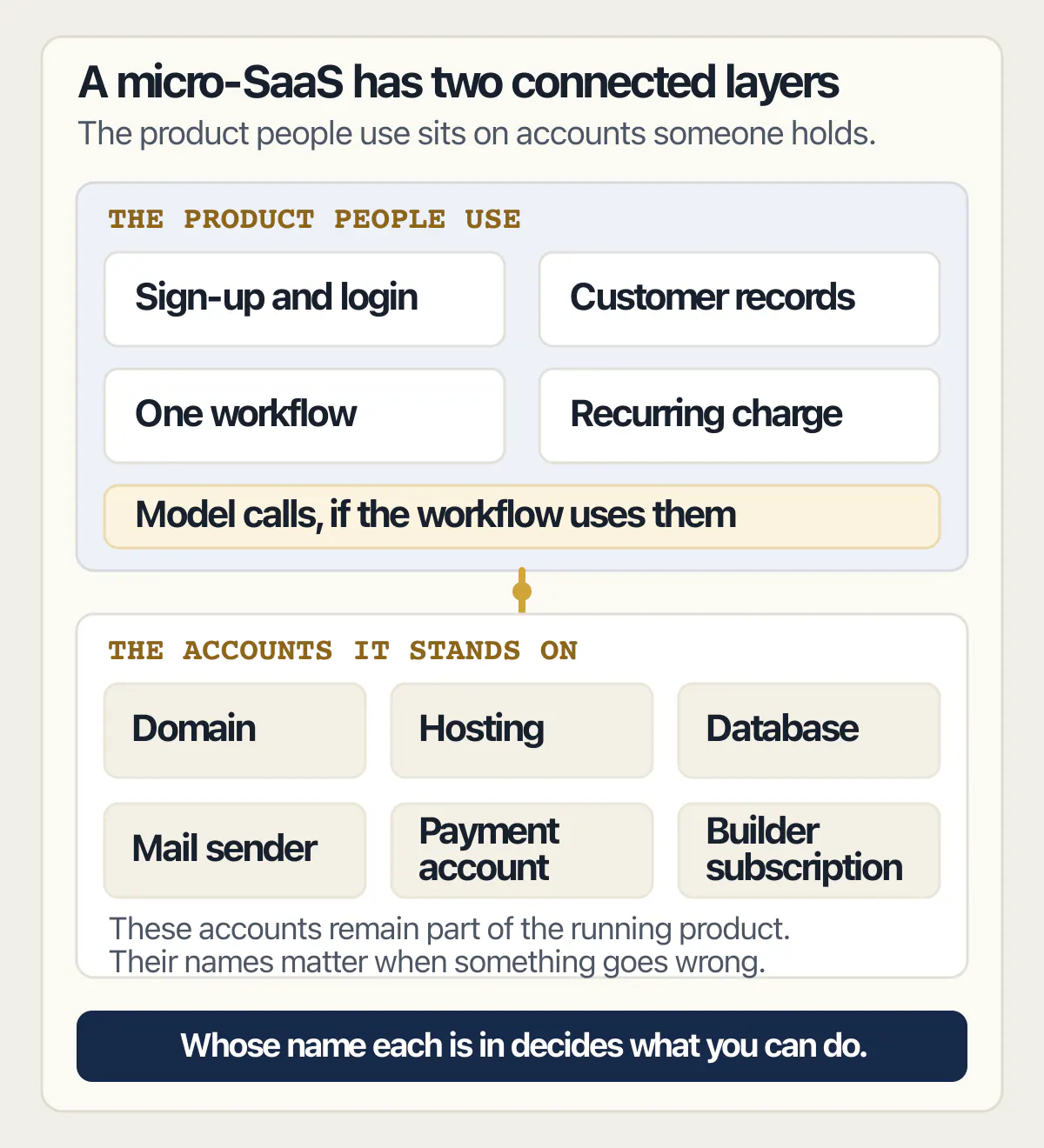
Almost all of them are the same five pieces. A signup and a login. A database where each customer’s rows are supposed to stay theirs. One workflow that does the actual job, usually a thing the owner used to do by hand for somebody. A subscription attached to a card, with a processor in the middle. And increasingly a model call somewhere in the middle of the workflow, which is the one piece that costs real money per use rather than per customer.
Around those five there is a sixth thing nobody counts as part of the product: the small pile of accounts it stands on. A domain, a place it is served from, a database, a mail sender, a payment account, and the builder subscription that generated most of it. Those accounts are the product in every sense that matters when something goes wrong, and whose name each is in decides what you can do at two in the morning.
If you want to see what this looks like at the code level rather than in a feature list, eight real applications read line by line are written up in vibe coding examples, and the question of who is holding each part once it is live is worked out in who owns what in a vibe-coded app in production. Neither of those is a micro-SaaS page specifically. Both describe the machine you are running.
The community language is a fair guide to the population. One public thread title in r/micro_saas reads “Micro-SaaS founders: what are you building, and where are you actually at?”, which is a question you only ask a room where most people are somewhere between a first customer and a first hard month.
There is one shape that changes everything else about the list above, and it is worth naming early: whether the subscription is the product’s only gate. If the paid tier is enforced in one place and that place is the checkout, then the checkout is the product. If it is enforced in the database, in the login, and in the workflow, you have three places to keep in agreement forever. In the apps I have read, the first version is what a builder produced, and the second appeared only when somebody asked for it directly; nothing was run to measure how often that holds, so treat it as a check to make on your own app rather than a rate.
What the month actually contains
Here is the honest list of what repeats. None of it is dramatic, which is exactly why it gets skipped.
| The job | What it looks like when nobody is doing it |
|---|---|
| Watching it is up | A customer tells you it has been down since yesterday |
| Shipping small changes | Fixes queue up until the next change is frightening |
| Answering the people paying | Cancellations with no reason attached |
| Keeping billing honest | People with dead cards still logged in, people who paid locked out |
| Deleting data on request | An email you cannot answer truthfully |
| Proving a backup restores | You have backups and no idea whether they open |
Six jobs. On a product with a few dozen subscribers most of them are quiet most of the time, which is the reason they get dropped, and then one week arrives where all six want attention at once.
Two of the six are worth linking rather than repeating, because they already have pages. Finding out something is broken before a customer does is the entire subject of uptime monitoring for a founder who is not sure they need it yet, including the argument about when an outside check earns its place. What you say to subscribers while it is down, and whether a public page is worth the maintenance, is worked out in whether a small SaaS needs a status page.
The other four sit with you in a way that is easy to underestimate. Answering people who pay is not support in the corporate sense; it is the only channel through which you learn what is broken, because instrumentation on a one-person product is usually thin. Billing is the job that punishes silence hardest, because a failure there is invisible from the outside and expensive in both directions. Deletion requests arrive rarely and then have to be answered within a defined window, which means the mechanism has to exist before the first one lands. And restores are the job everyone defers, because taking a backup feels like the work when opening one is the work.
Each of those jobs, and what doing it actually asks of the person who owns the product, sits on its own page for people running a SaaS without a developer, and this page does not try to reproduce it. The wider question of which jobs stay with a founder who cannot read code no matter who they pay is a different list again, written for the non-technical founder with an app already live, and that one is about ownership rather than about SaaS.
What none of this is, is a schedule. Nobody can tell you a week’s shape from the outside, and any page that prints one is describing a product it has never seen.
What the bill is actually made of
Every micro-SaaS invoice is the same small number of lines. Somewhere it is served from. A database. A mail sender, because password resets and receipts have to leave the building. The payment processor’s cut, which is a percentage of your revenue rather than a fixed line. Model calls, if the workflow has a model in it. And the builder subscription that made the thing, which stays on the card long after the building stops.
That is the anatomy. This page prints no number for it, on purpose.
Two reasons. The first is that any number here would be somebody else’s. The bill depends on which host, which database plan, how many people signed up this week, and whether the workflow calls a model once per user or once per click. A page that averages those into one figure is inventing a product. The second reason is that the numbers already exist on pages that keep them current, and restating them here would just make them stale in a second place.
So here is the routing instead. What a model call adds up to against each paying customer, and why per customer is the only honest way to ask that question, is in AI API costs and how they land in your margin. The backend nearly every AI builder reaches for, what its free allowance covers and what happens at the first paid step, is in the default backend and what it stops covering once you grow. If the question is where the thing should be served from at all, the tradeoffs between the usual targets are in the deployment target comparison, and what a different backend would actually change, including what you keep and what you rebuild, is in the alternatives to that default, one by one. The invoice itself, itemised at more than one user count, has its own page on what it costs to run an app each month, and that is the page to read if what you want is arithmetic.
One owner, writing publicly, named the three pieces their product actually runs on and said the question people keep asking them is whether it will hold as it grows. That is the right instinct and slightly the wrong question. The pieces rarely fail because of load at this size. They surprise people because one line on the invoice is metered against usage rather than against customers, and usage is the thing a stranger can move.
Where a one-owner product breaks first
Four things go wrong early and often, and all four live at the seam between the product and the money.
The subscription that lapses while the access stays on. Somebody cancels, or a card dies, and the account keeps working because cancellation was wired into the checkout and never into the thing the customer is actually using.
Two subscribers, one pile of rows. The product was built and tested by one person with one account, so the rule that keeps each customer’s records away from everybody else’s was never exercised. It usually holds on the screen and gives way through the API.
The payment event nobody hears. The processor sends a message saying a payment failed, a subscription ended, or a refund went through, and nothing at your end is listening, or something is listening and does not check that the message is genuine.
No way for the owner to look anything up. There is nowhere to find a customer, extend a trial, refund somebody, or see why an account is in a strange state, so every operational question turns into a database query you are nervous about running.
None of these are exotic and none of them are new. What is new is how often all four are present at once in a product that demonstrates perfectly. Why a working demo cannot show you any of this is set out in what goes wrong with vibe coded apps, which is also where the mechanism behind each one belongs. This page names them and points; it does not re-explain them. The reading behind those patterns, along with what that reading can and cannot support, is written up on the page recording what those application reviews found: the security findings from real vibe-coded applications.
The reason to name them together is that they share a failure mode. Each is invisible from the owner’s seat until a customer is standing in it, and each is a specific, findable, fixable thing rather than a general worry about quality. That distinction matters when you decide what to do about it. Which of the four you are looking at decides whether that is even the right conversation, and for three of the four the pages linked above will tell you before you ask anybody anything.
Is SaaS dead now that AI builds apps, and does any of that reach a product like yours?
The “SaaS is dead” argument is an argument about software vendors, not about small products with subscribers. Read the pages making it and they are about company valuations, per-seat licensing, and how many applications a large company is paying for at once. None of those are facts about a product with a few dozen customers.
That is not a dismissal, and the case is worth reading properly rather than being waved away.
The strongest version of it comes from the analyst side. Forrester’s post SaaS As We Know It Is Dead: How To Survive The SaaS-pocalypse!, read on 2 September 2026, opens on a sell-off in SaaS company valuations and lists the investor fears behind it: that SaaS companies will not be the provider of choice for AI agents, that the per-seat model becomes obsolete, that vibe coding lets startups replicate the features of complex SaaS platforms, and that buyers are drowning in the sprawl of hundreds of applications that do not talk to each other. Every one of those is a statement about vendors selling seats to enterprises. The third one is the only one that touches a small product, and it points the other way: it says building this kind of thing has become easy, which is a description of your advantage, not your obituary.
IDC’s post Is SaaS Dead? Rethinking the Future of Software in the Age of AI, published on its own page on 2 December 2025 and read on 2 September 2026, traces the phrase to a remark by Microsoft’s chief executive on the BG2 podcast in December 2024, and then argues the opposite conclusion from the same evidence: that the model is being disrupted by evolution rather than by decline, and that the pressure is on per-user licensing and on the interface layer, not on software existing. Its guidance section is addressed to IT and procurement leaders. That is who the whole debate is for.
So the honest answer for a one-owner product has two halves, and only the first half is comfortable.
The comfortable part: nothing in either argument says the demand for a small tool that does one job for a niche has gone away, and both suggest the opposite, since the sprawl complaint is a complaint about big general software rather than small specific software.
The uncomfortable part: the same drop in build cost that let you make this quickly applies to the next person who decides to make it again. If the only thing between your product and a copy is the code, the code is no longer much of a wall. What is left is the boring set of things that never got cheap: the customers who already trust you, the data they have already put in, the specific knowledge of a niche that made you build it in the first place, and the fact that you answer your email. A public thread title in r/micro_saas puts the shape of that risk plainly enough: “Micro SaaS reality check, part three: I got my first paying customer, lost them in…”. The competition that decides a product this size is a customer leaving, which is a much smaller and much closer event than a market forecast.
Neither of those two pages is written for you. Both are worth reading anyway, as long as you read them as reports on somebody else’s market.
What is yours, what you can buy, and where each question is answered
This page is the operating view. The questions next to it have their own homes, and mixing them up is how people end up buying the wrong thing.
Who does each of these jobs when the owner cannot read code, and what genuinely needs a person rather than the tool that built it, is the subject of a separate page on micro-SaaS development for non-developers. Building one in the first place, and what an AI builder finishes on its own before a person has to take over, is a different question again and gets its own page on building a SaaS application without a developer. The standing list of technical jobs that come with running a subscription product without an engineer, taken one at a time, sits on the page about running a SaaS when you are not a developer.
Two related questions are neither of those. The jobs that stay with a founder who cannot read code, whatever they pay for and whoever they pay, are set out on the page about being a non-technical founder with a working app. And the moment at which paying strangers turn a side project into something you answer for, which is the moment this whole page assumes has already happened, is worked through on the page about when to hire a developer for a startup.
And if the exit is ever the plan: what a buyer looks at in an AI-built product before they agree on anything is covered by the page on the checks to run before buying an AI-built app, and the preparation on the seller’s side is its own list on the software due diligence page. Neither is this page’s job, and both are worth reading long before you need them, because most of what a buyer asks for is the same evidence that makes the product easier to run.
Common questions about micro SaaS
What is a micro SaaS?
A micro SaaS is a small subscription software product that solves one narrow problem for one narrow audience, usually built and run by one person or a very small team, and funded by its own revenue rather than by investors. In practice it is a login, a database of customer records, one workflow, and a recurring charge.
What counts as a micro SaaS, and what does not?
Two things separate it from everything nearby. It charges on a recurring basis, and one person can hold the whole thing in their head. A one-off paid download is not one. A free tool with ads is not one. A product with a support team, a sales process and a roadmap owned by somebody other than the founder has stopped being one, whatever its revenue.
The line worth watching is not size but obligation: the day people who do not know you are paying you every month, the product starts making demands that a side project never made.
Is a micro SaaS worth it?
It depends on whether you want a product or an income, and the two are not the same thing. A micro-SaaS is a good fit if you already understand a narrow audience, if you enjoy or can tolerate the recurring work, and if you can absorb the week where everything breaks. It is a bad fit if the appeal was that software runs itself, because the part that runs itself is the part you built.
The pages ranking for this question are mostly answering it for someone with no product yet. If you already have paying customers, the question has changed: it is now about whether the product earns more than the attention it takes.
Are micro SaaS businesses profitable?
Many are, and the ones that are profitable are usually profitable early, because the cost base is small and the customers pay monthly. That is also the trap in the question. Profitability at this size is dominated by two variables, neither of which is revenue: how much of the bill is metered against usage rather than against customers, and how much of your own time the thing consumes.
A product that clears its hosting easily can still be a bad business if the work it generates crowds out everything else you meant to do with your evenings.
How much can a micro SaaS make?
There is no honest number to give you, and this page does not print one. Every figure you will find published for this question is self-selected: people announce the month they crossed a milestone and go quiet the month they lose a customer, so the visible distribution is not the real one.
What can be said usefully is which levers actually move it: how narrow the audience is, whether the price is per person or per account, whether people stay past the third month, and whether the product is enforced well enough that people who stopped paying stop having access.
How do you make money from a micro SaaS?
By charging a recurring fee for a job somebody does not want to do themselves, and by making sure the money and the access agree with each other. The second half is where most small products actually leak. Access that survives cancellation, payment failures that nobody hears about, and trials that renew themselves are all money problems disguised as technical ones, and each has its own page in this corpus rather than a paragraph here.
The mechanism is described in the failures that only appear once people are paying, which covers what a working demo hides about the paid path.
Can one person run more than one micro SaaS at once?
Yes, and it is common, because the recurring work per product is small and mostly parallel. One person described running several of these small subscription products at once, all of them built without writing the code themselves.
The constraint is not building capacity, it is incident capacity. Two products that are quiet cost about the same attention as one. Two products with a bad week in the same week cost far more than two, because everything urgent arrives through the same inbox and lands on the same person.
What happens to a micro SaaS when nobody is watching it?
It keeps taking money and slowly stops working. Certificates expire, a vendor deprecates something, a dependency stops resolving, a card on the payment side fails silently, and the first sign is a cancellation email with nothing written in the reason box.
Products at this size very rarely fail loudly. They decay, and the decay is only visible from the outside, which is the entire argument for having one automated check that is not you.
If you have a working app built with these tools and need it ready for real customers, this is what we do.
Built it with AI. Now it has to hold up for real customers.
The Production Hardening Sprint takes the app you already have and builds the production foundation underneath it. Authentication and access rules, payments that stay consistent, error handling, monitoring, backups, automated tests and a documented handover. Our engineers work inside your existing codebase for ten working days. All 123 deliverables are included, and you get the evidence for each one.
See the Production Hardening Sprint →  $2,500 fixed price · 10 working days · One codebase