A non technical founder with a working app is a person who cannot read the code of an app their own business already runs, with real people already using it. That is a different person from the one deciding whether to start, and a different question from which title outranks which on a startup’s org chart or what a share of a company is worth.
Almost everything written for the phrase is written for the earlier person, the one who has not built anything yet. Once the thing exists and strangers are logging into it, the job changes shape, and nobody hands you the new description.
Six jobs stay with you once the app is live: deciding what right looks like, keeping the accounts in the business’s name, knowing it is broken before a customer tells you, owning what it makes and costs, knowing what is under it, and being able to give the whole thing away. Five never transfer. One has to be bought.
Everything here is read rather than run. The pages that currently answer this question were opened and dated on 2 September 2026, and where one of them could not be opened that is said instead of guessed. Founders are quoted from their own public writing, unnamed and unlinked, with no company attached. The pages that carry each procedure are linked instead of summarised, and where the evidence is a body of audit work, the page holding that work is linked instead of quoted at a number. Nobody was placed, hired, tested or run for any of it.
What a non technical founder owns once the app is live
Six standing jobs, not six tasks. They are the things that are still yours next month whoever you pay this week, and they do not go quiet when the app does. Four you can settle without reading a line. Two turn on somebody else having read one.
Deciding what the app is supposed to do. Nobody else can write down what right looks like for your business. Somebody reading the code can tell you what the app does; they cannot tell you it is wrong about a rule that was never stated anywhere. If your refund window is fourteen days and the app gives thirty, no amount of reading finds it, because nothing in there looks like a mistake. It is the cheapest job on the list and the one most often skipped, because writing down what you already know does not feel like work. Product decisions for a non technical founder start and end here, and they do not get easier to delegate as the app grows.
Keeping the accounts in the business’s name. The domain, the store listing, the database, the thing that takes payments, the address the app sends mail from. Every one of them is registered to a person, and the person is not always you. That turns into a real problem exactly once, at the worst possible moment. Whose name the store account is opened in, and what to do when it turns out to be somebody else’s, is settled on its own page. Which accounts have to sit in the business’s name, and what to do about the one that does not, is a list somebody has already made.
Knowing it is broken before a customer says so. The gap between the app failing and you finding out is the only part of an outage you control. Whether a small live app is at the point where an outside check is worth setting up yet has its own answer elsewhere, and this page does not repeat the setup.
Owning what the app makes and costs. Which service bills you, what happens when the card on it expires, whether the thing charging customers is the thing you think it is, and whether money that arrives ends up somewhere you can see. No figure belongs in this paragraph, because the arithmetic is yours and nobody else’s numbers describe it.
Knowing what is actually under the app, and choosing who finds out. This is the one that splits. The finding out has to be bought. The choosing never leaves you, and neither does the judgement about whether the person you bought it from actually did it. Choosing the person is a different problem from choosing the work, because the usual evidence of skill is unreadable to whoever is doing the choosing. How to compare the people who sell the reading, and judging a sample of their work before sharing access, is a buying job with its own questions.
Being able to give the whole thing away. Not because you plan to, but because an app one person can transfer without an excavation is an app that survives that person going quiet. The packet, item by item, and the proof that the person receiving it can actually deploy and restore, is listed in full elsewhere. Handing the running of it to somebody else is the far end of the same readiness. What it takes to move the running of an app to another person, and what has to be true before that is a fair thing to ask, is a separate decision with its own page.
One owner listed what they did not have, one item at a time, and then said what they did have: products that were live with people paying to use them. That is the shape of this job. The list of things you are not is long and the list of things you are answerable for is short, and only one of those two lists matters after launch.
| The job | What you settle yourself | What needs somebody else |
|---|---|---|
| What right looks like | All of it | Nothing |
| Accounts in the right name | All of it | Nothing |
| Finding out it broke | All of it | Nothing |
| Money in and money out | All of it | Nothing |
| What is under the app | Who does it, and whether they did | The reading itself |
| Being able to give it away | Gathering it | Proving it works |
The jobs nobody you hire can take off you
Five of the six stay whoever you pay, and each one stays for its own reason rather than as a matter of principle.
Intent does not transfer, because nobody can be told what they were never told. Everybody who touches the app afterwards reads it as a statement of what you wanted. If the statement is wrong, they build on the wrong one faithfully. The only correction available is you saying the rule out loud, and there is nobody to say it for you.
Ownership does not transfer, because it is a fact about a name and not a task. Somebody else can set an account up on your behalf. Only you can be the name on it. Every account that stays in a helpful person’s name is a decision you have made by not making it.
Watching does not transfer, because the person who built it is not the person the customer emails. Whoever wrote the app has moved on to their next thing, and that is normal rather than a betrayal. The mailbox those complaints arrive in is yours. A short set of checks can be run on your own app in a browser, using an account you already hold, and they are written out step by step in one place.
The money does not transfer, because the card is yours. Costs on a live app move on their own: usage goes up, a free tier ends, a service changes what it charges for. Nobody else feels any of that, which means nobody else notices it.
Being able to give it away does not transfer, because only the holder can give. This is the job that is invisible until you need it and then is the only one that matters. It is also the one that quietly repairs itself when the other four are done, because an app whose accounts, intent and costs are all in one place is most of the way to being transferable already.
The list of things a founder cannot do is long and stable. The list of things they are answerable for is short and does not shrink when they hire somebody.
All of that argues for knowing which part of the work you are buying, rather than for doing everything alone, so that what comes back can be checked against something.
The one job you cannot do, and what that changes
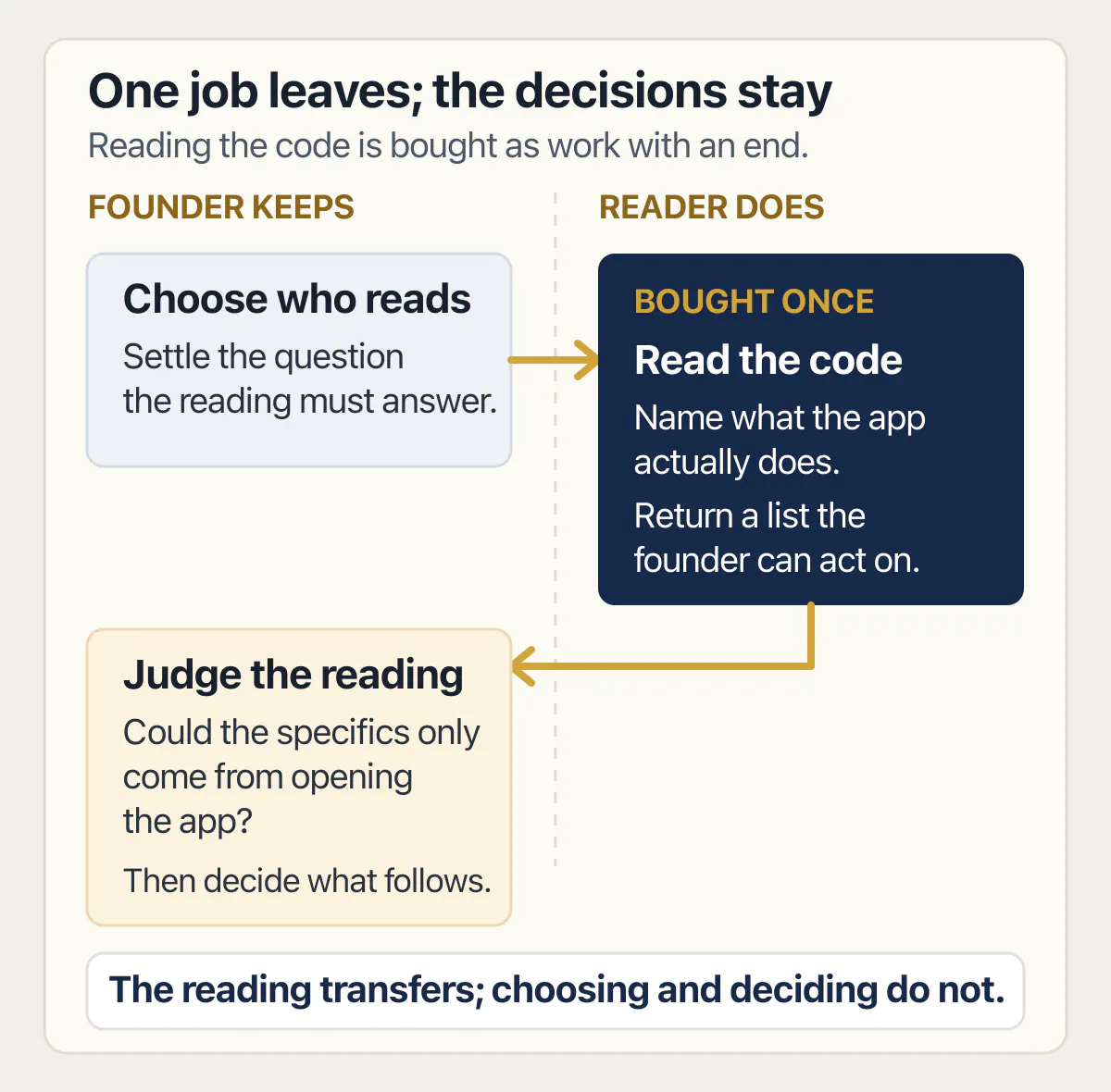
Reading the code is the only job on the list that has to leave it. It leaves once, as a piece of work with an end, and the deciding stays behind. That is a different purchase from keeping somebody around, and confusing the two is how founders end up paying for availability when what they wanted was an answer.
The reason it has to leave is that a working app is not evidence about itself, whatever the difficulty of the reading. What the screens do is the only thing you can see, and the things that go wrong under an app that already works do not show on the screens. Somebody has already counted and sorted what those things are, and the sorted version is more useful than a list of fears.
Buying a reading is its own purchase with its own questions, and what one actually hands back to somebody who cannot check it is set out where that argument lives. The thing to hold on to is that a reading with an end produces a list you can act on, and an arrangement without an end produces a relationship you have to manage. Both are sold, often by the same people, and the words for them are not standardised.
What some providers sell as a standing arrangement, and what they say it covers week to week, is a description of their side of this rather than of yours. Paying somebody by the month for an app that is already running is a different purchase again, and what a month of it actually contains is worked through elsewhere. Neither of those is the same as a reading, and neither of them removes a single job from the list above.
Whether the reading is worth what it costs is easier to answer if you know what tends to be found. What has actually been found under apps like this one, the method used to find it and the limits on reading anything into it are published in full where that ledger lives.
If the app landed on you rather than being built by you, the order changes. The week-one order when nobody is left to explain it starts with control and evidence rather than with the job list, and that sequence is set out on its own page. Get the accounts back first; the reading is worth more once you can act on what it says.
The judgement stays yours throughout. You cannot verify a finding, but you can verify that somebody looked: whether they name the file or route where it sits, whether they show you the behavior in the running app or the steps that reproduce it, and whether they say what their reading did not cover. A screen name or a service name on its own proves little, since anyone who used the app could name those. That is a check a non reader can make, and it is the check that separates a reading from a summary of your own website.
The advice on this search assumes the app does not exist yet
If you have already searched this phrase and come away with nothing that fits, the reason is structural rather than bad luck.
Read as raw HTML on 2 September 2026, in the body copy of the four pages on the first page of results that render anything at all to an automated read, not their site chrome and not their other pages, not one addresses a founder whose app is already live with people using it. Every one of them addresses the person deciding what to build. The one that touches keeping something running touches it twice, both times inside a cost comparison of ways to build a first version. Those pages are not wrong, they are aimed one stage earlier, and that is what makes following the one at the top expensive: it assumes the build has not happened, and your build has.
The results are also old. One of the pages currently answering this question on the first page of results is a public discussion comment carrying its own date of 30 May 2012, read on 2 September 2026. A question being answered by a fourteen-year-old comment is a question nobody current is serving.
And the reading itself was partial. Two of the results stayed unread on the day: one returned a page with no body copy in it and one returned a sign in wall. Two more refused the request outright, and a refusal on a date is a fact about the request rather than a fact about the page. That is stated here because the alternative is guessing at what four pages say and calling it research. Named here rather than linked, the pages read or refused on 2 September 2026 were arkenea.com/blog/non-technical-founders/, theanna.io/non-technical-founder, vadimkravcenko.com/qa/non-technical-founder-during-development/, codeventures.com/blog/top-10-tech-startups-founded-by-non-tech-founders/, news.ycombinator.com/item?id=4044442, quora.com/Is-a-non-technical-founder-in-a-startup-worthless and medium.com/startups-and-investment/working-with-your-non-technical-co-founder-d203f382ec11.
Meanwhile the people in your situation are writing about it in public, in plain words, without waiting for anybody to publish a guide. One public thread, seen on 17 August 2026, was titled “I’m not a developer. AI finally made me try building software for real.” The demand is current, and part of what answers it is fourteen years old.
The other names for what you are, and the one that means something else
Non technical founder, non technical cofounder, non technical solo founder, non technical entrepreneur. People reach for whichever of these fits the sentence they are in, and on a live app they all describe the same job.
I don’t know how to code… I am a Medical doctor… I just shipped a football prediction app …
That is somebody describing a whole situation in three clauses, and none of the three is a complaint. Another introduced themselves as the half of the partnership that does not write code, and was cheerful about it. The self description gets treated as a confession. It reads better as a statement about which jobs on the list have to be bought and which never do.
One of these words does mean something else, though, and it is worth separating. Non technical cofounder is also a phrase about ownership shares: who holds what percentage of a company, and what a person is worth to it. That is a different subject with a different set of arguments, and it is not what this page means when it uses the word. Here it means a person who does not read the code, in a company that already has a product.
Whether the answer to any of this is a partner rather than a purchase is the question the cofounder page is built around, and it does not have one answer. For an app that runs already and has users in it, the honest version of the question is narrower than it looks: you are not asking who can build this, because it is built.
All four of these self descriptions point at the same person: the one who decides everything about the app except what its code says.
The solo version is the same list with nobody to share it. It is heavier, but nothing on it becomes impossible. The parts that are impossible were already impossible with a partner who does not read code either.
Common questions about being a non technical founder with a working app
What does a non technical founder actually do?
Once the app is live: decides what the app is supposed to do, keeps every account in the business’s name, notices when it breaks before a customer does, owns what it earns and costs, decides who reads the code and whether they really read it, and keeps the whole thing in a state where it could be given to somebody else. Before launch the list is different, which is why most advice on this phrase does not fit.
Should a non technical founder learn to code?
Enough to read, if you enjoy it, rather than as a plan for covering the job. Learning enough to write code that customers depend on is a long road, and none of the six jobs above is waiting at the end of it. Learning enough to recognise what a service does, what a database row is, and what a deployment is, pays back quickly and makes every conversation with a developer cheaper. That is a smaller and much more useful target.
Who are non-technical entrepreneurs?
People who run a business built on software they cannot read. It covers founders who commissioned a build, founders who assembled something from tools, and founders who described what they wanted to a generator and shipped what came back. What they have in common is a live product whose internals are opaque to the person answerable for it, rather than a missing degree.
What skills does a non technical founder need once the app is live?
Writing down rules precisely, so that whoever implements them cannot get them subtly wrong. Keeping a plain register of every account and who holds it. Reading a bill. Asking a question that a person who did not do the work cannot answer convincingly. None of these is technical, all of them are ordinary habits of running a business, and every one of them keeps working after you hire somebody.
Can a solo non technical founder keep an app running alone?
Mostly, for a while, with one exception. Everything on the list except the reading can be done alone by somebody willing to be methodical about accounts, costs and what the app is supposed to do. The reading has to be bought, and the point where it has to be bought arrives sooner if the app takes payments or holds anything about other people.
What is the difference between a non technical founder and a non technical cofounder?
The word cofounder is about the share of the company and the second person on the paperwork; non technical describes what that person does not do. A solo non technical founder and the non technical half of a pair own exactly the same six jobs. What differs is who they can hand a piece of one to, and whether the argument about the future has two people in it.
The options people weigh instead of looking for a partner are set out one at a time somewhere else.
What should a non technical cofounder do once the product is live?
Take the five jobs that never transfer and make them explicitly yours rather than assumed. In a pair, the failure is that both people assume the other one is doing them. Write down what right looks like, put the accounts in the company name, own the bill, own the alerting, and keep the transfer packet current. The technical half is not better placed to do a single one of those.
What should a non technical founder hand to a developer?
Access, a plain statement of what the app is supposed to do, and the account list. The full version, item by item, plus the proof that the person receiving it can actually deploy and restore, is written out on its own page. The part that is yours is the middle one: nobody can reconstruct the intended behaviour of a live app from the code, because the code only records what it does.
How do I know whether the person reading my code actually read it?
By what they can name that you never told them. A real reading produces specifics tied to your app: a screen, a rule, a service you use, a decision somebody made. A summary of your marketing site produces generalities that would fit any app of that shape. You cannot judge a finding, but you can judge whether a finding could only have come from opening the thing, and that is the check that does the work.
Owning an app means being able to run it, change it and recover it without guessing. The sprint below leaves you with the runbooks and documentation to do that.
Built it with AI. Now it has to hold up for real customers.
The Production Hardening Sprint takes the app you already have and builds the production foundation underneath it. Authentication and access rules, payments that stay consistent, error handling, monitoring, backups, automated tests and a documented handover. Our engineers work inside your existing codebase for ten working days. All 123 deliverables are included, and you get the evidence for each one.
See the Production Hardening Sprint →  $2,500 fixed price · 10 working days · One codebase