The person this page means by a technical cofounder is whoever ends up owning a software startup’s code, alongside whoever owns everything else about the company. The same word turns up on cap tables and on accelerator application forms, and neither of those is the search happening here.
Four places take almost all of this search: the people you already know, the free matching platform an accelerator runs, the paid matching marketplaces, and the public boards where developers post their own asks. Which one you use changes little. Whether the product already exists changes almost everything.
The search has a standard answer, and the standard answer is a list of places. The guides holding page one each work through a short list of their own, and only one of the three that could be read prints a date a reader can see. Two of today’s ranking pages are dated before 2020 by their own sources. One of them recommends three resources by name, and one of those three no longer resolves to an address at all. So the roster is not really the problem. Knowing which parts of it are still standing, and what the person on the other end sees when they open your message, is the problem.
Where people actually look for a technical cofounder
Everything said below about a platform comes from that platform’s own published page, opened once on 2 September 2026 and reported as it stands. The founders’ words are public posts, quoted with nothing identifying attached. The ranking answers that could be read are dated from their own source rather than from a search snippet. Nobody here has joined a matching platform, posted an advertisement, been introduced to a candidate, or placed anybody with anybody.
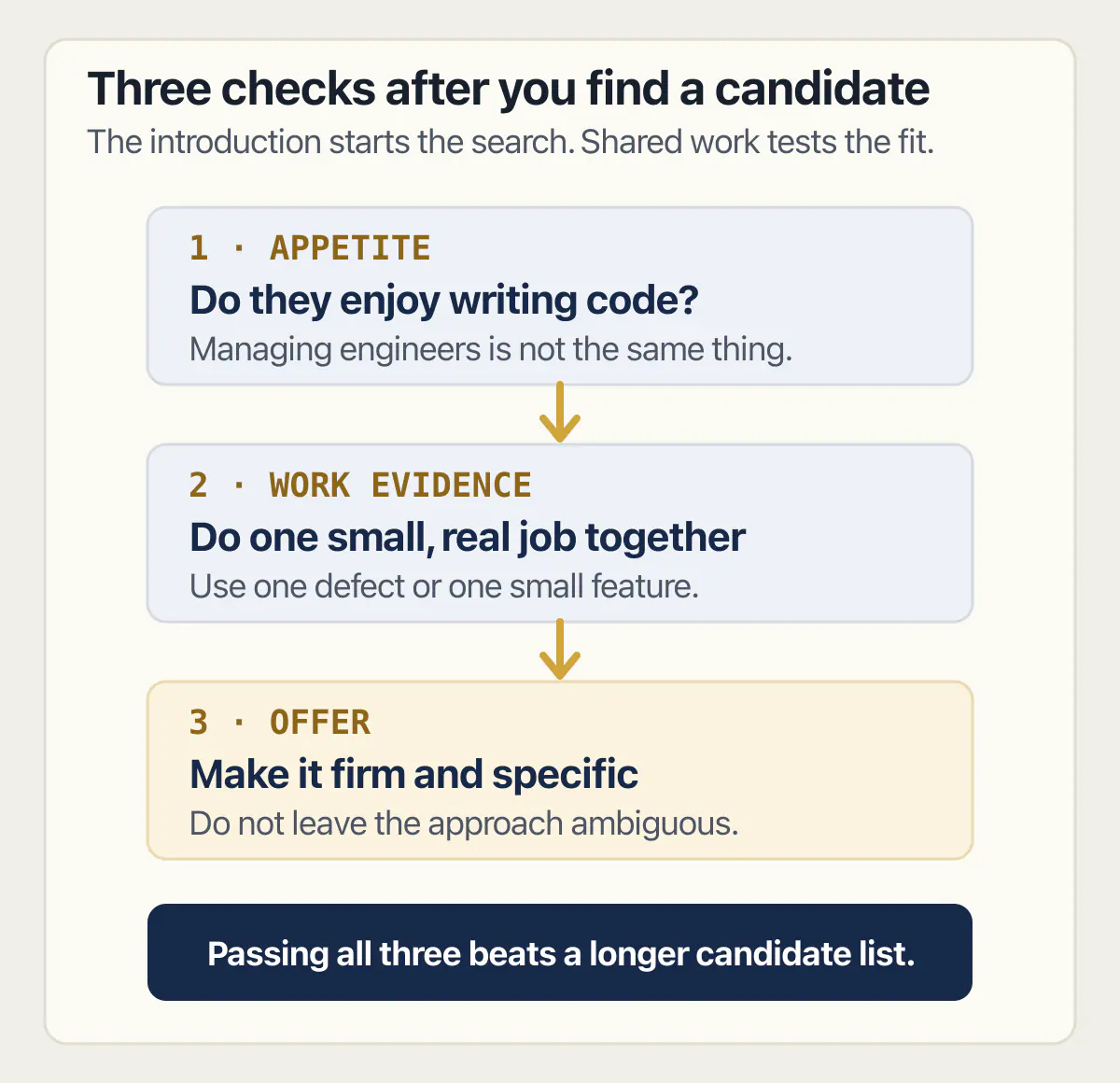
Start with the thing every serious answer starts with, which is the people you already know. Y Combinator’s library note at www.ycombinator.com/library/3i-how-to-find-a-technical-co-founder, read in raw form on 2 September 2026, tells the reader to make a list of everybody they know from high school, college and work, and then asks which of those people knows how to write code and actually enjoys it. It adds a warning in the same breath: somebody being a CTO or managing engineers does not mean they enjoy writing code. Spend more time with those people first, on something small and shared, until you know whether you work well together, and only then make a real, firm, specific offer instead of the ambiguous approach it says most people make.
That is a roster of one, and it is the pragmatic place to start, because it is the only one where the other person already knows whether they can stand you. Nobody has published a comparison of how often each route ends in a cofounder.
“I don’t need someone with a startup idea. I need someone who wants to build one.”
That was posted publicly, by somebody on the other side of this search, and it is the whole market in two sentences. The people worth finding have plenty of ideas. What they lack is a reason to believe yours is going anywhere.
When the contacts list runs out, the next place is the free matching platform the same accelerator runs. Its own page at www.startupschool.org/cofounder-matching, which redirected to www.ycombinator.com/cofounder-matching when it was read raw the same day, states that co-founder matching is a completely free product, that no equity is taken in return for using it and there are no strings attached, and that a profile is not public to the internet and is visible only to other people who have been approved for the platform. It says it is for anybody who is looking, with an idea or without one. Its four steps are its own: create a profile, get shown profiles that fit your preferences, invite somebody you like the look of, and if they accept, that is a match. The same page claims to be the largest network of its kind, with over 100K matches made.
The paid marketplaces work the same way with a membership attached. CoFoundersLab’s own homepage at cofounderslab.com, read on 2 September 2026, claims 700,000 users worldwide, 200+ expert advisors, and reach across 200+ cities and six continents, and offers joining for free. Its premium page at cofounderslab.com/premium describes what the free tier does and does not do, and the shape is the one that matters more than any figure on it: searching and messaging are limited on the free side, and unlimited searching and unlimited direct messages sit behind the paid membership. Every marketplace of this kind is sold on the same edge. You can look for nothing and you pay to reach.
That answers the question people ask in a shorter way, which is whether there is a dating app for cofounders. There is, several of them, and they are built exactly like one: a profile, a suggested list, an invitation, an acceptance. The accelerator’s version is free and gated by approval. The marketplaces’ versions are open and gated by a membership.
Then there are the public boards, which are where this search is loudest and least organised. Founders post what they are building and what they are missing. Developers post what they can do and what they want for it. Nothing is verified, nothing is matched, and it turns over fast. It is named here without naming any community, because which board is busiest this month is not a fact worth printing and will be wrong by the time anybody reads it.
The last place is the one founders reach for last and should probably look at first, which is the job boards, where the identical search is running in the opposite direction. That is the next section, because what is posted there is more useful than any list of platforms.
Which places the ranking answers send you to, and how old that advice is
Five of the pages ranking for this search were opened on 2 September 2026, read from the HTML the server returned rather than from a reading view. Two of the five could not be read at all, and they are recorded here as unread rather than summarised from a search snippet.
| Page | Where it sends the reader | What it is | Date its own source shows |
|---|---|---|---|
| Y Combinator library | Your own contacts first, then its own matching platform | A written note by Adora Cheung attached to an older video | 8 June 2020, in the page’s own embedded record |
| Founders Network | Three named places, reposted from a member | A post on a paid members-only founder network | 24 August 2011 in its schema, last changed 11 November 2018 |
| Arkenea | A development company, or hired app developers | A blog post by a company that sells development work | 27 June 2019, printed on the page and in its schema |
| Medium essay by Nir Zicherman | Nothing claimed here | A personal essay | Not readable |
| The community thread holding the top slot | Nothing claimed here | A discussion, roughly three years old by the search engine’s breadcrumb | Not readable |
The four named pages are, in row order, www.ycombinator.com/library/3i-how-to-find-a-technical-co-founder, foundersnetwork.com/flashback-finding-a-technical-co-founder-is-easier-than-you-think/, arkenea.com/blog/how-to-find-a-technical-cofounder/ and medium.com/@NirZicherman/stop-looking-for-a-technical-cofounder-c1cd76a29854, written out and not linked. The two unread rows are worth stating precisely rather than glossing. As of 2 September 2026 the essay returned HTTP 403 to an automated read, and nothing about its argument appears anywhere on this page. As of the same date the community thread returned HTTP 200 with a bot-check page and no discussion content, so nothing from it is quoted, described or counted either. Neither absence says anything about the quality of those pages. It says they were not read.
Two of the three that were readable agree on the useful part: have something before you ask. The third does not raise it at all, and sends the reader straight to a list of places instead. Most directly, the accelerator’s page says that for an iPhone app or a website you probably do not have to be that technical to build the first version, and it tells the reader to patch together a first version with existing tools that need no coding, launch it, and get some users, because at that point it is much easier to get somebody technical interested than when you have only an idea. The seller’s page arrives at the same place from the other end, telling a reader whose real motivation is getting the code written for free that they are starting off on the wrong foot.
Where they diverge is where each one sends you next, and each destination is exactly what the publisher has to offer. The accelerator sends you to its own matching platform, in a banner added to the top of the page after the original video: since the video was made, it says, YC Co-Founder Matching has launched, the advice in the video is still correct if you have an existing network to search, and the two are now recommended in parallel. The seller sends you to a custom software development company or to hiring app developers, which is the work that company sells. That is just the shape of the page rather than a scandal, and it is worth seeing before you take the advice.
The members-only network is the one that shows what happens to a roster over time. Its post carries no date anywhere in its visible body copy, checked against the delivered HTML rather than a reading view, and the year strings do not appear in the body at all. The only dates on it are in its schema block, and they say 24 August 2011 with a last change on 11 November 2018. What it recommends is a partial list of resources reposted from one of its members: two standalone lists of people looking to join a startup, and a group on a professional network. As of 2 September 2026, one of those two lists, cofoundergoogledocs.com, has no DNS record at all. A lookup returns nothing, and both the https and the plain http addresses return no response to an automated read. The other, techcofounder.com, answers over the plain http address only; the https address timed out on the same day.
There is one more absence worth scoping properly, because it is the reason this whole page exists. The seller’s post at arkenea.com was checked across its entire raw source on 2 September 2026 for the words lovable, vibe cod, ai builder, no code, no-code, chatgpt, claude and artificial intelligence. Every one of them returns zero. The string cursor returns fifteen matches and not one of them is the coding tool; five are stylesheet rules and the rest belong to a theme script that moves the mouse pointer. That page is a competent 2019 answer to a 2019 question, and it was written before a founder could describe an app and get a running one back.
The other side of the search, and what the people you want are actually posting
The half of this market founders never look at is the half where the developers post. It is public, it is searchable, and it tells you what you are competing with far better than any guide does.
Wellfound’s own remote technical co-founder role index at wellfound.com/role/r/technical-co-founder was opened once on 2 September 2026. On that read it showed page 1 of 11 and 299 results total. That is a count on a named day rather than a standing fact, and it will have moved by the time you look. Two things about the listings were consistent enough to be worth reporting. Almost every one advertises the role with a share of the company rather than a salary. And some of them had been posted months earlier and were still open, which is the most honest thing on this page about how long this takes.
Comparing what a share of the company costs against paying somebody for the same work is a separate calculation, and it is not made here: no share, no percentage and no split appears anywhere on this page, because a number like that is advice, and this page gives none.
The public asks that go up week after week have a shape in common: the person writing has the idea, the customers or the money, and describes the missing half as the one who owns the code. Several write the role out under two names in the same sentence, and several are written by people advertising what they already have rather than what they will pay.
“Early Dev looking to join a serious early-stage startup (Equity + Comp)”
A developer wrote that one, publicly, in a single line, saying what they want and what they expect to be paid in. Read the boards in that direction for an hour and the search stops feeling like a hunt for a rare person and starts looking like what it is, which is a market with a lot of supply and a matching problem.
The matching problem has little to do with a shortage of engineers. Both sides describe themselves and neither one describes the work. The founder writes what they have. The developer writes what they can do. Almost nobody writes down what would actually happen in the first month.
What changes when the thing already runs
The canonical answer on this search was written in 2020, and its central instruction was to build a first version yourself with tools that needed no coding, get some users, and use that to make somebody technical interested. That instruction was correct and it was expensive. Patching together a first version without code in 2020 meant assembling tools that were never designed to fit together, and what came out was a demonstration.
The same instruction now costs far less and produces something with a login, a database and a bill attached. That is a genuinely different object to put in front of somebody, and it changes the conversation in both directions.
In your favour: you are no longer asking anyone to imagine anything. They can open it, use it, and see whether people are using it. Nobody has to take a description on trust. Readers who have an idea and nothing running yet reach this search from an earlier place, and that earlier place has its own page.
Against you: what you are now offering is somebody else’s code, generated rather than written, and nobody has read it. The first honest question a good candidate asks is what is in there, and the answer to that question decides whether they are joining a company or inheriting a mess. Having a working app makes the approach far easier and the second conversation far harder, and founders who are surprised by that are usually surprised in the second meeting.
Both of those are true at once, and the practical consequence is small: know what is in the thing before you show it to somebody whose whole judgement will rest on what they find. Once the app is live the founder who is not a developer still owns the accounts, the bills and the decisions, whoever else joins later.
How to choose one once you have candidates
The published advice on choosing is thinner than the published advice on finding, and most of what exists is the accelerator’s. Three of its tests survive contact with an app that already runs.
The first is the one already quoted, and it is a test of appetite rather than of skill. Managing engineers and enjoying writing code are different things, and a person can be very good at the first without wanting the second at all. On an app that already exists, this is the whole question, because what the job needs early on is somebody willing to sit down and read.
The second is that you should work on something together before either of you commits, on something small and preferably not the startup. That advice was written for people at the idea stage and it converts cleanly for people with a product: pick one real defect or one small feature and go through it together, from the first look at the code to something users can see. You learn more from doing that once than from six conversations.
The third is the shape of the offer itself, and it is the one founders get wrong most often. The accelerator’s instruction is to figure out a real offer and to make it firm and specific, rather than doing the ambiguous dance most people do. Its last instruction is subtler and better: once you have the right person, do not pitch them your finished idea. Develop the idea together with them, so that it evolves with both of you. That is the difference between recruiting somebody to your project and starting something with them.
There is a practical layer under all three. Whoever joins is walking into an account structure, a set of services and a codebase that already exist, and what a developer taking over an existing app actually needs to see is the same list whether that person is a partner, a contractor or an employee. Having it ready before the second conversation is worth more than anything you say in the first. So is being clear about who ends up carrying an AI-built app once it is live in front of real users, because that is the job you are asking somebody to share.
If the search does not end in a cofounder
Plenty of these searches do not end in a cofounder, and there is nothing wrong with the ones that do not. Sometimes the honest reading is that the work you need done has an end to it, and a partner who shares the company is a different purchase from somebody senior bought by the month, even though the two words get used as though they were one thing.
What to do instead of finding one, option by option, is a separate list. Deciding whether this search is the right one to be making in the first place turns on what you already own, and that decision belongs on its own page. Choosing and paying a person to do a named piece of work runs on a different sequence from looking for a partner, and running the two sequences together is where most of the wasted months go.
Since this page has named a lot of other people’s businesses, here is AxonBuild’s own, once, and then it is done. It belongs on none of the lists above. That is a different thing from a partner, from a hire and from a membership, and it is deliberately not one of the options this page has been describing.
Common questions about finding a technical cofounder
Where do I find a technical cofounder?
In four places, in this order: the people you already know, the free matching platform an accelerator runs, the paid matching marketplaces, and the public boards and job boards where developers post their own asks. The first of the four is where existing trust already lives, and it has the smallest supply. The two matching products work with a profile and an invitation; the public boards and job listings verify and match nothing, so treat what you read there as a starting point rather than a shortlist.
How can I find a co-founder?
The same four places serve any cofounder search, technical or not, because the platforms do not sort by discipline at the front door. If what you want is somebody to run the commercial half rather than the code, the roster is identical and only your own profile changes. The one thing that changes your odds on any of them is having something a stranger can open.
Is there a Tinder for cofounders?
Yes, several. The accelerator’s own matching platform states that it is free, takes no equity, and keeps your profile off the public internet and visible only to others approved for it, and its four steps are a profile, suggested matches, an invitation and an acceptance. The paid marketplaces run the same loop with searching and messaging limited until you pay.
How can I find a technical cofounder for my idea?
Harder than finding one for a product, and two of the three readable answers on this search say so in their own way. The published advice is to build the smallest working version first, get somebody using it, and approach people after that rather than before. What that first version costs to make has fallen a long way since the advice was written, which makes the instruction easier to follow now than it has ever been.
How do I find good cofounders?
Good is decided after you find them rather than during the search. The published tests are whether the person enjoys writing code rather than only managing people who do, whether you have worked on something small together before either of you commits, and whether you can make them a firm, specific offer instead of an ambiguous one. Somebody who passes all three is worth more than a longer list of candidates.
How long does it take to find one?
Nobody publishes a trustworthy figure for this, and any page that prints one is guessing. The nearest honest signal is on the supply side: on a read of one job board’s remote technical co-founder index on 2 September 2026, some of the listings had been open for months. Both sides of this market wait.
What should I send when I first approach somebody?
Something they can open, and a specific offer. The accelerator’s own advice is that the ambiguous approach most people make is the mistake, and that the fix is a real offer made firmly. If your app already runs, the link to it does more work than any description of the idea, because it removes the part they would otherwise have to take on faith.
How can I find a CTO co-founder for my startup?
Through the same four places. The word CTO changes what people expect the role to include rather than where the person is found, and it is worth being careful with, because it means one thing on a three-person team and something else entirely in a company with an engineering department. Decide what you actually want the person to do before you put a title on the search.
Do the free platforms actually work?
They match people, which is what they claim to do, and the free one is free on its own published terms. What none of them can do is make you interesting to the person on the other end. The platforms handle introductions. Everything that decides the outcome happens after the introduction, and most of it depends on whether the thing you are building already exists.
If you have a working app built with these tools and need it ready for real customers, this is what we do.
Built it with AI. Now it has to hold up for real customers.
The Production Hardening Sprint takes the app you already have and builds the production foundation underneath it. Authentication and access rules, payments that stay consistent, error handling, monitoring, backups, automated tests and a documented handover. Our engineers work inside your existing codebase for ten working days. All 123 deliverables are included, and you get the evidence for each one.
See the Production Hardening Sprint →  $2,500 fixed price · 10 working days · One codebase