The fractional chief technology officer in this comparison is somebody senior who runs the technology side for part of the week and is paid for the days they work. The technical cofounder is a part-owner of a software startup who writes its code. Those two are what this page tells apart, and neither of them is the court order, the community treatment order or the crypto community takeover that the letters also stand for, or fractional ownership in the finance sense.
The two words point at two different things to buy. A fractional chief technology officer sells you hours of senior judgement that stop the week you stop paying. A technical cofounder holds part of the company and does not go away when the budget does. Your code decides which one you meant, rather than your budget.
You have an app. It works, people use it, and you did not write it. Somewhere along the way you read both phrases, probably on a page that was selling one of them, and they appeared to describe the same person: somebody senior and technical who would take the app off your hands and make the decisions you cannot make. They do not describe the same person, and picking the wrong word is the kind of expensive you only find out about later.
A note on the reading behind this page: the eight results Google returned for this comparison on 2 September 2026 were all requested; the six that answered were opened as source and checked for one thing, whether any of them writes for an app that already runs; the two results on a community site and a professional network could not be opened and are used only as a title and a search snippet; the founders’ words below are public posts carried without a name or an address; and nobody was placed, hired, interviewed or tested for this page, and no arrangement of either kind was entered into.
Fractional CTO or technical cofounder: what is the difference?
Three things separate them: how the arrangement starts, who decides what gets built, and what ends it. A fractional chief technology officer is bought by the week and paid in money. A technical cofounder is given part of the company and decides alongside you rather than for you.
Start with how the arrangement begins. A fractional one opens with a conversation about availability. How many days, which days, starting when, and what happens if you need more. It is a purchase, and it is written down as one. A cofounder arrangement starts with a conversation about ownership, and the paperwork that follows changes who owns your company. That paperwork is slower to write and much slower to undo. The two conversations feel similar in the first meeting, because both of them are you describing your app to somebody who understands it faster than the last three people did. They stop feeling similar the moment somebody sends a document.
Then who decides what gets built. With a fractional lead, you keep the decision. Their job is to put the trade-off in front of you in words you can act on: this will hold as you grow, that will not, this integration will cost more than the feature is worth. You can ignore the advice, and plenty of founders do. With a cofounder, the decision is shared by design. That is the point of giving away a share, and it is also the risk. A cofounder who thinks the whole product should be rewritten from the start has standing to argue for it, and standing is not something you can withdraw when the argument gets tiring.
Last, what ends it. A fractional arrangement ends when you stop paying for it, which is the honest reason so many pages sell it to founders who are nervous. A cofounder relationship ends through a vesting schedule, a buyout, or a fight, and often through all three in that order. This is the separator that gets written about least and matters most, because it is the separator that still holds once the novelty has worn off.
| A fractional chief technology officer | A technical cofounder | |
|---|---|---|
| How it starts | A conversation about days and a rate, then an agreement you can end | A conversation about ownership, then paperwork that gives away a share |
| Who decides what gets built | You decide, with their advice on the table | You both decide, and they have standing on the technical half |
| What ends it | You stop paying | A vesting schedule, a buyout, or an argument |
Read the table down the middle column and you are reading a service. Read it down the right and you are reading a marriage with a cap table attached. What a fractional chief technology officer is, in full, gets its own page, and this one starts after you already know the term and are holding it next to another one.
One question sits underneath the table and this page does not settle it. Whether somebody in the fractional role will open your code themselves or only advise on it is argued where that question belongs, and it changes what you would actually be paying for.
Four questions about your own app that tell you which one you meant
Four questions about the app itself settle which word you meant: whether anybody has read the code, whether the work that is left has an end, whether somebody has to be there when you are not, and whether you need to be able to replace them. Answer them honestly and the word picks itself.
- Has anybody read the code? Not running it or clicking through it, but reading it, line by line, with the authority to say what is wrong. If an assistant wrote most of your app and no experienced person has ever opened the files, that reading is the first job, ahead of both leadership and ownership. Having somebody read the code you already have is a smaller and separate purchase from either of the two arrangements on this page. It also tends to change what you ask for next.
- Does the work that is left have an end? Write down what needs to happen. If the list finishes, you are buying jobs, and a person you can end an agreement with is the right shape for that. If the list is genuinely endless because the product is the business and will keep changing indefinitely, you are describing a role rather than a job, and roles are what the cofounder conversation is for.
- Does this person need to be there when you are not? A fractional lead is there on the days you bought. Everything else waits. That works when the app is stable and the questions arrive in batches. It stops working when your users are in a different timezone, something breaks on a Saturday, and the only person who understands the payment flow is not contactable until Tuesday.
- Do you need to be able to replace them? This is the question founders skip, and it decides which paperwork you end up signing. A fractional arrangement is replaceable by design. A cofounder is not, and any arrangement you would find painful to unwind should be priced as a cofounder arrangement whatever the person calls it.
Whether you need a technical cofounder at all has its own answer on another page, and this one only tells the two words apart. If your honest answer to the second question is that the work does finish, the question of when a part-time technology lead is worth buying has an answer of its own too.
Any arrangement you would find painful to unwind is a cofounder arrangement, whatever the person calls it.
Who publishes the answers to this question, and what they sell
Google returned eight results for this comparison on 2 September 2026: one article on a professional network, one community thread, five company sites and one personal site. Six of the eight answered an automated request, and every one of those six was published by a company or an individual selling development work, part-time technology leadership, or both. Five of the six are comparison pages by title, and the sixth is a definitional page about the fractional role that carries the comparison as one of its sections. All six are named below and none is linked: each of them sells one of the options under comparison, so naming a page is a citation and linking it would be an introduction.
The clearest case is PixelPerinches, a build company whose page at pixelperinches.com/blog-fractional-cto-vs-cofounder.html, marked updated 2026-07-13, runs through quick definitions, a cost comparison, a decision matrix by stage and a section on equity, and then arrives at a heading called “Where PixelPerinches fits” whose body copy reads: “We act as a technical co-founder alternative: we ship the MVP, advise on architecture, and can stay through growth, without forcing you into a messy early equity split.” The page ends with a free cost calculator and a booking link. The comparison is real work. It is also the introduction to the third option, which happens to be the publisher.
ISHIR’s page, at ishir.com/blog/326688/technical-co-founder-fractional-cto-dev-agency-or-venture-studio-how-to-choose-the-right-technology-partner.htm, compares four things rather than two: a technical cofounder, a fractional CTO, a development agency and a venture studio. It sells three of the four. Its section headed “Quick comparison: Technical Co-Founder vs Fractional CTO vs Dev Agency vs Venture Studio” is worth a note for anybody trying to check this comparison against a machine, because when the page was read as source on 2 September 2026 the comparison under that heading was an image rather than a table, and the document contained no table element at all. Further down, a section headed “How ISHIR Helps Founders Build, Scale, and Fund Technology Products” says the rest. As of 2 September 2026 the page carries no publication or update date in its body copy; the dates exist only in the page’s metadata, which gives 3 June 2026 and is not something a reader sees.
The page at christianvismara.com/technical-co-founder-alternative belongs to one person selling fractional chief technology officer work, and it is honest about that. Its heading reads “You don’t need a technical co-founder. You need to start building.” The body underneath describes the author joining one company as its first engineer and another as its fractional CTO, which is a real account and also the sales argument. As of 2 September 2026 that page carries no date at all, in body copy or in metadata.
Shiny’s page, at useshiny.com/blog/fractional-cto-alternative-to-technical-co-founder/, is a fractional-CTO marketplace writing about the alternative to a cofounder, and it carries the date August 1, 2022 on the page itself, read as source on 2 September 2026. Anybody weighing its advice about a working app should notice that the page predates the tools most of those apps were built with. Its later section is headed “How to Hire a Fractional CTO for Free with Shiny”.
Two of the eight compare something slightly different from what the search asked for. WTT-Solutions, an outsourcing development company, dates its page at wtt-solutions.com/blog/technical-cofounder-vs-cto 30 March 2026 and compares a technical cofounder with a full-time chief technology officer rather than a fractional one; its body copy states that “Most CTOs join after a seed or Series A round when the product is already in production with active users and paying customers.” mvpdevelopment.company runs a definitional page at mvpdevelopment.company/blog/fractional-cto whose own heading asks what a fractional CTO is, and the comparison with a cofounder sits inside it as one section among many.
The two results this page could not read are the two written by people rather than companies. The result at rank one is an article on a professional network; Google’s breadcrumb for it reads three years ago, and the page itself did not answer an automated request, so only its title and snippet are available here. Rank two is a community thread, also snippet-only, and its title as Google returns it is “Being fractional CTO / co-founder - worth it?”, which is somebody deciding whether to take the role rather than somebody deciding whether to buy it. Of what could be read, all of it is written from the seller’s side of the market.
Then the absence, which is why this page is here. Across the six documents that answered a request, the phrase vibe coding appears exactly twice, and both appearances are site chrome rather than body copy: a footer link on christianvismara.com labelled “Vibe Coding Security Audit”, and a footer hire-skills item on ISHIR’s site labelled “Vibe Coding Cleanup Services”. In the body copy of those six pages, two of them mention tools of that kind at all: the outsourcing company’s page says AI tools and no-code platforms have made technology more accessible, and ISHIR’s answer to the question of how to build an MVP without a technical cofounder lists using low-code tools for early validation as one of four routes. Neither passage is addressed to somebody whose app already runs, and none of the six has a section for a founder whose working app was produced that way. Every one of them settles the question at the stage before the app exists: at a funding round, at an unbuilt MVP, at the start. If your app is already running and already has users, the pages that rank for your exact question were written for somebody else, and they are selling into that gap from the other side of it.
The buyers who use both words at once
The confusion comes out of the market’s own vocabulary rather than out of careless reading, and you can watch buyers produce it in public. One founder advertised for the two roles as though they were one, asking for somebody who would take the build on alone and own the payment side of it. A public post in August 2026 went up under the title “Looking for an AI app cofounder”, which is five words carrying the whole problem: the poster wants the app finished and has written that wish as a search for a part-owner.
The sellers write it the same way. Five of the six pages read here carry both role names inside the same heading, and one of them puts four options in a single line. When the pages that define the words fuse them, and the pages that sell against them fuse them too, a buyer writing one advertisement with both names in it is behaving reasonably.
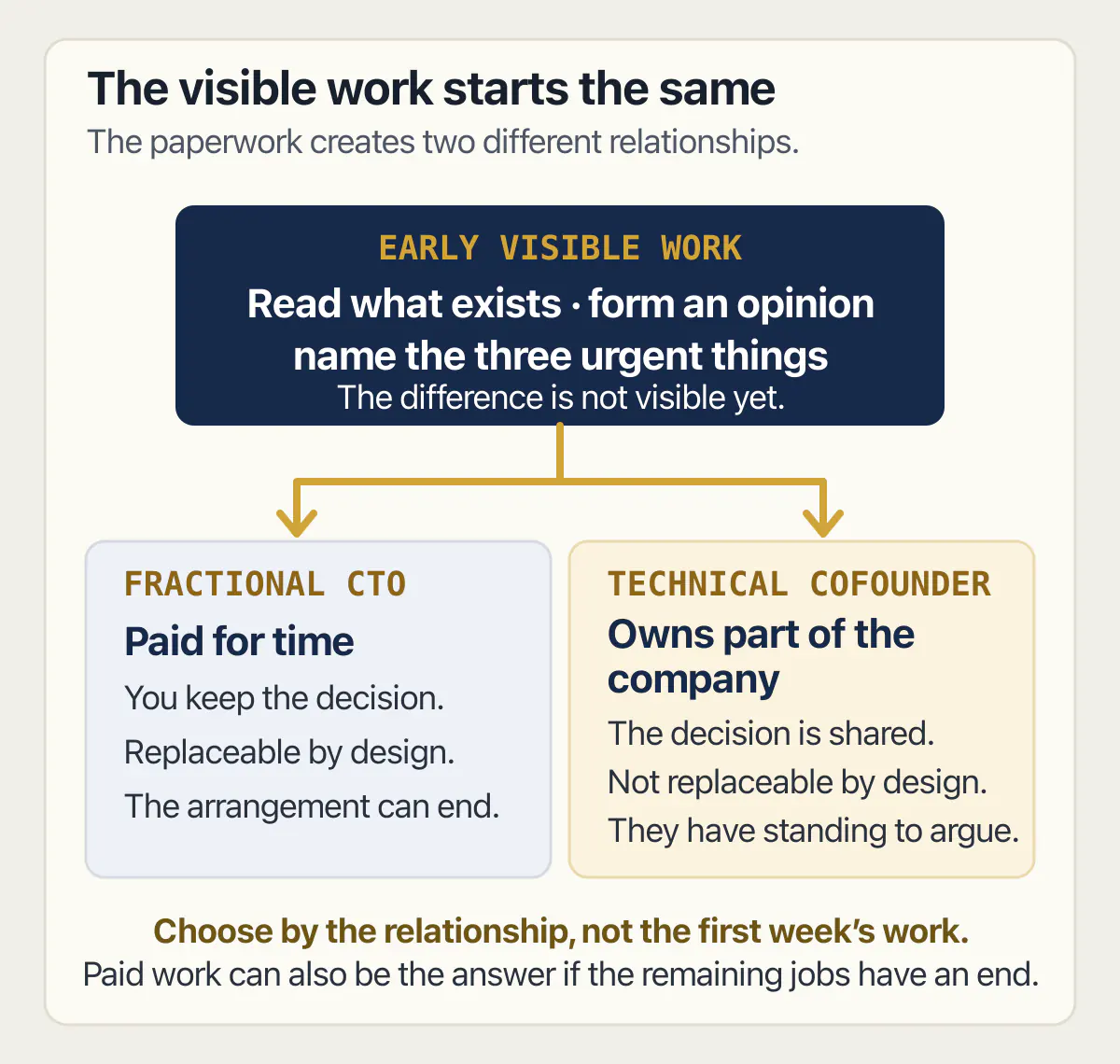
There is a practical reason the two overlap at the start. Early on, a fractional lead and a technical cofounder do the same visible work: read what exists, form an opinion, tell you which three things are urgent. The divergence is invisible early because it lives in the paperwork rather than in the work. Once the arrangement has been running a while, one of them has been paid and can be replaced, and the other owns a piece of your company and has opinions about the next round. That is why matching what somebody does at the start to a word is a poor way to buy either of them.
Some of the difficulty is the vocabulary itself. The other names sellers use for the same part-time arrangement, and what each name signals about hours, are collected on their own page.
When neither word is the answer
Both words describe attaching a person to the company. Plenty of owners of a working app do not need that. They need three specific things finished, and then to be left alone until the next three come up.
The route out of the comparison starts with the work rather than the title. Which parts of a running app are worth paying anybody for, and which parts stay yours, gets decided one job at a time somewhere else, and that split is more useful than either noun when your list is short. If the answer turns out to be neither word, the other routes open to you are laid out separately. Finding a technical cofounder, where that search happens and what it takes, is its own page.
Some owners want neither of these two things, but simply somebody who is around on an ongoing basis without holding a share of the company. That is a third shape, and it has published norms of its own. What an ongoing arrangement with a developer covers, and how such fees get published, belongs to the page about that purchase.
Whichever of the two you end up with, what they need from you on the first day is the same short list, written out on its own page. That list is also a cheap test of the person: somebody who reads it and asks two sharp questions about your database is not the same hire as somebody who asks for the login and starts pushing.
Attaching a person to the company is a slower decision to undo than buying the work that is actually left.
Common questions about fractional CTOs and technical cofounders
Is CTO higher than co-founder?
They are not on the same ladder, so neither is higher. Cofounder is an ownership fact: it says a person holds a share of the company and was there near the beginning. Chief technology officer is a job: it says a person runs the technology. One person can hold both, one, or neither, and in a three-person company the title matters far less than who is allowed to say no.
Is fractional CTO a thing?
Yes, and there is a market of providers, marketplaces and individuals selling it. On the search results page for this comparison alone, on 2 September 2026, a marketplace, a build company and an individual practitioner all published pages arguing that the fractional version is the better buy. Treat it as a real arrangement with real sellers, and read each page with the seller’s interest in view.
Can the same person be both?
Yes, and it happens often enough that some people advertise it. Somebody starts part-time and paid, the work goes well, and the arrangement is converted into a share of the company. The order matters: paid first, then ownership, means both sides have evidence before anybody signs. Ownership first, on the strength of a good first meeting, is the version that goes wrong.
Which one do I need if my app already works?
For most owners of a working app, the honest answer is neither yet. A working app with users is proof you got something built, and what it usually needs first is somebody experienced to read the code and tell you what is actually in it. That reading changes the question. Often the gap that reading turns up is a short list of unfinished jobs rather than a missing person.
What is a co-CTO?
Where founders use the phrase at all, it means two people sharing the chief technology officer job, usually because neither wanted to be the other’s manager. It is rare, and it is a phrase to be careful with when you are searching, because much of the search demand behind it has nothing to do with startups: on 2 September 2026 Google’s own autocomplete for “co-cto” offered “co cto meaning”, “co cto trial” and “co cto role”, and “co cto trial” in turn suggested “what is a community treatment order (cto)”, which belongs to mental-health law. Searching those three letters on their own will not bring you what you want.
How much does each one cost?
They are not priced in the same units, which is why comparing the two numbers directly is misleading. One is paid in money for time. The other is paid in a share of the company, which costs nothing today and can cost more than any invoice later, depending on what the company turns into.
Do I have to give away part of the company to get technical help?
No. Paying for the work is the ordinary route, and the reason cofounder searches are so common at the idea stage is that there is nothing yet to pay with. Once an app exists and people are using it, you have both more to protect and more to pay from, and the case for handing over a share is weaker than it was.
What if I do not want either arrangement?
Then buy work instead of people. Get the code read, write down what is unfinished, and pay for those jobs one at a time, keeping the ones you can do yourself. It is slower to feel like progress and much easier to stop.
Comparing those routes side by side, including the paid ones, is a separate page.
Owning an app means being able to run it, change it and recover it without guessing. The sprint below leaves you with the runbooks and documentation to do that.
Built it with AI. Now it has to hold up for real customers.
The Production Hardening Sprint takes the app you already have and builds the production foundation underneath it. Authentication and access rules, payments that stay consistent, error handling, monitoring, backups, automated tests and a documented handover. Our engineers work inside your existing codebase for ten working days. All 123 deliverables are included, and you get the evidence for each one.
See the Production Hardening Sprint →  $2,500 fixed price · 10 working days · One codebase