A web developer retainer is a prepaid claim on a developer, usually a block of hours and sometimes an unlimited-requests plan with a capacity limit in place of an hour count, plus the right to jump the queue. It earns the money when you will genuinely use the hours and when waiting a week for a fix would cost you something. For one small app that changes a few times a year, it usually does neither.
Everything ranking for this search is written by somebody standing on the other side of the table. Four sellers publish the case for the arrangement they sell. One designer publishes the case against the arrangement she stopped selling. Document vendors publish blank agreements that list the clauses without telling you which one matters. And the one community thread that ranks on all three searches is a seller-side discussion, judged from its search listing rather than from the thread itself, which does not open to an automated read.
Nobody adds up what the smallest block on the market costs against what one small application actually consumes. That subtraction is the whole of this page.
Every figure and every clause below comes from a page held by one of the three retainer searches on 1 September 2026: four sellers’ own pages, four blank agreements published by document vendors, one trade publication’s guide for designers, and one designer’s post explaining why she stopped offering the arrangement. The prices were confirmed against the page source rather than the rendered page, because a shop’s price block is often assembled in the browser.
What a web developer retainer is, and where the number comes from
Envato Tuts+, in a guide for designers dated 20 February 2024 at webdesign.tutsplus.com/a-guide-to-monthly-retainer-agreements-for-web-designers--cms-108493a, defines it in two sentences: “A retainer is a monthly contract between a web designer and a client. The client pays a fixed fee in advance to retain the web designer for a specific set of services or number of hours of work.”
The contract-template publisher eSign, on its web development retainer agreement page at esign.com/employment/independent-contractor/retainer/web-development/, marked last updated 17 May 2025 and read on 1 September 2026, adds the part buyers usually miss. The upfront payment, it says, “generally covers the developer’s initial service costs, with any additional charges billed to the client separately”. On the block-hour model, prepaying buys a quantity rather than an unlimited month, and work past the quantity arrives as a second invoice.
The same page carries the sentence no seller page prints, buried in its own instructions to developers on how to price the thing. It tells the developer to set an hourly rate first, then multiply that rate by the estimated hours to arrive at the retainer fee, and suggests discounting the result to reward paying up front.
Read that from the buyer’s chair and the monthly figure stops being mysterious. It is somebody’s guess at how many hours your app will need, priced at their rate, collected in advance. The person making that guess has usually never opened your code.
Both halves of that multiplication belong to somebody, and only one of them is yours. What one hour of a developer’s time actually sells for, and how far that price moves with seniority, is collected on a page of its own. Buying hours and buying one agreed figure fail in different places, and which failure you can live with is argued somewhere else again. This page is about the half you own: how many hours your particular application actually generates.
People do go looking for this arrangement by name, and they go looking early. One post on a developers community in August 2026 opened with the whole shape of the request in its title: “I am looking for indie Unity Mobile developers(Paid) for monthly basis project”. That is somebody asking for a monthly arrangement before anybody has quoted anything, which is the normal order. The price question arrives second.
Somebody weighing the same decision asked out loud whether paying for hosting and paying for later changes were one arrangement or two. They are two, and conflating them is the most common way a small owner ends up on a monthly bill that covers neither properly.
What a web developer retainer fee looks like on published pages
Of the four sellers on these searches, two publish a number and two do not. Both of the two price the arrangement in the low thousands per month, and one of them publishes the hour block that goes with each price.
| Hours a month | Seller, as the page names the plan | Published price | Read |
|---|---|---|---|
| 16 | Canny Creative, website retainer guide | £2160/month | 1 Sep 2026 |
| 40 | Canny Creative, website retainer guide | £3400/month | 1 Sep 2026 |
| 64 | Canny Creative, website retainer guide | £5120/month | 1 Sep 2026 |
| Not stated | Hey Reliable, Monthly Retainer | $2,995+ a month | 1 Sep 2026 |
Canny Creative’s guide, published 4 February 2025 and marked last modified 20 August 2026 in its own page source, at canny-creative.com/blog/website-retainers-what-marketers-need-to-know/, prints those three lines under a sentence saying its pricing is based on the number of hours required. The three figures were confirmed in the page source, not just the rendered page.
Hey Reliable’s figure comes from its own pricing page at heyreliable.com/pricing/, also confirmed in the page source. The plan is listed there as Monthly Retainer, described as an unlimited development retainer, with the price printed as a plus figure and labelled a starting monthly price. Its terms line says there are no long-term contracts and that a client can adjust or cancel before the next billing cycle.
Three dated limits belong with that row rather than after it. As of 1 September 2026, the seller’s dedicated retainer page at heyreliable.com/web-development-retainer/ returns an access-denied response to an automated read, so nothing on it is used here. As of the same date, the pricing page states no hour allocation for that plan, because the plan is sold as unlimited requests rather than as a block. And as of the same date, it states no response time and no turnaround time in hours or days to an automated read.
The two sellers who publish no price at all are worth naming, because their absence is the finding. Oneupweb’s post at oneupweb.com/blog/why-web-development-retainer-agreements-make-sense/, posted 18 July 2024, argues the case for the arrangement across six numbered reasons and states no figure anywhere on the page. Cool Code Company’s explainer at coolcodecompany.co.uk/what-we-offer/software-support/monthly-retainer/what-is-a-monthly-retainer renders no price, no response time and no article date to an automated read on 1 September 2026.
One number carries the rest of this page. The smallest block anybody here sells is sixteen hours a month. No average is taken across the two sellers, no hourly figure is worked back out of the pound prices, and the two currencies are not turned into one band, because a pound price and a dollar price from two different shops are two facts and not a range.
The hours test
Two questions, both answerable this week from your own records, and neither of them about how big or how complicated your app is.
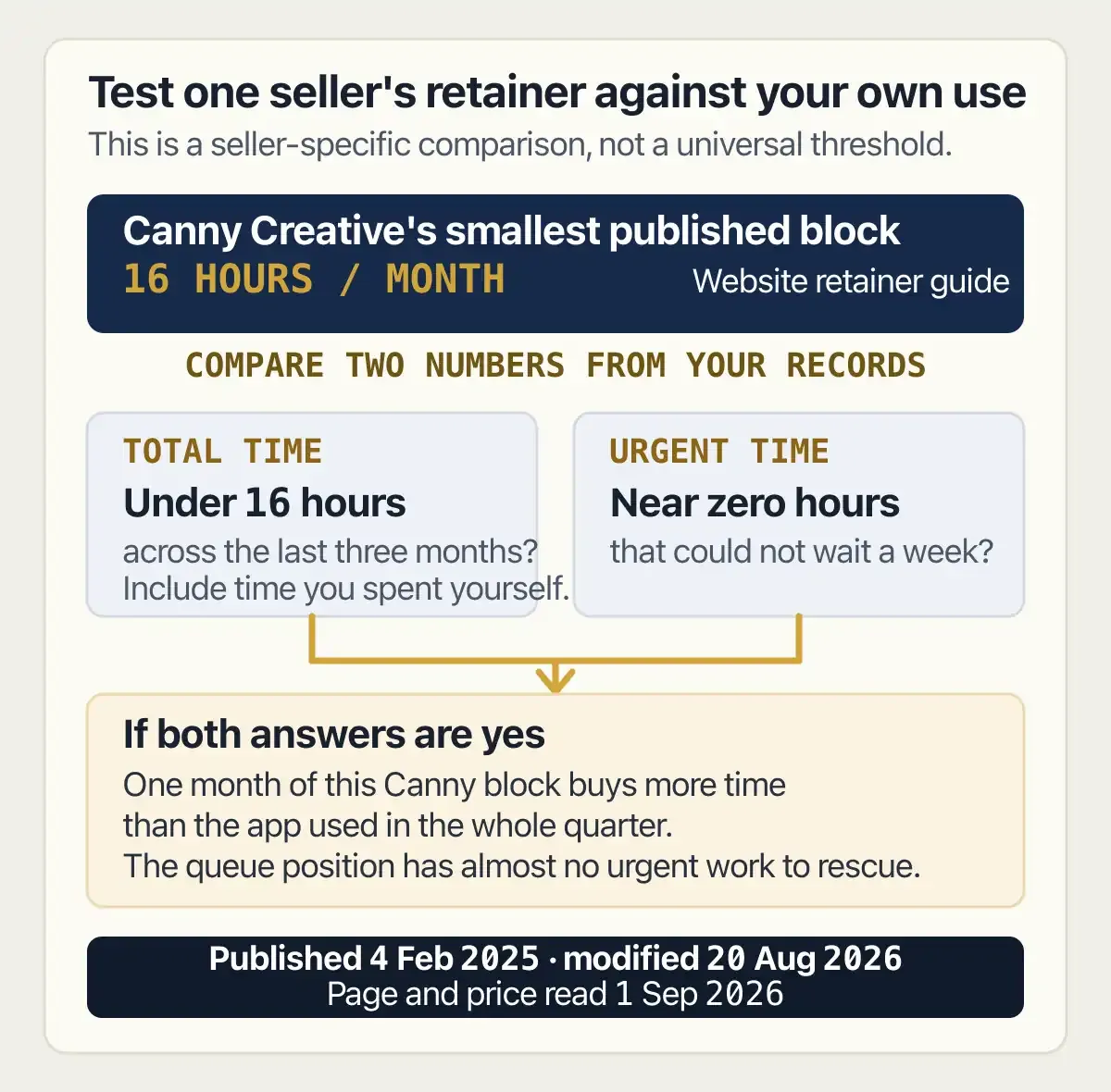
How many hours of somebody’s time did the app actually need over the last three months? Hours, not incidents. A password reset somebody handled in four minutes is four minutes. A dependency update that ate a Saturday is six hours. Add up the real time, including the time you spent yourself, and write down one number.
How many of those hours could not have waited a week? This is the second thing a retainer sells, and it is sold harder than the first. Oneupweb states it plainly on its own page: a retainer client’s needs sit “at the top of our to-do list”, with “a quick turnaround for addressing urgent bugs, tweaks or updates”. Note that the page names no time to go with that. Queue position is real and it is worth money, but only for the hours that genuinely could not wait.
Now the rule. If the first number comes in under sixteen hours a quarter, one month of the smallest block on sale already buys more hours than your app used in the whole quarter, and a monthly arrangement is buying idle time. If the second number is near zero on top of that, the queue position is not rescuing the purchase either, because you have no urgent hours to put in front of anybody else’s.
The seller who ranks first for this search puts the demand side on the record from her own client list. Paige Brunton, who builds websites and explains at paigebrunton.com/blog/who-no-monthly-retainer why she decided never to offer monthly packages, writes: “The average number of client emails I got with questions after a project is completed? 2 per year for the first year, and exactly 0 after that.” Her stated reason for the decision is about the shape of the promise rather than the money: with a retainer, she says, “you are basically pledging to make yourself available to that client, and you never really know when that client is going to want to cash in”. The visible byline on that post shows a day and month with no year; the page source dates it 23 May 2017 and marks it last modified 12 December 2024, both read on 1 September 2026.
There is one honest complication, and it lands on exactly the readers this page is written for. The first question is harder to answer on an app a generator produced, because the work arrives when something nobody was watching stops working rather than as a stream you can see coming. Of the twelve areas AxonBuild’s audits score, reliability and correctness sat at the bottom, with an average of 31.4 out of 100 over the 21 third-party applications inside a fixed cohort of 26 real applications audited in June and July 2026 by documented analysis of their code. Low reliability is precisely the condition in which last quarter’s hours are a bad guide to next quarter’s.
That cuts both ways, and it is worth being straight about it. Unpredictable does not mean large. An app can be entirely capable of surprising you twice a year and still generate four hours of work in twelve months. The right response to a number you cannot forecast is to keep the commitment small, not to make it monthly.
What belongs in a web developer retainer agreement
The templates on this search all list their clauses in the language of the person drafting them. Here is the same list in the language of the person paying, with the fetched page that names each one.
| In plain words | What a good answer looks like | Named by | Read |
|---|---|---|---|
| What the money covers, and what it does not | A written list of the ordinary work, plus what gets billed separately | Legal Templates, Genie AI | 1 Sep 2026 |
| How many hours a month, and how they are counted | A number, and who logs the time | Envato Tuts+, Canny Creative | 1 Sep 2026 |
| What happens to hours you did not use | Whether the month resets, and whether anything is refundable | Legal Templates, Canny Creative | 1 Sep 2026 |
| How fast they have to answer | A stated time, not a promise of speed | Genie AI, Legal Templates | 1 Sep 2026 |
| What you pay when the month runs over | The rate, or the right to draw on other months | Cool Code Company | 1 Sep 2026 |
| How you stop, and how much notice | A number of days in writing | ManyRequests, Genie AI, eSign | 1 Sep 2026 |
| Who owns what gets built | Ownership of the code named in the paper | Genie AI | 1 Sep 2026 |
Envato Tuts+ lists thirteen items it says the contract should contain, which is more than any seller page names and still leaves the buyer to work out which ones decide anything. Legal Templates, on its web development retainer agreement page at legaltemplates.net/form/employment-contract/independent-contractor/consulting/retainer/web-development/, marked last updated 25 May 2026 and read on 1 September 2026 after an earlier automated read was refused, is the only one of the four blank agreements that tells the writer to confirm whether monthly hours reset each period and to note whether unused fees are refundable. It also tells them to set limits on monthly work, naming request caps, turnaround times and support hours.
The honest finding across the four templates is how little any of them settles. eSign’s sample agreement runs to seven numbered clauses, and its termination clause reads “Either party may terminate this Contract upon [#] days’ written notice” with the number left blank. That sample states no hour allocation, no rollover term and no response time. ManyRequests, at manyrequests.com/templates/web-development-retainer-agreement, marked last updated 25 January 2025, lists nine parts and is one of two pages that names a number for getting out, recommending “a 30-day notice for termination to allow both parties to wrap up ongoing projects”. Genie AI, at genieai.co/en-us/template/web-developer-retainer-contract, marked last updated 28 May 2026, is the other, saying most such contracts allow either party to end the agreement “with proper notice, typically 30 days”.
Genie AI, read on 1 September 2026, is the only fetched page that names a response time as a service level the agreement should define, listing it beside performance standards. Legal Templates comes nearest to that, with the turnaround-time cap just named. Set that against three seller pages that state no response time of their own and the position is clear enough: how fast somebody has to answer is a promise that exists only if it is written down with a number attached, and on these pages it usually is not.
The one clause on that list this page does not argue is ownership of the code, which is a bigger question than a monthly arrangement and is settled on its own terms. Who owns an application somebody else built, and what has to be in your name before anybody works on it, is worked out separately.
Where a software maintenance and support services agreement is different
Buyers meet the longer name when the seller is larger, and the difference is mostly one of formality rather than substance. It is the same paper written for a buyer who expects promises in writing.
Two things tend to be present in the longer document that are missing from a one-page retainer note. The first is a stated response time. Genie AI names response times and performance standards as terms the agreement should define, and no other page fetched for this search puts a response time in the paper at all; Legal Templates’ instruction to cap turnaround is the nearest thing to one. The second is a named list of what is covered, separate from what gets billed on top, which Legal Templates also treats as a term to write out rather than assume.
If a seller offers you a short retainer note with neither of those in it, asking for both is a reasonable request rather than a difficult one. You are not asking them to change the price. You are asking them to write down the two things the price is supposed to buy.
What happens to the hours you did not use
Four of the fetched pages raise the unused hour, and not one of them settles it on your behalf. This is the single most valuable question to ask before signing, and the answer is different at every seller.
| Page | What it says about hours you did not use | Read |
|---|---|---|
| Canny Creative, website retainer guide | Tells buyers to clarify whether unused hours can roll over, and states no policy of its own | 1 Sep 2026 |
| Envato Tuts+, designer guide | Warns the designer that clients who do not use the services expect to roll them over | 1 Sep 2026 |
| Oneupweb, retainer post | Says the model lets a client bank hours for future projects in a light month | 1 Sep 2026 |
| Cool Code Company, retainer explainer | Describes rolled over or future hours as one of two ways sellers handle an overrun | 1 Sep 2026 |
| Legal Templates, retainer agreement page | Tells the writer to confirm whether hours reset and whether unused fees are refundable | 1 Sep 2026 |
| eSign, retainer agreement template | Leaves the retainer itself as a refundable or non-refundable checkbox, unticked | 1 Sep 2026 |
Canny Creative’s wording is the one to hold a seller to: it tells a buyer to clarify “how hours will be tracked, what happens if allocated time exceeds the agreement, and whether unused hours can roll over”. Its own page then answers none of the three.
Oneupweb answers the light month directly and in the buyer’s favour. Its post says the arrangement “ensures you pay for what you need and ‘bank’ hours for future projects when you don’t”, and describes working ahead in a heavy month instead. Cool Code Company describes the mirror image, the month that runs over: “If the hours of a retainer are exceeded during the period, some development companies may choose to charge the client at the standard or a discounted hourly rate to continue the work. Others may allow the client to use ‘rolled over’ or future hours to undertake the work.”
Banked hours are worth less than they sound if they expire. Hey Reliable sells prepaid hour blocks alongside its monthly retainer and states on its pricing page that those hours are good for two years and are non-refundable, which is a clearer answer than most retainer pages give and still means an unused hour has a deadline on it.
So the question worth asking is what happens to a rolled over hour that is still sitting there in eighteen months, which is a sharper question than whether hours roll over at all. If the seller cannot answer it in one sentence, the answer is that the hour disappears.
Paying for repairs one at a time
The alternative rests on arithmetic rather than on principle. Set the demand the designer quoted earlier recorded from her own finished projects against the smallest block on sale, and the gap is not close: a handful of questions in the first year, nothing after it, against sixteen hours every month for a year. An app that generates a couple of questions a year does not fill one of those months, let alone twelve of them.
Buying per job costs you the two things the monthly figure was buying. You lose the queue position, which means finding out on the day whether somebody is free. And you lose the person’s memory of your application, which is real: a stranger reloading your code costs time that a returning developer does not spend. Both are worth something. Neither is usually worth sixteen hours a month.
What a single named piece of work costs when it is bought on its own rather than by the month is priced route by route elsewhere, and not one of those bands is repeated here. What upkeep costs across a year, counting the machines, the store deadlines and the human time together, is added up on its own page.
Two neighbouring purchases are mistaken for this one often enough to be worth separating. A monthly code review is a narrower recurring purchase than this one, priced per unit of work reviewed, and what it looks at and what it costs is listed where it is sold. Putting one person in charge of everything technical, for good, is a bigger decision than a monthly arrangement, and what that actually means in practice is planned out on the page written for that move.
The four ways an app a tool built can be looked after, priced honestly against each other, are set out where that choice is made. Deciding you want somebody on hand and then actually finding that person is the next step, and it is worked through from the first message onward. Finding a web developer at all, and knowing which of them can work on something a generator produced, comes before any of this. Getting a half-finished first version over the line is a job with an end date, not an arrangement with a monthly.
How AxonBuild handles repeat work
I have no retainer and no monthly plan.
For most small applications that is the honest picture: a handful of separate changes spread across a year, each bought when it is needed.
Common questions about web developer retainers
What does a web developer retainer include?
Whatever the agreement says it includes, which is why the paper matters more than the pitch. Across the pages fetched for this article on 1 September 2026, the recurring items are ordinary upkeep, site updates, bug fixes and performance work, with anything larger billed separately. Envato Tuts+ names thirteen things the contract should cover; Legal Templates tells the writer to list the ordinary work and set caps on it. Nothing is included by default.
How much does a web developer retainer cost?
The two sellers on this search who publish a number both price in the low thousands per month. Canny Creative publishes 16 hours at £2160/month, 40 hours at £3400/month and 64 hours at £5120/month on its website retainer guide. Hey Reliable lists a Monthly Retainer at $2,995+ a month on its pricing page, labelled a starting monthly price, with no hour count stated. Both were read on 1 September 2026 and both are volatile.
How many hours a month should a retainer cover?
More than your app generates, or the arrangement makes no sense. Work out how many hours of somebody’s time your application actually consumed over the last three months, then compare it with sixteen, the smallest monthly block published by any seller on this search as of 1 September 2026. If your quarterly number is under that monthly number, you are being asked to prepay for time you will not use.
What happens to hours I do not use?
It depends entirely on the seller, and four of the pages fetched for this article raise the question without answering it. Oneupweb says clients bank unused hours for later. Cool Code Company describes rolled over hours as one of two ways an overrun gets handled. Canny Creative and Legal Templates both tell you to settle it in writing and neither states a policy. Ask what happens to a banked hour that is still unused a year later.
Should a web developer retainer contract state a response time?
Yes, with a number in it, because a response time that is not written down does not exist. Genie AI’s retainer contract page, read 1 September 2026, is the only source fetched for this article that names response times as a service level the agreement should define; Legal Templates comes closest otherwise, telling the writer to cap turnaround times. Three seller pages that sell the arrangement state no response time of their own, and one of them promises quick turnaround without ever saying how quick.
How much notice do I have to give to end a retainer?
Thirty days is the figure two independent contract publishers land on. ManyRequests recommends a 30-day notice for termination so both sides can finish work in progress, and Genie AI says most retainer contracts allow either party to end the agreement with proper notice, typically 30 days. Both were read on 1 September 2026. eSign’s sample leaves the number blank, which means whoever drafts it chooses.
Do I need a retainer for a WordPress site?
Usually not, and the seller pages that price WordPress upkeep sell it as a separate product rather than as development time. A content site that changes when you change it generates almost no developer hours; the recurring work is updates and backups, which is a cheaper thing bought under a different name. The retainer question only gets interesting once people sign in, pay or store data on the site.
Is a retainer the same thing as a maintenance plan?
No. A retainer buys a claim on a developer’s time that you direct, as a block of hours or, on plans like Hey Reliable’s, as requests worked one after another, and a maintenance plan buys a fixed list of upkeep tasks somebody performs whether you ask or not. The prices behave differently too: retainers are priced against hours or capacity, and maintenance plans against a list. The practical test is whether the seller can tell you what you direct, hours or requests, which a plan usually cannot.
Does a retainer cover fixing a broken app, or only new work?
Both, in principle, and that is the problem. Because the hours are one pool, an emergency and a new feature compete for the same allowance, and a month with one bad outage in it can consume the block before any planned work starts. If the fixing matters more to you than the building, say so in the paper and get the ordinary work listed separately from the emergencies.
If you have a working app built with these tools and need it ready for real customers, this is what we do.
Built it with AI. Now it has to hold up for real customers.
The Production Hardening Sprint takes the app you already have and builds the production foundation underneath it. Authentication and access rules, payments that stay consistent, error handling, monitoring, backups, automated tests and a documented handover. Our engineers work inside your existing codebase for ten working days. All 123 deliverables are included, and you get the evidence for each one.
See the Production Hardening Sprint →  $2,500 fixed price · 10 working days · One codebase