Somebody will read your code for money. The pages selling that today are written for a reader who has a team, a repository with pull requests moving through it, and a developer standing by to receive the findings. If your app came out of Lovable, Base44, Bolt or Replit, and you are the only person who has ever opened it, none of those pages is talking to you.
Code review as a service is real and purchasable, and published prices run from $129 a month to $13,499 for a single pass. Every one of those prices is quoted in lines of code, files, or pull requests per month, and the owner of an AI-built app can count none of the three.
The prices and seller pages below were read on 15 August 2026. The corpus numbers come from 26 AI-built apps AxonBuild audited in June and July 2026. Nothing here was bought, commissioned, or run hands-on: this is a reading of what sellers publish, set against findings already on record. Every agency and marketplace named below is cited by page path rather than linked, because they compete for the same buyer.
The question underneath “I need someone to review my AI built app” is usually narrower than it sounds. Something is behaving wrong, or something is about to carry real money, and there is nobody to ask. Two versions of that arrive most often: an app a contractor built for you with AI tools and then left, and a test suite reporting green while customers report the opposite. What follows is the price of asking, the shape of each seller, and the part of an AI-built app that the published checklists do not name.
Who sells code review as a service, and what each one actually is
Redwerk, at redwerk.com/services/code-review/, is the only seller ranking for this query that prints a full price list, and it prints two of them: a one-time pass at $4,799, $7,599 or $13,499 depending on how large the codebase is, and an ongoing arrangement at $129, $399 or $759 a month depending on how many pull requests you send it. Its page also carries a heading about AI-built code, and the sentence under it is fair: “When projects use AI tools for rapid delivery, code can appear to work while masking deeper issues.” What it says you get back is a report: statistics about the issues found, the critical ones called out, and recommended fixes.
ScienceSoft, at scnsoft.com/software-development/code-review, and Box UK, at boxuk.com/service/software-development/code-review/, sell a similar shape with no number attached. As of 15 August 2026, neither publishes a rate on its code review page. ScienceSoft offers a ballpark estimate through a form and says it can send one within 24 hours. Box UK offers a free consultation. ScienceSoft’s own definition is the plainest description of a source code review service anywhere in this set: “manual and/or automated examinations of application source code, performed by independent IT professionals able to identify the flaws that can compromise code quality and security.”
Codementor, at codementor.io/code-review, works as a marketplace rather than an agency: you post a request, you hire one of what the page calls “12,000+ vetted mentors”, and that person reads your code. No price appears on its code review page, because the price is whatever the developer you pick charges. Its promise names its intended reader precisely: the page sells the work as a way to clean up your team’s code without using up your own developers (codementor.io/code-review, read 15 August 2026). Both halves of that sentence assume something an app owner does not have.
Then there is software. Anthropic’s Claude Code ships a feature called Code Review that analyzes GitHub pull requests and posts findings as inline comments on the lines where it found something, tagged by severity. Graphite and CodeRabbit sell that same job as their entire product. This is the shape that has taken over the phrase: drop the words “as a service” from the search and half the first page of results is software rather than people.
The fifth shape is a reviewer network folded into a security platform. PullRequest built one and sold it. HackerOne announced the acquisition on 28 April 2022, calling PullRequest “the pioneer of code-review-as-a-service” and describing its reviewers as a community of senior-level developers whose expertise spans platforms from web to mobile. That announcement is at hackerone.com/press-release/hackerone-acquires-pullrequest-power-developer-first-security-testing-solutions, and it is worth reading if somebody recommended PullRequest to you, because the company on the other end of that recommendation is now a security platform. Neither it nor thoughtbot, the other name that used to come up for this work, appeared in a depth-10 result pull for code review as a service or code review service on 15 August 2026.
Four of those five shapes address a team. Redwerk’s monthly tiers count pull requests. ScienceSoft’s published case studies are a core banking system and a games platform. Box UK’s list of what it examines opens with the efficiency of your current development workflows. Codementor’s promise is about not using up your developers. The software shape needs a pull request to exist before it has anything at all to say.
How much does a code review cost?
Published code review prices run from $129 a month to $13,499 for one pass, according to the only seller on this result set that prints a full list. Three of the five sellers publish nothing and quote after they have looked. The cheapest one-time price anybody prints is $4,799.
| Seller | Shape | Published price | Priced by | What you get |
|---|---|---|---|---|
| Redwerk | Agency, one-time pass | $4,799 up to 150,000 lines and 150 files; $7,599 for 150,000 to 300,000 lines and 150 to 300 files; $13,499 above 300,000 lines and 300 files | Lines of code and file count | A report with issue statistics, the critical issues identified, and recommended fixes |
| Redwerk | Agency, ongoing | $129 a month up to 5 pull requests; $399 up to 15; $759 up to 30, all capped at 20 files per pull request | Pull requests per month | Continuing review of each new change |
| ScienceSoft | Agency, automated scan plus manual reading | None published. A ballpark estimate offered through a form, sent within 24 hours | The job, after they have looked | Automated and manual examination of source code by independent professionals |
| Box UK | Agency, static analysis plus manual reading | None published. A free consultation | The job, after they have looked | Findings on code quality, performance and scale, security, maintainability, and architecture |
| Codementor | Marketplace of individual developers | None published on its code review page | Per engagement, set by the developer you hire | A developer you hire directly reads your code and reports back |
| Claude Code’s Code Review feature | Software, on pull requests | $15 to $25 per review on average, billed as token usage | Pull request size and complexity | Inline comments on the changed lines, tagged by severity. Team and Enterprise subscriptions only, in research preview as of 15 August 2026 |
Prices checked 15 August 2026. Every figure belongs to the company in its row and none of them is a market rate.
“Free ballpark within 24 hours” is an honest position rather than a dodge. The seller cannot price the work until somebody has seen how much code there is and what it does. What it costs you is time: you describe the app, you wait, and you get a number that is still a range. Three of the five sellers work that way, so more than half the shopping trip is spent before any of them has told you anything.
Then there is the unit problem, and it is the whole reason this page exists. Redwerk’s one-time ladder is priced by lines of code and file count. Its ongoing tiers are priced by pull requests per month. Ask the owner of a Base44 app how many lines their app has and the honest answer is that nobody has ever told them, because the builder does not put that number on the screen. Ask how many pull requests a month they open and the answer is none: they type a prompt and the app changes. The one transparent price list in the category is transparent to the wrong person. The useful thing you can still take from it is the floor. The ladder starts at $4,799, so whatever your app turns out to contain, a published one-time review from that seller does not begin below that.
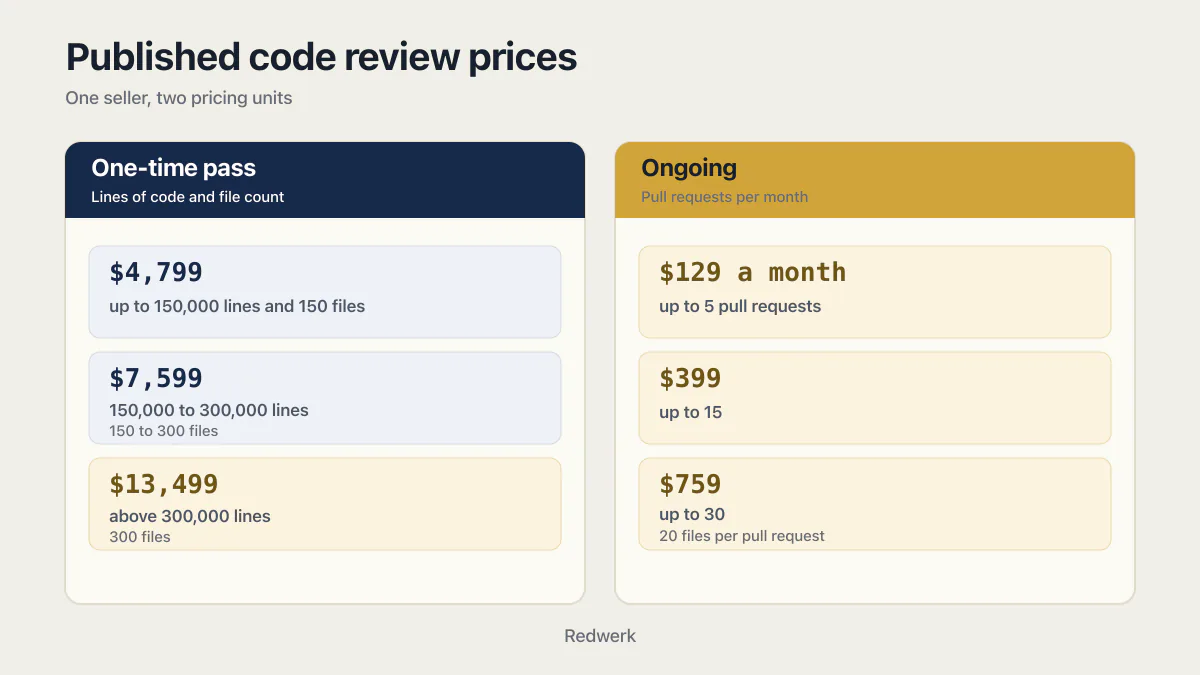
A per-pull-request review subscription is also priced for a different situation than yours. Paying $129 a month for up to 5 pull requests assumes there are pull requests, which assumes developers are still changing the code every week. An app that shipped once, works most of the time, and has now started doing something wrong produces no pull requests at all, so a subscription would meter an activity that has stopped. A review sold to a development team and one bought by an owner are two products wearing one name. If what you actually want to know is what a person costs by the hour or by the job rather than by the codebase, what developers charge by the hour and by the job covers those rates separately.
What a vibe coded app code review should actually check
Every seller above publishes what it examines. A secure code review service foregrounds the security items in that list, and a software code review service foregrounds the metrics, but the lists themselves rhyme. Set them beside what the 26 audited AI-built apps actually contained and the mismatch is visible in one table.
| What the ranked services publish that they check | What the audits found in AI-built apps |
|---|---|
| Cyclomatic Complexity and Maintainability Index, the code quality KPIs ScienceSoft names for its manual reviews | In one audited food-delivery app, the customer’s own browser decided what each order cost, and anyone signing up chose whether they were a customer, a seller or a driver with nothing verifying the answer. Six ways a working checkout still leaks money |
| A static scan for code injection, cross-site scripting, buffer overflows and race conditions | A stranger able to burn the owner’s AI bill without limit, confirmed in 12 of the 14 audited apps that had an AI feature at all |
| PHPMetrics, Nessus and RIPS, the tools Box UK names | Nothing recording an error when a customer hit one, in 17 of the 21 third-party apps. How a failure hides behind a success response |
| Architecture and design patterns | A logged-in customer reading or writing another customer’s rows, confirmed in 7 of the 21 third-party apps |
| Critical errors, security, scalability and efficiency, four of the six items on Redwerk’s list | A framework version carrying a publicly known hole that could be reached from the running app, in 9 of the 26 |
Every item in the left column is a real thing worth checking. They were all written for code that a team wrote by hand and intends to keep maintaining, where the danger is that it slowly becomes expensive to change. An AI-built app fails somewhere else. The code is usually young, usually small, and usually missing a control nobody thought to ask for, because a control has no screen and never appears in a prompt.
The audit scores make the same point from the other direction. Across the 21 third-party apps, the worst-scoring pillar was Reliability and Correctness at 31.4 out of 100, and the best by a wide margin was Secrets and Credentials at 84.4. A checklist built around code quality metrics expects roughly the reverse: careless key handling, decent test coverage, gradual decay in structure. What 26 audits found about maintainability puts that pillar at 61.1, near the top of the same table rather than the bottom.
The one seller that publishes a price quotes it in lines of code, and you do not know how many lines your app has.
What you are actually buying when you buy a code review
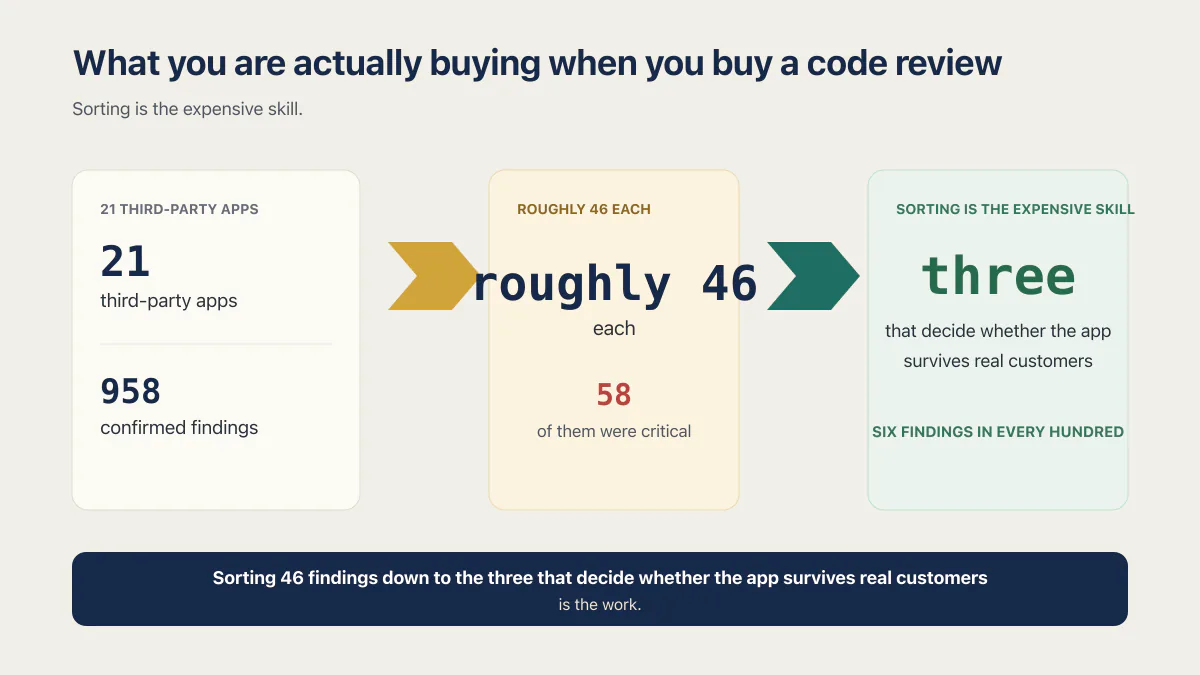
The 21 third-party apps in that corpus produced 958 confirmed findings, roughly 46 each, and 58 of them were critical. Six findings in every hundred decided whether the app could carry real customers. The other ninety-four were a menu you choose from at your own pace.
It runs in the other direction too. In 3 of those 21 apps a dependency scanner reported 33 to 44 known vulnerabilities, and tracing each one through the source found no route from the running application to any of them, while 8 other apps carried a single reachable known hole that stopped the launch outright. The corpus writeup that owns those figures carries the cohort rules, the severity model and the method behind both directions.
Which brings the pricing units back. A pass priced by the size of the codebase has no reason to hand back a shorter list, and a report with 46 items in it looks like more value than a report with three. Sorting is the expensive skill and the one nobody quotes a price for, because you cannot count it in advance either.
Sorting 46 findings down to the three that decide whether the app survives real customers is the work. No published price is quoted in that unit.
Can a tool do this instead of a person?
Software reviewers are good at the job they were built for, which is reading a change before it merges. Claude Code’s Code Review feature averages $15 to $25 per review, billed on token usage. All of these products need a pull request to exist. An app that shipped once and now misbehaves does not produce any.
The mechanics are worth understanding even if you never buy one, because they are the shape of the whole category. Anthropic’s documentation for the Code Review feature describes agents analyzing a pull request against the surrounding codebase, a verification step that checks candidates against actual behavior, and findings posted as inline comments ranked by severity. The same documentation puts the feature on Team and Enterprise subscriptions only, in research preview as of 15 August 2026. That is a genuinely useful loop for a team shipping changes every day.
The limit is what the diff contains. A tool reading one change knows what changed; it does not know that the price on the order was never checked on the server in the first place, because nothing about that arrived in a pull request. Whether AI can review its own code is a longer argument than this page should carry, and which AI code review tools are worth paying for is a separate comparison; both are covered elsewhere in this cluster. So is what a scanner proves about an app and what it does not.
Three questions to ask anyone offering to review your code
Whatever shape you buy, three questions separate a reading you can act on from a document you have to take on faith. What actually happens inside a code review, step by step, matters less at this stage than what comes back at the end of one.
- 01 What will you show me as evidence for each thing you report? Ask for the file and the line, and the reason it is a problem, rather than a category name and a severity label.
- 02 Which of these can actually be reached by somebody who is not me? A list of known vulnerabilities and a list of ways in are different lists, and only one of them is urgent.
- 03 What happens after the review, and what does that cost? Settle before you buy whether repairing anything is a separate purchase, and roughly at what price.
The first question is the one buyers skip and regret. What a verified finding should contain is the difference between a report you can hand to somebody and a report you have to believe. The third question is where most of the money actually sits, because the reading and the repair are almost always two separate transactions at two separate prices.
People shopping for this in public already know the shape of it. Someone looking for help with a Replit-built site, in a thread titled “Best auditing tool for a Replit site” that AxonBuild captured on 12 August 2026, wrote: “I might need to pay for a good quality audit”. The word carrying that sentence is “quality”. Paying was never the hard part of the decision.
Another comment, captured on 14 August 2026, came from someone who had already worked out what they wanted a person for: ”… getting human eyes on the math is now top priority”. They did not ask for the whole app to be read. They asked for the part that decides what a customer is charged, which is the right place to spend the first money.
What I do instead of selling you a review
Here is the actual sequence. He talks through what needs checking. A whole cleanup is a different job; what a whole cleanup of a vibe coded app costs, and who does that kind of work, is a separate question from this one.
Two readers should buy nothing here, from me or from anybody in the table above.
The first is the owner whose app has no users yet and no money moving through it. Nothing is exposed that a paid review would protect, and the free checks are enough for now. The evidence gates to clear before launch covers what to do with an app in that state, in the order worth doing it.
The second is the reader who needs a document for somebody else. Whether your app needs an outside security review at all works through that decision, including the cases where the honest answer is a firm you hire for the paperwork.
Common questions about code review services
What is the cheapest published price for a one-time code review?
Published prices run from $129 a month to $13,499 for a single pass, read on 15 August 2026. Redwerk is the only seller ranking for this query that prints a full list: $4,799, $7,599 or $13,499 for a one-time pass depending on codebase size, and $129, $399 or $759 a month depending on how many pull requests you send. ScienceSoft, Box UK and Codementor publish no rate on their code review pages and quote after looking at the work.
How long do these sellers say a review takes?
Published turnarounds run from a few days to several weeks. Box UK states that a focused review of a specific module or feature “can be completed in a few days, while a comprehensive review of a large, business-critical system may take several weeks”. ScienceSoft’s published case studies include a core banking system reviewed in 4 weeks and a games platform in 4 weeks. Both of those describe enterprise systems, so read them as the long end rather than the middle, and note that nobody quotes repair time before they have seen the findings.
Can someone review my AI built app if I cannot read code myself?
Yes, and saying so up front changes what you should ask for. A review written for a developer hands back a list to work through, which is worth nothing if nobody on your side can work through it. Tell the seller you cannot read code and ask what they will show you rather than what they will send you: the screen where the problem happens, the request that carries the wrong value, the account that could see somebody else’s row. Evidence you can check yourself is the only part of a review that survives you not being technical.
Do developers fix bugs, or only report them?
A code review reports; repairing what it found is usually a separate purchase at a separate price, which is exactly why the question belongs before the payment rather than after it. Redwerk describes its one-time deliverable as issue statistics, identification of critical issues, and recommended fixes with estimated resolution times, which is a document about repairs rather than the repairs themselves. Ask what fixing the top three items would cost before you commission the reading.
How do I convince a developer there is a bug?
Bring a reproduction rather than a theory. Write down the exact steps you took, what you expected, what actually happened, the time it happened, and the order or account it happened to, plus a screenshot and the response the browser received if you can get it. A developer can argue with an opinion about the code and cannot argue with a sequence that produces the wrong result twice in a row. If the answer is still that the behavior is expected, ask which line of code makes it expected, and the conversation moves to something checkable.
Is a code review the same as a security audit?
No. A code review reads the source for correctness, structure and risk and hands back what it found across all of those. A security assessment answers a narrower question about exposure, often against a named standard, and may involve testing the running application rather than reading the code behind it. Which one you are being asked for usually depends on who is asking. Whether your app needs an outside security review at all separates the five things people mean when they say audit.
Do I need a JavaScript code review specifically?
Not as a separate purchase. JavaScript and TypeScript are what Lovable, Base44, Bolt, Replit and v0 emit, so a javascript code review service and a code review service for AI code are usually the same booking with different words on the invoice. Most of the difficulty sits somewhere other than the language. The skill worth paying for is following one request from the browser through to the database and deciding whether the server ever checked who was asking, and that skill reads the same in JavaScript, Python or anything else.
Fixing the bug in this guide gets you past today. If you would rather have the whole foundation checked and built in one go, that is what the sprint below is for.
Built it with AI. Now it has to hold up for real customers.
The Production Hardening Sprint takes the app you already have and builds the production foundation underneath it. Authentication and access rules, payments that stay consistent, error handling, monitoring, backups, automated tests and a documented handover. Our engineers work inside your existing codebase for ten working days. All 123 deliverables are included, and you get the evidence for each one.
See the Production Hardening Sprint →  $2,500 fixed price · 10 working days · One codebase