Somebody has told you the app needs a code review. You own the app, you are the person customers will email when it goes wrong, and you cannot read a line of what it is made of. The thing you are being asked to buy is the one thing you have no way to inspect.
Someone in that exact position wrote it down in public: “Since I’m not a developer myself, I can’t do a proper code review on my own …” They had an AI-built app that already worked, and they wanted a person to look at it before real traffic arrived.
A code review for non developers is a person who did not build your app reading its source and telling you what it lets people do. What comes back sorts into three classes: what you can watch happen on your own screen, what you can be shown but not reproduce, and what you can only be told.
The developer-side descriptions quoted here were read on 25 August 2026: Google’s public engineering handbook for reviewers, and the three ranked guides that sit beside it. What this page did with them was sort every instruction they give a reviewer into the ones you could check yourself and the ones you would have to take on somebody’s word. The counts come from AxonBuild’s fixed study of 26 AI-built applications audited in June and July 2026. Nothing was run, installed or tested for this page, and no reader’s app was examined.
What a code review is when you cannot read the code
Somebody who did not build your app reads its source and tells you what they found in it. That is the entire mechanism. Nothing gets installed, nothing gets attacked, and the app does not go offline while it happens.
Three things it is not, because all three get sold under the same word. Scanning compares your project against a catalogue of things that have gone wrong elsewhere and returns candidates, and a candidate stays a guess until somebody has traced it through your app. A test run proves that one behaviour held on one run, and the paths nobody thought to test are the ones a reader is there to find. And somebody using the app for ten minutes and telling you it seems fine is the check you can already do yourself for free.
What separates your situation from the one every guide describes is who the reviewer is. On a development team, a code review is done by a colleague who works on the same code, who saw the change being written, and who can ask its author what they meant. You have none of that. If Lovable, Base44, Bolt or Replit produced the app, there is nobody to ask, because nobody sat down and decided anything. The code arrived a prompt at a time, and the only surviving statement of what it was supposed to do is the running app.
That absence changes the work. A reviewer on your app has to open the product, use it the way a customer would, and take the intent from the screens, because the screens are the only intent on record. It is slower than reading a change with its author sitting next to you, and it has one compensation: nobody on the reading side has a decision of their own to defend.
Whether the tool that wrote the app can be the one to read it back has its own answer, and the short version is that it settles what is written down and wrong, not what nobody ever wrote.
Some of this is sold under the word audit instead, and the pages selling the same reading under a different word stretch it from an automated scan all the way to a certificate, so the label on the invoice tells you very little about what somebody is actually going to do.
Every page that ranks for this is written for the reviewer
If you have already searched this and come away with nothing useful, the reason is not that you searched badly. A depth-10 pull for code review for non developers on 25 August 2026 returned eight organic results: three community and question-and-answer threads, two roundups of review tooling, one product page, and two practitioner guides written for engineers. Not one of them addresses somebody who is paying for the reading instead of doing it. Change the phrasing to code review for non technical founders and Google returns 132 results in total, and not one of them is about code review. What comes back is the non-technical-founder literature, which never mentions reading code, while the code-review literature never mentions a reader who cannot read it. Nothing joins the two. A third pull, for how to review code if you cant code, returns the pages that come closest to the question, and every one of them is still written from inside a team.
The Stack Overflow blog’s guide, at stackoverflow.blog/2019/09/30/how-to-make-good-code-reviews-better/, published by Gergely Orosz on 30 September 2019, says who it is talking to in one line: “If you’re not currently doing code reviews in your organization, start now.” Its nine headings are tone, approving versus requesting changes, nitpicks, new joiners and time zones. Swarmia’s guide, at swarmia.com/blog/a-complete-guide-to-code-reviews/, which ranks on that third pull, is arranged as why a team needs reviews, how to adopt them, best practices, and how to build a process around them, and its audience line addresses developers at every level from the most productive on the team to the newest graduate. Michael Lynch’s piece at mtlynch.io/human-code-reviews-1/, from 12 October 2017, opens by assuming the reader wants to improve reviews where their teammates are humans, and its worked example is a colleague sending you a change to look at. None of the three is linked here, because sending you to them would be sending you to the wrong page.
The closest thing on any of the three pulls to your actual question is a Stack Exchange thread about reviewing code you do not understand, at softwareengineering.stackexchange.com/questions/33968/. It could not be fetched on 25 August 2026, so this reads from the search snippet only: the person asking describes having been given the job of improving development at their company. That is a manager inside an engineering team, which is one step nearer to you and still not you.
Google’s own handbook for reviewers, which ranks for that third phrasing, is the exception worth reading, because it states the question a reviewer is actually answering: “Does this CL do what the developer intended? Is what the developer intended good for the users of this code?” CL is what Google calls a single proposed change. Read that question from your side of the table and it stops being reassuring. The same page tells the reviewer to spend part of the read “trying to think like a user”, which is the one instruction on any of these pages that you are better placed to follow than they are. You are not imagining your users. You have them, and you know which screen they complain about.
There is a whole literature of etiquette around this practice too, about how to phrase a criticism and when to let a nitpick go. All of it is written for colleagues who have to work together again on Monday. You are not a colleague, you are the client, and none of it applies to you.
Two of those eight results were roundups of software that does part of this job. The software reviewers are compared elsewhere, and the thing worth knowing here is that most of them need a repository and an open change before they can read a line of your app.
The audience does exist, and it names itself in the same words you would use. A post in the r/vibecoding community in August 2026 was titled “Free app + code reviews for non-dev vibecoders (I’m researching; not promoting)”. The demand has a name. The pages that rank do not answer it.
A reviewer checks the code against what the builder meant, and on an AI-built app nobody ever wrote down what was meant.
What you get from a code review, sorted by what you can see for yourself
Every published description of what a review produces is a list of what the reviewer looked at. That list cannot help you decide anything, because it is sorted by the reviewer’s job. Sorted by what you personally can do with each item, the same output falls into three classes, and the three are worth very different amounts to you.
The first class is what you can be shown happening in your own app. Two browser windows, a second account, a payment refused at the till, a page opened by somebody who never signed in. You watch the wrong thing happen and there is nothing to read. In the study these counts come from, a fixed set of 26 AI-built applications audited in June and July 2026, the most common finding of this kind was the server taking the browser’s word for something it should have worked out itself, in 10 of the 21 third-party apps covered by the 420-finding ledger.
The second class is what you can be shown but cannot make happen yourself. A key sitting in the project history, a version number matched to a published advisory, a request carrying a value it should not carry. You can see the line and you can see the evidence beside it. What you cannot do is reproduce it on a Tuesday afternoon and satisfy yourself. Customer personal data sitting somewhere readable belongs here too, at least 5 of the same 21 apps, and the “at least” is the ledger’s own wording rather than a hedge.
The third class is what you can only be told. Whether the app is put together well enough that the next change is cheap, whether anything would catch a mistake before your customers do, whether two parts of the app are working from different assumptions. There is no screen for any of it. This is where the reviewer’s judgement is the whole product, and it is the class where your honest position is trust.
Every count in the last column below comes from that same fixed study, and each one names the group it was counted over rather than rounding up to 26.
| What the reviewer found | Can you see it yourself | How you would see it, or why you cannot | How often it turned up |
|---|---|---|---|
| The server takes the browser’s word for what something costs or who somebody is | Yes | One order placed while the page is made to send a different price, and the total the app accepts at the end of it | 10 of the 21 third-party apps in the 420-finding ledger |
| One logged-in customer can open a different customer’s records | Yes | Two accounts, a record created in the first, the same record opened from the second | 7 of the same 21 confirmed; a further count of 9 of 21 had gaps in the rules that are meant to keep one customer’s records away from another |
| Nothing limits how often the most expensive thing in the app can be called | Yes | The same request sent over and over while you watch the usage counter or the bill move | 13 of the same 21 |
| A secret key sitting in the project history or shipped to the browser | Shown, not reproduced | The reviewer opens the line and points at the key. You cannot put it back, and no screen tells you whether somebody already took it | 6 of the same 21 |
| A published security hole in a library version your app still runs | Shown, not reproduced | The version number beside the published advisory. Establishing that it was reachable took tracing the path through your code | 9 of all 26 apps in the study |
| Text a stranger typed being read by the model as an instruction | Shown, not reproduced | The reviewer shows you the field and the route it takes into the instructions. Your own attempt failing proves nothing, because a safe app and a badly phrased attempt look identical from outside | 8 of the 14 third-party apps in the study with an AI feature at all |
| Whether the app is put together well enough that the next change is cheap | No | Nothing on a screen changes when this is wrong. You are told, and the test is whether the reviewer can name the two parts that disagree and what each of them assumes | Scored rather than counted: 22 of the 26 came out red on the same rubric, scores from 29 to 81, mean 52.1, median 51 |
| Whether anything would catch a broken change before your customers do | No | There is no screen for a test that was never written. You can ask what would have to exist and what writing it involves | Counted in the study as an absence rather than as something a user can do to your app |
Read down the second column and the buying decision gets simpler. The first class is the one to ask for by name, because it is the only class that is still yours after the reviewer has gone. The misbehaviour you have watched with your own eyes stays checkable after they stop answering email. A judgement about structure is borrowed from somebody whose number you may not have in three months.
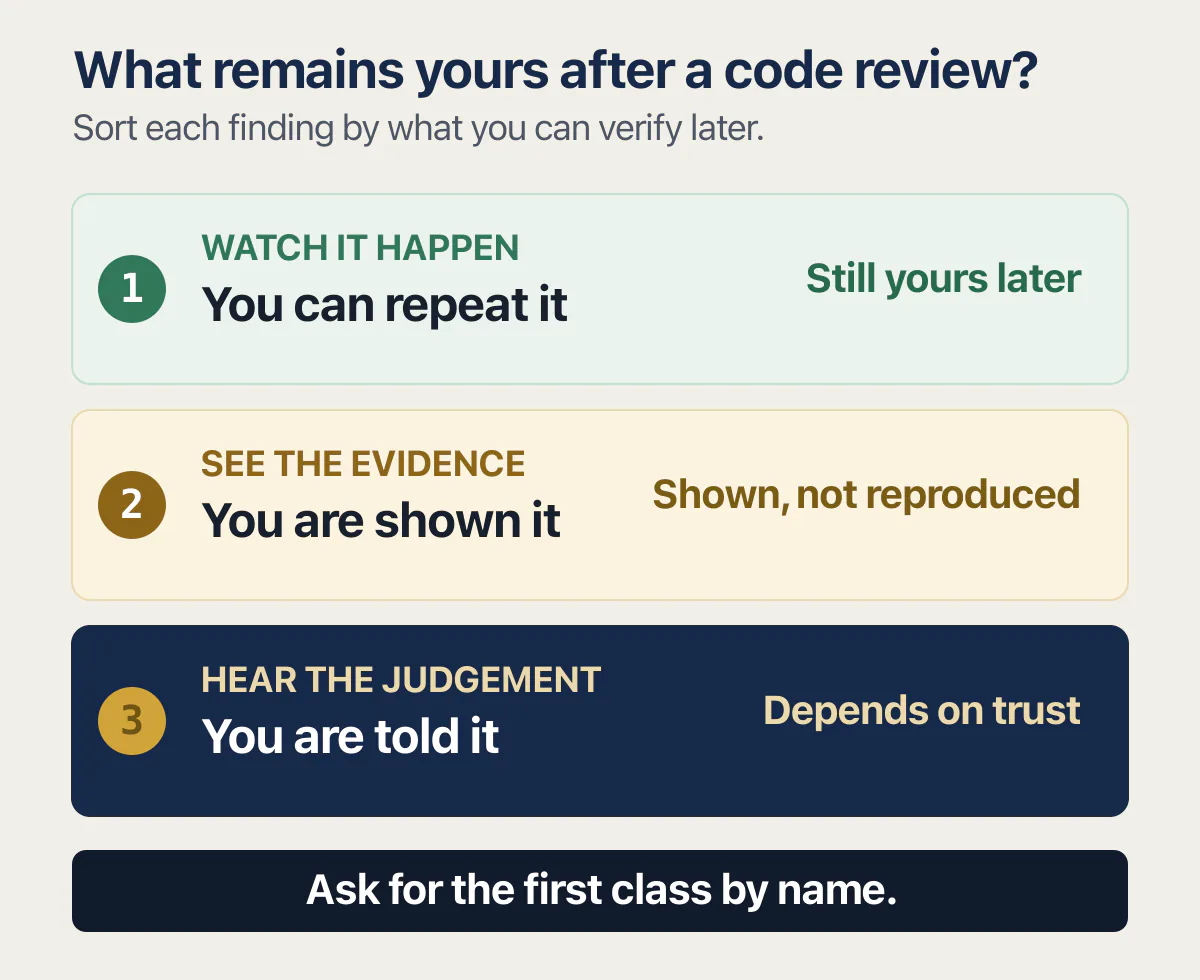
A screen you have watched misbehave is yours to keep. Everything else in a review, you are borrowing.
The three questions that decide whether a review is worth buying
You answer these three yourself, before you contact anybody. What to ask the person selling the reading is a separate list on a separate page. These three decide whether the reading will be about your app or about code in general.
Which parts of the app actually matter?
Only you know what the app is for. Name the paths: signing up, paying, the screen that shows one customer something about another customer, the button an employee presses that a customer must never reach. A reviewer who does not ask you this is going to pick an order themselves, and the order they pick will have nothing to do with your business.
Most owners cannot answer it off the top of their head, because the app grew past what they set out to build. One of them described that drift: “I am a non-developer building a two-sided marketplace, and what started as let me build an MVP has somehow turned into multiple user roles, organization accounts, profiles, verification, bookings, messaging, reviews, permissions, admin workflows …”
Listing features is the wrong way to answer it, because a long enough list is the same as no answer. The way that works is to name what you would refund money over. Three paths is a normal answer. Everything is not an answer, and a reviewer who accepts everything is either about to charge you for a very long read or about to skim.
What are you handing over, and what are you keeping?
Read access to the code and to the running product is ordinary and every seller will ask for it. Live keys and the production database are neither ordinary nor necessary for somebody whose job is reading, and the accounts with a card attached are a different thing again, which stay yours throughout. What the reviewer is actually doing between getting access and the last conversation, and how long each part takes, is set out step by step in what actually happens in a code review; this page stays on your side of it.
The decision underneath the mechanics is short. If somebody needs something you would not hand a temporary contractor on their first morning, ask what they are going to do with it, and expect a specific answer.
What will you be shown at the end, and can you open it yourself?
The screen, the request, the row. Those are the things a person who cannot read code can still check, and what counts as evidence for a single finding is set out in full elsewhere so that you can hold somebody to it.
The test that works for a non-reader is a sentence. Once a finding has been explained to you, try saying it back as a statement about your business. “Anybody who knows an order number can open somebody else’s receipt” is yours. “There is a missing ownership check on the orders handler” is theirs. If only the second version comes out of your mouth, you have been told something rather than shown it, and the finding is not yours yet.
That is a narrower question than the one you would put to a seller about the quality of their evidence. This one is about you, and about whether the thing you were handed is a thing you can open.
What a code review cannot do for you
Four limits, in the order they cost people money.
It cannot tell you your business rules are wrong unless you say what right is. Google’s reviewer is asked whether the code does what the developer intended, and on your app nobody wrote the intent down anywhere. So unless you say who may see what, what a refund is supposed to do, and what a free plan includes, no reader on earth can catch the app being wrong about it. A reviewer can see that two parts of your app disagree with each other. Only you can say which of the two is correct.
A review covers the paths that were read and no others. That is the direct consequence of your own answer to the first question, and it is the honest price of a review that has an end. Ask which paths were read and which were not, and keep the second list, because it is the thing you will want in six months when something breaks somewhere nobody looked.
Repairing is not part of it. Reading and repairing are separate pieces of work bought separately, and settling which one you are buying before the reading starts is the difference between a useful fortnight and an expensive one.
And it goes out of date the next time you prompt the builder. A review describes the app on the day it was read. Reading has an as-of date built into it, which is why the education you take out of a review lasts longer than its coverage does.
Somebody in the r/Base44 community made the same argument in August 2026 from the other side of the counter, in a post titled “A clean Base44 security scan doesn’t prove your users are actually protected”. The point holds for people as well as scanners. A clean read means one person, reading a stated set of paths, did not find a problem in them. That is worth having, and it is a much smaller statement than most buyers hear.
One non-technical founder put the boundary plainly: they can find and fix plenty on their own now, and still hand the judgement calls to somebody who reads code. That is the honest shape of it after a review as much as before one. A review moves that line further out and leaves it standing.
Who does this, and when you do not need one yet
Agencies, marketplaces, individual developers and software products all sell this reading, and the published prices are quoted in units an app owner cannot count. Who sells this work and what they publish for it carries that comparison in full, and the price question belongs there rather than here.
Before paying anybody, there is a cheaper step that most people skip. Everything you can still settle by asking rather than by paying is a separate list, and a review is what you buy once the asking has run out. If somebody you paid built the app with AI tools, where that app is most likely to be weak is worth knowing before you commission any reading at all.
If what put you on this page is a question about exposure rather than about correctness, that is a different job wearing a similar name, and the five different jobs sold under one word separates them before you buy the wrong one.
Some readers should buy nothing yet. An app with no users, no customer data and no money moving through it has little for a review to protect yet, unless it already holds live credentials, a metered AI key or a launch date, and what to do with an app that has no users yet is a better use of the same afternoon and the same money.
The moment to buy is easier to recognise than people expect. Somebody asked the room where it sits: ”… At what stage does this approach start breaking down?” It breaks down on the day the app starts holding something you would have to apologise for losing. Somebody else’s money, somebody else’s data, or a promise you made in writing.
Common questions about code reviews when you cannot read code
Do I need to understand the code to act on what a review finds?
No. You need to understand the consequence, which is a sentence about your business rather than a sentence about the code. “Any signed-in customer can open another customer’s invoice” is a complete basis for deciding what happens next, even if you never see the line that causes it. Acting on a review means choosing which two or three findings get money and attention first, and telling whoever does the work what has to be true when they are done.
What do I have to do while the review is happening?
Almost nothing, and the two things you do happen at the start. Grant read access to the code and to the running product, and tell the reviewer what the app is for and which parts carry money or other people’s information. After that the work is theirs until the conversation at the end, where your job changes: you are the only person who can say whether a behaviour they found is wrong or intended.
How do I tell a real answer from a stalling one?
A real answer names a part of your app. “Anyone signing up can pick their own role, including the one that sees every order” is checkable by you in about a minute. A stalling answer stays at the level of the repository or the category, as in “there are some security concerns in the codebase” or “the architecture needs work”. When you get the second kind, ask for one example with a screen attached, or, for a finding about structure or missing tests, which has no screen, the two parts of your app that disagree or the test that would have to exist. Somebody who has read your app can produce one immediately, and somebody who has not will change the subject to process.
How do I know somebody actually read my app instead of running a scanner over it?
Ask which screen each finding can be reached from and what a real user gets by reaching it. A scanner reports a package name and a severity word; a person reports the route through your product. A better question still: ask what they found that turned out to be fine. Somebody who traced candidates through your code will have several of those and will enjoy telling you about them, because working out that a suspicious-looking thing is already blocked somewhere else is most of the job.
What if the reviewer does not find anything?
Ask which paths they read and what they were looking for in each one. A finding-free read of three named paths is a genuine result and worth what you paid, because you now know something specific that you did not know before. A finding-free read with no list of paths behind it is not a result at all, and the difference between the two is a question you can ask in one line.
Who else can see my app once I hand over access?
Whoever the person you hired decides to involve, unless you ask first. Three questions settle it before you grant anything: is anybody else going to read this, does the work send your code through an AI tool belonging to somebody else, and what happens to their copy when the job ends. Reading the code needs neither your live database nor the keys that spend money, so an access request that includes either one is worth querying rather than approving.
What do I do with a finding I cannot fix myself?
Hand the two or three that matter to whoever does the work, in the reviewer’s own words. A finding written properly is already the brief for the repair: the path, what a user can currently do, and what should happen instead. You do not need to translate it. What you do need to do is say which one comes first, because that ordering is a business decision and the person doing the repair cannot make it for you.
My app changes every time I prompt the builder. Does the review still count?
The findings stay true about the code that was read, and the patterns behind them tend to come back, because the same generator keeps making the same shape of mistake. What expires is the coverage: a month of prompting later, nobody can say the app has been read. Treat a review as a description of the app on a date plus an education about where your app goes wrong, and re-read the paths that carry money whenever those paths change.
Built it with AI. Can’t get the last part right?
That’s the normal state of an AI-built app, and it’s fixable. I trace what the app actually does, explain what needs changing, and build it if you want me to.
Talk about your app →  Free 20-minute video call with Bilal.