You own one app. An AI builder wrote most of it, it runs, and a short list of things about it are wrong: a page that falls over when two people use it at once, a signup that lets the wrong person in, a payment flow nobody has ever run with real money. So you go looking for help, and every result sells the same shape of thing. A group of people, priced per person, per month, available from Monday.
Almost no single app needs a development team. A team is sold per person per month, and Agicent, the one page on this search that publishes purchasable tiers (instinctools prints an indicative $8,000 to $60,000 a month range for a 4 to 6 person team), starts at $2,900 a month for a single dedicated developer with shared help, checked 26 August 2026. One working AI-built app usually has a finite list of jobs, and where that list has been assessed and does not need several specialties at once, one person finishes it for less.
The nine results Google returned for hire dedicated development team on 26 August 2026, and the two variant pulls behind them, were listed in full, and five of those pages were opened and read for three things only: what each page says a team contains, the smallest unit it will actually sell, and whether it prints a number you could act on. That is what the table below reports. Nothing was bought and no seller was contacted.
The sellers are named here because you will meet them, and the specifics matter when you compare offers. What follows is what they publish, what the smallest purchasable unit turns out to be, and how much work one AI-built app usually has waiting for somebody.
What do you get when you hire a dedicated development team?
A dedicated development team is a group of people who work only on your product, billed per person per month. Sellers list six to nine roles: developers, QA, DevOps, a business analyst, an architect and a project manager. Most of those roles are shared with other clients at the bottom of the market.
The model is defined the same way across the ranking set. You do not buy a fixed result. You rent named people for a period, they work on your product and nobody else’s, and the seller handles hiring, replacing and paying them. Every guide then positions the model against two neighbours: staff augmentation, where you rent one or two specialists to fill a gap in a team you already have, and project outsourcing, where you buy a defined result for a fixed sum and the seller decides who does it.
Three pulls returned 27 result slots and 19 distinct domains. Eighteen of those nineteen sell development teams. The nineteenth is a money-transfer company running a content blog. There is no neutral reference, no publisher, no forum and no buyer-side page anywhere on page one of any of the three searches, which is worth knowing before you read any of it as advice. All 27 slots came back as organic results; the endpoint reported that an AI Overview and a People Also Ask block were both present on those searches and returned neither, so nothing here describes what Google itself summarises above the results.
Five pages were read in full. None of the addresses below is a link, and that is deliberate: every company in the table sells development services to the readers of this page, so each one is named and its address printed plain rather than hyperlinked.
| Seller, named and not linked | What it says a team contains | Smallest unit it will sell | A number you could act on |
|---|---|---|---|
Blackthorn Vision, blackthorn-vision.com/blog/dedicated-development-team-model/, published 23 January 2026, updated 22 May 2026 | Frontend, backend and full-stack engineers, quality assurance and testers, product owners and project managers, solution architects, DevOps engineers, security experts | Not stated | None. It puts engineers in Central and Eastern Europe or Latin America at 30% to 60% below the cost of hiring locally in the US or in Western Europe, and prints no baseline to apply that reduction to |
instinctools, instinctools.com/blog/dedicated-development-team-guide/, published 27 May 2024, updated 28 November 2025 | Project manager, business analyst, software architect, frontend and backend developers, DevOps engineers, QA specialists | No single-person unit; it sizes discovery at up to 5 specialists, an MVP at 6 or more and custom software at around 9 | Yes. A 4 to 6 person team from about $8,000 a month on a junior bench in a lower-cost market, up to $60,000 or more a month at the top of its published range |
Glorium Technologies, gloriumtech.com/hire-dedicated-development-team/, updated 18 June 2026 | UI and UX designers, frontend and backend engineers, QA engineers, DevOps engineers, business analysts, a dedicated project manager | Not stated | None. It claims 30% to 50% lower total cost of ownership in most regions and points at a calculator instead of a figure |
ScienceSoft, scnsoft.com/software-development/dedicated-teams | Project manager, business analyst, developers, QA specialists, solution architect, DevOps engineer, UX and UI designers, support engineer, data scientist | 0.5 of a full-time person | None. It says nearshore and offshore rates run two to four times lower than US rates, and publishes no rate |
Agicent, agicent.com/dedicated-software-development-team | One to three dedicated full-stack developers plus a shared project manager, a shared UI and UX expert and a shared tester, with DevOps on a need basis on every tier and a tech lead on a need basis except on the top tier, where the page says regular | One dedicated full-stack developer with shared support | Yes, in public. $2,900 a month for 200 hours, $5,400 for 400 hours, $7,300 for 600 hours, additional hours at $20 and at $18 on the top tier |
One more page belongs on that list and is not on it. BairesDev’s dedicated-team page ranks on two of the three searches, and bairesdev.com/software-development-services/software-dedicated-team/ answered an automated read with HTTP 403 on 26 August 2026. No claim on this page rests on what it says, because it was not readable that day.
Read the table as a buyer rather than as a shopper and two things stand out. Four of the five pages describe a saving without publishing anything to subtract it from, and only one of the five states what the entry-level purchase actually contains. That second gap is the one worth an entire section.
The smallest team on sale is one person with shared help
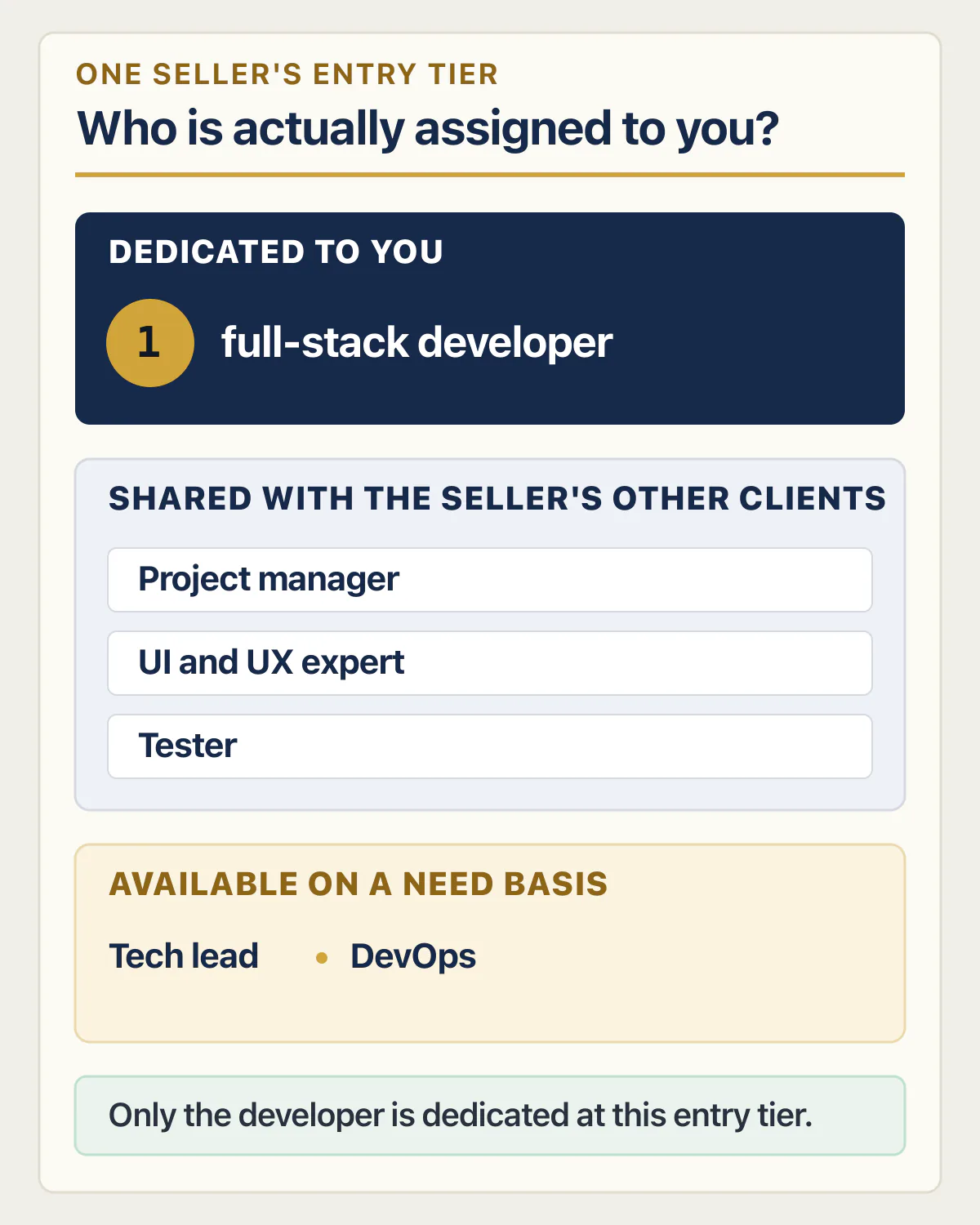
Agicent publishes its tiers on the page, which almost nobody in this market does. The entry tier is one dedicated full-stack developer, described as covering mobile apps, web and AI, plus a shared project manager, a shared UI and UX expert and a shared tester, with a tech lead and DevOps available on a need basis. That is $2,900 a month for 200 hours, checked 26 August 2026. The next two tiers are $5,400 for 400 hours and $7,300 for 600, with extra hours at $20, or $18 on the top tier. The page also states, in identical words under all three tiers, that there is no minimum duration commitment from the client, and says elsewhere that the arrangement runs month on month for as long or as short as you want.
Look at what the word “team” is doing in that first tier. One person is yours. Three other people are shared with however many other clients that seller has, and two more appear only when somebody decides they are needed. The billing shape is a team. The staffing shape is one developer with overhead attached.
The other pages point the same way once you look for the floor rather than the ceiling. ScienceSoft says its teams scale from 0.5 of a full-time person, which is half of one developer, not a group. instinctools is the only page that names group sizes, and it names them by job rather than by product: up to 5 specialists for a discovery phase, 6 or more for an MVP, around 9 for a custom software build. None of those is the shape of a working app with eleven things wrong with it.
Some sellers now advertise the same arrangement as an AI developer team, meaning the same roles with AI tools in their workflow. Others call it a software development partnership, which is the same billing shape in a softer word. Neither changes the question you have to ask.
Before you compare a single price on this market, get an answer to one question in writing: of the people named in that team, how many are yours full time, and how many are shared? A quote for one dedicated developer with three shared colleagues and a quote for four dedicated people are not the same purchase, and the pages that publish neither a headcount nor a rate will not settle it for you.
What one AI-built app actually has left to do
The roadmap framing is the sales argument underneath every page on that search: your product keeps going, so your staffing should too. Worth testing against how much work one AI-built app actually carries.
About 46 confirmed findings per app, across the 21 third-party apps in a fixed study of 26 AI-built applications audited during June and July 2026, taken from that study’s findings ledger, in which every finding was checked against the code itself instead of flagged by a pattern. The full count across the 26 audited apps carries the cohort rules, the severity split and the limits. Forty-six sounds enormous until you notice what kind of list it is: mostly small, mostly repeated, and orderable in an afternoon by somebody who has read one before.
The repetition is the useful part. No working automated test existed anywhere in at least 18 of those 21 third-party applications, and 17 of them had none at all. Across all 26 applications in that study, the five of the founder’s own included, 22 scored red, 4 amber and none green. Those 26 results are the same handful of gaps arriving in a different order each time, because the tools that write these applications produce feature code and skip the parts nobody asks for out loud.
That has a direct consequence for who you hire. Work that repeats rewards somebody who has seen the pattern before, and a group of nine people meeting your application for the first time gives you nine first readings.
It also means the work has an end. A list of 46 items, of which fewer than three per app were critical in that study’s own severity split, is something a person finishes, though the count says how many things were found and not how hard each is to fix, so an assessed list is the thing to staff against. A roadmap is something you staff. The teams on that search are priced for the second, and if what you have is the first, you are buying a supply of hours against a demand that runs out.
When a team is the right answer
Four situations where hiring a team of developers is genuinely the right purchase, and none of them are rare.
- 01 The application is genuinely large and several parts of it change at the same time, so two people working in parallel would collide without somebody coordinating them.
- 02 You have a plan with dates that continues past the current list of problems, and the work does not stop when those problems are fixed.
- 03 You are running more than one product, and the second one needs attention in the weeks the first one does not.
- 04 The other side of the contract needs to be a company rather than a person, because your buyer, your insurer or your own board requires it.
The demand is real and it is public. A post title in r/StartUpIndia on 12 August 2026 reads Looking for a software agency to build production grade platform, which is the whole genre in one line: somebody with a working prototype who has decided the next stage needs a firm rather than a person.
People arrive at that decision from different directions. One founder asked in public for a group who would finish work somebody else had started. Another wanted a firm available by the hour, on a continuing basis, across several live products they already owned. A third paid a company to rebuild their application outright after the platform it was built on buckled under its user numbers. Those are three different purchases, and only the second one is the monthly team model as the sellers describe it.
Not every version of this starts from a standing start, either. One founder described their own build this way: “I tested the ideation and workflows … on my 100+ client base and built it with a team I partnered with.” They had the customers before they had the product, and they still brought in other people to build it. A team is a supplier relationship like any other, which is why the question of who holds the accounts and the code deserves an answer before the first invoice rather than after it.
If the trigger is that the application fell over once real numbers arrived, that is a capacity problem before it is a staffing problem, and what actually gives way when the user count climbs is worth reading before you hire anybody. If the trigger is that the builder platform itself has become the constraint, when the job is really a move off the builder platform is a different piece of work with a different shape.
One thing this page will not do is pretend to be on that list. AxonBuild is not a development team, does not sell one, does not sell people by the month and does not sell hours. If you need five people for a year, buy from one of the companies on that search and use the question in the section above to compare them properly.
One person, one named job at a time
The honest cheaper shape starts with turning “the application needs work” into something a person can price. Four buckets, in the order they usually deserve money.
- 01 The thing that is broken now, in front of the people already using it.
- 02 The thing that will break when more people arrive, which is usually the same three suspects: no limit on anything expensive, no index on the query everybody runs, and nothing recording errors when they happen.
- 03 The thing that was never finished, where the feature exists in the interface and does nothing behind it.
- 04 The thing that only matters once money moves, which can wait until money actually moves.
Buy the first item. Watch it get done. Then decide about the second with a month of evidence you did not have before.
| Question | A dedicated team | One person, one named job |
|---|---|---|
| What you commit to | A monthly bill per person, renewed until you stop it | One job with a price agreed before it starts |
| When you find out whether it is working | After the first month, once several people have learned the application | After the first job |
| What a bad fit costs you | A month of several people | One job |
| What it fits | A plan with dates that keeps going | A finite list somebody can read in a day |
AxonBuild’s own offer sits at the smallest end of that column. The 20-minute video call is free: you show Bilal the app and the list, and he helps you work out what needs checking. If you want him to do the work, he checks the app and gives you a fixed quote for the items you agree on, and you pay after you see them working. The call produces nothing written. There is no file to take away afterwards: you see the problem on screen while the call is running, and later you see it fixed.
The boundaries belong here rather than in small print. Nothing on offer is a penetration test. Nothing on offer is a compliance certification. No change at a fixed quote makes an application safe, finished, or free of everything else on the list.
If the application stopped partway and the job is the last stretch, hiring one person to finish what is left is a narrower purchase than a team and it prices differently. Handing the whole application to somebody who then runs it from here is a different purchase again, and it is finished when a different test is met. Paying for one person’s time every month is the honest bottom of the team model, and what a month of somebody’s attention actually buys has its own arithmetic.
What does a development team cost by the month?
Published monthly prices for a dedicated development team are rare. Agicent prints $2,900 a month for 200 hours and $7,300 for 600, checked 26 August 2026. instinctools puts a 4 to 6 person team between about $8,000 and $60,000 or more a month. Everyone else quotes a percentage.
Prices checked 26 August 2026.
That percentage habit deserves naming, because it is the single most common thing on this search. Blackthorn Vision says engineers in Central and Eastern Europe or Latin America cut development costs by 30% to 60% against the US or Western Europe. Glorium Technologies claims 30% to 50% lower total cost of ownership in most regions. ScienceSoft says nearshore and offshore rates are two to four times lower than US rates. As of 26 August 2026, none of those three pages publishes a figure to apply the discount to. A discount off an unpublished number is not a price, and it cannot be compared against anything.
Two of the five pages are honest about when their own model is a poor fit, which is more than the market average. instinctools says that if you are filling specific skill gaps rather than putting an entire project outside your company, a dedicated team is the wrong route and staff augmentation is the right one. Glorium Technologies names short, well-defined one-off work, medium projects with fixed specifications, and work that cannot leave your own building.
For rates rather than team prices, the published rates for individuals and for agencies collects published figures from named sources for individuals and agencies. For the cleanup case specifically, the published figures for this kind of work, set side by side covers what sellers charge to clean up an AI-built application, which is the job most readers of this page are actually shopping for.
How to buy a bigger piece of work without a monthly commitment
Some readers genuinely do have more than one job’s worth of work and still do not want a monthly bill. The sequence that gets you there without one is short.
Order the list first, using the four buckets above. Buy the first item from one person at an agreed price. Keep the accounts and the code repository in your own name throughout, so that ending the arrangement is an administrative act rather than a negotiation. Then let the size of the second purchase be decided by what the first one taught you about that person, rather than by what a sales page said in month zero.
The part most people skip is checking the work. What a paid read of the code covers, and what the sellers charge for it sets out what that purchase includes. You do not have to be able to read the code to tell a real answer from a stalling one, and what a code review gives somebody in that position is the short version of that skill.
Running the hire itself works the same way whether one person or five are on the other side, and the steps from the first message to the day somebody starts are set out separately. Choosing between a marketplace freelancer, an agency and one developer for a single application is the broader version of the same decision, and it has its own answer. What an agency charges for a build, and why the number is set the way it is, is a different question from whether you need a standing team. Paying somebody once for an opinion on what the application needs, rather than for the work itself, is a third shape again. A company advertising AI app development is selling the build, not the aftercare on one that already runs.
The ordering does not solve everything, and the gap is worth naming. On the first tier of the one seller that publishes prices, the project manager, the designer and the tester are shared, and there is no published way to find out how much of their week you actually get. You learn that in month two, which is exactly when a monthly commitment stops being cheap to leave.
Common questions about hiring a development team
What is a dedicated development team?
A dedicated development team is a group of people supplied by one company to work only on your product, billed per person per month rather than per result. The sellers on this search list six to nine roles in a full team: frontend and backend developers, QA, DevOps, a business analyst, a solution architect, a designer and a project manager. At the entry level, most of those roles are shared with the seller’s other clients rather than assigned to you.
Do I need a development team or just one developer?
For one working application with a list of specific problems, one developer is almost always the right purchase. A team is priced for continuing work that does not run out, and a single AI-built application usually carries a finite list: about 46 confirmed findings per app across the 21 third-party applications in a fixed 26-app study audited in June and July 2026, most of them small. One experienced person working through that list in order finishes it. A team of nine meets it for the first time nine times over.
What roles are in a development team?
Across the five ranking pages read on 26 August 2026, the recurring roles are frontend, backend or full-stack developers, quality assurance and testing, DevOps, a business analyst, a solution or software architect, a UI and UX designer, and a project manager. Blackthorn Vision adds security experts and product owners; ScienceSoft adds a support engineer, an account manager and a data scientist. No page claims every role is present in every arrangement, and the entry tiers include far fewer of them.
What is the difference between a dedicated team and staff augmentation?
In the sellers’ own vocabulary, a dedicated team takes on a whole piece of work with its own management layer, while staff augmentation rents you one or two specialists who work inside a team you already run. instinctools states the split directly: if you are filling specific skill gaps rather than putting a whole project outside your company, staff augmentation is the right route and a dedicated team is not. For a founder with no in-house developers, that distinction mostly collapses, because there is no existing team to augment.
Is a dedicated team worth it for one app?
Rarely. The monthly model pays off when the work keeps arriving, and a single application that already runs tends to have a countable list instead. The cheapest published entry point on this search is $2,900 a month for one dedicated developer plus shared support, checked 26 August 2026, and it renews until you stop it. A named job at an agreed price costs less and tells you more about the supplier, because you see finished work before you commit again.
How long do I have to commit for when I hire a development team?
It depends entirely on the seller, and most of them do not publish the answer. Agicent states, under each of its three tiers, that there is no minimum duration commitment from the client, and describes the arrangement as running month on month. As of 26 August 2026, the other four pages read for this article publish no minimum term at all, which means the commitment is whatever the contract you are sent says. Ask for the notice period in writing before the first invoice, not after it.
Do development teams work with apps that were built with AI tools?
Most will, and several now advertise it. The thing to check is whether anybody has read your code before quoting; accepting AI-built code is the easy part. An application generated by a builder tends to arrive with no automated tests: at least 18 of the 21 third-party applications in a fixed 26-app study audited in June and July 2026 had no working test anywhere, and 17 of those had none at all. A supplier who quotes a monthly team price without looking at the code is pricing a guess.
Can an AI builder do what a development team does?
For building features, an AI builder already does a large part of it, which is why your application exists. What it does not do is the work that has no visible output: the tests that prove a change did not break the checkout, the limit that stops one stranger spending your compute budget, the record that tells you an error happened at all. Those are the gaps that showed up across the audited applications, and they are the reason people go looking for a person after the builder has done its part.
Built it with AI. Can’t get the last part right?
That’s the normal state of an AI-built app, and it’s fixable. I trace what the app actually does, explain what needs changing, and build it if you want me to.
Talk about your app →  Free 20-minute video call with Bilal.