Hiring a developer for an app that already exists runs in a different order from hiring one to build something new. You are not describing an idea and waiting to see whether the price that comes back has anything to do with what you meant. The app is already there, running or half running, and it is the most useful object in the conversation. Nobody can talk their way around being shown it and asked what they would do first.
The hire runs in seven steps: decide what you are buying, write the first message, shortlist three to five people, talk to each one, check them, agree one first job, agree a start date. Each step has a point where a candidate drops out, and two decide the outcome: the first message and the size of the first job.
That order is not what page one gives you. On 26 August 2026, Google returned nine organic guides and category pages across how to hire a developer and how to find an app developer, and every one that could be read starts somewhere else. Arkenea’s guide at arkenea.com/blog/how-to-hire-software-developers/ begins at defining requirements. ScienceSoft’s at scnsoft.com/software-development/startup/how-to-hire-developers begins at defining candidate requirements and finishes at scaling a team. Both are written for software nobody has started yet. Upwork, Fiverr and Toptal answer with a category page full of profiles. Two more guides, at itechcraft.com and empat.tech, returned 403 when fetched on that date and are described here only by what the search results showed. None of those domains is linked from this page, because every one of them sells the work you are about to buy.
The sequence below was set against the nine guides and category pages Google returned for how to hire a developer and how to find an app developer on 26 August 2026, four of them development shops’ own step-by-step guides and five of them marketplace category pages from Fiverr, Upwork and Toptal, and then rebuilt for an app that already exists; the access and idea-protection answers come from what GitHub and the US Copyright Office publish themselves, and what a first job usually lands on comes from AxonBuild’s fixed study of 26 AI-built applications audited in June and July 2026. Nobody was hired for this page, no candidate was contacted, and no app was examined.
How to hire a developer when the app already exists
Seven steps run from the moment you decide to pay somebody to the day they start. Two do the real work: the message you send first, and the size of the job you agree last. The five in between are filtering, and each has a stopping point where the sensible move is back to the shortlist.
| Step | What you do | What a good reply looks like | What stops it here |
|---|---|---|---|
| 1. Decide what you are buying | One named result, or somebody around every month | You can say it in one sentence | You cannot name the result yet |
| 2. Write the first message | The app, what is failing or unfinished, what you want to happen | They ask about the app, not about your budget | Only a template reply comes back |
| 3. Shortlist three to five | Contact them in parallel, same message | Two or three reply with a question | Nobody asks anything |
| 4. Talk to each one | The questions, asked in one sitting | They describe your app back to you | They give a verdict before opening anything |
| 5. Check them | History, references, work they say they shipped | Something checks out that they did not choose | Nothing can be verified |
| 6. Agree the first job | One result, provable in the running app, with the access it needs | They name what you will see when it is done | The first job is the whole app |
| 7. Agree the start date | A date, and what they get on day one | They tell you what they need before then | The date keeps moving |
Step one is where most owners lose a month. There are two things to buy here, and they attract different people: one named result, finished and gone, or somebody around every month for whatever comes up. If you cannot say which one you want in a sentence, your messages will be vague, and vague messages get priced high or ignored. Some of this you can still do yourself with the builder the app was made on, and the split between the two is worth settling before you contact anyone. Whether this is the month to hire anybody at all is a different question from how to run the hire, and it turns on what has changed in the app rather than on what you can afford. If you are not sure the app underneath is worth keeping, that comes first: whether the app is worth cleaning up or building again changes who you should be writing to.
Step two is the one that separates the field without any effort from you. A first message that names the app, says what is failing or unfinished in plain words, and says what you want to be true when it is done will produce two kinds of reply. One kind asks you something back, usually about how the app was built or who holds the accounts. The other kind is a paragraph about the sender’s experience and a request for your budget, with nothing about the app. Asking about budget is fair; asking about it before asking about the app is the tell. That difference arrives before you have spent anything, and it predicts more than anything on a profile page.
Speed is the pressure that breaks the sequence. A post on r/startup on 25 August 2026 carried the title “A founder called me to hire a developer in 3 days. Here’s what happened.” Three days is a real timeline when something is broken, and the steps dropped under that pressure are always five and six: checking the person, and keeping the first job small. Dropping either turns a bad hire into a bad month.
Step five is worth the hour it costs. Checking that somebody is who they say they are, without reading a line of code, is a short set of checks you can run in an hour, and it is the step most owners skip. One rule covers it: something has to check out that the candidate did not choose for you. A reference they picked and a portfolio they curated both tell you only that they can curate. The plainest example: they say they shipped an app, so open its store listing and read the publisher name the store prints, which they did not write for you. The page on vetting a developer when you cannot read code runs the full set.
Where to look when your app already exists
Five channels produce candidates for an app that is already running, and they sort by how much work you do before the first message. Marketplaces carry the volume and do none of the filtering, referrals do the reverse, and the builder communities sit between them as the only place somebody has already seen an app like yours.
Marketplaces are the obvious first stop and the reason page one looks the way it does: search how to hire a developer and Upwork, Fiverr and Toptal all rank with a category page rather than an answer. They work, with one caveat. Their filters sort by skill labels and hourly bands, neither of which tells you whether somebody has opened a codebase a machine wrote most of. Directories such as Clutch and Business of Apps do the same for companies rather than people, sorting by reviews and industry rather than by what your app is made of.
The channel most owners miss is the community around the tool the app was built with. Lovable, Base44, Replit and Bolt all have places where people who work on those apps professionally are already visible, and somebody who has shipped three Base44 apps to a store knows things about your app no general filter can surface. Referrals from other owners running a live app are the same thing at smaller volume: ask what the person actually did and how long it took, not whether they were good.
Whichever channel produces the name, the first reply is free data. Send the same message to everybody on the shortlist at the same time, and read the replies against each other. Whether the right supplier for one app is a freelancer, an agency, or somebody who repairs broken apps for a living, is a question about suppliers rather than about sequence, and it is worth settling before you write to anyone. Whether an app that already runs needs an outsourcing vendor at all is a separate decision, and the answer usually depends on how much of the app is finished. Some sellers offer advice about the hire itself rather than the work, which is a third kind of purchase again.
Do you need somebody local?
No. Distance is not the variable that decides whether a hire works on an app that already runs. Three things do: how many working hours you and they share, whose name the accounts sit in, and how quickly somebody answers when the app stops responding at a bad time.
Look at what the near-me results contain. On 26 August 2026, the highest-volume near-me phrasing returned nine organic results, and six were a national vendor’s page for one particular city, three of those sitting under a dedicated near-me, locations or Locations path. The other three were two directories and a community thread. Typing near me surfaces national sellers who built a page per city, plus a local pack and the refinement chips Google attaches to local-business queries.
Six of the nine organic results for the busiest near-me phrasing were a national vendor’s page for a single city. Typing near me surfaces the sellers who built a page per city, not the people nearest to you.
Time overlap is the one that bites. Four shared working hours is enough for a first job with one named result, because the work is mostly asynchronous and the conversation is short. It stops being enough once the arrangement turns into somebody being around every month, because then the gap between a customer reporting something and anybody looking at it is measured in your night.
The accounts question is paperwork rather than geography. If the GitHub repository, the database, the domain and the payment account are in your name, the person’s location is an inconvenience at worst. If any of them sit in theirs, distance turns a solvable problem into a slow one.
Response time is something you agree in advance rather than infer from a map. Ask what happens when the app goes down on a Saturday, and prefer the answer that names a number of hours. Somebody two time zones away who commits to four hours is more use than a closer person who has never thought about the question.
What to send in the first message, and what to leave out
Three things go in and they fit in a short paragraph. A way to see the app running, which means a link and a login that is not your own. What is failing or unfinished, in the words you would use out loud. What you want to be true when it is done, stated as something you could watch happen on screen.
Four things stay out of the first message. Your budget goes first, because a number quoted before anybody has looked at the app is a number about you rather than about the work. Leave out the source code too: nobody needs it to reply to a message, and the access conversation belongs later. Live customer records have no part in a message that has not produced a reply yet. And a document to sign turns a two-line answer into a legal errand for a stranger.
The full list a developer wants before they can put a number on the job is longer than a first message, and it is the same list for every person you write to. The first message stays smaller on purpose. Its whole job is to find out who asks you something back.
The conversation, and what you are grading
One call beats four emails when the app already exists, for a reason that has nothing to do with rapport. You are trying to find out whether somebody can describe your app back to you, and that only happens live, while they are looking at it and thinking out loud.
Put every candidate through the same conversation in one sitting if you can, so you are comparing answers given under the same conditions rather than answers written at leisure a week apart. Ask everything in one call. A second call, before you have agreed anything, is usually a sign that the first one did not settle much.
Which eight questions to ask, and what separates a real answer from a fluent one, is its own page with its own answer key, and it is what you say once you are in the conversation.
How to protect your idea before you hand over the code
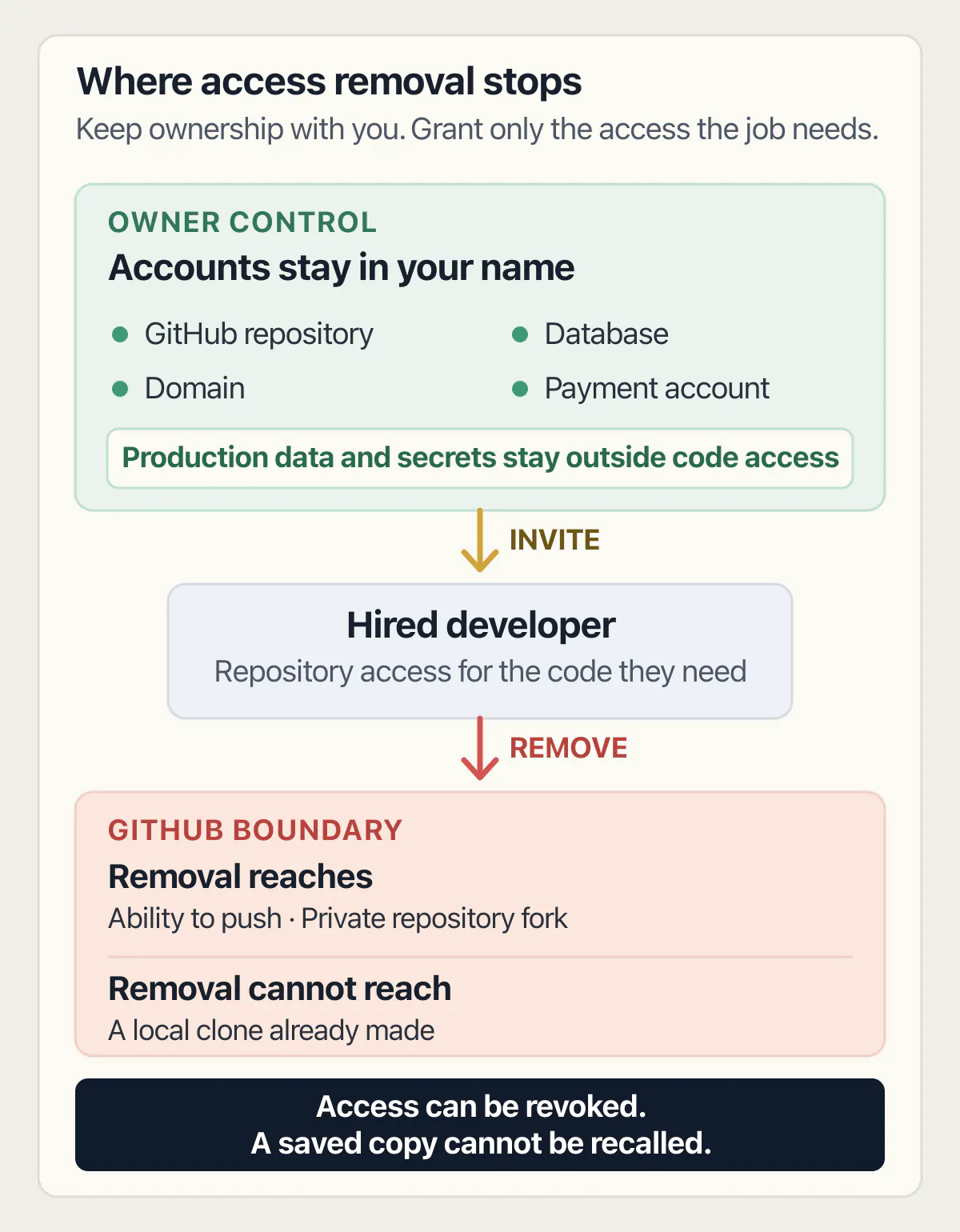
You cannot protect the idea. Copyright does not cover it, and the two US Copyright Office circulars that say so are in print and free to read. What you can protect is the access: which accounts sit in your name, what somebody can reach while they work, and what happens to that reach when the work stops.
Start with what the law actually excludes. The Copyright Office circular on works not protected by copyright, revised March 2021, puts it in one sentence:
Copyright law expressly excludes copyright protection for “any idea, procedure, process, system, method of operation, concept, principle, or discovery, regardless of the form in which it is described, explained, illustrated, or embodied.”
Its companion on software is the part that catches owners out. The circular on copyright registration of computer programs, also revised March 2021, states that “the copyright law does not protect the functional aspects of a computer program, such as the program’s algorithms, formatting, functions, logic, or system design.” Copyright in your app covers the particular expression that was written down, and stops short of what the app does or how it decides to do it.
So how to copyright an app idea has a short answer, and the answer is that you cannot. What is left still matters. The expression in the code is yours if the paperwork says so, and the accounts the app runs on are yours if they were opened in your name. Which accounts have to be in your name, and how to check each one yourself, is the list that decides whether you can hand the app to anybody else later.
An NDA is a contract in which both sides agree not to pass on what they are shown. Whether one is worth asking for, what it covers, and what it is worth where you live are questions for a lawyer in your own country, and this page does not answer them. One thing can be said with no legal claim attached. As of 26 August 2026, neither of the two hiring guides that ranked for these queries and answered a fetch on that date, Arkenea’s and ScienceSoft’s, mentions an NDA, copyright or intellectual property anywhere in its steps. The pages telling owners how to hire skip the part owners worry about most.
The practical protection is access you can take back, and its limits are documented. On GitHub’s page on permission levels for a personal account repository, the behaviour on removal is stated plainly:
While forks of private repositories are deleted when a collaborator is removed, the person will still retain any local clones of your repository.
That sentence is the boundary of what removal does. Taking somebody off the repository ends their ability to push and deletes the fork sitting on their account, and it never reaches the copy already on their laptop. Still remove them; just treat the decision about who gets access in the first place as the one that counts, with the removal as housekeeping afterwards. Access levels differ by account type and are worth understanding before the first invitation goes out, which is ground what a reviewer is given access to, and what they are not already covers.
Two habits follow, and both are free. Give code access rather than production access, because a person can read the code without holding your live database password or your payment keys. And run the removal the day the work stops, since that housekeeping is easy to postpone and impossible to backdate.
None of the above is legal advice. The circulars say what they say, and everything about contracts, ownership clauses and confidentiality where you live is a question for a lawyer there.
What a fair first job looks like
One named result, provable inside the running app, small enough that being wrong about the person costs you one job rather than the app. That is the whole standard. It is also why a confident verdict about the whole codebase should move you less than somebody naming one thing they can fix and show you by Thursday.
A blanket verdict separates nobody because the verdict is almost always the same. In AxonBuild’s fixed study of 26 AI-built applications audited in June and July 2026, the median score was 51 out of 100 and the range ran from 29 to 81, counted from that study’s own scoring index. Not one came out green. Ten of those 26 were a held-out set the audit method had never seen before, audited blind to test whether the method held up, and the picture did not change. Anybody who looks at an AI-built app and reports that it has problems is describing the fixed study of 26 AI-built apps these numbers come from as much as they are describing yours.
A first job should be small enough that being wrong about the person costs you one job rather than the app.
The more useful half of the same data is that small real jobs exist. Nine of those 26 AI-built apps sat on a dependency version carrying a published hole that outside code could still get to, counted by comparing what each app had installed against the advisories for it, and closing the hole meant changing one number in one file. That is a first job: named, checkable, done in an afternoon. Payments failing on one card type, a login that drops people on mobile, an export that times out over a certain size all sit in the same band.
Price is a separate question with published bands behind it, and what each hiring route actually costs is where those numbers live. What to agree before any number comes up is what you will be shown when the job is called done, in the running app, on a real account.
How AxonBuild’s own call and quote work is one worked example of that shape. The 20-minute video call with Bilal is free: you show him the app and what should happen, and he talks through what needs checking. If you want him to make the change, he checks the app first and gives you a fixed quote, you agree what the app should do, and you pay after you see it working.
If what you are buying is somebody to finish the part that was never built, the shape of the first job changes, because the thing you are paying for does not exist yet to be shown. Agree what the finished part does instead, in the same terms: something you can open and use on a real account, not a status update.
When to walk away
Five things end a conversation early, and each costs nothing to act on before money moves. Every one of them is the person telling you, without meaning to, that the job in front of them is not the job they want.
A verdict before anybody has opened anything. Somebody who tells you the app needs rebuilding after reading your two-paragraph message has not read your app. The rebuild answer may turn out to be right, and it was still not theirs to give yet.
A request for your live customer data while you are still deciding. Nothing at the quoting stage requires real customer records. A copy of the code, a look at the running app and a description of what breaks are enough to price a job, and anybody who prices work for a living knows it.
A first job that is the whole app. When every conversation about one specific result comes back as an offer to take over everything, the person is selling a different product from the one you are buying. That is not dishonest, and it is a reason to keep looking.
Accounts they want to open on their side. A new hosting account, a new database, a new repository, all in their name, to make it easier. It does make the first month easier, and it makes every month after that harder. This is the most common reason an owner discovers later that they cannot hand the app to anybody else.
A start date that keeps moving. One reschedule is life. Two, before the work has started, is the calendar telling you where you sit in somebody’s priorities, and that position rarely improves once you are paying.
If this already happened once and the person you paid stopped halfway, what went wrong in that hire is the most useful thing you own going into the next one. Write down the point at which you first felt uneasy, and watch whether the next candidate produces it at the same step.
The start date is the end of the hire and the beginning of something else. Which accounts the person needs on day one, which they should never be added to, and what a first week looks like belongs to what somebody needs on the first morning rather than to choosing them.
Once the work is done and you have something finished to open rather than a person to be graded, checking what you paid for is a different set of requests. Keep the three conversations separate, and none of them will contaminate the others: choosing, starting, and checking.
Common questions about finding and hiring a developer
How to hire developers for a startup?
Run the same seven steps, with one change: name the result as something a customer will be able to do, rather than as an amount of work. A startup hire goes wrong most often because the first job is defined by effort instead of outcome, which makes it impossible to tell whether it finished. Talk to three to five people, ask everybody the same things in one sitting, check one thing about each candidate that they did not choose to show you, and agree a first job small enough to survive being wrong about the person.
How many developers should I talk to?
Three to five. Fewer than three gives you nothing to compare a reply against, and more than five turns the conversation into an administrative job you will rush. Contact the whole shortlist with the same message on the same day, so the replies are comparable and the wait is one wait instead of five. Expect two or three to ask you something back, and treat the rest as already filtered out. If the whole shortlist replies with a template, the message is usually the problem, so rewrite it before adding names.
How do I hire a developer for an app?
Show them the app first. That is the one thing you have that somebody hiring for a new build does not, and it is the fastest filter available: a link, a test login, a plain description of what is failing or unfinished, and what you want to be true when it is done. Send that to three to five people and read the replies for who asks about the app rather than about your budget. Then talk to each of them, check something they did not choose, and agree one result you can watch working.
How do I find a developer for an app?
Five channels, in rough order of effort before the first message: referrals from other owners running a live app, the communities around the builder your app was made on, marketplaces, directories, and specialists who work on AI-built apps. Marketplaces give volume with no filtering and are where most people start. The builder communities are the only channel where somebody has likely opened an app built the same way as yours. Whichever you use, the reply you get back does more filtering than any profile filter will.
How to hire dedicated developers?
A dedicated developer or a dedicated team means people working only on your product for a fixed period, usually sold monthly by an outsourcing vendor. One app that already runs almost never needs that shape, because the work arrives in bursts, and paying for continuous availability to cover occasional work is how owners end up with a monthly bill and no result they can name. One app almost never needs a whole team, and what a team is actually for is worth knowing before anybody offers you one.
How do I hire a developer if I cannot read code?
Grade what you can see rather than what you cannot. You can tell whether somebody asked about the app before quoting, and you can tell whether anything in their history checks out that they did not curate for you. Both are available to somebody who has never opened a code editor. The fuller hour of checks, and the one check that needs another pair of eyes, is step five above rather than this answer.
Do I need an NDA before I show somebody my app?
Not to send a first message and not to have a first conversation, and whether one is needed at all is a legal question in your own country rather than something this page decides. Worth knowing before you ask: the US Copyright Office states in print that copyright does not protect an idea, procedure, process, system or method of operation, and that copyright in a program does not cover its algorithms, functions, logic or system design. The protection that holds day to day is which accounts sit in your name and who has access to what.
How long does hiring a developer usually take?
It depends on three waits, and naming them is more useful than naming a number of days. The first is how long your shortlist takes to reply, which you control by contacting everybody on the same day. Second comes getting every candidate into one conversation, usually the longest wait and the one worth pushing on. The third is the gap between agreeing the job and the start date, and that one tells you something: a date that moves twice before any work starts is a signal about priorities.
What if I only have an idea and no app yet?
This sequence is not for you, and following it will cost you money. Everything above leans on having a working app in front of you, which is the object that separates candidates without any effort from you. Without one, you are back where every ranking guide starts, and the price you get is a price for a description. The useful first move is usually to build something rough yourself with one of the AI builders and hire against that.
The position is common enough to be a genre. A post on r/AppDevelopers on 17 August 2026 was titled “I have an app idea fully planned out, but I’m not a developer, how should I approa…” and the answer there is almost always to make something first, however thin.
Built it with AI. Can’t get the last part right?
That’s the normal state of an AI-built app, and it’s fixable. I trace what the app actually does, explain what needs changing, and build it if you want me to.
Talk about your app →  Free 20-minute video call with Bilal.