A technical cofounder here means one thing: somebody who joins your software company as an owner of it and takes responsibility for the code. Not the question of what share to give one, not whether the title sits above or below chief technology officer, and not what an accelerator asks for on an application form.
You are reading this because the app runs. People sign in, some of them pay, and the thing you once described to a builder now has a support inbox and a list of things that break. Somebody has told you, more than once, that what you need next is a technical cofounder. Often the person saying it has never opened the app.
If your app already works and has users, the question is usually not whether you need a cofounder. It is whether what is missing is a partner in the company or somebody who owns the code and is paid for it. Five questions below settle which.
The two published positions named below were read on their own pages on 2 September 2026, along with what Google returns for this question on that date; the founders’ own words come from public posts, quoted without names, companies or links. No one was placed, met, interviewed or paid in order to write this page, and I run no cofounder, fractional or advisory arrangement to compare against.
What a technical cofounder is, and what makes one different from anybody else who writes your code
The word gets used for four different arrangements inside a single conversation, so the safest place to begin is a published definition rather than whatever the last person meant by it. The founder-services publisher startups.com runs a lexicon entry for the term at startups.com/lexicon/technical-cofounder, read on 2 September 2026, on a day when a plain request for its page source returned a rate-limit page and the entry rendered only to a second reader, both reads giving the same sentence, which defines a technical cofounder as “the founding-team member with primary responsibility for building the product and technical architecture of a startup”. The same entry separates that person from a hired developer and from a bought-in chief technology officer arrangement on one test, which it calls founder-grade commitment: taking on the risk and the ownership of a founder rather than the position of an early employee.
Two things follow from that definition, and between them they decide almost everything else.
The first is that this is an ownership position. What the person receives is a piece of the company rather than an invoice, which means the arrangement has no price you can look up and no moment at which it is finished. The second is that it is permanent by design. Anything technical that nobody has claimed ends up theirs by default, which is the point of having one and also the reason the decision is hard to undo.
One vendor’s published guidance makes the same separation from the other end. Plane, which sells payroll, contractor and employer-of-record services, publishes a piece called “What to look for in a technical co-founder”, last updated 24 October 2025 and read at plane.com/blog/what-to-look-for-in-a-technical-co-founder on 2 September 2026. It names five traits to look for, and the fifth is that the person is neither a chief technology officer nor a VP of engineering. Its reasoning is that titles are something companies hand out and the reader does not have a company yet, so what they actually need is somebody who can build a prototype quickly.
That is written for a reader with no product, and it is still worth holding onto, because it shows what the word has always meant to the people who use it most. A technical cofounder is a founding position at a company that is still being founded. If your app has customers, a support inbox and a payment provider attached to it, you are past founding it and into running it. Both of the positions in the next section were written for the founding stage, and neither of them addresses the running stage, which is most of the reason looking this question up feels unsatisfying.
The two published answers to this question, and what both of them assume
Two pages actually argue this out, one on each side, and both of them rank for it.
Y Combinator published “Why you really DO need a technical co-founder” on 30 November 2023, written by Dalton Caldwell, at ycombinator.com/blog/why-you-really-do-need-a-technical-co-founder and read on 2 September 2026. The argument is stated without hedging: based on the thousands of companies the accelerator has funded, companies lacking a technical cofounder underperform, and recruiting one is described there as the single biggest way to create value as somebody trying to start the next big thing. The post also names the arguments it is answering, which it lists as no-code tools, part-time consultants, or dev shops. Its reader is somebody looking to start a venture-funded technology company, and there is no product in the picture yet.
The counter-argument sits on Pawel Brodzinski’s Substack, dated 21 May 2025, at pawelbrodzinski.substack.com/p/do-you-need-a-technical-co-founder, read the same day. Its verdict is no, and its reason is that the title is the wrong test: what a product needs is expertise in product development, which the piece treats as a separate skill from writing the code, and the two alternatives it weighs against a partner are an outside product-development company and AI-assisted tooling. The author’s own company sells software development, so this is one seller’s published position rather than neutral advice, and its only mention of a pre-pre-seed startup sits in a sentence about that company’s own clients rather than about the reader.
A third result holds a top-three position on all three searches run for this page and cannot be read at all. The Medium essay “Stop Looking for a Technical Cofounder” by Nir Zicherman refused an automated read twice on 2 September 2026, returning HTTP 403 to a plain request for medium.com/@NirZicherman/stop-looking-for-a-technical-cofounder-c1cd76a29854 and again when the same address was asked for as raw page source. Nothing about what it argues appears on this page. Its title, its author and where it ranks are search-result evidence, and that is how they are used here.
Read the two that can be read and the same assumption sits under both. As of 2 September 2026, neither the accelerator’s post nor the Substack post has a section addressed to a company whose product is already running with users, which was checked against the body copy of each page rather than against its site navigation. One assumes a company that has not been built and argues you cannot build it without a partner. The other assumes a company that has not been built and argues you can manage without one. Nobody on either side of that argument is writing to somebody who already shipped.
The results around them say something similar about the demand. On the head query on 2 September 2026, five of the nine organic results answer a different question from the one typed: two explain how to find a cofounder, one is a job marketplace at Wellfound listing cofounder roles, one is a lexicon entry, and one is a matching community’s front door. Search the decision phrasing instead and Google attaches a discussions-and-forums block to it, which is the search engine saying out loud that it reads this as something people argue about rather than something with a settled answer.
What the people actually asking it write looks like neither side of that argument. One public post, in full:
Looking for a technical cofounder / dev partner
Two different purchases in one line, separated by a slash, as though choosing between them were a formatting decision. It is the most honest description available of the confusion this page exists to sort out.
Are you missing a partner, or an owner for the code?
The test is a short one: five questions, and the pattern in the answers decides. A partner is right when the decisions keep coming and never end. An owner for the code is right when what is missing is work with a finish line and a person accountable for it.
One owner whose product was finished and whose paying customers were growing asked the question this page is named for, out loud, of anybody who would answer: what is the partner actually for at that point.
Is the next hard decision about what the company does, or about what the code does? Write down the three decisions you have been avoiding. If they are about which market to chase, what to charge, or which customer to say no to, a technical person does not unblock any of them; a partner might, and that is a decision about the company rather than about the code. If they are about whether the database survives a busy month, whether the payment webhook can be trusted, or what happens the next time the builder changes its pricing, those are code decisions, and code decisions can be bought one at a time.
Does this person have to still be here in five years, or does the work have an end? Say the work out loud and listen for a finish line. “Someone to own the technology as we grow” has none, and the only honest way to buy that is to give somebody a reason to still care in year five. “Someone to stop sign-in dropping people, and then keep the thing patched” has two ends in it, and both of them have prices.
Would you offer the same person a share if the app were finished tomorrow? This is the question that catches the honest answer, because it takes the work out of the offer. If the share is still on the table with nothing left to build, you want a partner, and that is a legitimate thing to want. If the share evaporates the moment the list is empty, then the share was payment for the list, and a list can be paid for in ways that do not involve the company.
Do you need somebody to decide, or somebody to build? Deciding and building are separate purchases sold under similar names. Somebody who decides tells you which six of the forty things on your list matter this quarter and which twenty will never matter. Somebody who builds makes the six true. A good part of the bad conversations founders have on this subject comes from wanting the first and being quoted for the second, or the reverse, and neither side realising it until the second call.
Is what is missing a person, or a specific thing that does not work? Say the last thing that went wrong in one sentence, without using the word technical. If it comes out as “the invite email stopped arriving for customers on the paid plan”, that is a named problem with an end and no ownership structure is required to fix it. If you truthfully cannot say what is wrong and have no way to find out, then the missing thing may genuinely be a person, and the question is which kind.
| The question | If yes | If no |
|---|---|---|
| Is the next hard decision about the company rather than the code? | Points to a partner | Points to somebody paid to own the code |
| Does the person have to still be there in five years? | Points to a partner | The work has an end, so buy the work |
| Would the same share be on the table if the app were finished tomorrow? | The share is for the person | The share is payment for a list of jobs |
| Do you need somebody to decide rather than somebody to build? | Points to a partner | Points to hands you can pay for |
| Is what is missing a person rather than a named broken thing? | Points to a partner | Fix the named thing first, then ask again |
A share of the company is meant to buy somebody’s next five years; what it actually buys is whatever the vesting and departure terms say. Nothing on this month’s list costs that much.
Read the five answers as a pattern rather than a score. Most pointing one way is an ordinary result. A mixed set usually means the real question is a different one: whether the app is worth another year of anybody’s life, rather than who should own the code. No hire settles that one.
When a working app genuinely does need one
Some working apps do need a partner, and saying otherwise would be a sales position rather than an answer. Three situations qualify, and none of them has anything to do with how long the list of broken things is.
The first is when the direction of the company turns on technical judgement continuously rather than occasionally. If the question of what to build next cannot be answered without knowing what is cheap and what is impossible in your own system, and that question arrives every week rather than every quarter, then the judgement has to live inside the company. Buying it by the hour means the person who knows most about your constraints is the one with the least reason to be there in a year.
The second is when somebody the company already depends on is being asked to carry founder-level risk for employee-level pay. This is the situation founders notice last. There is often already a person: the contractor who has been there since the second month, who answers at midnight, who knows why the migration was written that way. If the company would stop working without them and nothing about their arrangement reflects that, the live question is whether to make the person you already have official, before somebody else gives them a reason to leave.
The third is when the product is the technology. If what customers pay for is the thing that is hard to build, rather than a market you understand and a piece of software that serves it, then the technical call is the business call every time, and it gets made weekly for years. That is a partner-shaped problem no matter how well the current version runs.
Only one thing about equity belongs on this page, and it is a definition rather than advice. The lexicon entry quoted above draws its line between a cofounder and everybody else at founder-grade commitment: taking on the risk and the ownership of a founder rather than the position of an early employee. Setting a share of the company against the same work paid for, with both sides taken from published sources, is a comparison with its own page.
What you are buying if the answer is no
If the five questions came out on the paid side, the thing to buy has a name nobody advertises: somebody who owns the code, as distinct from somebody who owns a share of the company that the code belongs to.
Owning the code means three specific things, and all three are checkable within a week. They have read it, so they can describe what it does without opening a chat window to ask. They can change it, so a request turns into a change instead of an estimate of how long it might take somebody to understand the codebase first. And they are accountable for it, so when something breaks in front of a customer at eight in the evening, the person who finds out is not you.
None of that needs a share of anything. It needs access, an agreement in writing about who owns what, and money. Paying somebody to take an existing project over, and what that purchase actually involves, is described where taking a project over is the subject.
The shape of the person is a separate decision from the shape of the work, and there are three shapes worth knowing apart. What a fractional chief technology officer is, and what buying part of one senior person’s week actually means, is a definition with its own page. The options open to somebody who has decided not to look for a partner, and what each of them costs the person choosing, are set out where alternatives are the subject. What other providers mean when they sell a technical-partner arrangement, and what their own pages say those arrangements cover, is described where that phrase is the subject.
If you have not stopped looking, that is a reasonable position too, and it does not conflict with paying for the next three broken things while you look. Where people actually look for one, what tends to work, and how long it tends to take, belongs to the page about finding somebody rather than the page about needing somebody.
Worth knowing before a share of the company changes hands to solve something that already has a name: not every problem needs a person attached to it permanently.
Where this leaves the code you already have
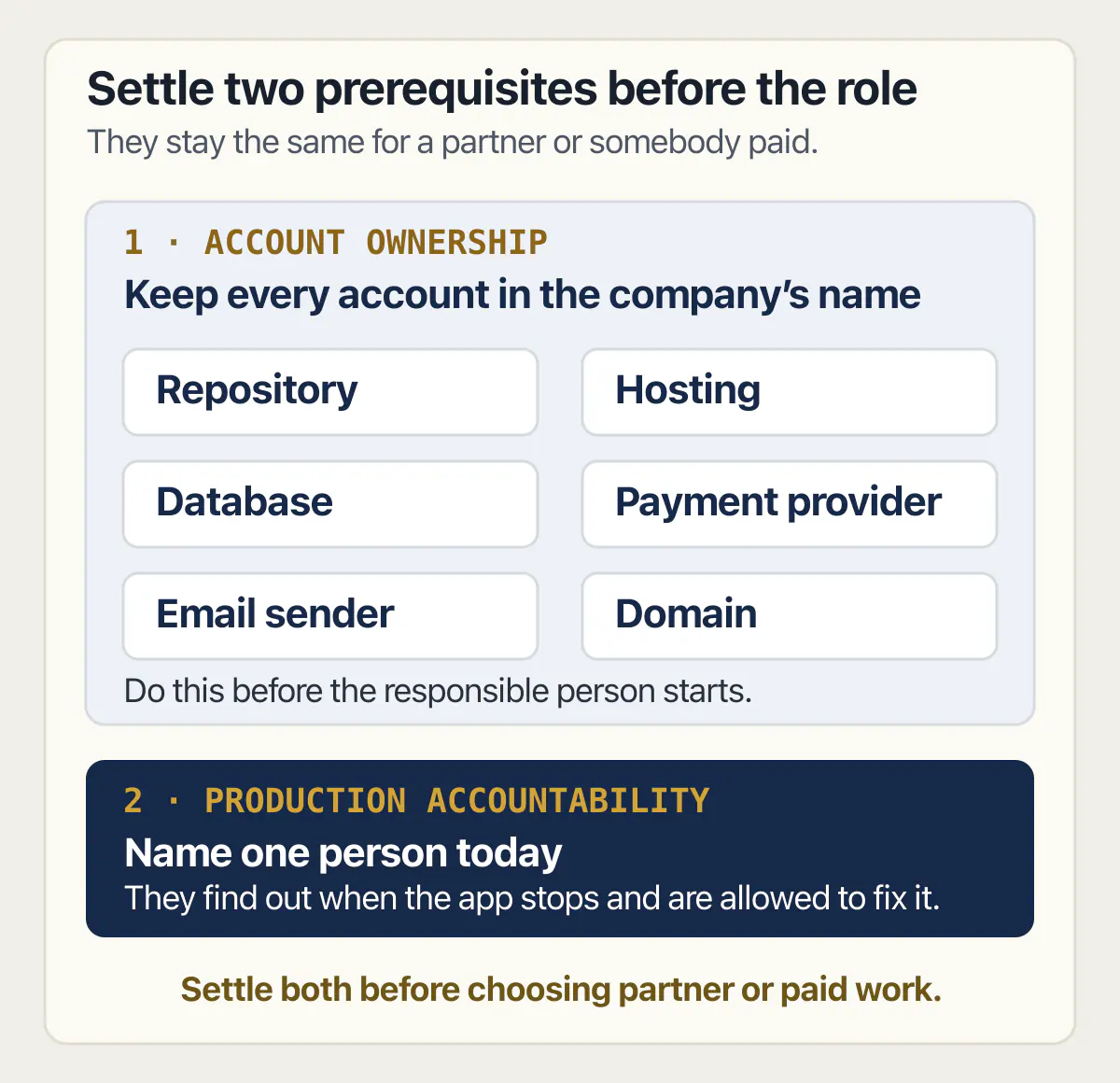
Both answers have the same prerequisite, and it is the one nobody checks until checking it is expensive. Whoever ends up responsible for the code, the accounts around it have to be in the company’s name before that person starts. The repository, the hosting, the database, the payment provider, the email sender, the domain: each of those is an account with an owner, and if the owner is a person rather than the company, the arrangement you agreed is not the arrangement you have.
This matters more with a partner than with somebody paid. A paid arrangement ends and you notice immediately what you cannot get into. A partnership does not end, so an account in the wrong name can sit there for two years and only become a problem on the day the relationship changes.
The second prerequisite is that one named person is accountable for the app in production, today, before any of this is settled. Accountable means something narrower than responsible for building it: the person who finds out when the app stops, and who is allowed to fix it. Who should be accountable for an app once real people depend on it, and what that accountability has to include, is answered where running one in production is the subject.
Neither of those changes with the answer to this page’s question, which is the argument for settling them first. A founder who has the accounts and knows who answers at midnight can take their time over the partner decision without anything getting worse. A founder who has neither is making the decision under pressure that has nothing to do with cofounders.
Common questions about technical cofounders
Who is a technical cofounder?
A technical cofounder is a founding-team member who takes primary responsibility for building the product and the technical architecture of a startup, as startups.com’s lexicon defines the term. What separates them from a hired developer is not skill but position: they hold ownership in the company and carry a founder’s risk rather than an early employee’s, and their responsibility has no defined end.
Does having a working app change whether I need a technical cofounder?
Yes, in one specific way. Every published argument for finding one that was read for this page is written about a company with nothing to look at, where nobody can judge a technical person’s work in advance because no product exists. When your app runs, anybody you are considering can open it, and you can pay for one named piece of work and see the result. That does not make the case for a partner disappear, but it does remove the reason most often given for it.
Can I decide I need one later, after the app has grown?
Yes, and later is usually a better position to decide from. Nothing about paying for work now closes the partner option, while giving away a share closes the paid option for that share permanently. The people worth having as partners are also easier to attract to something with customers than to something with a description, so waiting tends to improve the offer rather than damage it.
Do I need a technical cofounder to raise money?
It depends entirely on who you are raising from. Y Combinator’s post of 30 November 2023 argues that among the thousands of companies it has funded, those lacking a technical cofounder underperform, which is a clear published position from one of the most influential investors in the market and is addressed to companies with no product yet. An app with paying customers is a different conversation, because revenue is evidence and a slide deck is not, but if the investors you want have published a preference this strong, it is a real cost to weigh rather than one to argue with.
Is a part-time senior technical person the same thing as a technical cofounder?
No. A part-time senior technical person is paid for a portion of their week and their responsibility ends where the arrangement ends. A cofounder holds a share of the company and the responsibility has no end written into it beyond what the vesting and departure terms set. The two get confused because both are described as senior, both cost more than a developer, and both are pitched as the answer to not having technical judgement in the room.
Do I need a technical cofounder if I cannot read code?
Not for that reason on its own. Not being able to read the code is a reason to need somebody who can, which is a description of many arrangements and not just this one. What decides it is whether the reading has an end. If somebody can read the code once, tell you what is wrong, fix the parts that are worth fixing and hand it back working, you needed a paid job. If reading and judging the code is a thing that has to happen continuously and forever, that is closer to a position than a job.
What if somebody has already offered to be my technical cofounder?
Ask them to do one paid piece of work first, and agree what “done” means before they start. This is not a trick or a test of loyalty, and any good candidate will recognise it as sensible: it tells you whether they can work in the code that already exists, whether they explain themselves in a way you follow, and whether the thing that was broken is now fixed. Somebody who will not take a defined first job for money is telling you something useful about how the next five years would go.
What a new person needs in front of them before they can do anything useful with the app, account by account, is listed in full in what to give a developer taking over your app and is not repeated here.
What should I do first if the answer is no?
Write down the one thing that is most obviously broken, in a sentence a person who has never seen your app would understand, and get that one thing fixed by somebody who can read the code. One named repair produces more information about what you actually need than three months of conversations about partnership, because it tells you what the code is like to work in and how the person behaves when something does not go to plan.
Owning an app means being able to run it, change it and recover it without guessing. The sprint below leaves you with the runbooks and documentation to do that.
Built it with AI. Now it has to hold up for real customers.
The Production Hardening Sprint takes the app you already have and builds the production foundation underneath it. Authentication and access rules, payments that stay consistent, error handling, monitoring, backups, automated tests and a documented handover. Our engineers work inside your existing codebase for ten working days. All 123 deliverables are included, and you get the evidence for each one.
See the Production Hardening Sprint →  $2,500 fixed price · 10 working days · One codebase