Technical partner, in the sense sellers use it for founders, means a person or a firm that owns the engineering side of one company’s product. It does not mean a software vendor’s channel-partner programme, a consulting firm’s partner grade, or the alliance tier a platform sells to resellers, and those are what almost all of the traffic on those two words is actually about. Mined on 2 September 2026, Google Autocomplete returns 360 unique suggestions for those two words on their own. Nine mention a startup, a founder, equity or what the words mean. The other 351 belong to somebody else’s market.
You are most likely here because a person you respect told you to go and find one, and because the pages that came back all sounded the same. They do sound the same. Read closely, they sell two different things under one heading, and which one you are being offered is the whole decision.
Technical partner covers two separate bargains: a share of the company, or an invoice. Across seven pages read on 2 September 2026, exactly one number is published for the arrangement, and it measures how quickly new work reaches production. None of them describes an ordinary week on an application that already has users.
The seller and platform pages named here were opened and read on 2 September 2026, one of them against its own HTML because the page assembles its copy in the browser. The public asks quoted below are reproduced as they were posted, without names or addresses. Pages that already answer neighbouring questions are linked rather than summarised again, the aggregated record of what founders write when they go looking is described and never linked, and nobody was hired, placed, briefed, interviewed or paid for anything on this page.
What does technical partner mean when a founder uses the phrase?
Two arrangements share the phrase. One is a cofounder who takes equity and a say in the business. The other is a firm you pay to build and keep building. The pages selling either one file both under the same heading, which is why the phrase on its own tells a buyer almost nothing about what they are being offered.
The clearest published example belongs to a product studio’s selection guide. altar.io/finding-the-right-tech-partner-for-your-startup/, read the same day, runs a heading naming a technical cofounder, a chief technology officer, a team of developers and outsourcing with a software development company, and then says to its reader: “When looking for a potential technical partner you have four options”. The four it goes on to describe are learning to code yourself, a cofounder or chief technology officer, a team of freelance developers, and an agency.
The same page is unusually blunt about what separates the first two. A technical cofounder, it says, is one who has “a say in the business and are normally compensated with equity”. A chief technology officer “is strictly an employee. They have a say in the tech but not necessarily the business vision. Commonly they are compensated with a salary.” That is the split a buyer needs, published on a seller’s own page, and it is filed underneath the same two words as everything else.
A development firm’s taxonomy post is the only page on either search that types the arrangement explicitly. jetrockets.com/blog/4-valuable-tech-partnerships-for-non-technical-founders, dated 4 March 2024 on the page and read on 2 September 2026, names four: A Technical Co-Founder, Technical Advisor or Mentor, Software Development Agency and Tech Incubators or Accelerators. No figure of any kind appears against any of the four. The reader it addresses is a non-technical entrepreneur with “great product ideas they want to bring to life”.
A firm-directory publisher’s own article collapses the two senses into one image and then walks away from it. rightfirms.co/blog/choosing-right-tech-partner-for-startup/, dated 19 May 2025 and read on 2 September 2026, opens with “Think of a tech partner as your behind-the-scenes co-founder”, then spends the rest of the page describing a company you hire and evaluate on portfolio, client references and a pilot project or test sprint. Its own rankings and directory listings are not quoted here.
So the word arrives before the arrangement does. What you are trying to work out is which of those the person who answered your message actually is, and no page you have read is going to tell you, because most of them are one of them.
Whether you need somebody in the ownership sense at all comes before this one, and that question is answered elsewhere. The fractional chief technology officer is the same market under a different name, and what that title actually covers is defined on its own page.
What does a technical partner own, according to the pages selling one?
Ownership language, mostly. Across the seven pages behind this article, the claim is strategy, architecture, delivery, product thinking and the technical direction of something not built yet. All seven describe new work. None describes taking responsibility for software other people are already using.
| Source page, named not linked | What it claims the partner owns | The reader it addresses | Any figure in its body |
|---|---|---|---|
| Applore capability page, no date shown | Strategy, architecture and delivery, owned together | A startup at its earliest decisions | One, and it counts new work |
| JetRockets taxonomy post, 4 March 2024 | Four named types of partnership | A founder with a product idea | None |
| Altar selection guide, no date shown | Four options for who builds it | A founder choosing between them | Two, neither a price |
| Arkenea survival post, 24 February 2025 | The company you hire before a cofounder | A founder still seeking one | None |
| Metricoid post, 4 December 2024 | Outsourced development, start to finish | An entrepreneur whose product lags | Failure statistics only |
| LinkedIn article, 25 July 2025 | Turning ideas into workflows and systems | A founder deciding who builds | None |
| Directory publisher post, 19 May 2025 | Building and evolving the product | A founder with no way to build | None |
The strongest ownership language on any of them belongs to a development company’s capability page. apploretechnologies.com/capabilities/startup-technology-partner assembles its copy in the browser, so it was read against its own HTML on 2 September 2026. Answering its own question about what a technology partner for startups does, it says “More than an agency. We own strategy, architecture and delivery together”. Asked how that differs from renting people, it says “Augmentation rents you hands. We own outcomes”. Asked whether it works with the earliest companies, it says “Yes. We engage earliest, where the architecture and sequencing decisions are still open”.
Read those three answers together and the offer is coherent: decisions, not hands, made early, while the shape of the thing is still open. It is a real product and somebody needs it. It is also, by its own description, aimed at the point before there is anything to be responsible for.
A custom software firm’s post makes the same claim in a plainer register. metricoidtech.com/blogs/why-does-every-entrepreneur-need-a-tech-partner-for-their-startup, dated 4 December 2024 on the page and read on 2 September 2026, sets out its definition in a heading that equates a tech partnership with strategic software development outsourcing, then describes outsourcing companies handling “anything from project planning to cost assessment to wireframing to UI/UX designing to software development”. Its warning to a price-shopper is the only caution it publishes: “Whatever you believed would save you money will indeed cost you a lot since you would lose customers due to poor quality of work.”
A platform article published on 25 July 2025 at linkedin.com/pulse/how-find-right-tech-partner-your-startup-the-startup-stage-2lndc, read on 2 September 2026, says the same thing in the register founders actually hear it in: the partner is “helping you translate ideas into workflows, assumptions into logic, and vision into scalable systems”. Its opening decision is “who builds your product”, and the example it gives is first-time founders arriving with an idea.
There is a common thread and it is worth stating as what the pages themselves claim rather than as a criticism of them. Every one of them claims the decisions, the architecture, the direction and the delivery of new work. That is the product on sale under this phrase.
What none of those pages says the arrangement owns
Absences, and every one of them is dated and scoped. In the body copy of the seven pages read on 2 September 2026, there is no price for the arrangement, no rate, no hours, no notice period and no team size. The single published number counts weeks to first production, and it counts them on new work.
That number belongs to the capability page. Read against its raw HTML on 2 September 2026, it prints 11 wks, labelled average time-to-first-production for greenfield surfaces. It is a good number and the company is right to publish it. It is also a measurement of how quickly something that did not exist reaches production.
Eleven weeks to first production measures how fast something new goes live. It describes nothing about the fourteenth month of an application that already has customers in it.
Every absence below belongs to one named page, to that page’s body copy, and to 2 September 2026. Not one of them says anything about a company’s whole site, or about what this market publishes generally. A claim that wide would need the whole market read, and that is not what happened here.
A dollar-sign scan of the capability page’s raw HTML returns only its framework’s own markers, and no currency at all. No price, no rate, no monthly figure, no equity percentage, no hours and no team size appears anywhere in the body of the survival post at arkenea.com/blog/non-technical-founders/, dated 24 February 2025. Two dollar amounts appear in the selection guide, one about what poor code costs companies each year and one about an acquisition, and neither is a price for anything on offer. The custom software firm’s post prints startup-failure percentages and a figure for worldwide losses to cyber attacks that it attributes to a magazine, and no price, rate or fee of its own. The platform article publishes no figure at all, and the directory publisher’s article body publishes none either, though other posts carried in the same page’s chrome do.
The survival post is also the one that answers the buying question most directly, and its answer is to buy the firm. It states that “Most successful founders hired a custom software development company like Arkenea (in the healthcare industry) to help them develop their apps and then hired a cofounder along the way.” That is a seller recommending itself, which is ordinary, and it is still the clearest published sequence anybody puts in writing under this phrase.
Only one of the seven names a shape that carries on after launch, and it names it as a possibility rather than a term. The directory publisher’s post says the relationship “might even evolve into” “Revenue-sharing or equity partnerships” and “Long-term retainer models with built-in flexibility”. No length, no notice, no fee is attached to either. Notice periods, unused hours and what a written monthly agreement has to say belong to the page that reads the retainer terms.
What is missing across all seven is the part a founder with a working app is actually buying: who answers when it breaks at the weekend, who has read the code, who decides what ships next, and what happens on an ordinary Tuesday when nothing is on fire. The duties somebody has to hold once an app is live are already itemised, and this page is about who that somebody turns out to be.
Several of the questions this raises are separate purchases with their own published numbers, and the honest thing to do is name them rather than blur them together. Buying several people’s time by the month is another market entirely, and the numbers sellers publish for it are gathered on the page that prices that purchase. Paying one developer by the month is the smaller version of the same idea, and what a month of that actually contains gets worked through where that month is argued. Somebody paid for part of their week rather than owning the whole thing is a third thing again, with its own published rates, argued on the same page. Whether to hand the work to an outside company at all, and what changes when that company sits somewhere else, is decided separately. Buying one competent person’s opinion once, rather than an arrangement that continues, is a narrower purchase and it is priced differently.
Why do the same words return cofounder pages?
Search treats the two senses as one, and it can be measured. On 2 September 2026, technical partner for startup returned four sellers among eight organic results. A near-identical phrasing, finding a technical partner for your startup, returned eight results the same day, and every one of the eight was about finding a cofounder.
Those two result sets were pulled minutes apart with the same settings. The second returns a forum thread about finding a technical cofounder, an accelerator’s own library page on the subject, two cofounder-matching platforms, a founders network post, a second page from the same product studio about where to find a technical cofounder, and a bank’s guide to finding a cofounder. Not one of the eight is about a supplier. Adding the word “finding” to the front of the phrase changes which market Google thinks you are in.
One essay ranks on both. An automated read of medium.com/@NirZicherman/stop-looking-for-a-technical-cofounder-c1cd76a29854 answered with HTTP 403 on 2 September 2026, both when the searches were run and again when this page was written, so its position on two of the three result sets is stated as a fact about the results and nothing at all is said here about what it argues.
The forum and question-and-answer threads on these searches are not fetchable either. Everything said about them here is limited to what the result listing itself shows: the community, the title and the comment-count breadcrumb.
Google’s own stored related questions for the phrase, captured on 2 September 2026, carry four items. One of them is What does "technical partner" mean?, which is the flat definitional question and the reason this page exists. Two of the other three are about cofounders and about equity. The search engine cannot keep the phrase away from cofounders either, which is the finding restated by the machine that produces the confusion.
The autocomplete drift measured at the top of this page is the same thing from a third angle. The two founder-facing tails that surface for the bare phrase are technical partner meaning and technical partner for startup equity. One is a person asking what the words mean. The other has already collapsed into the equity sense.
Where founders actually go looking, and what that search takes out of them, is a separate piece of work. What a founder can do instead of taking anybody on, and what each of those choices costs the person making it, is set out elsewhere.
What these searches look like from the founder’s side
A public board carries both halves of the phrase in a single line. A post in r/cofoundermatch, seen on 9 August 2026, was headed UAE-based professional building an AI venture and seeking a technical partner. Whether that writer wanted a co-owner or a supplier is not in the line, and everybody who replied to it had to guess.
The professional networks are thicker with these than the forums are. One founder posted an open search for somebody technical to grow the business alongside them, and said nothing about what either side would get out of it. Somebody else wrote theirs as a search for a technical person who would carry the product through whatever it needed next. Two more of these searches are written as founding engineering roles first and as a partnership second, which tells you what the writer expects the arrangement to involve.
Read a run of them and the pattern is that the phrase itself has no settled meaning to be precise about, rather than that founders are being vague, so a person writing one of these posts has no way to say which bargain they are proposing without dropping the phrase and writing four more sentences. Most do not, and the replies arrive from both markets at once.
What the founder keeps hold of once an app is live, whoever else is involved, has a page to itself.
Which of the two purchases is being offered to you?
Five questions, asked before anything is signed. They sort the two bargains by what changes hands, what an ordinary week contains, whose name is on the accounts, what ends the arrangement, and whether anybody has read the code. None of the seven pages read on 2 September 2026 answers a single one of them for you.
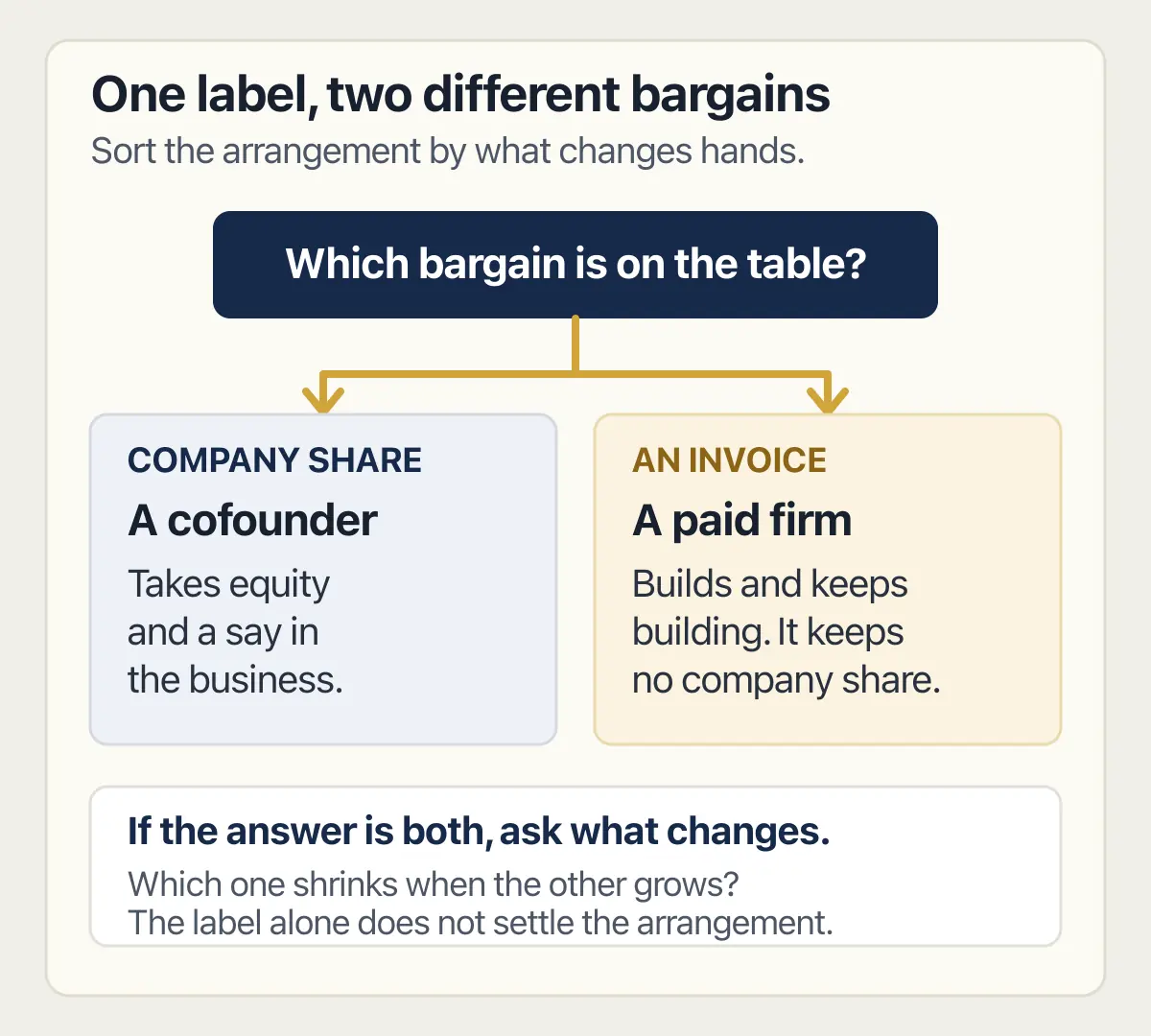
- 01 Ask which bargain is on the table: a share of the company, or an invoice. If the answer is both, ask which one shrinks when the other grows.
- 02 Ask what an ordinary week looks like on an application that is already running, with users in it and nothing on fire. A page written for new builds will not have an answer ready.
- 03 Ask whose name is on the repository, the hosting, the database, the payment provider and the domain while this runs, and whose name is on them afterwards.
- 04 Ask what ends the arrangement, how much notice either side gives, and what happens to work that is half finished on the day it ends.
- 05 Ask whether anybody has read your code before a price or a share is named, and if the answer is no, ask what the number is based on.
The last one sorts more offers than the other four together. A number produced without reading the code is a number produced from a description of the code, and the description came from you.
Two of these questions have pages of their own behind them. The first week with code nobody in the room has read has its own sequence, and it starts the day after this decision is made. One paid reading of the code, done before any arrangement starts, is a separate purchase with limits of its own, and what that reading is bought to settle is set out where it is sold.
Where AxonBuild sits in this
Nothing described on this page is on sale here, and it is worth being exact about that on a page named after somebody else’s product. AxonBuild is neither a person who joins your company nor a standing arrangement.
Common questions about a technical partner for a startup
What does technical partner mean for a startup?
It means one of two arrangements, and nothing in the words themselves says which. Either somebody joins the company as an owner, takes a share of it and carries the code, or a firm is paid to build and keeps nothing. Every readable page that came back for those words on 2 September 2026 sells one or the other, and several file both under one heading.
Is a technical partner just a technical cofounder under another name?
Sometimes, and that is the problem. A product studio’s guide read on 2 September 2026 puts a technical cofounder, a chief technology officer, a team of freelancers and an agency under one heading as four options for the same job, then separates the cofounder from the rest by what changes hands: equity and a say in the business, against a salary and a say in the technology.
What does a technical partner own week to week?
None of the seven pages read on 2 September 2026 says. They describe what the arrangement owns in kind, meaning strategy, architecture, direction and delivery. Not one of them sets out a week, a rota, a response time, or what happens the first time something breaks outside working hours.
What does a technical partner cost?
No page on either search publishes a figure for the arrangement. In the body copy of all seven read on 2 September 2026, there is no price, rate, monthly figure or equity percentage attached to a technical partner. Two pages print dollar amounts about other subjects entirely, and one prints statistics about startup failure.
That absence is scoped to those seven pages and to their body copy on that date. What a group of people costs by the month, what one developer costs over the same month, and what a monthly written agreement contains are all priced on pages that exist for those purchases, and this page routes to them rather than guessing.
Do I need a technical partner if my app already works?
The pages selling one are not written for you. All seven read on 2 September 2026 address a founder who has not built the product, and the only published number among them measures how fast new work reaches production. That does not settle whether you need somebody. It does mean the ranked answers are aimed at a different situation from yours.
Is a technical partner the same as hiring a development team?
Not in the sense the phrase is sold in, though one of the four types a taxonomy post names is a software development agency. The distinction that matters to a buyer is whether you are getting a decision-maker or capacity, and the pages that sell the phrase describe the first while several of them deliver the second.
What should I ask before agreeing to a technical partner arrangement?
Ask which bargain is being proposed, what an ordinary week looks like on an app that already runs, whose name sits on the accounts during and after, what ends it and with how much notice, and whether anybody has read your code before naming a price or a share. The five questions above are the long form, and not one of the seven pages behind this article answers any of them.
Can one person be a technical partner, or does it need to be a firm?
Both are sold under the phrase. A taxonomy post read on 2 September 2026 lists a technical cofounder and a technical advisor alongside a software development agency and an accelerator, all four as tech partnerships. What changes with the answer is not the label but who is accountable when something goes wrong, and how quickly you can replace them if it does.
Owning an app means being able to run it, change it and recover it without guessing. The sprint below leaves you with the runbooks and documentation to do that.
Built it with AI. Now it has to hold up for real customers.
The Production Hardening Sprint takes the app you already have and builds the production foundation underneath it. Authentication and access rules, payments that stay consistent, error handling, monitoring, backups, automated tests and a documented handover. Our engineers work inside your existing codebase for ten working days. All 123 deliverables are included, and you get the evidence for each one.
See the Production Hardening Sprint →  $2,500 fixed price · 10 working days · One codebase