Type the question into Google and page one hands back eight results: two forum threads where people are asking exactly what you are asking, four companies that sell the thing being asked about, an education publisher and a site that sells paid advice. That imbalance is the whole difficulty with researching this decision. The sellers write the guides, the guides answer for an app nobody has started yet, and you have one that already exists and mostly works.
This page is written for that owner. You built something with an AI tool, it runs, people use it, and there is now a list of things that are wrong, missing or worrying you. You are looking at outsourcing companies because that is what the internet returns when a non-developer types the question. The decision underneath is which of four supplier shapes your list matches, and three of the four are priced for a job you do not have.
The market described here was read on 26 August 2026: three Google result sets for the outsourcing and nearshore queries, six of the ranking pages opened and read in full, two more that refused the request and are therefore not described at all, and every ranked list of best companies checked for one thing, whether the company publishing it appears on its own list. Nothing was run hands-on. No supplier was contacted, hired or tested. No seller on any of the three result sets is linked.
Outsourcing is usually the wrong shape when one app already runs and your list is specific. Of the four supplier shapes on this page, three are priced for a build nobody has started. What a working app needs is named changes to code somebody has read, which is a different unit and a different price.
Should you outsource app development when the app already exists?
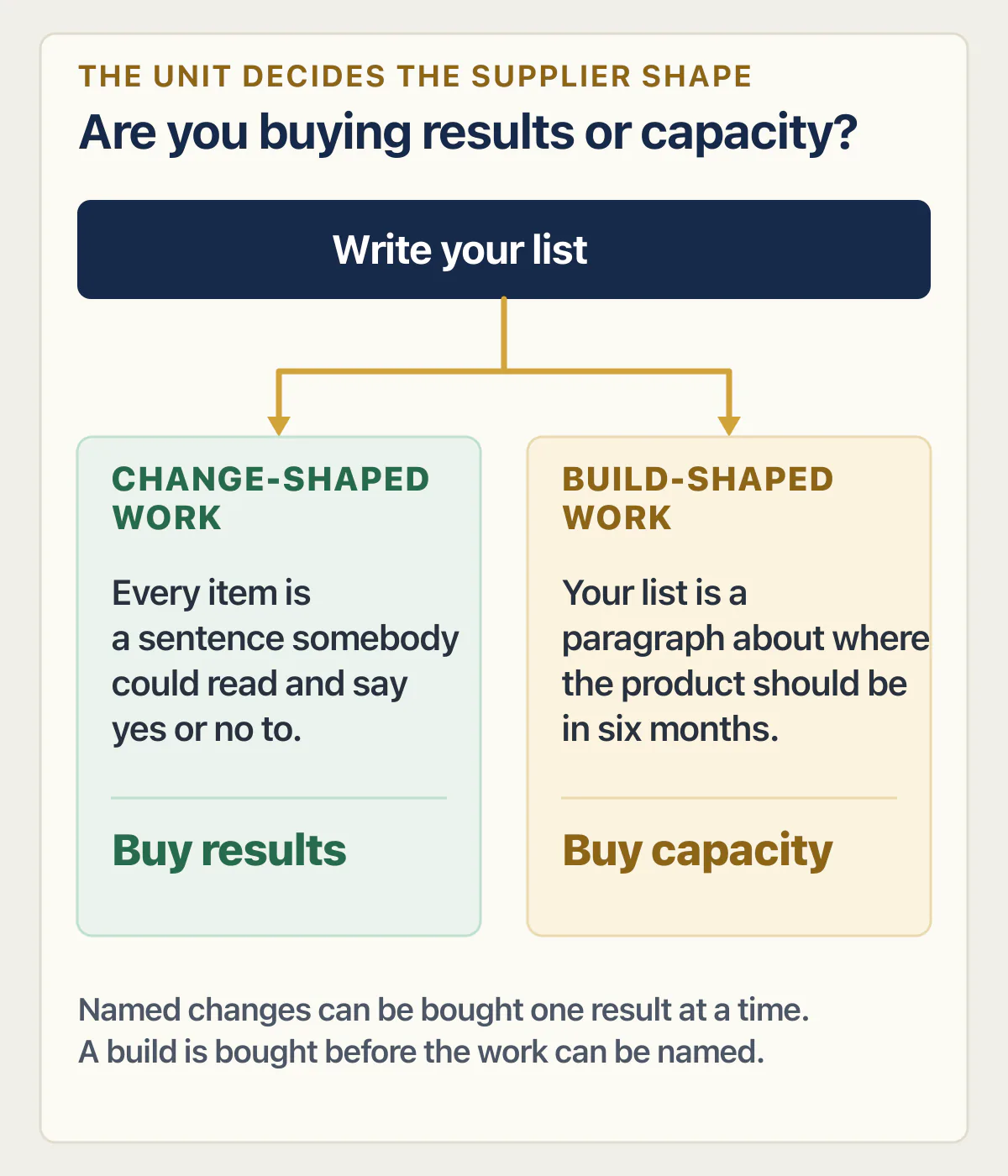
Outsourcing an app that already exists is usually the wrong fit, because outsourcing is organised around builds. A build is bought by the month or by the project, since nobody can name the work yet. Changes to a running app are bought one named result at a time, because you can name them.
Almost everything published on this question answers the build version of it. The split is the unit, and the unit decides which supplier shape fits.
That difference shows up in what people actually ask for. One founder posted publicly this year looking for a person to take a mobile app past the prototype they already had and make it hold more users. Another posted that a developer had quoted them a month of work for a small tool, and that they went away and built it themselves with an AI builder instead. Neither of them was shopping for a supplier organisation. Both were describing one specific piece of work on something that already existed, which is the unit outsourcing companies are worst at pricing and freelancers and repair-shaped suppliers are best at.
There is a practical test. Write your list. If every item on it is a sentence somebody could read and say yes or no to (“card payments fail on renewal”, “anyone with the link can open another customer’s file”, “the export button times out”), you have change-shaped work and you are buying results. If your list is a paragraph about where the product should be in six months, you have build-shaped work and you are buying capacity. Suppliers are organised to sell the second thing, which is why every guide on this question prices it.
Whether to keep going with the builder yourself or pay a person for the part that is stuck, one job at a time, is the decision underneath this one, and it is worth settling first, because a supplier cannot help you with the parts you were always going to do yourself. How you actually run a hire, from the first message to the day work begins, is the same sequence whoever you pick, and it is worth walking before you shortlist anybody.
What an outsourcing company actually sells
Four supplier shapes cover almost everything on offer. They differ in how they charge, which tells you more about the fit than any description of what they can do, because everybody can do everything. The pricing basis is the honest signal.
| Supplier shape | How it is priced, as its own sellers describe it | What it fits | What it costs you |
|---|---|---|---|
| One freelancer you find yourself | By the hour, or by the job | One job at a time on an app that already exists | Your own time explaining the app, every time |
| A contractor through a marketplace | By the hour, through the platform | Short jobs you can describe accurately in writing | Judging strangers yourself, from profiles |
| A supplier organisation that staffs your work monthly | Per person, per month | Months of planned work needing more than one person | A minimum size you may not need |
| Somebody who takes one agreed change | Per result, after reading the code | One thing that is broken, risky or unfinished | Nothing until that thing works |
Row three is what the word outsourcing usually means on this search, and it is a good product for the buyer it was designed for. A supplier organisation gives you people who have worked together, a company on the other side of the contract, and the ability to add a second or third person without repeating a hiring process. Every one of those advantages costs money whether or not you use it this month. If the plan is one person for three weeks, you are paying for an organisation to stay assembled around a job that does not need it.
Row four is the one the directories never list, because it is not a staffing arrangement at all. The supplier reads the code first, names one result, and charges for the result rather than for the time. What it looks like when somebody carries out one whole job for you is the closest live example of the shape: a fixed job with a stated end state, priced after somebody has looked at what is actually there. That is the shape AxonBuild sells, and its terms are stated once, further down.
Handing the whole app to somebody who runs it from here, rather than buying one job at a time, is a different purchase again with its own set of checks, and it sits between rows three and four rather than on this table.
One thing the table cannot show is that the rows are not exclusive. Plenty of owners use a marketplace contractor for two small jobs, then a repair-shaped supplier for the one thing nobody else would take on, then nothing at all for six months. Buying help one job at a time for an app that already works commits you to nothing beyond that job, on terms each seller sets; payment timing, cancellation and minimums are in the contract, not in the pricing unit. Treating it as a commitment is how founders end up on a monthly bill for capacity they stopped using in week three. The four shapes are the same whether you outsource mobile app development or web app development, and whether the supplier sits in your city or eight time zones away; only the specialist skills on the other end change.
Why every list of the best outsourcing companies is written by one of the companies on it
Search for top software outsourcing companies, or for software development outsourcing companies, or for the nearshore version of either, and the ranked lists that come back are advertising with a ranking on top. Four of them were opened on 26 August 2026 and checked for a single thing: whether the company publishing the list appears on its own list. All four do, and three of the four put themselves first.
| List | Who publishes it | Where the publisher sits on it | Date the page shows |
|---|---|---|---|
| 25 nearshore software development companies | Arc, a talent marketplace | First of 25 | 2026-05-26 |
| Top 15 application development outsourcing companies | Near, a staffing company | First of 15 | Last updated February 4, 2026 |
| The 7 best nearshore software development companies | Near, the same staffing company | Second of seven | Last updated July 13, 2026 |
| Top 10 mobile app development outsourcing companies | Deazy, a development company | First of ten | No date shown anywhere on the page |
Every ranked list of outsourcing companies on page one was published by a company that appears on it, and three of the four put themselves at the top.
Be fair to them about one detail. Near’s application-development list says in its own words that “This list isn’t organized in any specific order, so focus on finding the best match for your needs”, which is a more honest framing than most ranked pages carry, even though Near still occupies the first slot. Arc’s page carries the date 2026-05-26. Deazy’s page shows no publication or update date anywhere, which matters more than it sounds: a list of the best companies with no date on it cannot be checked for whether it is current. A fifth publisher on the same result sets, tecla.io, is a staffing company whose page-one result is its own top-seven list. It was not opened, so nothing is claimed here about where it puts itself.
None of this makes the lists dishonest. A company that sells development work and also publishes a guide to buying development work is doing normal marketing, and the companies named on those lists are real companies doing real work. The practical consequence is narrower. The ranking tells you who wrote the page, and who fits your job is a separate question that no list on that first page is answering. Read them for names to look up, never for an order to trust.
The pattern goes wider than the lists. The single most contested query in this market, nearshore software development company, returned nine organic results on 26 August 2026, and all nine were vendor service pages or vendor-published rankings. No publisher, no community thread, no neutral reference anywhere in the set. On the main outsourcing query, four of the eight results were companies selling development work; the four that were not were two forum threads, an education publisher and a site that sells paid advice.
Those forums are worth a minute for a different reason. On 11 August 2026 an agency posted its own new site to a design community with the title “Launched our agency’s new site. Handcrafted, no vibe-coding. Roast it”. Two days earlier a contractor advertised in a jobs community under the heading “[For Hire] Most agentic systems in production are laggy, expensive, unmaintainable…”. One is selling distance from what you built. The other is selling repair of what you built. Both are describing the same category of app, in opposite words, in the same fortnight.
Which suppliers actually take on work that an AI tool started, as opposed to the ones who only want new builds, is a shorter list than the directories suggest, and it is worth working out before you send the same message to fifteen companies. What to ask a supplier before you agree to anything, and what a real answer names, is the conversation this decision ends in. Checking that a supplier is what it says it is, when you cannot read a line of the code, takes about an hour and does not need a developer.
The four ranked lists above are arc.dev/employer-blog/nearshore-software-development/, hirewithnear.com/blog/application-development-outsourcing-company, hirewithnear.com/blog/nearshore-software-development-companies and deazy.com/knowledge-hub/outsource-app-development-companies. The two build-pricing guides quoted later are mindsea.com/blog/mobile-app-agency-inhouse/ and appinventiv.com/blog/outsource-app-development/. All six were read on 26 August 2026. None is linked. All of them sell development, staffing or outsourcing services to exactly the reader this page addresses, so each one is credited by name and by address rather than with a link. Two more page-one results, median.co and upwork.com, returned HTTP 403 to an automated read on the same day, so nothing at all is claimed about what they say.
Working with a company in another country, straight
The nearshore and offshore vocabulary describes one variable, which is where the people are. Sellers define nearshore as a supplier in a nearby country with substantially overlapping working hours, and offshore as one far enough away that the working day barely overlaps. That is the whole distinction, and it is a scheduling fact before it is anything else. The word travels loosely, too: Google’s autocomplete on hire offshore developers, run on 26 August 2026, mixes software suggestions with oil-rig recruitment, including “how to apply for offshore oil rig jobs” and “oil rig companies hiring”.
Two things change with distance. The first is the published rate. Deazy, a development company that also publishes a ranked list of outsourcing companies, prints per-hour bands by region on a page that shows no date: between $100 and $135 per hour in the US, between $75 and $100 per hour in Western Europe, and between $25 and $40 per hour in Eastern Europe. It works an example on the same page, saying a simple mobile app takes around 300 hours and that at $30 per hour the development cost is $9,000. Near, a staffing company placing engineers in Latin America, states on a list last updated 13 July 2026 that a software engineer earning $36K to $108K in Latin America costs $100K to $238K in the US, and that companies hiring there typically save 30 to 70 percent against equivalent US hires. Arc, a talent marketplace, says on a page dated 2026-05-26 that nearshore development “can reduce engineering costs by 30% to 60%” against hiring locally in the US or Western Europe, and describes a “20% fee” on its own full-time placements. Every one of those figures is the seller’s own published claim about its own market, printed here with its publisher’s name attached because that is the only form in which it means anything.
The second thing that changes is overlap. If your supplier’s working day covers four hours of yours, a question you ask at noon gets answered tomorrow. On a build with a plan, that is an inconvenience. On a live app where something is failing for paying customers, it is the whole cost.
Three things do not change at all with distance, and they are the ones that decide whether this works.
Somebody still has to read your code before anybody can price the job honestly. A supplier who quotes from your description alone is quoting a guess, wherever they sit. The accounts still have to be in your name: the hosting, the database, the domain, the payment processor and the repository, with the supplier invited in rather than handed the keys. And the person on the other end still has to be judged on their own history and their own answers, which is exactly as hard at four thousand miles as at four.
Prices sit with the page that owns them. The monthly band one publisher puts on a team, and what a cleanup costs piece by piece collects the published figures for work on an app that already exists, including the abroad-and-at-home split for a monthly team, and none of those numbers are repeated here as this page’s own.
What an outside supplier walks into on an AI-built app
Whoever you hire, and wherever they sit, their first week is reading. An app that runs is not the same as an app that is understood, and the gap between the two is what a supplier is actually charging you for at the start of any arrangement.
Across the 26 AI-built applications AxonBuild reviewed in June and July 2026, scored against a fixed set of production-readiness checks, the results landed between 29 and 81 on a 100-point scale, averaging 52.1, with a median of 51. That is what that fixed study of 26 AI-built apps recorded, and the cohort is a fixed historical one that does not grow. The mid-range scores are the point. These were not broken apps. Most of them worked, took users and did the job they were built for, and still carried a list of unfinished things that only appears once somebody reads the code rather than uses the product.
Nine of those 26 were sitting on a framework release with a hole that was public knowledge and reachable from outside, and the audits recorded the repair for most of them as one changed version number in a dependency file. Some of what an outside supplier finds on an AI-built app is a week of work. Some of it is that one changed number, in a file nobody had a reason to open. From a description alone, nobody can tell you which of the two you have.
A supplier selling months of capacity has to name a price before anybody knows whether your list is nine lines of work or nine weeks. A supplier who reads first does not.
This is the argument for buying a read before you buy anything larger. Buying a read of the code as a job on its own is a small, bounded purchase that turns a description into a list, and a list is the only thing that makes three quotes comparable.
Who an outsourcing company is actually right for
There is a reader for whom a supplier organisation is the correct answer, and this page would be dishonest without naming them. Five situations qualify.
You have months of planned work that more than one person has to carry, and the plan is stable enough that capacity is the constraint rather than clarity. You need a company on the other side of the contract, because your buyer, your insurer or your board requires one. You are starting a second product line while the first one keeps running. You are replacing in-house capacity you used to have. Or you really are building something new, from nothing, and the app you already own is a separate matter.
In all five, a supplier organisation beats one freelancer. It absorbs a person leaving, it carries more than one skill, and it can put a second pair of hands on something in a week rather than a month. What a team of people gets you that one person cannot, and why one app almost never needs one, is the same question asked with a different word, and it is worth reading before you commit to a monthly shape.
If a build really is what you need, the comparison changes shape completely. What an agency charges for an app build, and what the money is actually buying, is the comparison to run in that case, and it is a different set of numbers from anything on this page. Paying somebody to help you decide what to build before anybody builds it is its own arrangement again, and it is bought before the build rather than as part of it.
The published guides are all written for these five readers, which is why they read as if they are talking past you. MindSea, an app development agency, published a guide on 10 March 2026 arguing in-house against agency and pricing a small internal team at $212,000 to $374,000, against a median agency-built app of $37,000 to $171,000 that the same page says “could climb to more than $500,000”. Appinventiv, an app development company, dates its own guide 24 August 2026 and prices “$30,000 for simple apps with basic features to $300,000 or more for complex, enterprise-grade applications”, with 4 to 6 months for the simple end. Both are answering for an app nobody has started. MindSea’s only mention of an app after launch is a passing line about handing a finished build to an internal team. Those figures price a genuine piece of work, and it is not the piece of work you have.
One more branch is worth naming before you buy anything. Whether this app is worth keeping at all is a question some owners should settle first, because the answer changes which supplier shape you are shopping for.
Where this leaves you, and where AxonBuild does not fit
AxonBuild is row four of the table. It starts with a free 20-minute video call with Bilal: show him the app, explain what should happen and what happens instead, and say what you have tried. He will help you work out what needs checking. If you want him to make the change, he checks the app and gives you a fixed quote, you agree what the app should do, and you pay after you see it working. Further changes can follow the first one, each quoted the same way.
AxonBuild does not sell a new build, a roadmap, staffing, or a team you direct. If your list is months long, if you need a company on the other side of a contract, or if you are starting from nothing, the suppliers named on this page are selling what you need and this one is not. The free call produces no document to take away: what you get is a conversation about what needs checking, and then the changes you agree to.
Name your list before you talk to anybody. A list of specific, checkable items makes the directories mostly beside the point, because what you are buying is results and the rankings sell capacity. A list that turns out to be a direction means you are buying capacity after all, and then the supplier organisations on those rankings are worth your time, in whatever country makes the hours and the rate work. The part nobody in this market can tell you in advance is which of the two you have, and finding out costs somebody an afternoon of reading.
Common questions about outsourcing app development
How much does it cost to outsource app development?
The published figures price a build, not changes to an app that already runs: Appinventiv puts a simple app at $30,000 and a complex one at $300,000 or more on a page dated 24 August 2026, and MindSea puts the median agency-built app at $37,000 to $171,000 on a page dated 10 March 2026. Neither number describes your job if your app already exists. What that work costs depends on what a person finds when they read the code, and what the same work costs through each hiring route collects the current published figures for it in one place.
What is the difference between nearshore and offshore development?
Nearshore means a supplier in a nearby country whose working day substantially overlaps yours. Offshore means one far enough away that it mostly does not. Sellers use the words this way consistently. What matters to you is how many hours a day you can get an answer in and what the published rate looks like where they are, and the label decides neither on its own.
What is the best country to outsource app development to?
There is no answer to this question that survives contact with your actual job, and any page that ranks countries for you is selling one of them. The questions that decide the outcome are who reads your code before anybody quotes, whose name the hosting and payment accounts are in, and how many working hours a day you overlap. A supplier who gets all three right in a far country beats one who gets them wrong nearby.
Can you outsource app development if the app was built with an AI tool?
Yes, and the practical filter is whether the supplier will take on work that an AI tool started. Some will not, and say so openly in their marketing. The ones who will should be able to tell you, after reading the code, which parts they would keep and which they would rewrite, before they give you a price. A supplier who quotes on the description alone has not looked.
What should I send an outsourcing company before they can quote?
Send access to the code and the running app, a plain-language list of what is wrong or missing, and whatever you know about who the users are and what they do. What to send a supplier before anybody can put a price on the job, written down in plain words, is what turns three wildly different quotes into three comparable ones. If somebody is taking over the running of the app rather than doing one job, what the next person needs on day one is the fuller version for after the hire.
How do I make sure I still own the code and the accounts?
Keep every account in your own name and add the supplier to it rather than handing it over. That is how the platforms are built to work: GitHub’s page on inviting collaborators to a repository describes sending an invitation to collaborate in your repository, either to someone on GitHub or to their email address, and says that once they accept they have collaborator access to your repository. The same pattern exists on hosting, database and payment platforms. Access is only half of the question, though: rights to code a contractor writes are settled by the contract you sign with them rather than by who can open the repository, so have that contract say in writing that the code they produce is yours, and get a lawyer to read the clause if the wording is unclear. Whether the code and the accounts are actually yours, when somebody else set them up, is worth settling before anybody starts work rather than after.
Is one company better than one freelancer for an app that already runs?
For a single app with a specific list, one person who reads the code is usually the better buy, because a company charges you for an organisation you are not using. A company wins when the work outlasts any one person, when you need cover for illness and holidays, or when a contract has to be with a business rather than an individual.
What if I already paid a company and the app still is not finished?
Get the accounts and the code into your own hands first, before any conversation about money, because access is the thing that gets harder to recover the longer it waits. What the hiring itself got wrong, when somebody was paid and the app never got finished, is worth reading before you sign with the next one. Checking what was actually delivered, once a company has handed something back, is a separate exercise from choosing them, and it is worth doing before you decide how much is left.
Built it with AI. Can’t get the last part right?
That’s the normal state of an AI-built app, and it’s fixable. I trace what the app actually does, explain what needs changing, and build it if you want me to.
Talk about your app →  Free 20-minute video call with Bilal.