The app works. Customers are inside it, some of them paying. Then a developer, an agency, or a thread you were not looking for tells you the code is a mess and you should start over, and suddenly a few thousand dollars is pointed at a decision nobody has actually costed.
Fixing is the cheaper answer in almost every case. A rebuild only pays when the shape of your data blocks something you have already sold. What decides it is arithmetic rather than how bad the code looks: across 21 audited AI-built apps, 58 of 958 confirmed findings were critical.
The suggestion is common enough to count. Of 1,255 rows in a fixed harvest of public founder posts, read once on 14 August 2026, 46 used rebuild or from-scratch language about an app that already existed. That is a pattern match from one reading pass over an internal harvest rather than a survey, so it says the question is common and nothing about how often rebuilding is right.
The rest of this page is the arithmetic, plus the one condition that overrides it.
When rebuilding a vibe coded app is genuinely the right call
One condition overrides everything else: the data model cannot express what the business now does, or who is allowed to see what. Cross-customer access is the clearest version. In AxonBuild’s 21 third-party audits from June and July 2026, 7 apps let a logged-in user reach another customer’s data.
A related figure from the same fixed cohort: 9 of the 21 had a gap in their row-level security rules. Both counts are computed over the 21 third-party apps in that historical cohort, never over the full 26, which includes five of my own production apps.
This class matters more than the others because a surface fix does not always reach it. If two customers’ records live in the same table with nothing in the schema separating them, every screen, every endpoint, and every future feature has to remember to filter correctly, forever. You can patch each place you find, and the next feature reintroduces the risk, because the thing enforcing separation is a habit rather than the database.
The same override applies without any security angle. A pricing model that now needs per-seat billing on a table storing one price per account, or an app that sold multi-location support on tables with a single location column: same failure. The business changed, the data shape did not, and no amount of careful editing on top of it produces the thing you sold.
Two honest limits. The override has to block something real and already promised, not something on a roadmap. And it usually justifies replacing the data model and what sits directly on it, which is a much smaller job than replacing the app. For the code-level version of this diagnosis, how to tell whether the app is repairable at all covers the signals inside the codebase itself.
Why rebuilding a vibe coded app does not fix what usually breaks
A rebuild replaces the wrong thing. Maintainability, the area a new build directly improves, averaged 61.1 out of 100 across the 21 third-party AI-built apps AxonBuild audited in June and July 2026, and ranked tenth of twelve for weakness. The four worst areas were never built at all, and a rebuild starts them at nothing again.
Those averages come from the same fixed cohort of 21 third-party AI-built apps, scored on a 0 to 100 rubric across twelve areas between June and July 2026. Areas that did not apply to an app were excluded rather than scored zero, which is why the eligible count differs by row. The cohort is small and drawn from public AI-built apps rather than a random sample, so it describes those 21 apps and not every AI-built app in existence.
| Audit area | Average score | Apps scored | Does a rebuild replace it |
|---|---|---|---|
| Reliability and correctness | 31.4 | 21 | No. Tests and error tracking get written on purpose or not at all |
| Dependencies and supply chain | 34.5 | 20 | No. A new build picks its own packages and needs the same updating habit |
| Deployment and operations | 37.0 | 21 | No. Deploy gates, a staging copy, and working backups are separate work either way |
| AI and LLM risk | 38.4 | 14 | No. Spend limits, quotas, and handling of untrusted text are chosen deliberately or missing |
| Maintainability and evolvability | 61.1 | 21 | Yes. This is the one a rebuild genuinely improves, and it ranked tenth of twelve for weakness |
Read the last column downward and the shape of the problem is plain. The four weakest areas are things the app never had. Generators produce the feature you asked for; nobody prompts for the test that proves the feature still works next month, or the record of the error a customer hit at 2am.
The four weakest areas in the audit corpus are things the app never had. A second codebase starts every one of them at zero again.
Volume of bad code is also a poor guide. Those 21 apps produced 958 confirmed findings, roughly 46 each, and 58 of them were confirmed critical. That is about six per cent. The 58 criticals fell across 17 of the 21 apps, an average of about 3.4 apiece, and the underlying records carry no per-app breakdown, so that average does not tell you how many sit in any single app, including yours. What it does tell you is that “there is a lot wrong with it” and “there is a lot stopping you” are different counts, and only the second one costs money.
The honest counter belongs here too, because it cuts the other way. Not one of the 26 apps in that fixed June and July 2026 cohort came out in the green band. Scores ran 29 to 81 out of 100, mean 52.1, and five of those apps were my own production apps put through the same method. A rebuild starts you at whatever the second build’s checks catch, which for most people is the same set of checks the first build had. If the real question underneath yours is whether the app is ready for real users at all, that is a separate answer and a cheaper one to get.
What rebuilding a vibe coded app costs that fixing it does not
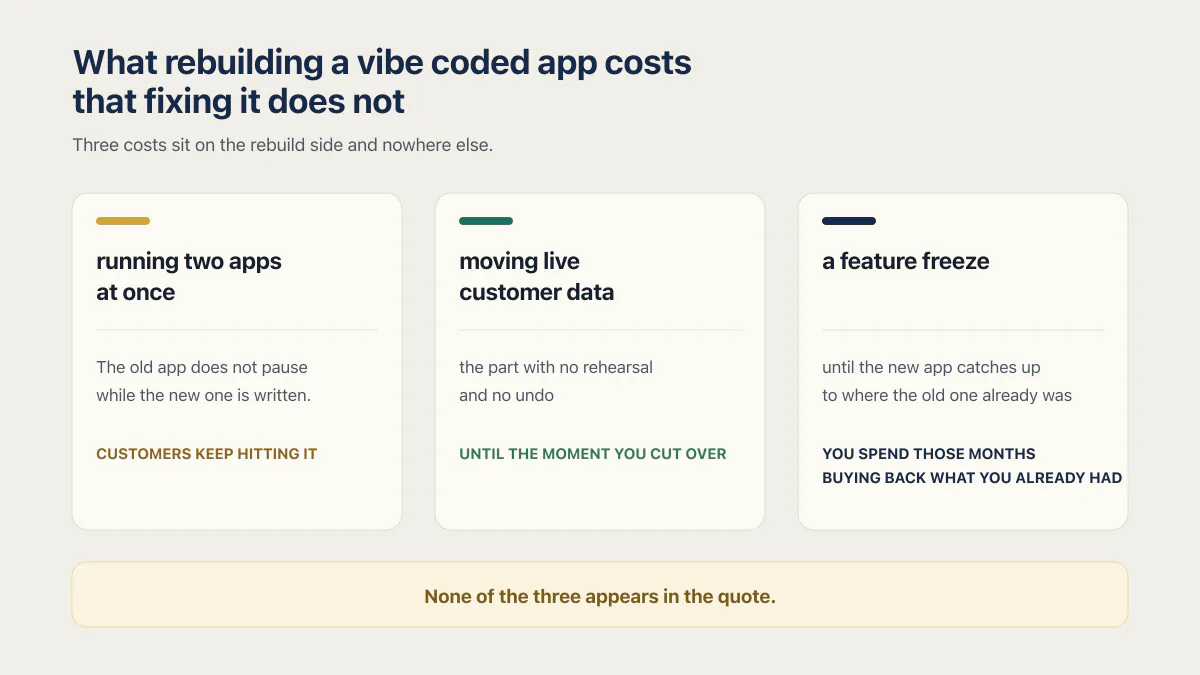
Three costs sit on the rebuild side and nowhere else: running two apps at once while the old one keeps serving customers, rehearsing the live data move on a copy before cutover, and a feature freeze that lasts until the new app catches up to where the old one already was. None of the three appears in the quote.
The old app does not pause while the new one is written. Customers keep hitting it, bugs keep arriving, and a payment failure in week three still has to be fixed in the codebase you are trying to leave. Every fix in that window lands twice, or lands once and gets forgotten in the new build.
Moving the data is the part with the least room for undo. Rehearse it on a copy first. Accounts, orders, files, message history, and anything else a customer would notice missing all have to arrive in the new shape, with the old app still writing to the source until the moment you cut over. Nobody quotes this accurately, because nobody knows what is in the data until they open it.
The freeze is the quietest of the three and often the most expensive. For the length of the rebuild, the answer to every customer request is that it is coming after the new version. You spend those months buying back what you already had.
One person in the corpus described exactly this situation:
I’m rebuilding my vibe coded app, more or less from scratch. It started as a little hack project… and, in the same post:
I have users, paying customers, and a functional app
That is the whole decision in two sentences. With customers already inside, a rebuild means running a second app that has to stay in step with the first one, while the first one keeps taking money.
The rebuild quote is never the rebuild cost. It prices writing the new app, and leaves out keeping the old one alive while you do it.
Is it cheaper to rebuild or fix your vibe coded app? Run the sum
Fixing wins the sum until the count of broken things gets high. The honest starting number is the rebuild quote in your hand. Divide that number by a realistic cost for one repair.
The method below runs on your rebuild quote, repair estimates and count of blocking problems. It is arithmetic, not an estimate of your app.
Step one: the rebuild quote. Use a written quote for rebuilding your app. Check whether it includes keeping the current app running, moving its data, matching live features, switching users over and fixing launch failures. A quote that covers only writing the new app is not the full rebuild cost.
Step two: the count of things actually stopping you. Not everything wrong with the app. The things that block a customer from paying, block the next feature you promised, or would cost you a customer if they happened. Write them as sentences a non-developer can read. If you cannot produce that list, having someone read the code before you decide is a much smaller purchase than either option here, and it turns the count from a guess into a number.
Step three: the cost of one repair. Use a published rate rather than a feeling. A job that takes 6 to 12 hours runs about $240 to $960 at mid-level freelance bands, and what one fix costs across four hiring routes works through the same figures for freelancers, agencies, and the fixed-price route.
Step four: multiply and compare. Multiply the number of blocking items by the repair estimate for each one. Compare that total with the complete rebuild quote. That is your break-even point.
Say your assumptions out loud so the sum stays yours. If the repair estimates rise, the break-even count falls. If the complete rebuild quote rises, the count goes up. And if the blocking item is the data model itself, the count stops mattering, because that item cannot be bought at the per-result price at all. What a rebuild actually costs to buy deserves its own page.
Worth knowing who else writes about this decision. Four company pages rank on the first page for this question: sidekickinteractive, codessavvy, xtreemetech and vu.co.uk. I read all four on 15 August 2026. Every one decides on code signals, and between them they publish no cost figure, threshold, or ratio you could put in a subtraction. Two carry a heading about cost with no number under it: xtreemetech’s is called “Cost of Fixing vs. Rebuilding: How to Compare Fairly”, and vu.co.uk’s asks how much it costs and answers with a pricing structure. The one figure any of them publishes is sidekickinteractive’s illustration of a founder spending around a thousand dollars in credits and a developer’s hours reaching ten times that, offered as an example rather than a threshold. All four sell the work, which explains why none of them publishes a sum that can end in “spend less than you were about to”.
Four things to count before you decide
Every row below is countable by a non-developer in an afternoon, using a billing dashboard, a bank balance, and one honest look at the next thing you promised somebody.
| What to count | How to count it | Points toward fixing | Points toward rebuilding |
|---|---|---|---|
| Paying customers inside the app right now | Paid accounts on this month’s billing statement | Any number above zero | Zero, and none promised to anyone yet |
| Live customer data you cannot recreate | Rows in the tables holding accounts, orders, messages, and uploaded files | Anything a customer would notice missing tomorrow | Nothing a customer would miss if those tables were emptied |
| Months of runway | Cash on hand divided by what you spend each month | Fewer than about six, because a rebuild spends most of them before anything ships | Enough to pay for the rebuild and still be trading when it lands |
| The next thing you already promised | Write it in one sentence, then name which tables it needs | It is unbuilt, and the tables it needs exist or can be added alongside | It is blocked, because the existing tables cannot hold or separate what it needs |
Three of those four rows point at fixing for almost everyone who gets this far. The fourth is the override from the top of this page, and it is the only row that can outvote the other three on its own.
Can you replace part of a vibe coded app instead of rebuilding all of it?
Replacing one part while the rest of the app keeps running and keeps taking money is the third option, and usually the cheapest of the three. Start with the one part that blocks what you already promised, and keep the old path alive until the new one holds on real traffic.
The order matters more than the technique. Replace the piece that blocks the promise first, ahead of the piece that annoys you most. Build it behind the app that is still running, so customers see nothing while it is being written. Keep the old path in place until the new one has handled real traffic, then remove it. That order turns a rebuild into a sequence of separately affordable, separately cancellable fixes, and it lets you stop after the first one. On the code side, when regenerating one module beats repairing it covers how to judge a single piece; the step-by-step cleanup, once the decision is settled, belongs on its own page rather than here.
The false binary shows up in the corpus in one line:
Now, I have to start from scratch and write production code.
The “have to” is the part worth arguing with. Production code comes down to a handful of things that either exist or do not: a test that runs the payment path, a record of errors customers hit, a deploy that can be stopped, a schema that separates one customer from another. Each can be added to a running app, though not always in any order or invisibly: a test, error records and a stoppable deploy go in without a customer noticing, while a schema that separates customers is a data move with limited undo, so it needs a migration and release plan of its own and is the one to sequence carefully.
One of the four ranked company pages, vu.co.uk, describes keeping the parts that pass its review and replacing only what needs changing, which is the same idea. Read on 15 August 2026, none of the four publishes the order to do it in. The commercial reason is plain: partial replacement is the smallest version of the job, and a sequence the customer might stop after step one is hard to sell.
If you have already decided to rebuild your app, carry these three things over
Sometimes the answer really is a new app, and one corpus row records that decision being made and bought:
I hired a company to rebuild my app…
If that is where you are, three things decide whether the new app comes out better than the old one or just newer. The order is real: each one is worth less if the one before it is missing.
- 01 Write down what the app does, before anyone opens an editor. Not a document about the code: what happens when a customer signs up, pays, cancels, asks for a refund, or hits a limit. If those rules exist only inside the running code, the new build has nothing to aim at, and the ones nobody wrote down turn up in your support inbox one at a time.
- 02 Plan the data move as its own job, with its own owner and its own rehearsal on a copy. Every account, order, file and message has to arrive in the new shape while the old app is still writing to the source. People discover this step late, and it is the one with the least room for undo.
- 03 Decide which checks the new app ships with, and write them into the deal: a test that runs the payment path, a record of errors customers hit, a deploy that can be blocked, and a schema that separates customers from each other. Left off the list, they are left out of the build, which is how the four weakest areas above got that way the first time.
The same three apply if the app is being handed to you rather than away from you: picking up an app somebody else built with AI has the same first week either way. For the engineer who inherits the code, legacy code takeover lays out a four-week plan, ending in the keep, fix or replace call.
One boundary worth stating plainly, since this page has been doing arithmetic about money. If you have counted the four rows above and correctly concluded you need a new app, that is a different purchase from a different kind of provider.
Common questions about rebuilding a vibe coded app
Should I rebuild my vibe coded app or fix it?
Fix it, in almost every case. A rebuild earns its price only when the data model cannot hold or separate what the business now does, which is a different problem from messy code. Across 21 third-party AI-built apps audited in June and July 2026, 958 confirmed findings included 58 confirmed criticals, roughly six per cent, and most of the rest were work a new build would have to do again anyway.
The exception is narrow: if the thing you already sold cannot be expressed in the tables you have, no amount of careful editing on top of them produces it.
Is it cheaper to rebuild an app or fix the one I have?
Fixing is cheaper until the number of things actually blocking you, multiplied by the estimated repair cost for each one, passes the complete rebuild quote. Run the sum with your own numbers. The blocking items belong to your app, and the two quotes must cover the work you will actually need.
How do I know if my app is worth fixing?
Count four things: paying customers inside the app right now, customer data you could not recreate, months of runway, and whether the next thing you promised is blocked by the shape of the data or simply unbuilt. An app with paying customers, real data, and an unbuilt rather than blocked next feature is worth fixing, and the sum almost always agrees. All four are countable in an afternoon without a developer, which is the point of choosing them.
Will a rebuild make my app secure?
No, not on its own. The four weakest areas across 21 third-party AI-built apps audited in June and July 2026 were reliability and correctness at 31.4 out of 100 across 21 apps, dependencies and supply chain at 34.5 across 20, deployment and operations at 37.0 across 21, and AI and LLM risk at 38.4 across 14. All four describe things the apps never had rather than things they built wrong, and a new codebase starts each of them at nothing again. Security in a second build comes from deciding which checks ship with it.
How long does an app rebuild take compared with a fix?
There is no honest number for this, and none of the four company pages ranking for this question published one when I read them on 15 August 2026. What can be said is what a rebuild adds to the clock: the old app stays alive and keeps needing attention while the new one is written, the customer data move needs a rehearsal before a production cutover with limited undo, and the roadmap stops until the new app reaches where the old one already was. A single fix carries none of those three.
Can I rebuild part of my app without starting over?
Yes, and it is usually the cheapest route of the three. Replace the one part that blocks what you already promised, build it behind the app that is still running and still taking money, and keep the old path alive until the new one has handled real traffic. This option gets offered least often because it is the smallest version of the job.
What should I write down before anyone rebuilds my app?
Write down what the app does, in plain sentences, before anyone opens an editor: what happens when a customer signs up, pays, cancels, asks for a refund, or hits a limit, and which of those rules have exceptions. If those rules exist only inside the running code, the new build has nothing to aim at, and the ones nobody wrote down surface in your support inbox one at a time after launch.
The same document is what makes a fixed price possible on either option, because it is the only thing that says what “working” means.
Will the same AI tools produce the same problems the second time?
Usually, unless something changes about how the work gets checked. The same tools, the same prompts, and the same absence of tests and error tracking produce the same gaps in a second codebase. Nothing about generating code again adds a deploy that can be blocked, a test that runs the payment path, or a record of the errors customers hit.
Those are decisions somebody makes on purpose, and they cost the same to make in the app you already have.
Fixing the bug in this guide gets you past today. If you would rather have the whole foundation checked and built in one go, that is what the sprint below is for.
Built it with AI. Now it has to hold up for real customers.
The Production Hardening Sprint takes the app you already have and builds the production foundation underneath it. Authentication and access rules, payments that stay consistent, error handling, monitoring, backups, automated tests and a documented handover. Our engineers work inside your existing codebase for ten working days. All 123 deliverables are included, and you get the evidence for each one.
See the Production Hardening Sprint →  $2,500 fixed price · 10 working days · One codebase