You own an app that works. One thing in it does not, the tool that built it has now failed at that one bug more times than you want to count, and before you talk to a human being you would like to know what fixing it costs.
The search will not give you one. It gives you a different industry answering a different question: what a defect costs the company that shipped it, expressed as a multiplier across a development lifecycle you were never part of. Underneath those results sit two community threads where people are asking your question in plain words, and no result on the page answers it with one.
So this page went and read the pages that publish figures instead. Six of them, opened on 31 August 2026, every figure recorded against the unit its own page says it buys. The answer is short enough to say before the table.
One repair carries a published price at exactly one seller in this search. Afterbuild Labs prints $299 for one bug identified and fixed inside 48 hours, read 31 August 2026. Every other seller met here starts at a whole review or a whole project.
What one bug in an app costs, on the prices sellers actually publish
The figures below come from six seller and publisher pages opened on 31 August 2026, each one recorded with the price its own page prints and the unit that price is attached to. No seller was asked for a quote, no repair was purchased, and nothing here is an average of the six.
| Who publishes it | Its smallest published unit | Published price | Read |
|---|---|---|---|
| Afterbuild Labs | One bug identified and fixed, 48 hours, refund stated if it is not | $299 | 31 Aug 2026 |
| Afterbuild Labs | A severity-ranked issue list with a fix-cost estimate beside each issue, no repair | $49 | 31 Aug 2026 |
| Afterbuild Labs | One integration fixed end to end, with tests and a production deployment, 3 to 5 days | $799 | 31 Aug 2026 |
| AppStuck | An hour, sold against a stated prepaid floor | $70/€60 per hour | 31 Aug 2026 |
| Fora Soft | A week of one senior developer reading the code, written up, no repair | $3,000 to $10,000 | 31 Aug 2026 |
| Relux Works | One week of review, credited toward later work | $3,000 | 31 Aug 2026 |
Prices checked 31 August 2026. The pages behind those rows are afterbuildlabs.com/pricing, appstuck.com, forasoft.com/blog/article/lovable-app-bugs-fix-cost and relux.works/en/vibe-code-rescue/. Not one of the four carries a hyperlink here. All four sell repairs and takeovers to exactly the person reading this, so each gets its name and its plain address and nothing clickable.
Read the second column rather than the third. Only one of those six rows is a price for one bug. Every other row’s smallest unit is somebody reading the whole app before anybody touches it, and three of the six list only reading and writing up inside the price, with any repair quoted afterwards.
The ladder above each of those rows tells the same story from the other end. Afterbuild Labs starts at a $0 tier that is a free 30-minute diagnostic call rather than a written read, listed at 48 hours and with no repair in it, then prices exactly two named items, the $299 bug and the $799 integration, and every rung above those two is counted in weeks or in months rather than in items. Relux Works starts its rescue audit at $3,000 for a week and prints “From $10,000” for a two-to-three-week stabilization sprint whose inclusions are “Critical bugs fixed, security holes closed, tests around the core flows”. Fora Soft’s bug-cost article, dated 6 August 2026 on the page and carrying a second date stamp whose label is written in Russian, read on 31 August 2026, has no row below its security and bug audit. That article writes its bands in thousands shorthand, so the audit row it prints as $3k to $10k is $3,000 to $10,000 and the harden-in-place row above it, printed as $15k to $45k, is $15,000 to $45,000. Its smallest published unit is one senior developer for a week. That is a different Fora Soft page from the tiers already recorded elsewhere on this site, read on a different day, and the two sets of figures are not the same claim.
The $49 row deserves its own sentence, because it is the clearest thing in the table. What it sells is a severity-ranked issue list with a fix-cost estimate against each issue, and the page’s own FAQ says plainly that nothing is patched or merged. Somebody has built a product out of the exact gap this page is about: the market will pay $49 to be told what the repairs would cost, because nowhere else can it find out. Relux Works does the same thing at a different altitude, selling a $3,000 week of review that it credits back against later work if you buy the later work. Both are the same admission in different currency. The counting is the product, and the repair is quoted afterwards.
Three dated limits on the reading, all as of 31 August 2026, stated as limits rather than as findings. AppStuck publishes no separate pricing page; its rate and its minimum sit on its home page, which prints $70/€60 per hour and 5-hour minimum (prepaid). Relux Works’ rescue page carries no publication or review date, so its three figures are recorded with the date they were read and nothing more. Fiverr’s service-fee help page at fiverr.com/support/articles/360010560878-Fiverr-service-fee returned HTTP 403 to an automated read that day, so this page makes no marketplace-fee claim of any kind.
Once the answer stops being one named thing, the purchase changes shape and somebody has to count before anybody can price, which is where what the published cleanup market charges once the whole app is in the price takes over. When the answer is not one named thing but the whole app, the search changes and so does the shape of the bill.
The number the search results are actually answering
Type the question into Google on 31 August 2026 and page one belongs to the testing industry. Two DataForSEO pulls that day, nine organic results each, returned eighteen results between them, and not one of them states what a buyer pays somebody to fix one named fault in an app they own.
What ranks instead is the cost of a defect to the company that shipped it. On testomat.io’s software-bug-cost article, marked “Update Jul 16, 2026” and read 31 August 2026, the framing is a ladder by phase: “A bug found during design costs 100 dollars to fix” and “The same bug found in production costs 10,000 dollars”, with multipliers of roughly 6x at implementation, 15x at testing and 100x after deployment. The page attributes all three to IBM’s Systems Sciences Institute. On cloudqa.io’s bug-cost report, marked “Last Updated: August 31st 2026” and read the same day, the same claim appears compressed into one line: a bug fixed at design is “100 times cheaper” to resolve than the same bug found in production, credited to the same institute.
Neither page links a retrievable study for the multiplier. Both name the source and stop there, which is the part worth carrying away: the most-cited number in this search is an attribution without a document behind it on either of the two pages ranking on it. Their addresses, for anybody who wants to check that reading, are testomat.io/blog/software-bug-cost/ and cloudqa.io/how-much-do-software-bugs-cost-2025-report/. Both are marketing for a testing tool, which is why they appear here as text rather than as links.
The demand is on page one too, just not in the answers. Two of the eighteen results are people asking this question of each other. A Facebook group post titled “How much do people charge hourly to fix bugs (lovable …” sat at rank five on the first pull and rank two on the second, nine months old with more than fifty comments on it. An r/webdev thread titled “Advice on developers asking for payment to fix bugs they …” ranked first on the second pull. Both are snippet-only evidence. Facebook, Reddit and Quora returned nothing to the automated reads run on 31 August 2026, so only the stored titles, the comment counts and the positions are recorded here, and neither thread is quoted beyond its title or linked. They establish no price. What they establish is that the question is common enough to rank while going unanswered.
The honest page on this search is the one that refuses to answer. A post on Atlassian’s community forum titled “What is the price of one bug?”, dated 10 October 2023 at community.atlassian.com/forums/App-Central-articles/What-is-the-price-of-one-bug/ba-p/2501052, prints no dollar figure anywhere and closes by asking what one bug costs and answering that nobody knows. Its author writes for a company selling a bug-reporting extension for Jira, so it is not linked here either, but it is the only result on page one that admits the question has no general answer.
Here is the separation that makes all of this usable. A defect-cost multiplier measures what a fault costs an organisation that built, shipped and now supports the software: rework across teams, released versions, support load, revenue. You are not that organisation. You are a person with one app, one broken thing in it, and a decision about whether to hand somebody money to make the broken thing stop. The multiplier does not price that transaction, and the two numbers have nothing to do with each other.
One more dated observation from the same morning. Google’s public suggest endpoint returned zero completions on 31 August 2026 for the qualified phrases cost to fix a bug in my app and hire someone to fix a bug in my app. Strip the app context off the stem and the suggestions fill up with windscreens, dents, pest control and a long run of Bugatti. Almost nobody is typing this question in the form that would find a repair price, which is roughly what you would expect when everything that ranks for it answers something else.
The four things a one-bug price is actually paying for
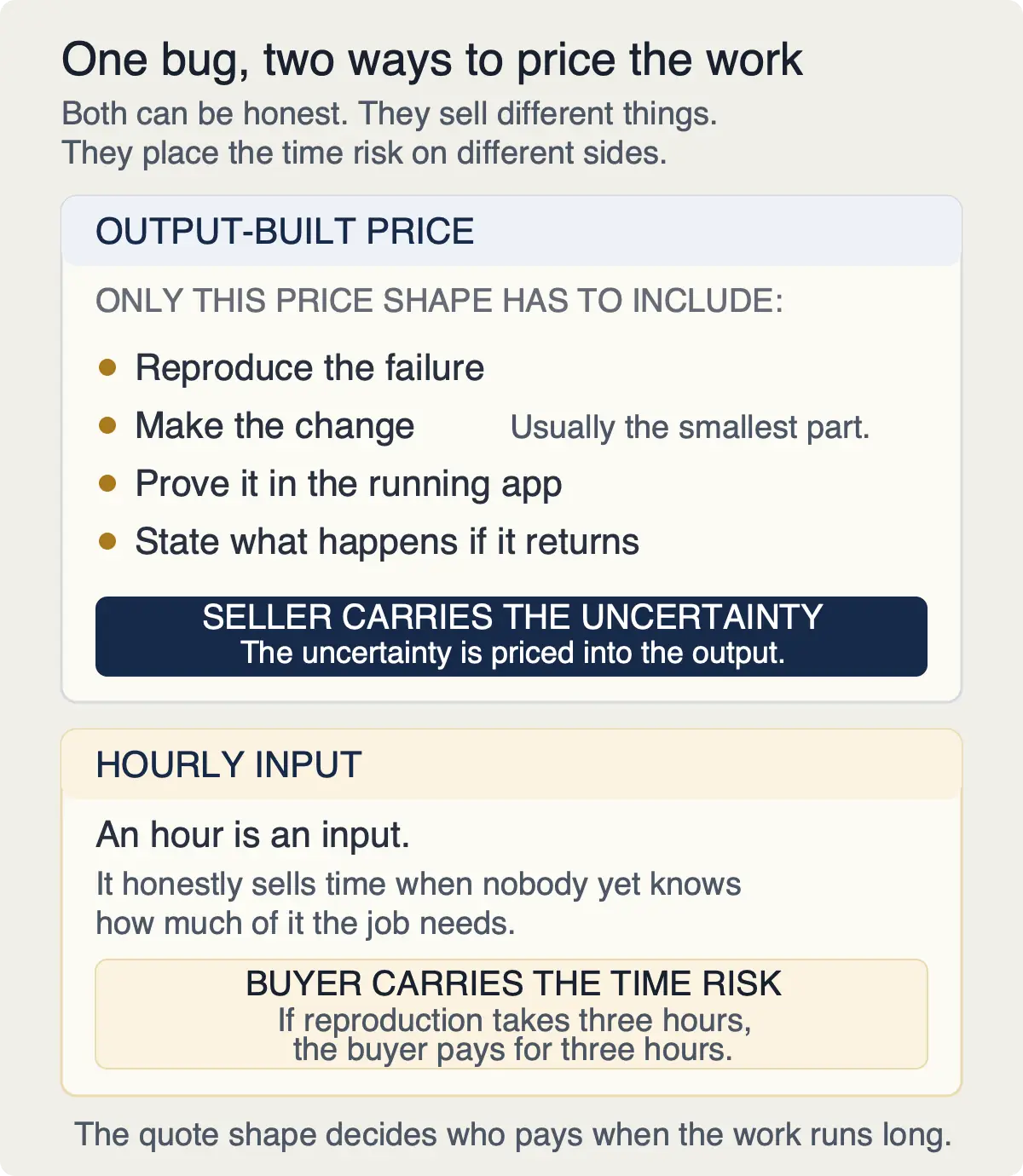
A price for one repair is buying four separate things, and the sellers who publish inclusions tell you which of the four they include. Reproducing the failure comes first: somebody has to make the broken thing happen on purpose, on your app, with your data, before any change is worth making. The change itself comes next, and it is usually the smallest part. Then proof that it worked inside the running app rather than on somebody’s machine, and finally an answer for what happens if it comes back next week.
Afterbuild Labs’ $299 tier states three of those four in its own inclusion list, read 31 August 2026: an explanation of the root cause, a git diff you can read before anything ships, and one round of follow-up questions. The fourth it states as a condition rather than a task, in the words “Fixed in 48 hours or full refund”, which covers the delivery and says nothing about the same bug coming back after delivery; that recurrence term is a question to ask, and the root cause, the diff and the follow-up round are what the page states rather than a guarantee that the failure was reproduced and tested. Its $799 integration tier goes further on the third item, naming integration tests on the fixed flow and deployment to production inside the price.
AppStuck’s home page states none of the four, and that is not a criticism of AppStuck. An hour cannot state them. An hour is an input, and the four things above are outputs, so a rate and a prepaid floor are the honest way to sell time when nobody yet knows how much of it the job needs. Whether a repair is bought as an hour or as one named result decides who carries the risk when it runs long, and that choice has an answer of its own.
The gap between those two shapes is the whole reason quotes for the same broken screen come back so differently. A price built on outputs has to include the reproduction, the proof and the comeback clause, so the seller prices the uncertainty into the number and carries it. A price built on hours leaves all three with you: if reproducing the fault eats three hours, you paid for three hours of reproducing the fault.
Platform particulars matter here too, because the reproduction step is where the builder tools differ most. What a fix on a Lovable app involves in particular covers the access, export and environment questions that decide whether the first hour is spent on the bug or on getting to the bug.
When the broken thing in your app is not what you are paying for
Two apps can present the identical symptom and carry honestly different prices, and the reason is almost never the symptom.
Take a sign-in page that lets the wrong person through. In one app that is a missing condition on one query, and the change is a line. In another it is a live credential sitting somewhere it should never have been, and the repair means replacing that credential everywhere it is used, one service at a time, in a sequence that keeps the app answering while real people are on it. Same complaint from the owner. Same screenshot. Different jobs, and the second one is not expensive because anybody is padding it.
The symptom is what you can see. The price is set by what has to be true when the symptom stops.
That second case is not hypothetical. Across the fixed June and July 2026 cohort of 21 third-party AI-built apps AxonBuild audited from their code, six of them shipped a real secret, and in three of those six that secret sat permanently in the repository’s history. Denominator, cohort and method are set out with the rest of the counts in how the cohort was fixed and how each finding was counted; the cohort is fixed and is never resized to make a number look better.
This is also why a good first question from a seller is often about the change that came before the break rather than about the break. Working out which change actually broke it is the step in front of this page, and it is frequently the difference between a repair priced as one item and a repair priced as an investigation. One owner in the research pool put the shift plainly: the question they had stopped asking was whether the generated code ran, and the one they had started asking was whether it would hold up when it mattered.
How many separate faults an app of this kind usually contains is a count rather than a price, and it has its own answer. Writing the whole application over again, rather than mending the one you already have, is a separate transaction with a market and a set of published figures of its own.
When describing one fault keeps turning up two more, price stops being the live question and whether repairing this app is still the sensible route takes its place.
What the other option costs: one more round of asking the builder
The alternative to paying a person is not free, and the people living it say so in the same words every time.
One owner, describing what happened when they pointed a second assistant at the same problem, wrote: “I had my Claude do the same burned 200 credits in a day cuz idk how to turn off Lovable agent mode”. That is a credit burn on a runaway loop rather than a price anybody paid for a repair, and it is quoted here only as evidence that the burn happens. The same feeling shows up as a thread title in a community of Replit users in July 2026: “Why is Replit charging me more than $1 to update a label or change a color?” Another owner in the research pool spent more than a day, and a night, chasing a single install failure in their own app, and got nowhere.
None of that converts into a number here. Working out whether the next dollar is better spent on the meter or on a person is arithmetic somebody has already done properly, and it is not repeated here. What ten more attempts on the same failure actually add up to is counted attempt by attempt somewhere else.
What does belong on this page is the shape of the cost. Every failed attempt leaves edits behind, so the app you eventually hand to somebody is not the app that broke: it is that app plus however many rounds of changes were made in response to a description of the fault. The repair gets bought later and it gets bought bigger.
The meter feels like the cheap option because it charges in small amounts and charges them while you are still hopeful. A seller’s price arrives once, in full, at the moment you are least sure it is worth paying. The two costs never line up side by side on a screen anywhere, which is most of why owners keep going round one more time.
Before you pay anybody, one free attempt is still worth making, with the failure mode understood first. Asking the tool that wrote it to fix its own output works often enough to be worth an hour, and knowing when it has stopped working is what keeps that hour from becoming a week.
How to check a price for one bug against what you are getting
Three checks, and each one is answerable from the seller’s own published page before you send a single message.
Check one: is there a stated turnaround attached to the price. Afterbuild Labs prints 48 hours beside its $49 and $299 tiers and 3 to 5 days beside its $799 integration tier. Relux Works prints one week against its $3,000 audit and two to three weeks against the sprint above it. AppStuck prints an hourly rate and a prepaid floor and no turnaround at all, which is consistent with selling hours rather than results. A price with no time beside it is not wrong, but it means the finish line is still yours to negotiate.
Check two: is there a stated answer for when it is not fixed. Of the four sellers read on 31 August 2026, exactly one publishes one: “Fixed in 48 hours or full refund”, printed against Afterbuild Labs’ $299 tier. Nobody else met here prints a condition of any kind. Ask for one in writing before money moves, in whatever words the seller prefers.
Check three: is there a stated definition of what counts as one. Almost nobody runs this one, and it settles whether a $299 price and a $3,000 price are even measuring the same thing. Afterbuild’s $299 says one bug identified and fixed. Its $799 says one integration end to end. Everything above those two rows, at every seller in the table, is counted in weeks or in months rather than in items, which means the buyer has stopped buying a result and started buying a period of somebody’s attention.
None of the three checks requires you to read code, and that is the point of choosing them. A turnaround, a condition for failure and a definition of one unit are all written in ordinary language on a public page, which means you can run all three before you have introduced yourself to anybody. A seller who publishes none of the three is not necessarily worse than one who publishes all three. They are selling a different thing, and knowing which thing is on the table is what stops the conversation from ending in a surprise.
The handful of things a seller actually needs from you before an honest number is possible has been written down properly on its own page. One owner in the research pool got there without being told: they wrote down the part of the build they had not done, listed exactly what that part contained, and asked openly what a fair price for it would be. That is a better message than any quote form.
Rates by the hour, and which kind of person to hire in the first place, are a separate table on what hiring an app developer costs by the hour and by the route. Clearing everything standing between a working app and its first paying customer is a list rather than a single repair, and the list is priced separately.
How AxonBuild prices a fix
AxonBuild publishes no price for a bug, for the reason the table above keeps showing: nobody can price a fix honestly before reading the code. The sequence is this. The 20-minute video call is free. You show Bilal the app, describe what should happen and what happens instead, and say what you have tried. He talks through what needs checking. If the cause is not clear on screen, he explains which part of the code he needs to check after the call. If you want him to make the change, he checks the app and gives you a fixed quote, you agree what the app should do, and you pay after you see it working. The current version of that sequence is on the page that explains the call.
The same sequence covers a list of problems, an unfinished feature or making the app ready for real users: each is checked first and quoted as a whole. AxonBuild does not rebuild apps from scratch.
There is no AxonBuild row in the table above, on purpose. One seller there prices a single bug, one prices an integration, one prices an hour, and the other three price a week or more of reading. A quote given only after the code has been checked has no standing figure to put in that column.
Common questions about what it costs to fix a bug in an app
Why do search results say a software bug costs a hundred times more in production?
Because those pages are pricing the defect to the company that shipped the software, not the repair to the person who owns the app. The figure comes from a phase multiplier attributed to IBM’s Systems Sciences Institute, printed by testomat.io on 16 July 2026 as roughly 100x after deployment and by cloudqa.io as “100 times cheaper” at design, both read 31 August 2026. Neither page links a retrievable study for it. It measures rework across an organisation, so it cannot tell you what a person will charge you.
Why is one repair so rarely on a price list?
Because a seller who publishes a price for one bug is guaranteeing an outcome before seeing the app. Of the four sellers read on 31 August 2026, one does it: Afterbuild Labs prints $299 for one bug identified and fixed. The other three price a review or a project first, because a review turns an unknown quantity of work into a known one and they would rather sell you the counting than carry the risk of guessing. It is a defensible choice, and it is why almost every published figure in this market is larger than the thing you wanted priced.
What am I actually buying when somebody quotes for one fix?
Four things, and a good quote says which of them are included: reproducing the failure on your app, making the change, proving it works inside the running app, and what happens if it comes back. Afterbuild Labs’ $299 tier names three of the four in its inclusions and states the fourth as a refund condition, read 31 August 2026. AxonBuild’s quote is given only after the app has been checked, so it can say which of the four it covers, and you pay after you see the fix working.
Does a five-hour minimum mean a ten-minute fix costs five hours?
It means five hours is the smallest amount you can buy. AppStuck’s home page, read 31 August 2026, prints $70/€60 per hour with a 5-hour minimum (prepaid), which is how sellers of time protect themselves against jobs too small to be worth scheduling. Whether that is bad value depends entirely on whether the ten-minute fix is really ten minutes, and nobody knows that until somebody has reproduced the failure. Ask what happens to unused hours before you prepay, and get the answer in writing.
How do I tell a small repair from a large one before I pay?
By asking what has to be true when the symptom stops, not by describing the symptom. A sign-in fault caused by one missing condition on one query is small. The same visible fault caused by a credential that leaked is large, because fixing it means retiring that credential and issuing a new one everywhere it was trusted, with no gap in service while that happens. In the fixed June and July 2026 cohort of 21 third-party AI-built apps AxonBuild audited from their code, six shipped a real secret, so this is not a rare branch.
Who pays when the fault was left by the person I hired?
That depends on what you agreed with them, and it is worth settling before you hire the next person rather than after. A repair bought as one named result usually carries the seller’s own comeback terms, which is why the stated refund or rework condition is worth reading before money moves. Who keeps the app working month after month, once this one repair is finished, is bought on a different footing and priced on that footing. If the original builder has gone quiet, the practical question stops being blame and becomes access: who can reach the code, the database and the services today.
Does the price change if my app is already taking money?
Usually yes, and not because anybody is charging you for having customers. A live app constrains how the work can be done: changes have to go out without downtime, data cannot be reset to make testing easier, and a failed attempt now has consequences beyond the developer’s afternoon. Afterbuild Labs’ $799 integration tier prices deployment to production inside the figure rather than beside it, read 31 August 2026, which is one seller’s way of saying the same thing. Say early that the app is live, because it changes the method rather than the markup.
What happens to the price if the one fault turns out to be two?
The purchase changes, and an honest seller will say so before continuing rather than after. This is the exact seam where a single-item price stops applying and a counted job begins, which is why the definition of what counts as one is worth agreeing in writing at the start. At AxonBuild the quote is given after the app has been checked, so a fault that turns out to be two is counted before a figure is named rather than after.
Built it with AI. Can’t get the last part right?
That’s the normal state of an AI-built app, and it’s fixable. I trace what the app actually does, explain what needs changing, and build it if you want me to.
Talk about your app →  Free 20-minute video call with Bilal.