The app works. You open it, it does the thing, and for months that was enough. Then somebody looks at it properly and says it is not ready for real customers, and the question stops being technical and becomes a number. What does that cost?
The search does not answer it. Every commercial page that ranks for this question is pricing something else: building an app from nothing, which is the one purchase you have already made. Nobody sells “production ready” as a priced item, so the prices here were taken on 31 August 2026 from the services and pricing pages of the sellers who price the work under some other name, grouped by what each seller says the money actually buys, and a page that prints no figure is recorded as that, in place of a number.
Production readiness has no single price, because sellers attach the phrase to four different purchases. Published figures run between $799 for one named blocker cleared and the $5,000 to $30,000 one publisher attributes to community reports for a full rebuild, all read on 31 August 2026. The cheapest honest version is usually one blocker rather than a package.
What sellers are actually pricing when they say production ready
Four different jobs get sold under the phrase, and the sellers who publish numbers publish them at four very different levels. Here they are next to each other, each with the seller’s own label and the seller’s own figure.
| What is being bought | The page’s own label | Figure on the page, read 31 Aug 2026 | Stated time |
|---|---|---|---|
| One named blocker cleared | Integration Fix (Afterbuild Labs) | $799 | 3 to 5 days |
| A single pass to get it live | Deploy to Production, sold as the launch pass (Afterbuild Labs) | $1,999 | 7 days |
| A hardening pass over the whole app | Harden existing app (Gaincafe) | $5,000 to $15,000 | 2 to 4 weeks |
| Readiness sold as a rebuild | Professionally rebuilding a vibe-coded application (HatchWorks) | $5,000 to $30,000 | None stated |
Those four are separate purchases that happen to share a phrase rather than tiers of one product. The distance between the first row and the last is the difference between paying for one broken connection to be repaired and paying for the whole application to be written again by somebody else; nobody is offering it as a discount.
Read the rows for what each seller says the money buys. Afterbuild Labs sells the first two as flat published fees with no negotiation attached, the $799 on its pricing page and the $1,999 on the service page for deployment and launch that owns it. Gaincafe’s figure comes from a decision table published 8 May 2026 that also names the condition it applies under: the app logic works, there are paying users, and only the foundation needs fixing. The page prints the band in thousands shorthand, which is $5,000 to $15,000, over two to four weeks. HatchWorks is the one to read most carefully. Its page, dated 13 April 2026, does not quote its own price at all. It states that community reports put the cost of professionally rebuilding a vibe-coded application at $5,000 to $30,000, which is a reported figure rather than a price sheet, and the distinction matters when somebody sends you that number in an email.
This is the part buyers usually get wrong, and it is not their fault. A person describing what they need describes a list, not a purchase. Somebody on a public forum this year set out what they were about to build before anybody had priced any of it:
“The application would be a real multi-tenant SaaS handling customer data, payments and some AI functionality…”
That list is real work and every item on it is separately priceable, which is exactly why a seller quoting against it can land on any of the four rows above depending on how much of the list they decide to take. The list itself is not this page’s subject: producing it belongs to the two live launch pages, and what one costs to buy is built here from seller pages only.
Two neighbours own the ground on either side. On one side is what production ready actually means. What the phrase means, and what evidence settles it, is defined there; here it is only a thing sellers put a price on. And what tidying an already-written app is quoted at collects the cleanup market’s own published grid. The one-paragraph version of this question, with one seller’s package grid beside it, already sits on the page that tracks what tidying an existing app is quoted at; this page is the market behind that answer.
How much does it cost to launch an app once it already works?
Three separate bills arrive between a working app and a paying customer, and only one of them is the work this page prices. Confusing them is why launch-cost searches return store fees to people who wanted labour costs, and labour costs to people who wanted store fees.
The first bill is the fee to be listed. That is a fixed, published, small number set by the stores themselves, and it is not negotiable and not interesting. What the stores charge to list an app tracks both platforms’ current figures. What the stores themselves charge to accept a listing is tracked there and is not repeated here.
The second bill is the meters. Hosting, the database and the metered services all start charging the moment real users arrive, and that monthly total is worked out somewhere else. It is a recurring number rather than a one-off, and it moves with how many people show up, which makes it the wrong thing to compare against a fixed quote.
The third bill is the human work between the app running and the app being safe to hand to strangers, and that is the one with a four-way spread on it. It is the one bill of the three anybody quotes for, which is why every published figure on this page came off a seller’s page rather than a fee schedule.
The order the launch steps happen in, and which of them cannot be hurried, is set out in the launch sequence in the order it happens; the only thing counted here is what the work between them costs to buy. If what you actually want is what one person costs rather than what one job costs, what hiring somebody for an app you already have costs has published rates from named sources.
Somebody moving off a hosted builder this year said the reason was simple: they were about to start charging people, and that needed a platform they could stand behind. That sentence is the whole market for this page in one line. The trigger is the first real payment rather than the code.
Why almost nobody publishes a price for this
Search for this work by its own name and the results are not sellers. A search run on 31 August 2026 for the service phrasing returned seven results: one community thread, one personal blog post, four engineering handbooks and cloud documentation pages, and one vendor’s own definition page. Not one was a priced offer. The people who write about production readiness are explaining it to engineers. The people who charge for it are selling something with a different name on the invoice.
That shows up again in the sellers themselves. Six of the pages fetched for this article describe exactly this work and put no number on it anywhere.
As of 31 August 2026, KodingKlouds’ app rescue and takeover page does not render a figure to an automated read. What it does publish is a shape: an audit of what works, what is broken and what is risky, stated at three to five days and written down.
As of 31 August 2026, Wavect’s vibe coding rescue page does not render a figure to an automated read. It states the model instead of the number: the audit is a fixed fee over a few days, and the price for the rescue itself is set after that audit, once what has to be fixed is known.
As of 31 August 2026, JustSolve’s vibe coding rescue page does not render a figure to an automated read. It puts a length on the work rather than a price, putting most rescues at several weeks up to several months.
As of 31 August 2026, Outsourcify’s vibe coding rescue page does not render a figure to an automated read, and unlike the two above it publishes no duration either.
As of 31 August 2026, Symilars’ project-takeover guide does not render a figure to an automated read. Published 14 July 2026, it puts the first phase alone at a few days to two weeks depending on project size.
As of 31 August 2026, DestiLabs’ page on getting a vibe-coded app production ready does not render a figure to an automated read. Published 21 April 2026, it prices nothing and lengths everything: four to ten weeks overall, with the heavier rewrites at six to eight weeks.
The publishers who define the term are no different. As of 31 August 2026, MindStudio’s page on what production ready actually means does not render a figure to an automated read; published 15 April 2026, it explains the standard and stops before anybody has to pay for it. And Couchbase’s app development costs post returned HTTP 403 to an automated read at brief time and again on a re-try on 31 August 2026, so nothing about its contents is described here. The only thing recorded is where it sat: on both 31 August 2026 pulls it ranked under a whole-build cost heading.
Put those together and the honest reading is uncomfortable but useful. The market prices packages and rescues, not readiness. A buyer who asks for a price by this name will usually be given a quote for something larger, because the seller has no line item that matches the question and reaches for the one that does exist. That is what happens when a phrase has no product behind it, and it is not dishonesty.
One publisher shows the same conflation in the opposite direction. Utsubo’s web app budget guide, published 4 April 2026, folds launch work into the build rather than pricing it separately: standard deployment sits inside its starter tier as an included item, alongside the pipeline and staging environment in the tier above. If the deployment was included in a build you already paid for, and the app still is not live, that is worth knowing before the next conversation. Where the money goes inside a build quoted from nothing, row by row, is a different arithmetic from the one on this page.
What actually moves the number
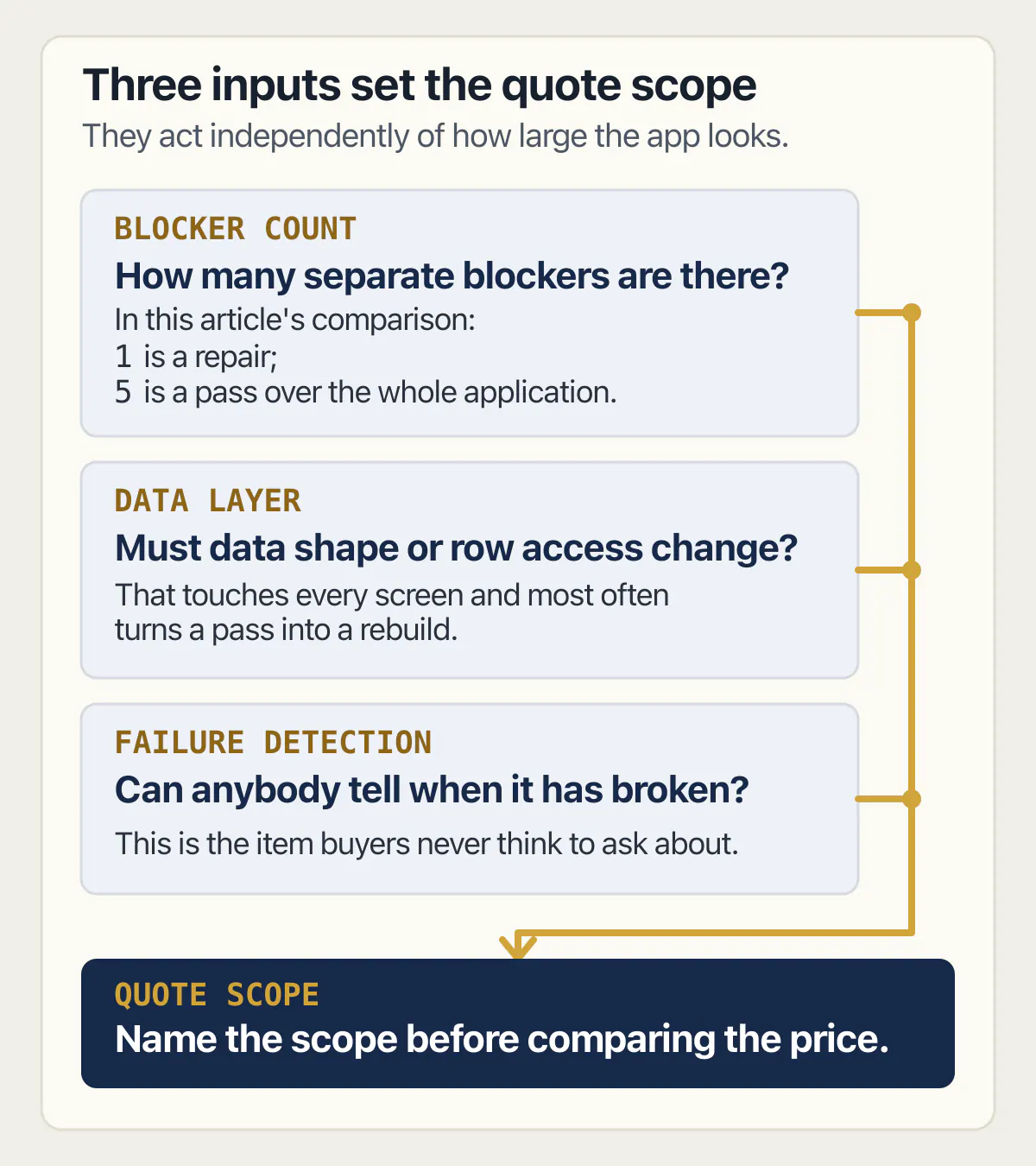
Three things move a published figure from the cheap row to the expensive one, and none of them is how big the app looks.
The first is how many separate blockers there are. One is a repair. Five is a pass over the whole application, and the sellers price it that way: the gap between $799 and $5,000 to $15,000 in the table above is mostly a count, with the severity of each item, the testing it needs, the integrations it touches and the seller’s own rate making up the rest. Which of the missing pieces a person has to build, rather than what clearing them costs to buy, is worked through on its own page.
The second is whether the data underneath has to change. Everything else can be added around a working database. Adding a compatible column or tightening one permission rule is contained work. Replacing the shape of the data that every screen reads from is the item that can turn a pass into a rebuild. Gaincafe’s own table draws its line in the same place, moving from hardening to a selective rewrite when the data layer is one of the parts needing replacement.
The third is whether anybody can tell when it has broken. This is the item buyers never think to ask about, and it is the one the audit corpus is clearest on. In an audit of 26 real applications built with AI tools between June and July 2026, all five of the founder’s own production apps, audited on the same method, sent every push straight to production with no check standing between the two, and several apps in the wider set switch off their own build-time type and lint checks so broken code compiles and ships anyway. That is drawn from what 26 audited apps looked like, counted from the confirmed-finding ledger rather than from a scanner’s raw output.
The bill for anything metered has the same blind spot with money attached. In the same audit, 16 of the 18 audited apps with an AI feature, which is the 14 third-party ones plus the founder’s four, left a way open for an unknown visitor, or somebody on an unpaid account, to spend the owner’s AI budget without limit. Nobody quotes for that item because nobody asks for it, and it is invisible until the invoice arrives.
Somebody looking for a developer this year had customers already signed up to trial the product and said outright that they were uneasy about the testing and the security. That is the normal order of events. The list of what is missing gets produced under time pressure, after the customers exist, by a person who cannot check it themselves. Producing a first version of that list is free and does not require hiring anybody, though what you can observe from outside is an initial evidence list rather than the whole blocker list, and some items only show up once somebody reads the code or watches it run: the seven checks that settle whether an app is ready for real customers walks through it. That page produces the list of what is actually blocking you, at no cost and without asking anybody; this page starts once the list exists and somebody has to be paid to clear it.
How one seller splits the work into stages
The most useful thing on any page fetched for this article is a sequence rather than a price. Afterbuild Labs publishes a stage-by-stage shape for this work on its rescue service page, with a week band against each stage: a read of the code returned in 24 to 48 hours, then stabilising at weeks one to two, then making the app ready for production at weeks two to four, then shipping at weeks four to six, and then a fifth row from week six onward for whoever keeps it running. Six weeks to the end of the shipping stage, published as the seller’s own timeline.
That sequence is what turns a wall of package names into something a buyer can reason about, because each of the priced packages below is a slice of it. Four of the five sit on the seller’s pricing page and the $1,999 has a service page to itself. These are the prices one company published on one day, not what the market charges.
| The seller’s own label | Published price, read 31 Aug 2026 | Turnaround stated on the row |
|---|---|---|
| Async Audit | $49 | 48 hours |
| Integration Fix | $799 | 3 to 5 days |
| Deploy to Production, sold as the launch pass | $1,999 | 7 days |
| Break the Fix Loop | $3,999 | 2 weeks |
| Finish My MVP | $7,499 | 4 to 6 weeks |
Line the two up and the pricing logic falls out. The $49 read buys the first stage on its own, and the seller credits 25% of that $49 against a follow-on fix. The $799 and $1,999 packages buy slices in the middle. The $7,499 package is the only one whose stated length matches the full six-week sequence, which is why it costs almost four times the go-live pass rather than a little more.
The $3,999 tier is the one worth pausing on. It is named on the page for a situation rather than for a piece of work, and the situation is an app stuck in a repeating cycle of broken fixes. This seller prices getting an app out of that cycle at twice its price for getting an app live in the first place.
What that ladder deliberately does not include is anybody staying afterwards. Keeping somebody paid to look after it month after month, once it is live, is a separate arrangement with its own price, and this seller sells that separately too. What a first version costs to have built, before any of this applies, is its own question.
What the price does not include
Four things are routinely assumed to be inside a production-readiness quote and are routinely not.
Running costs. Hosting, the database and every metered service begin charging as soon as real users arrive, and that recurring bill is counted apart from this one. A fixed price to get live says nothing about what live costs to keep.
Store fees. Small, fixed, published by the platforms, and set by the platforms rather than by anybody quoting for the work. No seller includes them, and none of them should.
Somebody being available afterwards. The ladder above prices the work and stops. Keeping a person on call is bought on a different footing again, priced on a recurring basis instead of against a named piece of work.
Starting again. Starting over instead of clearing what is in the way is a different decision with a different bill behind it, and the two get confused because the top of one range overlaps the bottom of the other. The HatchWorks figure in the first table is a rebuild figure, and it is in that table only because the page files it under production readiness, which is exactly the conflation this article exists to separate.
How to get a number you can check
A quote for this work can only be checked if it names three things: which specific problems it clears, what will be true when it is finished, and what happens to anything found along the way that was not on the list. A quote missing the third item is the one that grows.
Ask for the count first. That is the correct order and far fewer buyers follow it than should, because most ask for a price before anybody has agreed on what is being priced, and a seller given no boundary will price the widest reading of the question. What to put in front of somebody so the number they give back can be checked is a short list, kept where that method is set out.
A seller who will not name the individual problems is usually selling time rather than outcomes, with no evasion intended, and the price it quotes has to cover the worst case it can imagine, because it has not been given a boundary to price against. That is why the same application can produce a $799 quote from one seller and a five-figure quote from another on the same day. The second seller has been asked a broader question, and that is where the higher figure comes from.
A single failure inside an app that is otherwise fine is a much narrower thing to buy, and it carries a price of its own. What a plain website costs to build in the first place is followed elsewhere, and its own launch work is a shorter list than an app’s. What a web app costs to build from an empty folder, rather than to get over the line, is followed on its own page. An internal system that staff use all day is bought on different terms again, and what one costs to have built is kept on its own page.
How AxonBuild prices this work
AxonBuild publishes no price for this, because the boundaries above cannot be counted from the outside. The 20-minute video call is free. You show Bilal the app and explain which of those boundaries you are worried about and what you have tried. He talks through what needs checking. If you want him to make the changes, he checks the app and gives you a fixed quote for the boundaries you agree on, and you pay after you see them working.
Whether that is one boundary or all of them, the quote follows the check, and the work can continue boundary by boundary afterward.
Common questions about the cost of getting an app production ready
What does production ready mean when somebody is quoting for it?
In a quote it means whatever that seller’s package covers, which is why two quotes for “production ready” can differ by a factor of ten without either being wrong. Treat the phrase as a label on a package rather than a standard, and ask which specific problems the package clears. The term does have a real definition away from any invoice, and that definition turns on evidence rather than on what a package happens to be called.
Is there a standard price for making an app production ready?
No, and the absence is structural rather than temporary. Of the twelve sellers and publishers fetched for this article on 31 August 2026, seven render no figure at all and one refused an automated read, and the four that do publish are pricing four different jobs under one phrase. A standard price would require a standard job, and no such job exists.
Can one seller’s package be compared with another’s?
Only after both have been converted into a count of specific problems. Afterbuild Labs’ $1,999 launch pass and Gaincafe’s $5,000 to $15,000 hardening option, both read on 31 August 2026, are not the same purchase at different prices. Compare what each says it clears, not what each is called.
How long does the work between working and live usually take?
The sellers that publish durations cluster between a few days and a couple of months. KodingKlouds states three to five days for its written audit alone, DestiLabs states four to ten weeks for the whole run with rewrites at six to eight, Gaincafe puts hardening at two to four weeks, and JustSolve puts most rescues at several weeks up to several months. All read 31 August 2026.
Do I have to fix everything before I can take money from customers?
No. The list of what is missing is almost never a list of equals: some items lose you customers, some lose you money quietly, and some are only untidy. The point of producing the list yourself first is that you can decide the order, which you cannot do once somebody has quoted for all of it as one package.
Can the builder that wrote the app finish this part itself?
Sometimes for individual items, rarely for the whole list, and the reason is visible in the audit corpus. The items that block a launch are usually the ones nobody prompted for, because they have no screen attached: nothing recording errors, nothing checking a change before it ships, nothing stopping a stranger spending your money. A tool builds what it is asked for, and nobody asks for those.
What do I need in writing before I hand over money?
The list of specific problems, in writing, before any figure is discussed. Then ask what happens to problems found after the price is agreed. A seller who answers both questions plainly can be compared with another seller who does the same; a seller who answers neither is quoting a worst case, and you will pay for that caution.
Is a cheap flat price for going live a bad sign?
Not on its own, as long as it names what it covers. Afterbuild Labs publishes a $799 figure for one integration fixed and a $1,999 figure for a go-live pass, both read on 31 August 2026, and both are cheap precisely because they are narrow. The bad sign is a low figure attached to an open-ended description, because the boundary will be found later and it will be found at your expense.
What does it cost when only one thing is blocking the launch?
Less than any package, and the published figures show it: the narrow rungs on Afterbuild Labs’ ladder sit at $799 and $1,999, read 31 August 2026, against five figures for the pass-over-everything options. When a single blocker is all that stands in the way, that is a repair rather than a package, and what one repair costs is tracked apart from this.
Every figure on this page was read on 31 August 2026 from the seller’s or publisher’s own page. Every one of them sells fix, rescue or development work to exactly the reader this article is for, so each is named and its address given in plain text instead of being linked: afterbuildlabs.com/pricing, afterbuildlabs.com/services/deployment-and-launch, afterbuildlabs.com/services/ai-app-rescue, gaincafe.com/blog/scale-vibe-coded-app-production-ready, hatchworks.com/blog/gendd/cost-of-vibe-coding/, destilabs.com/blog/vibe-coded-app-production-ready, mindstudio.ai/blog/what-does-production-ready-actually-mean, kodingklouds.com/app-rescue-and-takeover, wavect.io/services/vibe-coding-rescue/, justsolve.solutions/services/ai-data-automation/vibe-coding-rescue/, outsourcify.net/vibe-coding-rescue/, symilars.com/blog/how-to-take-over-a-failed-or-abandoned-software-project/, utsubo.com/blog/custom-web-app-cost-budget-guide and couchbase.com/blog/app-development-costs/.
Built it with AI. Can’t get the last part right?
That’s the normal state of an AI-built app, and it’s fixable. I trace what the app actually does, explain what needs changing, and build it if you want me to.
Talk about your app →  Free 20-minute video call with Bilal.