The two numbers are $99 and $25. Apple charges 99 USD per membership year for the Apple Developer Program, Google charges a one time US$25 registration fee for a Play Console developer account, and $124 puts you on both stores in your first year. Every page answering this question prints them, and both are correct.
They are also the cheap part. The money that actually leaves a first-time publisher’s account goes to whoever produces a signed binary when you have no Mac, to the second and third attempt after Apple rejects the first one, and to the purchase code Apple requires before your app may sell digital goods or subscriptions inside it. None of the three appears in a fee table.
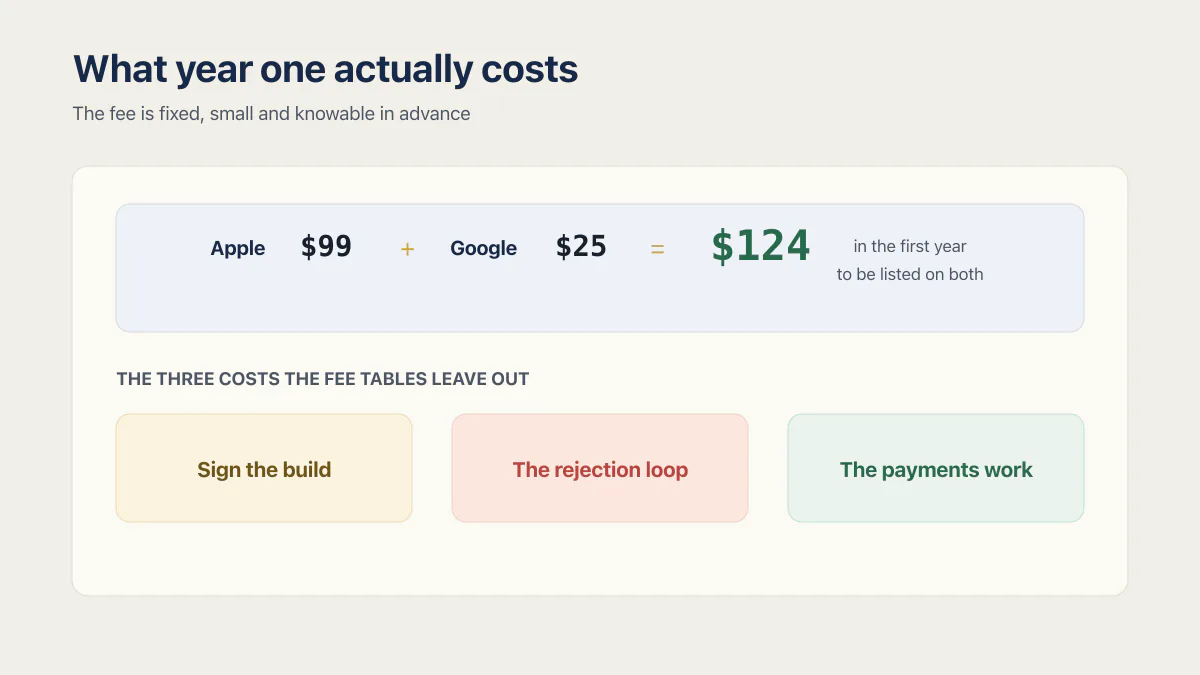
Publishing an app costs $99 a year to Apple and $25 once to Google, so $124 in the first year to be listed on both. Those two fees are fixed and small. The costs that move are signing the build, going round the rejection loop, and building the payments code.
One note on method. Every fee, rate and plan price below was read on 16 August 2026 on the page of the company that charges it. Nothing is estimated, no account was created, and where a company publishes no answer, this page dates the absence instead of filling it from a forum. If you need the sequence of steps rather than the bill, that is a different question with its own guide.
How much does it cost to publish an app on the app stores?
The bill to be listed on both stores is $124 in year one: 99 USD a year for the Apple Developer Program and a US$25 one time registration fee for a Google Play developer account. Year two onward is $99, because only Apple’s fee recurs.
| Store | What you pay | How often | What it buys | If you stop paying |
|---|---|---|---|---|
| Apple App Store, through the Apple Developer Program | 99 USD | Every membership year | App distribution, App Store Connect, TestFlight, and notarization and Developer ID for Mac apps | Your apps stop being available for download and you cannot submit new apps or updates |
| Google Play, through a Play Console developer account | US$25 | Once, at registration | A Play Console developer account able to publish to Google Play | Nothing recurs, so nothing lapses |
Prices checked 16 August 2026.
Apple’s membership comparison page is exact about it: enrollment runs 99 USD for each membership year, charged in your own currency wherever Apple offers that. The same page closes most of the free question. A free Apple Account gets you Xcode, on-device testing, the developer forums and Feedback Assistant. App distribution, and app management, testing and analytics through App Store Connect, sit on the paid side and nowhere else. You can run an iOS app on your own phone for nothing. You cannot put it in front of a stranger for nothing. The membership also covers beta distribution before the store sees anything, and what TestFlight gives you before submission is worth reading before deciding the $99 is expensive.
Google’s registration page states its fee just as plainly: “There is a US$25 one-time registration fee that you can pay with the following credit or debit cards”. Two sentences further down sit the sharpest facts on the Play side. Processing a Play developer account can require an identity check, Google says: a government-issued ID plus a payment card, each carrying the legal name you registered under. Then: “If this information is determined to be invalid, your registration fee will not be refunded.” A mismatch between your card and your ID can cost you the $25 with nothing to show for it. Settle whose name and which entity holds each account before anybody pays, because on the Apple side the account holder also controls renewal and every certificate the app depends on.
Apple documents what happens if the membership lapses: your apps come off the store and you cannot submit anything new, though apps already installed keep working. Google’s fee has no equivalent, because there is nothing to renew.
Both fees are charged whether your app is free or paid. Apple’s $99 buys membership rather than taking a share of sales, and Google’s $25 registers the account rather than the app. A free app with no in-app purchases still costs $124 to publish on both stores.
Can you publish an app for free?
Free publishing on either main store is out of reach for a normal founder. Apple charges $99 a year and waives it only for nonprofits, accredited schools and government entities that sell nothing digital. Google charges US$25 once and documents no waiver. Free routes exist, but none of them is a store listing.
Apple: no, unless you are a nonprofit, a school or a government
Apple publishes a real fee waiver, and almost nobody reading this page qualifies for it. The membership fee waiver page says that “If your organization is approved for an Apple Developer Program fee waiver, you won’t need to pay annual membership fees.” Then the conditions. You must “Be a legal entity with a status as a nonprofit organization, accredited educational institution, or government entity”. You must “Not be an individual, sole proprietor, or single-person business”. The agreement condition comes next: no signed Paid Applications Agreement, the one that lets you offer paid apps or in-app purchases, unless you have terminated it. And you must “Not otherwise sell digital goods or services through any of your apps.”
Three of those four conditions disqualify the typical founder. One person with an idea fails the second. An app that sells digital goods or subscriptions inside it fails the third and fourth. The waiver is genuine, and it is for institutions.
How to create an app in the Play Store for free
You cannot. The Play Console developer account costs US$25 once, charged before you can publish anything, and as of 16 August 2026 Google’s registration page documents no waiver, discount or exemption of any kind. That is the page Google points registrants at, so if Google grants exceptions, it does not say so where developers are told to look.
The $25 is a one time charge, which makes Play the cheaper store over any horizon longer than a year. Getting an AI-built app through Play’s own review gates after the account exists is a longer story than the fee.
What “free” actually gets you
Free routes exist, and they are all versions of not having a store listing. A website or progressive web app costs nothing and buys you no listing, no store search and no in-app purchase. For plenty of working products that is a fair trade, and whether you need a native listing at all is worth deciding before you pay either fee.
A direct APK installs on an Android phone with no store involved. The oldest result still ranking on this query is a May 2014 MIT App Inventor thread titled “How can i publish my apps in Google Play without paying?”, where the advice is to email the APK or host it on a website and let the recipient allow installs from unknown sources. Twelve years on it is still on page one, and it still works.
Third-party Android stores are the real answer to “free store to publish android app”. Uptodown’s developer console, read on 16 August 2026, says “Registration and app publishing are completely free” and advertises “no profit sharing or mandatory SDK integration”. That is a genuine free channel with a genuine catch: nobody looking for your app is looking there.
One last thing, because a category of pages ranks on the word “free” while selling something. A builder can be free to use and still leave you owing Apple $99 and Google $25, because the stores charge for the accounts rather than the tool charging for the app. No tool removes either fee. Which builders can produce a store-ready binary is a separate question worth asking first.
What Apple and Google take when you charge money
Apple takes 30% of each sale as standard and 15% under the Small Business Program, which covers developers with up to 1 million USD in proceeds in the prior calendar year. Google’s rate depends on where your buyer is and, since 30 June 2026, on whether their install is new.
Apple, by program (the reduced rate needs enrolment in the Small Business Program, which covers developers with up to 1 million USD in proceeds in the prior calendar year):
| What you sell | Standard rate | Enrolled in the Small Business Program |
|---|---|---|
| Paid app or in-app purchase | 30% | 15% |
| Auto-renewing subscription | 30% until a customer accrues more than one year of paid service, then 15% | 15%, since subscriptions are in-app purchases under the program |
Google Play, by region and, since 30 June 2026, by whether the install is new (the EEA, UK and US cells are Google’s figures for the first $1M of annual earnings):
| What you sell | EEA, UK and US, new installs | EEA, UK and US, existing installs | All remaining markets |
|---|---|---|---|
| Paid app or in-app purchase | ”10% + 5% billing fee" | "10% + 5% billing fee” | 15% on the first $1M of annual revenue, 30% on annual revenue above $1M |
| Auto-renewing subscription | ”10% + 5% billing fee" | "10% + 5% billing fee” | 15%, whatever the revenue |
Rates checked 16 August 2026 on the pages cited below.
Apple’s App Store Small Business Program page states the reduced rate in its own words: “It features a reduced commission rate of 15% on paid apps and In-App Purchases”. Eligibility runs off proceeds, which Apple defines: “Proceeds are your sales net of Apple’s commission and certain taxes and adjustments.” Cross the line mid-year and “the standard commission rate will apply to future sales”; fall back under it later and you “can re-qualify for the 15% commission the year after”. Developers new to the App Store qualify as well, with no prior-year figure to clear, which is most people reading this.
That page never states what the standard rate is, and neither do the App Review Guidelines. The number lives in the contract you sign. Schedule 2 of the Apple Developer Program License Agreement, version 126 dated 17 December 2025, section 3.4(a), read on 16 August 2026: “For sales of Licensed Applications to End-Users, Apple shall be entitled to a commission equal to thirty percent (30%) of all prices payable by each End-User.” The same clause drops to fifteen percent on renewals from subscribers with more than a year of paid service.
The United States carve-out sits inside guideline 3.1.1(a) itself, read on Apple’s App Review Guidelines page on 16 August 2026. On the United States storefront, an app does not need any entitlement before it points customers at the developer’s own website to buy digital content or services. Everywhere else the old rule stands: on every other storefront, an app and its listing may not steer customers toward a purchase route outside in-app purchase unless Apple has granted an entitlement for it.
So a United States storefront app may carry a button or link sending a customer to your own site to buy, with no entitlement to apply for. What that costs you is a question Apple’s published pages do not answer. Apple’s support address for the StoreKit external-purchase-link entitlements, developer.apple.com/support/storekit-external-entitlement-us/, showed Apple’s generic Developer Support page on 16 August 2026, so it appears here unlinked. Third-party pages print a percentage for these purchases. No Apple page read for this article does, so this page prints none.
Google’s service fee page carries this query’s freshest fact. “For transactions with users in the EEA, UK, or US starting June 30, 2026”, the fee depends on whether the buyer’s install is new or existing. Within the first $1M of annual earnings, subscriptions, new installs, and existing installs are all charged “10% + 5% billing fee”. At the standard rate, new installs are “20% + 5% billing fee” and existing installs are “25% + 5% billing fee”, or “20% for external web links”. Everywhere else the older table governs: 15% on the first $1M of annual revenue, 30% above it, and 15% on auto-renewing subscriptions.
Google’s own framing there, quoted rather than endorsed: “97% of developers distribute their apps and take advantage of all Google Play has to offer at no charge”, and of those subject to a service fee, “99% are eligible for a fee of 15% or less by participating in different programs offered by Google Play”. The last clause carries the condition. Those programs are Play Games Level Up and the Apps Experience program, whose rates run 15% plus a 5% billing fee on new installs and 20% plus 5% on existing installs, or 15% for external web links, so the 99% describes developers who signed up for a program rather than the rate a developer pays by default.
Most pages ranking for this question print 15% and 30% as the Play rates without qualification. That is the remaining-markets table, and it stopped applying to buyers in the EEA, the UK and the US on 30 June 2026.
The three costs the fee tables leave out
Somebody has to sign the build
An iOS app has to be compiled and cryptographically signed on macOS before Apple will accept it. Owning a Mac makes that a step. Building your app in a browser on a Windows laptop makes it a purchase, and the first real cost after the $124.
Two vendors publish their prices, so the band is knowable rather than guessed. Expo’s pricing page, read on 16 August 2026, lists a Free plan at “$0/month” with 1 build concurrency, Starter at “$19/month plus additional usage cost” with 1 concurrency, Production at “$199/month plus additional usage cost” with 2 concurrencies, and Enterprise on custom pricing with 5. Codemagic’s pricing page, read the same day, offers “500 free macOS M2 minutes / month”, then “$0.095 / minute” for a Mac mini M2, “$0.114 / minute” for a Mac mini M4, and “$0.045 / minute” for Linux and Windows.
Read honestly, that is often $0. One app submitted a handful of times a year fits inside both free tiers. The cost turns real when the rejection loop makes you rebuild twenty times in a fortnight, which is when you are least able to think about build minutes. Which route suits a founder with no Mac is a decision this page does not make: it prices the band.
The rejection loop
The rejection loop can add rebuilds, policy changes and waiting time after the first binary exists. Its duration depends on what the reviewer finds and how quickly each issue is corrected. How long a review actually takes, and what a normal wait looks like against a stuck one, is a clock question with its own answer.
A rejection is charged as a second attempt: another build, another wait, another set of assets or strings or policy answers, and if you paid somebody to handle the submission, another payment for the same work. Multiply by however many rounds it takes. The founder who budgets $124 and three days, then spends three weeks, was charged by the loop rather than by Apple.
The way to reduce that cost is to reduce the number of rounds, which means knowing which guideline Apple cited and what fixes it before you resubmit. This page maps none of that: what to do when Apple rejects a vibe-coded app covers the common rejection reasons and the fix for each, and breaking a cycle where the same app keeps coming back rejected is a separate subject again. What to check before an AI-built app goes live is the pass most first-time publishers skip, and it is cheaper than finding out from a reviewer.
The payments work
Apple’s App Review Guidelines, read on 17 August 2026, generally require in-app purchase for digital features or content used inside the app. The guidelines allow other purchase methods in defined cases, including reader apps, multiplatform access, organization-only enterprise services, real-time person-to-person services, physical goods and services, some free companion apps, advertising-management apps and limited hardware-linked features. United States storefront apps may also link to other purchase methods without an entitlement.
That is the largest cost on this page for most readers, and it is invisible in every fee table. Before Apple can take a commission, your app has to contain working purchase code: products defined in App Store Connect, purchase and restore flows, receipt handling, and a server that knows who paid for what. It comes after the app already works, and it is where a lot of AI-built apps stop being something the builder can finish alone. What that implementation involves on an iOS app is a subject in itself.
A smaller cost sits next to it: the store artwork. Screenshots at the required sizes for every device class, an icon that meets each store’s rules, and a listing that passes review are hand work, and somebody bills you for them if you cannot produce them yourself.
What year one actually costs: three worked totals
Three cases, with the arithmetic left visible so you can redo it with your own numbers.
(a) A free app with no purchases, built and submitted by you. $99 to Apple plus $25 to Google is $124, and that is genuinely the whole bill. Build minutes fit inside Expo’s or Codemagic’s free tier, and there is no commission because there is no revenue. Year two is $99. This is the case the fee tables describe, and for a solo builder shipping one free app it is accurate.
(b) A paid or subscription app, built and submitted by you. $124 in fees, plus the payments work, plus a commission on every sale at the rates in the table above. The commission stays invisible until money moves, but at Apple’s standard 30% a $10,000 year hands over $3,000. Getting into the Small Business Program at 15% is the highest-value hour of paperwork available to a small developer, best done before your first sale. If you build on a paid AI builder, its subscription stacks on top: what running a Rork app in production actually bills is a worked example of the builder cost sitting alongside the store fees.
(c) An app where somebody else signs and submits. $124 in fees, plus a person. The price of the person does not belong in a store-fee total: what a developer charges to work on an app covers the rates. Paying somebody specifically to run a store submission is its own arrangement with its own price, and so is the end-to-end path for one builder’s app, from export through signing to an accepted binary. What building the app costs in the first place is a separate number again, and a wrapper vendor that turns an existing web app into a shippable binary charges its own licence on top.
All three follow the same pattern. The fee is fixed, small and knowable in advance. What moves is how many attempts acceptance takes, and nobody can name that number before they have seen the app.
What actually costs money
The store fees are $124 in year one and $99 a year after that. The account fees are rarely what decides a launch; the three variable costs above are.
What stops people is the work between “it runs on my phone” and “the store accepted it”. That work is unpredictable in a way a fee is not, and it gets priced per result rather than per app.
Here is where AxonBuild fits. Apple’s $99 membership year is Apple’s fee and sits outside any quote.
So if the thing standing between you and the store is one specific failure, say so, because it is a smaller quote. If you want somebody to carry the whole submission, ask for that by name, because it is a bigger one. Either way the figure comes after the app has been checked, not before.
Common questions about the cost of publishing an app
Does it cost money to publish an app on the Apple Store?
Yes. The Apple Developer Program costs 99 USD per membership year, and there is no way to distribute through the App Store without it. The fee is charged whether your app is free or paid, and it recurs annually. A free Apple Account lets you build and test on your own device only.
Can I publish my app for free on the App Store?
No, unless your organization qualifies for Apple’s fee waiver. Apple grants it to nonprofits, accredited educational institutions and government entities that are legal entities rather than individuals, have not signed the Paid Applications Agreement or have terminated it, and do not sell digital goods or services through any of their apps. A solo founder with a paid app meets none of those conditions.
Can I publish my app on the Play Store for free?
No. A Google Play Console developer account costs US$25 as a one time registration fee, paid before you can publish. As of 16 August 2026, Google’s registration page documents no waiver or exemption. The fee is non-refundable if the identity information you supply is determined to be invalid, so match your ID and card first.
Does Apple still take 30%?
Yes, as the standard rate. Schedule 2 of the Apple Developer Program License Agreement, version 126 dated 17 December 2025, entitles Apple to “a commission equal to thirty percent (30%) of all prices payable by each End-User”. Developers under 1 million USD in prior-year proceeds, and those new to the App Store, pay 15% under the Small Business Program.
Do I still pay the $99 if my app is free and has no in-app purchases?
Yes. Apple’s 99 USD is a membership fee for the Apple Developer Program, not a commission on sales, so revenue has nothing to do with it. Distribution through the App Store requires an active membership whatever your app charges, paid unless your organization holds Apple’s fee waiver for nonprofits, schools and government entities. Google’s US$25 works the same way: it registers the account, not the app.
What happens to my app if I stop paying Apple’s annual fee?
Apple’s renewal documentation is explicit: “If your Apple Developer Program membership expires, your apps will no longer be available for download and you won’t be able to submit new apps or updates or access Certificates, Identifiers & Profiles.” Apps already installed keep working, and renewing restores free apps within 24 hours.
Is there a free app store for Android apps?
Yes, if you accept a smaller audience. Uptodown’s developer console, read on 16 August 2026, states that “Registration and app publishing are completely free” with no profit sharing. Direct APK distribution from your own website is also free. Neither route puts your app in Google Play, where nearly everyone searching for an Android app looks.
Fixing the bug in this guide gets you past today. If you would rather have the whole foundation checked and built in one go, that is what the sprint below is for.
Built it with AI. Now it has to hold up for real customers.
The Production Hardening Sprint takes the app you already have and builds the production foundation underneath it. Authentication and access rules, payments that stay consistent, error handling, monitoring, backups, automated tests and a documented handover. Our engineers work inside your existing codebase for ten working days. All 123 deliverables are included, and you get the evidence for each one.
See the Production Hardening Sprint →  $2,500 fixed price · 10 working days · One codebase