A website tells people what your business does. A site where customers log in, pay, or leave personal details behind is a different product with a different price. Once the thing holds customer accounts and takes money, the number moves for reasons that have nothing to do with how many pages it has, and that version is priced on its own. Everything below is about the first kind.
The question is asked in a dozen wordings and they all return the same page. Website construction cost is the variant that was pulled against the head phrase on 29 August 2026, and six of the nine domains came back identical; cost for website creation and website creation cost are the same question in different words. Every readable page on that set answers with a band per route and stops there.
Every number on this page came off a seller’s own current price list, opened one at a time on 30 August 2026, with Wix’s plan list re-read on 31 August 2026 after its Light price moved: six builder, hosting, store-platform and registrar pages that publish a plan price, and three companies that publish what they charge to build a site. Nothing here is averaged, nothing is carried over from another page’s summary of somebody else’s price, and where a price list would not open to an automated read this page names it and leaves the space empty rather than filling it with a guess.
Website cost in 2026 splits in two. Builder plans publish a monthly figure, like Wix’s Light at $17.77 a month on 31 August 2026. Companies that publish package prices open at $1,500, NEWMEDIA.COM’s Starter band. The gap between them buys human work, not more website.
How much does it cost to build a website in 2026?
Building a website in 2026 costs either a published plan price or a published package band, depending on who does the work. Wix’s Light plan is $17.77 a month as read on 31 August 2026; NEWMEDIA.COM’s Starter Web Design Package is $1,500 to $5,000. Neither figure covers the content.
There are four ways the job actually gets done, and the honest version of the answer sets the published figure next to the part no seller prices.
| Route | What it is | Published figure, with the seller | Still yours |
|---|---|---|---|
| A builder plan | You lay pages out in the seller’s editor | Wix Light, $17.77 mo, read 31 Aug 2026 | Words, photos, proving the form arrives |
| An AI builder | You describe the site and it generates one | Subscription plus credits, on the pages that own those prices | Everything behind the pages |
| One person | You pay somebody to build it | No rate appears anywhere on this page | Saying what done means before they start |
| A company | A firm builds it and hands it over | NEWMEDIA.COM Starter, $1,500 to $5,000, read 30 Aug 2026 | Content, and the day after launch |
The fourth column is where this page differs from the rest of the search. It carries no figure at all, because nobody sells it as a line item. It is the reason the same site can be true at $17.77 a month on Wix’s plan list, read 31 August 2026, and true at $15,000 where NEWMEDIA.COM’s Growth band tops out, read 30 August 2026: those two prices buy different amounts of a person, and roughly the same amount of website.
The AI builder row is deliberately vague on price, because those subscriptions are metered per tool and each one has its own page. If you want the shape of that meter, what an AI builder subscription runs to is worked through with the current tiers attached.
Two of the most-typed searches in this family are website cost calculator and website cost estimator, and both usually land on a form that trades a number for an email address. Readers who want the number worked out for one specific project, rather than the bands it sits between, are sent to the page that lays out that method.
What a website builder plan gets you for the money
A builder plan buys hosting, an editor, a certificate, and a set of limits. It does not buy the site. What you pay monthly is closer to rent on a shop unit than to the cost of the shop’s fit-out, which is why builders quote per month and companies that build sites quote per project: the builder is selling you a place to keep the thing, and the company is selling you the making of it. Reading a monthly figure against a project figure and calling one cheap is the most common mistake on this search.
| Seller and plan | Published price | Billing note as the page states it | Read |
|---|---|---|---|
| Wix Free | $0 | Prices and currency vary by location | 31 Aug 2026 |
| Wix Light | $17.77 mo | Yearly subscription, paid in full | 31 Aug 2026 |
| Wix Core | $29.77 mo | Yearly subscription, paid in full | 31 Aug 2026 |
| Wix Business | $39.77 mo | Marked recommended on the page | 31 Aug 2026 |
| Wix Business Elite | $159.77 mo | Yearly subscription, paid in full | 31 Aug 2026 |
| Framer Free | $0 | Billed on the cycle chosen at checkout | 30 Aug 2026 |
| Framer Basic | $10 per month | Billed on the cycle chosen at checkout | 30 Aug 2026 |
| Framer Pro | $30 per month | Billed on the cycle chosen at checkout | 30 Aug 2026 |
| WordPress.com Personal | $9 monthly, $4 annual | Both figures shown per month | 30 Aug 2026 |
| WordPress.com Premium | $18 monthly, $8 annual | Marked most popular | 30 Aug 2026 |
| WordPress.com Business | $40 monthly, $25 annual | Marked best value | 30 Aug 2026 |
Those come from Wix’s pricing page, read 31 August 2026, and Framer’s pricing page and WordPress.com’s pricing page, both read 30 August 2026. The Wix footnote is worth reading before you compare anything: the page states that “Displayed prices are for yearly subscriptions, paid in full at the time of purchase”, so the monthly-looking number is a year’s commitment shown twelve ways. WordPress.com publishes both a monthly and an annual figure side by side, and the annual one is roughly half.
The way people ask this out loud is worth noticing. A post on r/smallbusiness in August 2026 was titled Best budget website builder for a new business?, and the answer that helps is not a name. What separates two plans inside one seller’s list is rarely how the site looks. Every one of these pages sorts its plans by limits and by which features unlock, and a visitor cannot tell a cheap plan from an expensive one by looking at the page. So the useful question when comparing two rows is which limit you are about to hit, not which row sounds more professional. Wix marks Business as its recommended row and WordPress.com marks Premium most popular and Business best value, which tells you where each seller wants you rather than where your site belongs.
Two price lists would not open. As of 30 August 2026, Squarespace’s pricing page does not render a figure to an automated read. Plan names and an annual-saving line arrive; no dollar amount does. That is Squarespace’s pricing page as a machine saw it on one day, and it is not a statement about what the company charges. As of 30 August 2026, Webflow’s pricing pages at webflow.com/pricing and webflow.com/pricing/site-plans return a header error to an automated read, so no Webflow figure appears here at all.
If the pages already exist and only need somewhere to sit, the price collapses. Netlify’s pricing page lists a Free plan and a Pro plan at $20 a month, read 30 August 2026, and a static site with a contact form fits inside the lower end of that comfortably. Getting a site publicly reachable is a set of steps rather than a set of prices, and those steps are written out in order elsewhere.
The domain is the one line everybody forgets and nobody minds. Porkbun’s domain pricing page, read 30 August 2026, lists .com registration and renewal both at $11.08, and .org renewal at $11.84. That is a year, not a month. Pointing your own domain at something a builder generated is a procedure, and it has its own page with the waiting times on it.
What sellers publish for a site built to order
The cost of website development, when a company does it, is published by almost nobody. Most agency pages on this search sell a conversation instead of a number. Three publish a real figure and those three are worth reading closely, because a website development cost that comes with a list of what is inside it is the only kind you can compare.
NEWMEDIA.COM publishes three named packages with bands and contents at newmedia.com/blog/web-design-packages. The page is attributed to Steve Morris, CEO and founder, and carries a last-updated line of 29 August 2026. Read 30 August 2026:
| Package as NEWMEDIA.COM names it | Published band | What the page says is in it | Read |
|---|---|---|---|
| Starter Web Design Package | $1,500 to $5,000 | 3 to 5 pages, mobile-friendly, contact form, basic on-page setup, standard launch support | 30 Aug 2026 |
| Growth Web Design Package | $5,000 to $15,000 | 6 to 12 pages, custom design, CMS setup, speed work, forms, tracking | 30 Aug 2026 |
| Custom Website Package | $15,000 to $50,000+ | Fully custom design, custom CMS work, integrations, technical SEO, analytics | 30 Aug 2026 |
WebFX publishes one figure of its own at webfx.com/web-design/pricing/: $8,000/month, which the page marks as the starting point for its web design services, read 30 August 2026. The same page also states a market range for web design across the whole industry. That second number is a claim about everybody, not a price WebFX charges anybody, and it is not repeated here for that reason.
Read those two together and the whole website design and development cost question turns into three: how many pages, how much of the design is drawn from scratch, and who writes the words. A package that names five pages and a contact form is describing a job of a known size. A band whose top is many times its bottom is describing a conversation.
That gap is what the search results look like. On 29 August 2026, five of the eight organic results for the head phrase belonged to a company that sells the thing being priced: three website builders, one registrar and host, one page-builder vendor. The other three were an affiliate guide, a video, and a forum thread roughly four years old. One of the eight, Forbes Advisor’s website-cost guide at forbes.com/advisor/business/software/how-much-does-a-website-cost/, refused an automated read on 30 August 2026, so nothing it says is repeated here. GoDaddy’s website builder page at godaddy.com/websites/website-builder refused the same way on the same day, which is why no GoDaddy figure appears above.
Two sellers ranking on these searches, Pronto Marketing and WebFX, run a lead-capture calculator where the number arrives after your email address does. A figure produced by a form that wants your details first is a sales step, and it is treated here as one.
The clearest evidence that the average cost to build a website, as published on this search, is not a trustworthy input comes from a page that ranks on it. A pricing guide at tldesignstudios.com/affordable-website-design-packages-in-complete-pricing-guide-whats-included/ republishes other sellers’ plans under plan names. Read on 30 August 2026, it attributes the names Combo, Unlimited, Pro and VIP to Wix. Wix’s own pricing page, read 31 August 2026, lists Free, Light, Core, Business and Business Elite. Not one of those four names appears on Wix’s current list. The figures attached to them are not reproduced here, because a seller’s summary of another seller’s price is not evidence of anything.
This page states no rate of any kind. What one person costs for a defined piece of work, rather than what the site costs, is answered where the rate evidence lives, and that is the page on what one person charges for a defined piece of work.
What an ecommerce website costs on top of a plain site
The ecommerce website development cost is the plain-site cost plus two recurring lines that no build quote contains: a platform charge every month, and a slice of every sale. The cost of an ecommerce website is therefore the one version of this question where the build can be the smaller half within the first year, depending on the build amount, the platform chosen, its transaction fee and how many orders go through; on the bands quoted here, from $500 to $150,000 and more, no single answer covers every case.
| Seller and plan | Published price | Fee on sales through other providers | Read |
|---|---|---|---|
| Shopify Basic | $25 USD/mo monthly, $19 USD/mo yearly | 2% | 30 Aug 2026 |
| Shopify Grow | $65 USD/mo monthly, $49 USD/mo yearly | 1% | 30 Aug 2026 |
| Shopify Advanced | $399 USD/mo monthly, $299 USD/mo yearly | 0.6% | 30 Aug 2026 |
| Shopify Plus | Starts at $2,300 USD/mo | 0.2% | 30 Aug 2026 |
| WordPress.com Commerce | $70 monthly, $45 annual | Not published on that page | 30 Aug 2026 |
Both sets of rows come from the sellers: Shopify’s pricing page and WordPress.com’s pricing page, read 30 August 2026. The percentage column is the one that changes decisions. Shopify publishes that fee as applying to third-party payment providers, and it falls as the plan price rises, which means the cheap plan is only cheap while the store is quiet. A store turning over a modest amount every month can pay more in percentage than in plan, and neither figure appears in the quote for building the thing.
For the build itself, OuterBox publishes five of its own store bands at outerboxdesign.com/articles/web-development/ecommerce-website-pricing-costs/, on a page dated 18 May 2026 and read 30 August 2026. The three that describe a first store: a starter hosted or DIY store at $500 to $5,000+ plus monthly platform fees; a small professional ecommerce site at $5,000 to $25,000+; a custom growth store at $25,000 to $150,000+. The page calls its own numbers planning ranges rather than promises. Its two larger bands describe B2B or large-catalog stores and enterprise or headless commerce platforms, and padding a first-store budget with them is the move this page exists to refuse.
The cost of creating an ecommerce website is also where the two halves of the bill separate most visibly. A generated storefront looks complete on the day it is generated. What it usually lacks is the part that decides whether a refund reverses cleanly, whether one customer can read another customer’s order, and whether anybody hears about it when the checkout stops working. Both store entry charges are fixed, published and counted on the page that owns them, and they belong to a different purchase again.
What you still pay a person for once the site exists
This is the half of the bill that no page on the search prices, and it is now the larger half. An AI builder or a template will produce pages that look finished. Four things reliably arrive unfinished behind them: a contact form that reaches a real inbox, a login that stops one account reading another account’s records, a payment path that survives a refund, and somebody who notices when any of the three quietly stops.
Each of the four is checkable before anybody is paid, and checking them is free. Submit the contact form on the live site with your own address in it and see whether the message arrives, then send a second one an hour later to see whether it still does. Open the site in a second browser signed in as a different account and try to reach the first account’s page by typing its address in directly. Put a test order through and refund it, then look at whether the order and the money agree afterwards. Turn the form off at the source, on purpose, and see whether anything anywhere tells you. Whoever quotes for the site should say which of those four is covered.
The evidence for that is not a feeling. An audit of 26 real AI-built applications ran across June and July 2026, with each finding checked against the running code instead of matched to a pattern, and 22 of them showed at least one confirmed critical problem. The full breakdown of what 26 audited AI-built applications were actually missing sets out the cohort and the method. In the distilled ledger behind those numbers, 11 of the 21 third-party codebases had endpoints doing privileged work with nobody logged in, a count that is a lower bound rather than a total, and it is the plain-language version of a login that looks real on the screen and lets anyone through underneath it.
None of that is a price. It is a list of what tends to be left, and it is why the same site quotes at figures an order of magnitude apart: one seller is pricing the pages, the other is pricing the pages plus the person who makes them true.
The market has already noticed. One founder wrote publicly this year that they turned down an agency quote for their company site and built it themselves instead. Another described moving a company site off a hosted builder with an AI assistant rather than paying a firm to do it. A third launched a client-facing site in a single sitting with an AI assistant, which is the part of the market the published bands have not caught up with. Every one of them still ends up at the same question a month later, which is who fixes it.
Getting something fit to take real customers, once it exists, is its own piece of work. Starting the whole thing again, rather than finishing what is there, is a separate decision with a separate number. Tidying a site that already exists and was put together fast is a different purchase from building one, and the published quotes for it sit elsewhere. That page prints what tidying an existing site is quoted at from named sellers.
If the site was built with an AI tool and one of those four things is what is not working, show Bilal what happens and what you have tried on a free 20-minute video call. He will help you work out what needs checking. If you want him to make the change, he checks the site and gives you a fixed quote. You pay after you see it working. AxonBuild does not build sites from scratch.
The charges that do not stop at launch
Website setup costs get all the attention because they arrive once and hurt visibly. The charges that keep arriving are smaller, quieter, and add up to more. A domain renews every year, at $11.08 for a .com and $11.84 for a .org on Porkbun’s own page as read on 30 August 2026. A plan renews every month or every year, at whichever of the figures above you picked. A store keeps paying its percentage on every order, for as long as the store takes orders.
A post on r/webdev in July 2026 was titled I found out my mom is paying $400 a month for a static website and an email.... The figure in that title belongs to whoever wrote it and it is quoted as a title, not as a market rate. What the title captures is the failure mode: a recurring charge attached to something that stopped changing years ago, still being paid because nobody knew what it was for.
Leaving is its own line. If you started on a builder and later want the site somewhere else, what moving off a builder later is quoted at is worked out on a page of its own, because the answer depends on how much of the site the builder is holding.
The bill that turns up every month after launch, once the database, the email sending and the metered services are added together, is counted separately from the build. Paying a person to keep it working, month after month, is a different arrangement from paying for it to exist.
When the site you asked for is really a web app
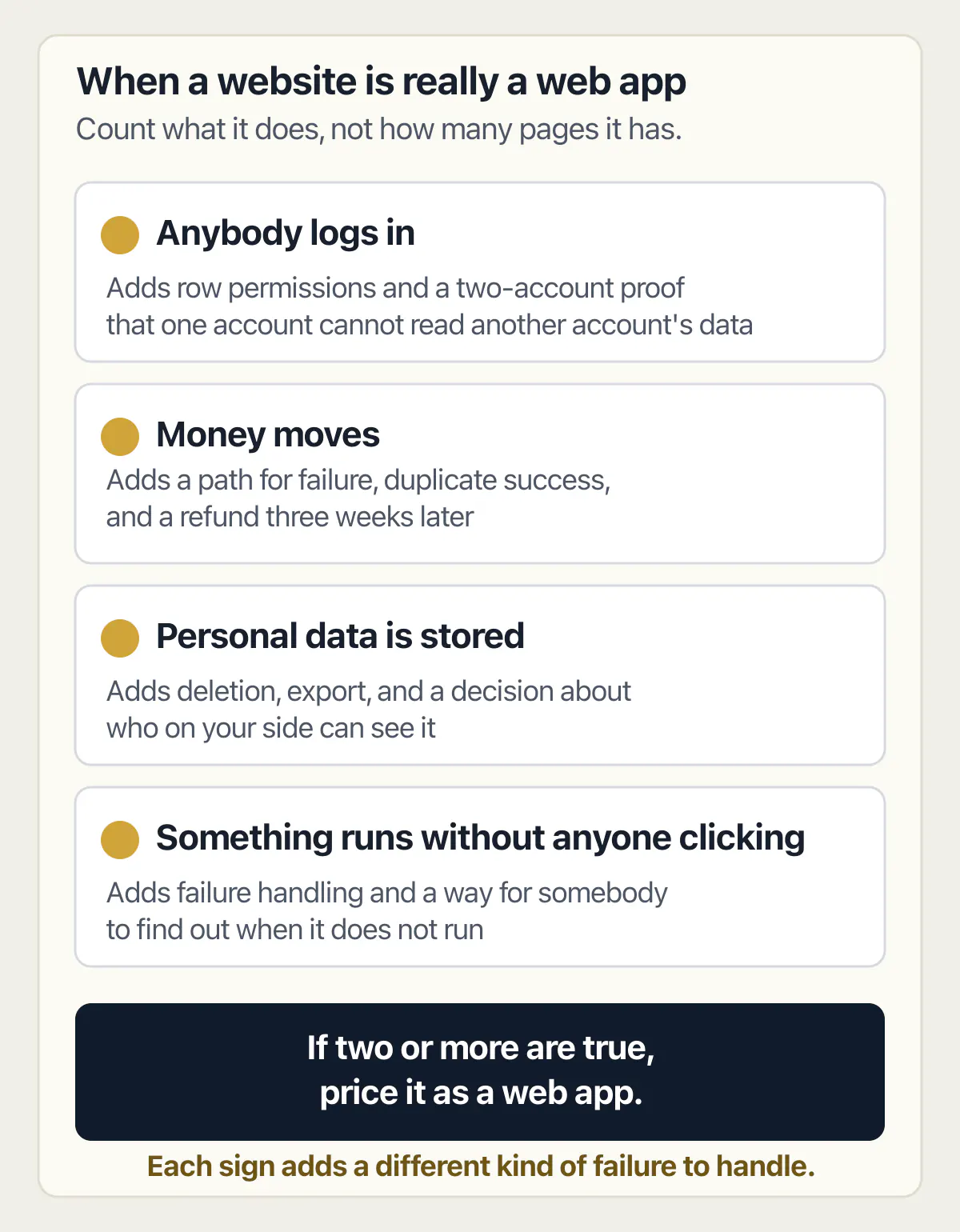
Four signs say the thing you described is really the second product, whatever it was called when you asked for it: anybody logs in, money moves, data about a person is stored, or something runs on a schedule without anyone clicking.
Each one adds to the bill in kind rather than in dollars. A login adds a rule about who can read which row, and a way to prove that rule holds when two accounts are open at once. Money moving adds a path that has to behave the same when the payment fails, when it succeeds twice, and when it is refunded three weeks later. Stored personal data adds deletion, export, and a decision about who on your side can see it. A scheduled job adds the question of what happens when it does not run, and who finds out.
None of those four cost more because of design. They cost more because each one has a failure that only shows up later, in front of a customer, and somebody has to have handled it in advance. A builder plan covers none of them, and a package band covers whichever ones its list happens to mention.
If a site of yours has two or more of the four, price it as the second thing. Something you submit to a store instead of publishing at an address is a different purchase with a different set of published bands behind it.
Common questions about what a website costs
Can I build a website for free?
Yes. Wix lists a Free plan at $0, Framer lists a Free plan at $0, and WordPress.com lists a Free plan at $0 with no expiration date, all three read on 30 August 2026. A domain of your own is a separate purchase from any plan, free or paid: a .com registers and renews at $11.08 on Porkbun’s page as read the same day. So free covers the making and the hosting, and the address is the first thing you actually buy; whether a free plan lets you attach that address, or asks for a paid plan first, is set on each builder’s own plan page, so check that line before counting on it.
Is $1,500 a good price for a website?
It matches the bottom of the lowest published package band on this search. NEWMEDIA.COM’s Starter Web Design Package runs $1,500 to $5,000 as read on 30 August 2026, and its own list for that band is 3 to 5 pages, a mobile-friendly layout, a contact form, basic on-page setup and standard launch support. So $1,500 is a fair price for exactly that list. It becomes a bad price the moment the job includes accounts, payments, or content somebody has to write.
How much does a website cost per month?
The monthly figure is the plan, and the builder plans read for this page span $0 at the free end and $159.77 a month at the top. Wix’s Light is $17.77 a month and its Business Elite is $159.77 a month, both read 31 August 2026; Framer’s Basic is $10 per month and WordPress.com’s Personal is $9 billed monthly or $4 a month billed annually, both read 30 August 2026. A store platform charges on a ladder of its own, which starts higher and is set out in the store table above. Everything else on a monthly bill, hosting extras and metered services, is counted separately from the plan.
How much does a website cost per year?
Multiply the plan by twelve and add the domain. On the figures read 30 August 2026, a WordPress.com Personal plan billed annually is $4 a month, and a .com renewal on Porkbun is $11.08 a year, so a small site on the cheapest paid plan read here lands just under sixty dollars for the year. Wix’s own page states that its displayed prices are yearly subscriptions paid in full at the time of purchase, so its monthly-looking figures are already a year’s commitment.
How much does a small business website cost?
The published answer splits by who builds it. On a plan you are inside the table above, tens of dollars a month. Paid to a company that publishes its prices, the lowest named band read on 30 August 2026 is NEWMEDIA.COM’s Starter Web Design Package at $1,500 to $5,000 for 3 to 5 pages. The cost to build a website for a small business is almost never decided by the pages, it is decided by whether anyone else has to write the words and answer the form.
What does it cost to build a website from scratch?
From scratch means nobody began with a template, and it is the version companies publish highest. NEWMEDIA.COM’s Custom Website Package runs $15,000 to $50,000+ as read on 30 August 2026, and its list for that band includes custom CMS work, integrations, technical SEO and post-launch support. WebFX publishes $8,000/month as the starting point for its own web design services, read the same day. Below those, from scratch usually means an AI builder plus your own time.
Why does the same website get two very different quotes?
Because the two quotes are pricing different amounts of a person. A plan price covers the place the site sits and the tool that lays it out, and stops there. A package band covers somebody deciding what the pages say, drawing them, wiring the form, and being reachable after launch. The two published extremes on this search are Wix’s Light plan at $17.77 a month, read 31 August 2026, and the top of NEWMEDIA.COM’s Custom Website Package at $50,000+, read 30 August 2026, and neither is wrong: they are answers to questions that only sound alike.
Is it cheaper to build the website yourself?
In cash, almost always, and the published figures make the gap obvious. In total, it depends on what the site does. A brochure site you build on a plan costs the plan and a domain. A site with a login or a checkout hands you the four unfinished things listed above, and the audited cohort described earlier on this page is the reason to take that list seriously. Doing it yourself moves the cost from an invoice to your own calendar, and to whoever fixes it later.
Built it with AI. Can’t get the last part right?
That’s the normal state of an AI-built app, and it’s fixable. I trace what the app actually does, explain what needs changing, and build it if you want me to.
Talk about your app →  Free 20-minute video call with Bilal.