Lovable pricing starts at $0 on the Free plan. Pro is from $25 per month and Business from $50 per month, and both include 100 credits. A credit is worth $0.25 on Pro and $0.50 on Business, so the plan price alone does not tell you what a given workload costs.
A Lovable credit is the single unit Lovable uses to measure and bill usage across your workspace. One balance now pays for three different things: building in the editor (Build), running the deployed app on Lovable Cloud, and model calls your live app makes through the AI gateway. Cloud and AI gateway usage appear together as Run.
Those three categories have different cost drivers, so a falling balance does not tell you by itself whether the editor, the backend, or users calling a model caused the spend. This page covers what the meter counts, what a credit is worth in dollars, and how to trace a spike before you buy more.
Lovable is rolling this unified balance out gradually. Some workspaces may still show the older Cloud and AI balance experience. The current credits and usage documentation, verified 5 August 2026, says old Cloud and AI dollar balances are converted into credits during the transition without changing the underlying Cloud or AI cost.
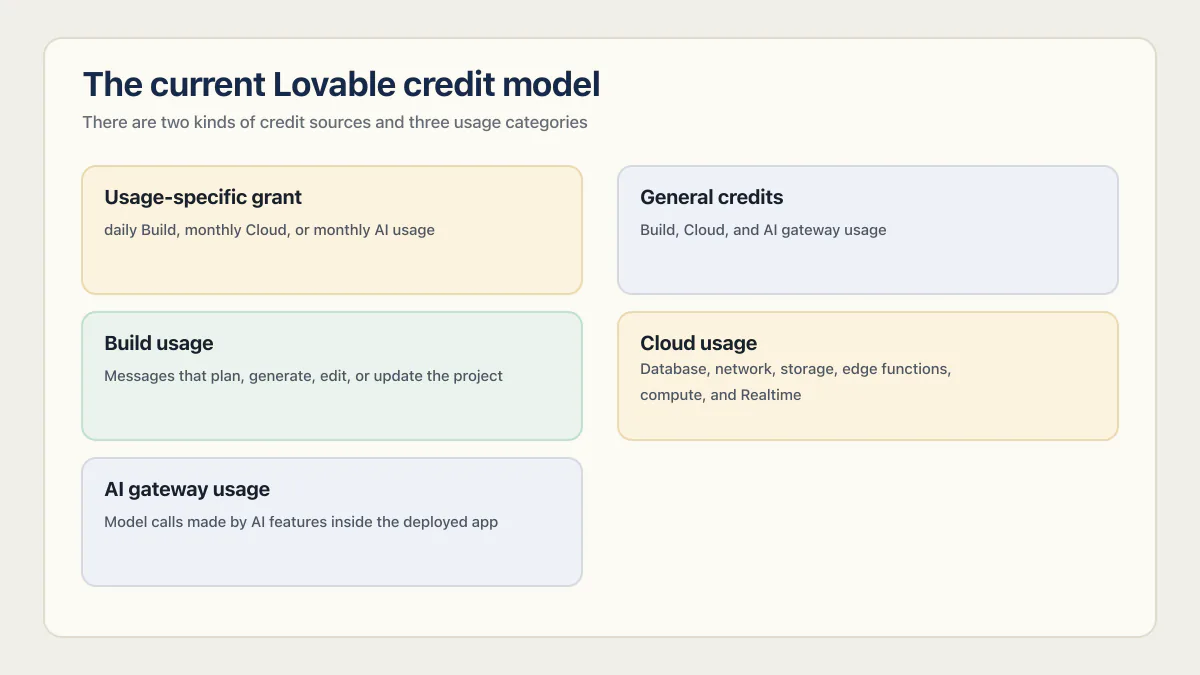
The current Lovable credit model
There are two kinds of credit sources and three usage categories.
| Term in Lovable | What it means |
|---|---|
| Usage-specific grant | Included credits restricted to daily Build, monthly Cloud, or monthly AI usage |
| General credits | Monthly plan, rollover, top-up, or bonus credits that can pay for Build, Cloud, and AI gateway usage |
| Build usage | Messages that plan, generate, edit, or update the project |
| Cloud usage | Database, network, storage, edge functions, compute, and Realtime for the deployed app |
| AI gateway usage | Model calls made by AI features inside the deployed app |
Lovable spends usage-specific grants first. After the relevant grant is exhausted, it draws from general credits, using the general credits closest to expiry first. This ordering explains why two workspaces with the same visible total can consume different credit sources during an identical task.
The Usage details screen labels Build separately and groups Cloud plus AI gateway activity under Run credits. Run usage can take up to 24 hours to appear, so a new backend or model spike may not be visible immediately.
If you learned the old Platform and Cloud credit names
Most Lovable tutorials and comparison posts still describe a two-bucket model: platform credits for building and Cloud credits for the deployed app. Those guides were written before the unified balance rolled out. Here is the mapping to the names on the screen today.
| What older guides call it | What it is now |
|---|---|
| Platform credits | Build credits |
| Cloud credits | Run credits (Cloud plus AI gateway) |
| Separate AI dollar balance | Converted into credits, reported under Run |
If a guide tells you that building and hosting draw from two separate balances, it is describing the old model. One balance now covers all three categories, and the split you see in the dashboard is a reporting split, not a wallet split.
How much does Lovable cost?
Lovable costs $25 per month on Pro and $50 per month on Business, both including 100 credits, and nothing on Free. The plan fee buys a monthly credit allowance rather than unlimited usage. Build, Cloud, and AI all draw down that one balance, and top-ups cost $15 per 50 credits on Pro.
A credit is not worth the same amount on every plan, which is why credit counts alone cannot be compared across plans. These figures come from Lovable’s credits and usage documentation and its subscription plan comparison, both verified 5 August 2026.
| Plan | Plan price | Plan credit rate | Top-up price per credit | 20-credit monthly Cloud grant is worth | 4-credit monthly AI grant is worth |
|---|---|---|---|---|---|
| Pro | From $25 per month (100 credits) | $0.25 | $0.30 | $5.00 | $1.00 |
| Business | From $50 per month (100 credits) | $0.50 | $0.60 | $10.00 | $2.00 |
The grant counts are identical on both plans, so the same 20 Cloud credits and 4 AI credits are worth twice as many dollars on Business. That is the arithmetic behind the Pro-versus-Business warning later on this page: Business credits are priced higher, so the same workload burns fewer of them. Compare dollars per completed task, not credit counts.
How Build credits are charged
Plan mode costs 1 credit per message, whatever the length of that chat message, and makes no code changes. An extended planning conversation still consumes the Build grant or general balance.
Build mode is usage-based. Lovable publishes four example requests with the work each one did and the credits it used.
| Request | Work done | Credits |
|---|---|---|
| Make the button gray | Changes the button styles | 0.50 |
| Remove the footer | Removes the footer component | 0.90 |
| Add authentication | Adds login and authentication logic | 1.20 |
| Build a landing page with images | Creates a landing page with generated images | 2.00 |
Lovable explicitly labels those numbers as illustrations. They are not a guaranteed 0.50-to-2.00 price band. Actual cost depends on the request and the work completed, including codebase exploration, verification, browser checks, web search, and image generation.
You can inspect the exact cost of a Build response from the three-dot menu below that response. For a Build-credit spike, compare the expensive responses before you change plans. The habits under “how to spend fewer Lovable credits” below cut the repeat work that causes most spikes.
The meter can show which response consumed credits, and it is honest about what it counts: messages, completed work, tokens. It cannot tell you whether the resulting change is correct, maintainable, or complete. It also has no column for whether the code those credits bought survives a stranger using the app instead of you clicking through a demo, and no alert for a public endpoint that lets one visitor drain the balance being metered.
How Cloud and AI gateway usage is charged
Cloud usage follows resources consumed by the deployed app. Lovable currently breaks it down into database server and storage, network, file storage, compute, and Realtime. The database instance size and how long it remains active also affect usage, so Cloud cost is not purely a visitor counter.
AI gateway usage is separate from the Lovable agent that edits the project. It comes from model calls made by AI features in the live app. The model, input tokens, output tokens, call volume, and feature type determine consumption.
That distinction gives you a practical diagnosis:
| Usage pattern | Likely place to inspect |
|---|---|
| Build credits rise after editor sessions | Individual Lovable responses and repeated prompts |
| Database usage rises with little traffic | Instance size, slow queries, retained data, and background work |
| Network or storage rises | Large API responses, downloads, uploads, images, and media |
| Compute rises | Edge functions and background processing |
| AI gateway usage rises | Model choice, prompt/context size, response length, and calls per user action |
How to check your Lovable credit balance
Open Settings → Plans & credit usage → Usage details, then select Build or Run credits and filter by project and time range. Four tabs sit inside that screen.
| Tab | What it shows |
|---|---|
| Breakdown | The credit types you hold and what remains in each |
| History | Individual events: monthly credits granted or expired, bonus credits granted or expired, top-up credits granted or expired, commitment credits granted, and credits converted |
| Projects | Credit usage by project |
| People | Credit usage by workspace member |
Workspace admins and owners can see project-level usage; role and plan determine what other members can inspect.
Two things make this screen look broken when it is not. Run usage can take up to 24 hours to appear, so last night’s model spike may still be missing this morning. And Lovable only began recording credit history on 8 March 2026, so a workspace older than that shows a shorter history than you expect. Neither is a lost balance.
How to spend fewer Lovable credits
Most credit waste is repeated work, not expensive work. The same requirement attempted four ways costs more than one well-scoped request that lands.
- Batch related changes into one Build request instead of five small ones.
- Use the code editor for a one-line copy or style fix instead of spending a Build message on it.
- Look for repeated attempts on the same requirement or file.
- Separate investigation into Plan mode when you need a decision before an edit, while remembering that each Plan message costs 1 credit.
- Make each Build request bounded enough that success can be checked in one response.
- Stop a failing direction early. Lovable charges a stopped Build request for work completed before it stopped, so restate the request instead of retrying the same prompt.
- On the Run side, cut prompt and context size and pick a cheaper model before you touch the plan.
Included Lovable credits and expiry
As of 5 August 2026, Lovable’s subscription plan comparison lists these usage-specific grants for Free, Pro, and Business workspaces:
| Grant | Free | Pro | Business | Rollover |
|---|---|---|---|---|
| Daily Build grant | 5 per day, capped at 30 per calendar month | 5 per day | 5 per day | No, expires at the daily reset (midnight UTC) |
| Monthly Cloud grant | 20 | 20 | 20 | No, expires at the end of the grant period |
| Monthly AI grant | 4 | 4 | 4 | No, expires at the end of the grant period |
In plain terms, the free allowance is 5 build credits per day, resetting at midnight UTC (00:00 UTC), capped at 30 per calendar month.
Lovable labels the monthly Cloud and AI grants as temporary and subject to change. Recheck the official documentation before relying on them in a budget.
Do Lovable credits roll over?
Grants do not roll over; paid plan credits do. The daily Build grant expires at the daily reset and the monthly Cloud and AI grants expire at the end of their grant period, so an unused Tuesday is gone on Wednesday.
Paid Pro and Business subscriptions start at 100 general credits per month. Under the normal active-subscription rules, unused monthly plan credits roll over. Credits issued on a monthly plan expire two months from issue; monthly credits on an annual plan expire one month after the annual billing period ends. Purchased top-up credits are valid for 12 months.
When a workspace moves to Free, unused monthly plan and rollover credits freeze. They become usable again if the workspace upgrades before their original expiry. Unexpired top-up and eligible bonus credits remain usable on Free until they expire.
Lovable top-ups: how to buy more credits
Top-ups are how you add credits without changing plans. Auto top-up buys credits for you when the balance falls below a threshold; a one-time top-up is a single manual purchase. Both are configured in the same Plans & credit usage screen.
| Setting | Default | Options |
|---|---|---|
| Auto top-up amount | 100 credits | 50, 100, 150, 200, 300, 500, 1,000 |
| Trigger threshold | Balance below 25 credits | 25, 50, or 100 |
| Monthly spend limit | 400 credits | 100 up to 25,000, or no limit |
| One-time top-up | Not applicable | 50 up to 10,000 credits |
Top-up credits cost $15 per 50 on Pro and $30 per 50 on Business, and they stay valid for 12 months. Lovable’s pricing FAQ says the underlying cost of running an app and its built-in AI features is the same for Pro and Business; Business represents that cost with lower credit consumption because its credits are priced higher. Comparing Run-credit counts across those two plans without the dollar conversion can therefore give the wrong conclusion.
The monthly spend limit caps how many credits the auto-top-up feature may purchase during a calendar month. It is not an application-level cap on model calls, downloads, or database work. A public AI feature still needs authentication, per-user limits, and a bounded request design if one caller should not be able to spend the workspace balance.
What happens when Lovable credits run out
Running out affects all three usage categories under the unified model:
- Building stops until credits become available.
- AI features inside deployed apps stop working while no credits are available.
- Built-in backend services such as database, storage, and authentication pause shortly after the workspace runs out.
An empty credit balance can pause a live app. Lovable does not define “shortly after” as a duration or state whether database, storage, or authentication pauses first. The Free plan’s specific limits and reset behavior, including whether Lovable gives you a grace period when credits run out, are covered separately.
If your live app suddenly stops responding, or logins start failing, check the credit balance before you check for an outage. A workspace at zero pauses database, storage, and authentication, which looks exactly like downtime from the outside. Auto top-up, described above, reduces the chance of that surprise.
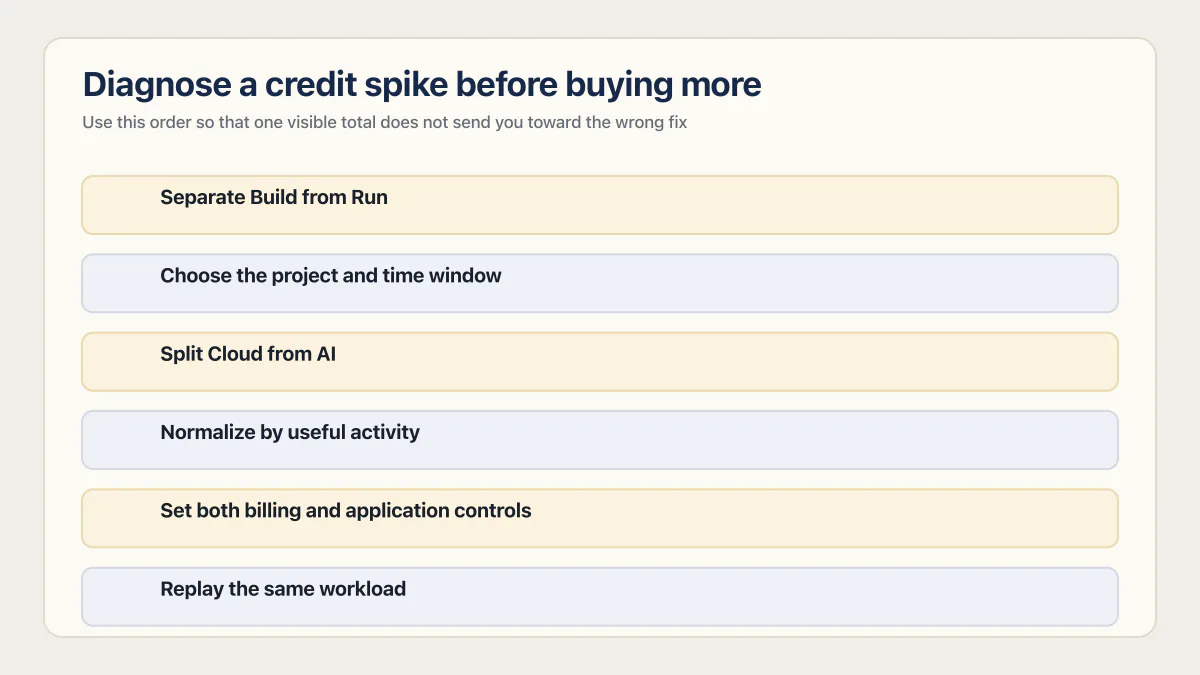
Diagnose a credit spike before buying more
Use this order so that one visible total does not send you toward the wrong fix:
- 01 Separate Build from Run Filter Usage details. A Build spike came from editor work; Run combines Cloud and AI gateway usage from deployed apps.
- 02 Choose the project and time window Find when the slope changed and which project was active. Account for the possible delay in new Run-usage reporting.
- 03 Split Cloud from AI Inspect database, network, storage, compute, Realtime, and top models. Do not infer the cause from the total credit bar.
- 04 Normalize by useful activity Compare credits per completed build task, active user, processed document, or successful model action. A total can rise safely while the unit cost falls.
- 05 Set both billing and application controls Configure top-up behavior for continuity, then add product-level limits so one user or loop cannot consume an unintended share of the balance.
- 06 Replay the same workload After changing a query, model, prompt, payload, or instance, compare the same time window and user action. Keep the result with the change.
The decision to move should come from portability, control, and measured unit economics. A proportional bill may be a fair price for managed infrastructure. A bill that grows faster than successful user activity deserves investigation before migration. If migration becomes the answer, moving off Lovable Cloud explains what the export includes and what must be rebuilt or re-verified. The same shape shows up one layer further down the stack, in Supabase egress limits, once your own backend replaces Lovable Cloud entirely: metered usage that needs the same split-then-normalize diagnosis before you pay to escape it.
Common questions about Lovable credits
How do Lovable credits work now?
Lovable is moving to one credit balance that pays for Build, Cloud, and AI gateway usage. Restricted daily or monthly grants pay their matching category first. General credits then pay for any of the three categories, with the credits closest to expiry used first. Some workspaces may still show the older Cloud and AI balances while the rollout continues.
Does Lovable Plan mode use credits?
Yes. Each Plan-mode message costs 1 credit. Plan mode does not edit code, so the useful unit is the decision or resolved question, not lines changed.
How much does Lovable Build mode cost?
Build mode has no single price per prompt. Cost depends on the request and completed work. Lovable’s published examples run from 0.50 credits to make a button gray, 0.90 to remove a footer, 1.20 to add authentication, and 2.00 for a landing page with generated images, and it labels them as illustrations, not a price band. Check the response’s three-dot menu for its actual charge.
How many credits does it take to build a website on Lovable?
Lovable publishes no figure for a whole site, because the cost tracks how many Build messages the site takes rather than the site itself. The only site-shaped example in its documentation is 2.00 credits for a landing page with generated images, and Lovable labels that number an illustration. The practical version of the question is what 100 credits buys, since 100 credits is the monthly allowance on both Pro at $25 and Business at $50. Divided by the published example costs of 0.50 to 2.00 credits, 100 credits is 50 to 200 requests of that size, and materially fewer when the same requirement is attempted several ways. Read the three-dot menu under your own first ten Build responses and you will have a better estimate for your project than any published average.
Which Lovable credits roll over and which expire?
Usage-specific daily Build and monthly Cloud or AI grants do not roll over. Paid monthly plan credits normally roll over while the subscription remains active and expire under the plan’s stated window. Top-up credits expire after 12 months. When a workspace moves to Free, unused monthly plan and rollover credits freeze. They become usable again if the workspace upgrades before their original expiry, while unexpired top-up and eligible bonus credits remain usable on Free.
How many free credits does Lovable give per day?
Five build credits per day on the Free plan, capped at 30 per calendar month. The daily grant resets at midnight UTC and does not roll over, so unused days are not banked. Free workspaces also get monthly grants of 20 Cloud credits and 4 AI credits, which Lovable labels as temporary and subject to change.
When do Lovable credits reset, and what time?
Three clocks, not one. The daily Build grant of 5 credits resets every day at 00:00 UTC on Free, Pro, and Business alike, and whatever is unused at that moment expires rather than banking. The monthly Cloud and AI grants expire at the end of their grant period instead of daily. Monthly plan credits do not reset at all in the daily sense: they are issued on your billing cycle, and unused ones roll over while the subscription stays active. Lovable’s documentation calls the daily event a refresh at 00:00 UTC, so a search for a reset time and a search for a refresh time are asking about the same event, verified 16 August 2026.
What does Lovable cost in my currency, and when do credits reset in my timezone?
Lovable publishes every price in US dollars. As of 16 August 2026, neither its pricing page nor its subscription plan documentation lists a price in any other currency, so the rupee, pound, or taka amount on your statement is whatever conversion your card issuer applies that day rather than a rate Lovable quotes. The reset is more definite, because 00:00 UTC is a fixed instant everywhere: 5:30 am in India, 6:00 am in Bangladesh, 1:00 am in the UK during British Summer Time and midnight there in winter, and 5:00 pm on the previous day on the US Pacific coast in summer. If you build in the evening in South Asia, tomorrow’s five Build credits land early in the morning rather than at your local midnight, which is the usual reason a balance looks stuck overnight.
Why are my Lovable credits running out quickly?
Filter Usage details into Build and Run first. Build cost comes from editor messages and tasks. Run cost comes from Cloud resources and AI gateway calls in deployed apps. Within Run, inspect the resource or model breakdown and compare it with completed user activity.
Are Lovable credits refundable?
No. Lovable’s pricing FAQ says credits are not refundable and cannot be redeemed for cash or any other value. Plan payments and top-ups buy credits, and unused credits expire on their own schedule rather than converting back to money. Treat a top-up as spend, not as a balance you can recover later.
Does Lovable charge per seat or per credit?
Per credit. Lovable says workspaces support unlimited members on all plans, and plans are priced by the credits they include, not by seats. Adding a cofounder, a contractor, or a whole class to a workspace costs nothing by itself; what costs money is the Build, Cloud, and AI usage those people generate from the shared balance.
Can you transfer or share Lovable credits?
Sharing happens by default inside a workspace; transferring between workspaces or accounts is not documented. Credits belong to the workspace, so anyone invited to it is already drawing from the same balance without anything being moved. As of 16 August 2026, neither Lovable’s pricing page nor its credits and usage documentation describes a way to send credits to another workspace, hand them to another account, or gift them to a person. If a second workspace runs short, it needs its own top-up or plan rather than a slice of the first one’s balance.
Does Lovable offer a student discount?
Yes. Lovable’s pricing FAQ says it offers a student discount for students with a valid student email. It does not publish the discount amount there, so check the current terms in your account before you build a budget around it.
Are Lovable credits expensive?
The per-credit price alone cannot answer that because Build, Cloud, and AI consume credits differently, and Business represents Run usage differently from Pro. Compare the dollar cost per successful build task or useful production action, then include the value of hosting, managed backend services, and the work required to operate an alternative. Base44 pricing uses a separate message-and-integration-credit model, so compare the work each platform completes rather than treating the credit labels as equivalent. Which of the two builders you should be on is a wider question than price, and Base44 versus Lovable is a comparison in its own right.
Thinking about moving off the platform?
I check what has to move, what can stay, and what breaks on the way. You get a plain answer and a fixed quote if you want it done.
Talk about your app →  Free 20-minute video call with me.