Yes, Lovable is free to use. The Free plan includes 5 daily build credits, capped at 30 per calendar month, plus monthly grants of 20 Cloud credits and 4 AI credits. Building stops when no applicable build or general credits remain. Deployed AI features fail and built-in backend services can pause when no applicable grant or general credits remain. The published site’s pages keep serving.
Lovable is gradually moving workspaces from separate Cloud and AI balances to one credit balance. The grants remain usage-specific: build credits pay for editor work, the Cloud grant pays for hosting and backend resources, and the AI grant pays for model calls made by the deployed app. Some workspaces may still show the older balance interface during the rollout. This article reflects the documentation checked on 5 August 2026.
Is Lovable free?
Lovable’s Free plan is a standing plan, not a free trial. Its grants keep refreshing on a schedule (build credits daily at 00:00 UTC, the Cloud and AI grants on the 1st of the month), Lovable’s documentation sets no end date on them, and paid plans start at $25 a month on Pro.
What the free tier does limit, besides credits, is a long list of paid features: custom domains, code download, and the removal of the “Edit with Lovable” badge among them.
What are the Lovable free plan limits on credits per month in 2026?
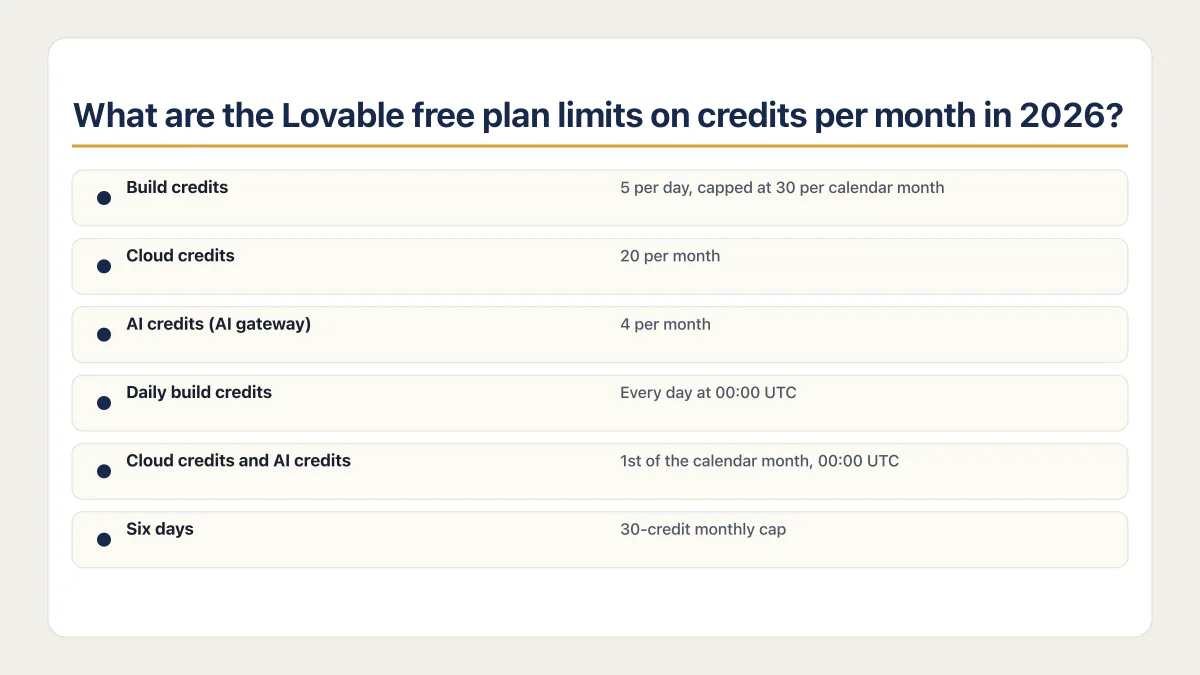
The Lovable Free plan grants 5 build credits per day, capped at 30 per calendar month, plus 20 Cloud credits and 4 AI credits per month. Daily build credits reset at 00:00 UTC; the two monthly grants refresh on the 1st. Unused usage-specific grants do not roll over.
| Credit type | What the free plan grants | Resets | Rolls over |
|---|---|---|---|
| Build credits | 5 per day, capped at 30 per calendar month | Every day at 00:00 UTC, until the 30-per-month cap is hit | No |
| Cloud credits | 20 per month | 1st of the calendar month, 00:00 UTC | No |
| AI credits (AI gateway) | 4 per month | 1st of the calendar month, 00:00 UTC | No |
All three figures were verified on 5 August 2026 against Lovable’s subscription-plans documentation. Lovable labels the monthly Cloud and AI grants a temporary offering subject to change. Six days of using the full daily build grant reaches the 30-credit monthly cap, after which daily grants stop until the next calendar month. What one credit buys varies by the work performed, covered in the next section and in more depth in how Lovable credits are charged.
Lovable says unexpired monthly plan and rollover credits are frozen when a workspace moves to Free. You cannot use them on Free. If you upgrade again before their original expiry, they become usable until that date. Unexpired top-up and bonus credits remain usable on Free.
“Unexpired” has published numbers behind it. Monthly plan credits expire two months after they are issued, annual plan credits expire one month after the annual period ends, and top-up credits last twelve months from purchase (verified 5 August 2026 on Lovable’s pricing page). Free grants are shorter-lived than any of these: daily build credits expire at the end of the day, and the Cloud and AI grants expire at the end of the calendar month.
What is the Lovable daily limit, and what do 5 credits actually buy?
The Lovable daily limit on Free is 5 build credits per day. That allowance does not map to a fixed number of prompts because Build Mode charges vary with the request and the project.
| Example prompt | Credits |
|---|---|
| ”Make the button gray” | 0.50 |
| ”Remove the footer” | 0.90 |
| ”Add authentication with sign up and login” | 1.20 |
| ”Build me a landing page, use images” | 1.70 on the pricing page; a similar docs example is 2.00 |
The first three figures and the 1.70 landing-page figure come from Lovable’s pricing page. The current credits documentation lists a similar landing-page request at 2.00 credits and calls all four examples illustrative. Use the cost shown on the completed message for accounting. Do not use either landing-page example to predict how many prompts 5 credits will buy.
The monthly cap is the harder limit. Six days of spending the full daily grant reaches 30 credits, and daily build credits then stop until the 1st of the next calendar month. Spend everything in the first week and the free tier gives you nothing for the remaining three.
One lever changes the math. Plan Mode costs a flat 1 credit per message, while Default Mode charges by task complexity. Thinking a change through in Plan Mode and issuing one well-specified Default Mode request usually costs less than three vague attempts, because each retry in Default Mode is charged.
What the Lovable free tier limits besides credits
The free tier limits features as well as credits. Custom domains, code download, code editing, and removing the “Edit with Lovable” badge are all paid-only, which matters more than the credit math for anyone publishing to real users.
| Capability | Free plan | Paid plans |
|---|---|---|
| Publishing domain | lovable.app subdomain only | Custom domains |
| ”Edit with Lovable” badge | Shown on published apps | Can be removed |
| Code download | Not included | Included |
| Edit code | Not included | Included |
| Design templates and design systems | Not included | Included |
| Personal projects inside a workspace | Not included | Included |
| Internal publish, publishing and sharing controls | Not included | Included |
| Custom connector support | Not included | Included |
| Roles, permissions, SSO, SCIM | Not included | Included on the relevant paid tiers |
| Security center, workspace insights, audit logs | Not included | Included on the relevant paid tiers |
| Scheduled security scans | Not included | Included on the relevant paid tiers |
| Email, priority, dedicated support and onboarding | Not included | Included on the relevant paid tiers |
| Credit rollover | Not included | Included |
| On-demand top-ups and auto top-up | Not included | Included |
Every row was verified on 5 August 2026 against Lovable’s subscription-plans documentation. Two of them decide things for the reader of this site. Native codebase download is paid-only, but Git sync to github.com or GitLab.com is available on every plan, so a Free workspace can keep a full source repository even without Lovable’s download button. No top-ups, on demand or automatic, means there is no setting that keeps a Free app running through exhaustion: the only routes are waiting for the next grant refresh or upgrading.
Free, Pro and Business: what actually changes
Paid plans do not enlarge the free grants. Pro and Business receive the same 5 daily build credits, the same 20-credit monthly Cloud grant, and the same 4-credit monthly AI grant as Free. What they add is monthly plan credits, rollover, top-ups, and the removal of the 30-per-month build cap.
| What you get | Free | Pro | Business |
|---|---|---|---|
| Monthly plan credits | None | From 100 at $25 a month, ladder to 10,000 at $2,250 | From 100 at $50 a month, ladder to 10,000 at $4,300 |
| Daily build credits | 5 a day, capped at 30 a month | 5 a day, no monthly cap | 5 a day, no monthly cap |
| Monthly Cloud grant | 20 credits | 20 credits | 20 credits |
| Monthly AI grant | 4 credits | 4 credits | 4 credits |
| Credit rollover | No | Yes | Yes |
| On-demand top-ups | No | $15 per 50 credits | $30 per 50 credits |
| Auto top-up | No | Yes | Yes |
| Member credit limits | No | Yes, build usage only | Yes, build usage only |
Prices and grants verified 5 August 2026 against Lovable’s credits-and-usage documentation and subscription-plans documentation. Annual billing is listed at ten times the monthly price (100 Pro credits at $250 a year), so a year costs about two months less than paying monthly.
Most pricing write-ups get the daily grant backwards, describing 5 credits a day as a free-plan perk that paid users trade away. The docs’ own included-grants table says otherwise: the daily grant, the Cloud grant, and the AI grant are identical on all three plans. Free’s distinguishing constraint is the 30-per-month cap on the daily grant, not a smaller grant. Support is one of the rows that is genuinely plan-gated: email, priority, dedicated support and onboarding are not included on Free, so what to do when the answer never comes is worth reading before you file anything.
That has a direct consequence for the AI section below. Upgrading to Pro or Business does not enlarge the 4-credit monthly AI grant. It only gives you plan credits that can be spent once that grant is gone.
What happens when Lovable credits run out on the free plan?
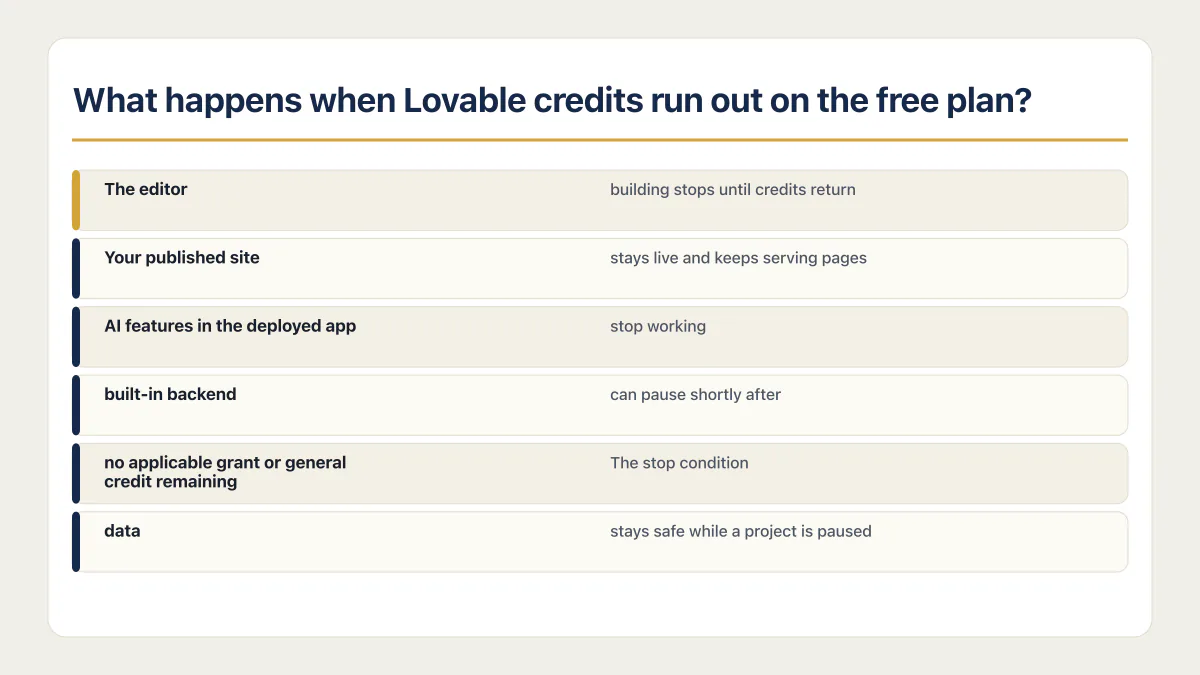
When no applicable build or general credits remain, the editor shows a blocking dialog and building stops until credits return. Your published site stays live and keeps serving pages. AI features in the deployed app stop working, and apps that rely on the built-in backend can pause shortly after, when no applicable grant or general credits remain for that usage. Lovable does not define “shortly after” as a duration or publish which backend service pauses first.
Lovable documents alerts for low credits, zero credits, and deployed apps that pause. The interface can show a blocking dialog, banner, inline message, or email depending on the event and the user’s role. A usage-specific grant reaching zero does not always cause a pause: Lovable uses available general credits after the Cloud or AI grant is exhausted. The stop condition is no applicable grant or general credit remaining.
Knowing what drains each grant tells you which one runs out first. Cloud spend has six documented drivers: database server, database storage, network, storage, compute, and realtime. AI gateway spend has five: model choice, input tokens, output tokens, call volume, and feature type. Both land under Run credits in the workspace breakdown, separate from the Build credits the editor spends. Lovable says data stays safe while a project is paused.
| Looks fine | Actually fine |
|---|---|
| The published page loads | The page loads and its database, storage, authentication, and AI actions still complete |
| The 4-credit AI grant is spent | You checked whether another applicable credit source remains before assuming the feature has stopped |
| The workspace shows credits remaining | You checked which grant or general-credit source remains and which usage it can cover |
Does Lovable have a grace period after free credits run out?
Lovable says building stops when no applicable credits remain and documents no post-zero grace window. On Free, the documented routes are the next applicable grant refresh or an upgrade; top-ups are available on Pro and Business.
There is no separate cancel action on a paid plan either. Cancelling is a downgrade: Settings > Plans & credit usage > Manage > Downgrade to free. The paid plan then runs to the end of the current billing period, and Lovable says unused monthly plan and rollover credits are frozen, keep their original expiry date, cannot be used on Free, and are not refunded.
The current 30-day grace period applies to deleting a Lovable account, not running out of credits. Deleting a project remains final according to Lovable’s FAQ. These are separate lifecycle events.
| What you might mean by “grace period” | What Lovable documents |
|---|---|
| Time to keep building after credits hit zero | None. Building stops until the next grant refresh or an upgrade |
| Time to cancel a scheduled account deletion | 30 days by signing back in and cancelling the deletion |
| Time to recover a deleted project | None. Deleting a project is final, with no way to restore it |
Deleting a project is the irreversible row. Before removing its Cloud resources, check what moving off Lovable Cloud leaves behind, including database data, storage objects, function code, and secrets that need rotation or recreation.
The failure your users see before you do
The published page can remain online after the backend pauses. A visitor may still load the form even though its next database write or authentication request cannot complete. Whether that failure reaches you depends on the app’s error handling and monitoring.
Running out of credits leaves your pages up and your backend down, so your users find the failure before your dashboard does.
In AxonBuild’s fixed June-July 2026 research cohort, 17 of 21 third-party apps recorded errors nowhere. That historical denominator comes from the audit corpus methodology and findings; it is not a rolling claim about every Lovable app. The failure pattern is the same one examined in an app that fails silently and answers 200 OK, with an exhausted credit balance as the trigger.
An open AI route can consume the monthly grant
The Free plan includes 4 monthly AI credits. A deployed feature without authentication or a useful per-caller limit can let a visitor consume that grant. Lovable supplies the gateway and tracks workspace usage; your app still needs to decide who may call each route and how much each caller may consume. In the fixed June-July 2026 cohort, 12 of 14 third-party apps with an AI surface had a confirmed path for a stranger or free account to consume the owner’s model budget without a useful cap.
The pattern behind that number is boring by the third repetition: the generator wires the API key server-side, correctly, then leaves metering, quotas, and authentication to somebody else. One in the set was an incident-timeline tool running three unauthenticated endpoints against a paid model, told in full in the security gaps vibe-coded apps actually ship with.
The documentation backs the argument. Member credit limits exist on Pro and Business only, they apply to build usage only, and run credits from deployed apps do not count against them. Free cannot set a member limit or turn on auto top-up at all. So no plan gives you a per-caller spend cap on a deployed AI feature, which is exactly why the cap has to live in your app.
On Free, an exposed route can consume the 4-credit AI grant. The feature stops only after no applicable general credits remain. One unauthenticated route can therefore turn a small included allowance into a user-facing failure while the published pages continue serving.
When is the Lovable free plan fine, and when does it break a live app?
The Lovable Free plan fits prototypes and low-usage published sites. A live app needs more scrutiny when a user’s core action depends on the 20-credit Cloud grant or 4-credit AI grant. The practical question is what happens after those grants and any applicable general credits are exhausted.
| Use case | Verdict on the free plan | What breaks first |
|---|---|---|
| Marketing page or portfolio without Cloud or deployed AI | Suitable for publishing | Editor work stops at zero, while the published pages keep serving |
| Low-usage internal tool on Cloud | Test before relying on it | The Cloud grant can be consumed by database, network, storage, compute, and realtime usage |
| Demo shown to early users | Usually suitable with a reset plan | The 30-credit monthly build cap can stop editor changes before the month ends |
| Live app with sign-in and data on Cloud | Upgrade or plan for a pause | Built-in backend services can pause after applicable credits run out |
| Live app with an AI feature open to visitors | Add authentication and limits first | Visitor model calls consume the 4-credit AI grant and then any applicable general credits |
The bottom two rows involve usage generated by visitors, even when nobody opens the editor. Whether Lovable is safe to build on separates platform controls from application controls. If the grants themselves are the constraint, Lovable alternatives are more useful when compared on backend ownership, authentication, export, and operating cost together, and Base44 vs Lovable free tiers compared is the head-to-head version.
What to check before you rely on the Lovable free plan in production
Relying on the Lovable Free plan for real users comes down to five checks about usage and failure behavior. Start with deployed AI routes because visitors can consume that grant without opening the editor.
- 01 List every route in your app that calls a model, and mark which ones require a signed-in user. Anything a stranger can reach spends AI credits on your behalf.
- 02 Put a cap on each route with a per-user limit, a per-IP limit, or both. Confirm the server enforces it rather than relying on a disabled button in the browser.
- 03 Break one Cloud call on purpose in a preview and watch what the UI does. If the test produces an empty state where an error message belongs, record that as one likely zero-credit failure path.
- 04 Add error tracking before you need it, so a paused backend produces an alert instead of a support email three days later.
- 05 Open Settings > Plans & credit usage to see what remains, then open Usage details to split spend into Build credits and Run credits. The credit-balance History tab is available on Pro, Business and Enterprise, while Breakdown is available on Pro and Business. Record that Free monthly Cloud and AI grants refresh on the 1st at 00:00 UTC.
These checks cover the credit boundary. What makes an AI-built app ready to launch covers the broader reliability, authorization, payment, and recovery questions that a plan limit cannot answer.
One thing I still have not found a clean answer to: Lovable says backend services pause “shortly after” you run out, and that is the whole specification. Shortly is not a number, and nothing in the docs says which of database, storage, and authentication goes first.
Common questions about the Lovable free plan
Is Lovable AI free?
Partly. The Free plan includes 4 AI credits a month for model calls made by deployed app features, plus 5 daily build credits capped at 30 per calendar month. The AI feature can continue after its grant is spent only when another applicable general-credit source remains.
How many prompts do 5 Lovable credits get you?
There is no fixed prompt count. Lovable’s published examples include 0.50 credits for “Make the button gray”, 0.90 for “Remove the footer”, and 1.20 for adding authentication. Its pricing page lists a landing-page request at 1.70 credits while the credits documentation lists a similar request at 2.00 and calls the examples illustrative. Plan Mode remains a flat 1 credit per message.
Why did my Lovable daily credits stop arriving?
You most likely hit the 30-credit monthly cap. On Free, daily build credits are capped at 30 per calendar month, so six days of spending the full 5-credit grant exhausts the month. Daily credits resume on the 1st of the next month at 00:00 UTC, and the 20-credit Cloud and 4-credit AI grants refresh on the same date.
Do Lovable free plan credits roll over?
No. On the free plan, daily build credits expire at day’s end and the monthly Cloud and AI grants reset on the 1st without carrying a balance forward, so an unused week is gone rather than banked. Paid plans handle rollover differently, and how Lovable credits are metered across plans covers that side.
Can you use a custom domain on the Lovable free plan?
No. Custom domains are a paid feature, so free-tier apps publish to a lovable.app subdomain. The “Edit with Lovable” badge also stays on published free-tier apps, and removing it requires a paid plan.
Can you build a real app on the Lovable free plan?
You can build and publish one. For a live app, check whether its core workflow depends on the 20-credit Cloud grant or 4-credit AI grant and what the interface does when no applicable credits remain. Whether a Lovable app is production-ready depends on the app’s controls and failure paths as well as its plan.
How much does Lovable Pro cost compared with the free plan?
Pro starts at $25 a month for 100 monthly plan credits and Business starts at $50 a month for the same 100 credits, with both ladders reaching 10,000 credits ($2,250 a month on Pro, $4,300 on Business). Neither plan enlarges the free grants: Pro and Business get the same 5 daily build credits, 20-credit monthly Cloud grant, and 4-credit monthly AI grant as Free. What paying buys is plan credits, rollover, top-ups ($15 per 50 credits on Pro, $30 per 50 on Business), and the removal of the 30-per-month build cap.
What happens to my published Lovable app if I stop paying?
At the end of the paid billing period the workspace moves to Free, and unused monthly plan and rollover credits freeze with no refund. Your published pages stay live, but deployed AI features stop and built-in backend services can pause once no applicable credits remain. Paid-only features leave with the plan: the “Edit with Lovable” badge reappears on the next publish, and custom domains sit in the paid column of the feature matrix.
Two details are worth knowing before the switch. Frozen monthly plan and rollover credits become usable again only if you upgrade before their original expiry. Unexpired top-up or bonus credits can remain usable on Free until their own expiry. The rest of the downgrade list is documented: scheduled security scans and scheduled data exports stop, verified email sign-up stops adding new sign-ups, and announcement banners disappear.
Thinking about moving off the platform?
I check what has to move, what can stay, and what breaks on the way. You get a plain answer and a fixed quote if you want it done.
Talk about your app →  Free 20-minute video call with me.