The best Lovable alternatives are Replit when development and production data have to be separate by default, Bolt.new when the builder must import an existing GitHub repository, v0 by Vercel, Cursor or Claude Code when you already own the repository and the deployment pipeline, Dyad when you want a free, open-source build loop on your own machine, and Bubble when you never want a repository at all. Which of those wins depends on what you want to own after the app is generated. Replit also has the clearest documented development-and-production database split. Softr, WeWeb and Webflow sit beside Bubble on the no-repository branch. Base44 and Lovable keep more of the backend experience inside their own platforms.
Here is every alternative in one line, with the reasoning behind each pick further down.
- Replit: best when development data and production data have to be separate by default, inside a hosted workspace.
- Bolt.new: best when you want the same prompt-to-full-stack loop but need to start from a repository that already exists.
- v0 by Vercel: best when the team already lives in Next.js, GitHub and pull requests, and wants generation to enter through that door.
- Cursor and Devin Desktop: best when a technical owner already controls the repository and wants an agent inside it rather than a platform around it.
- Claude Code: best when you already own the repo and want the cheapest serious entry point here, at $20 a month against the code on your own machine.
- Base44: best when you are building an internal business app where entities, roles, workflows and connectors matter more than portability.
- Dyad: best when you want no subscription, no credit meter and no vendor holding the code, with the build loop running on your own laptop.
- Bubble: best when the founder is never going to open a code editor and will trade portability for that; with Replit and Base44, it is one of the picks here with a documented app-store path.
- Softr: best when the data already sits in Airtable, Sheets, Notion, Postgres or a similar system you control, and only the interface is missing.
- WeWeb: best when you want visual editing and still want the code, because export and self-hosting are documented on the paid seat plans.
- Webflow: best when the thing you are building is closer to a site than an app.
Lovable itself stays the answer when the managed Cloud stack fits and the reason for leaving is vague frustration.
No option wins every category. A founder who wants a managed database and authentication has a different decision from a developer who already has a repository and deployment pipeline. The durable comparison is therefore backend ownership, environment separation, repository control, and the work required to leave.
If you are deciding whether to keep an existing project rather than replace the tool, the Lovable safety analysis owns that narrower question.
What Lovable is, in one paragraph
Lovable is an AI app builder: you describe an app in chat, and the tool writes the code, runs it, and hosts it for you. An AI app builder differs from an AI coding assistant in what it hands you. The assistant edits a repository you already own and leaves hosting, database and identity to you. The builder supplies those pieces itself, which is why the interesting question is never “which one writes better code” but “what do I still own when I stop paying”. Lovable’s own managed layer, Lovable Cloud, covers database, authentication, storage, Edge Functions, secrets, logs and AI calls, and it syncs code two ways with GitHub.
Best Lovable alternatives at a glance
Vendor docs and plans checked: 5 August 2026. Prices are the entry paid tier billed monthly, in US dollars, before tax.
| Tool | Starting price (checked August 2026) | Backend starting point | Production separation | Best fit |
|---|---|---|---|---|
| Lovable | Free tier; Pro from $25/mo | Lovable Cloud provides database, auth, storage, functions, and AI; Supabase remains supported | The reviewed docs do not promise a separate production database for every project; confirm the environment design | A web app builder who wants a managed full-stack path |
| Bolt.new | Free tier; Pro $25/mo | Bolt Database and Bolt hosting are integrated; Supabase and Netlify remain options | Git branches are available; database environment behavior depends on the selected backend | A builder who wants managed infrastructure without giving up an existing repo |
| Replit | Free Starter; Core $20/mo | Replit provides app hosting, auth choices, and managed databases | Separate development and production databases; Agent cannot edit production data directly | A hosted workflow where default data separation matters |
| v0 by Vercel | Free tier; Plus $30/user/mo | Database and other services come from connected providers | Each GitHub-connected chat works on a branch; deployment environments depend on the Vercel project | A Next.js team that wants repository-first generation |
| Cursor | Free Hobby; Pro $20/mo | No bundled auth, database, or hosting | Uses the environments and release process already attached to the repo | A technical owner who already has the stack |
| Claude Code | Claude Pro $20/mo | Nothing bundled; your repo, your infrastructure | Whatever the repository already has | A founder willing to work in a terminal against their own repo |
| Base44 | Free tier; Builder $50/mo month to month | Integrated entities, auth, functions, agents, connectors, and hosting | Publish remains an explicit action after code sync; environment design stays platform-specific | A team that values an integrated business-app backend |
| Dyad | Free and open source; bring your own model API key | Nothing bundled; you connect your own backend | Whatever you configure yourself | Someone who wants the build loop running on their own laptop |
| Bubble | Starter $32/mo web only, $69/mo web plus mobile | Bubble’s own database, workflows, and hosting | Development and live versions inside Bubble; no repository | A non-technical founder who never wants to touch code |
| WeWeb | Paid seat plans from $20/mo | Bring your own backend (Supabase, Xano, a REST API) | Depends entirely on the backend you connect | A team that wants visual editing and still wants the code |
Repository control and exit position vary just as much. Lovable offers two-way GitHub sync for code, while moving Cloud data and managed services is a separate migration. Bolt.new can import an existing GitHub repository and sync code back. Replit makes Git tooling available, while managed data and runtime still need an exit plan. With v0 by Vercel, GitHub becomes the source of truth and changes move through pull requests. Cursor works directly with an existing codebase, and its cloud agents produce reviewable pull requests. Base44 supports two-way GitHub sync on the Builder plan and above, but local apps retain Base44 configuration and service dependencies.
The four additions sit at the ends of that range. Claude Code and Dyad never take custody of anything: the repository, the backend and the host were already yours, so there is nothing to exit. Bubble is the opposite end, with no repository to hold at all. WeWeb sits in between, because code export and self-hosting are documented on its paid seat plans.
The “best fit” column is a decision aid derived from documented product boundaries. It is not a measured performance ranking.
How I compared these
Here is the method, so you can judge how much weight the table deserves.
- What I read. Primary vendor documentation and public pricing pages, checked on 5 August 2026. Where a pricing page renders client-side and could not be read directly, I used the vendor’s own docs or help pages for the figure.
- The four axes. Backend ownership (who runs the database, identity and functions), environment separation (whether development and production are actually different), repository control (can you get the code, can you bring your own), and exit work (what breaks if you stop paying).
- The set. Ten tools in the table, chosen to cover four branches of the decision: managed builders, repo-first agents, free and self-hostable options, and no-code platforms. Devin Desktop, Softr and Webflow appear in the sections below without a table row.
- What I did not test. I did not build and ship the same app on all ten. So this page does not rank generation quality, model choice, support, uptime, or how any of them handle a large codebase. Nobody who publishes a ten-tool roundup has done that either. Treat anyone who claims otherwise with suspicion.
- What that leaves. Documented product boundaries, which is the part of the decision that survives the next model release.
What each alternative costs
Prices below are the entry paid plan billed monthly, checked 5 August 2026. Every one of these vendors changes plans, so re-check before you commit.
| Tool | Entry paid plan (monthly) | What the plan meters | What runs out first |
|---|---|---|---|
| Lovable | Pro from $25 | One credit balance for Build, Cloud, and AI gateway usage, reported as Build and Run; some workspaces still see the older balances during rollout | General credits after heavy Build work, or after deployed Run usage exceeds the included grants |
| Bolt.new | Pro $25 | Tokens, starting at 10M a month, unused tokens roll over | Tokens, on long chats over large files; the free tier is 300K a day and 1M a month |
| Replit | Core $20, or $17 billed annually | A $20 monthly credit balance covering Agent work and compute | Credits, after which usage bills on top of the subscription |
| v0 by Vercel | Plus $30 per user | A $30 monthly credit balance plus $2 of daily login credits | Credits; the free tier also caps you at 7 messages a day |
| Cursor | Pro $20 | Agent requests, with Pro+ and Ultra multiplying the limits | Agent limits during a long cleanup pass |
| Claude Code | Claude Pro $20 | Usage limits, with Max plans (from $100) at 5x or 20x Pro | Usage limits inside a long agent session |
| Base44 | Builder $50 month to month, $40 billed annually | Message credits and integration credits | Message credits; Builder is also the first plan with GitHub sync |
| Dyad | $0 with your own model API key; Dyad Pro $20 | Nothing, unless you buy Dyad credits (200 a month on Pro) | Your model provider’s bill, which you control directly |
| Bubble | Starter $32 web only, $49 mobile only, $69 both | Workload units, consumed by page loads, queries and workflows | Workload units as traffic grows, not seats |
| WeWeb | Seat plans from $20 | Seats, with hosting priced as a separate plan | The hosting tier, which you cannot buy without a seat plan |
Two patterns matter more than any single number. First, managed builders meter different layers. Lovable now uses credits for both Build work and deployed Cloud or AI usage, while other tools separate generation from hosting in different ways. Second, the tools that look free (Dyad, Cursor, Claude Code) move the meter to a model provider or a host you pay directly. Cheap is a question about your whole stack, never about one subscription line.
How to choose an alternative to Lovable
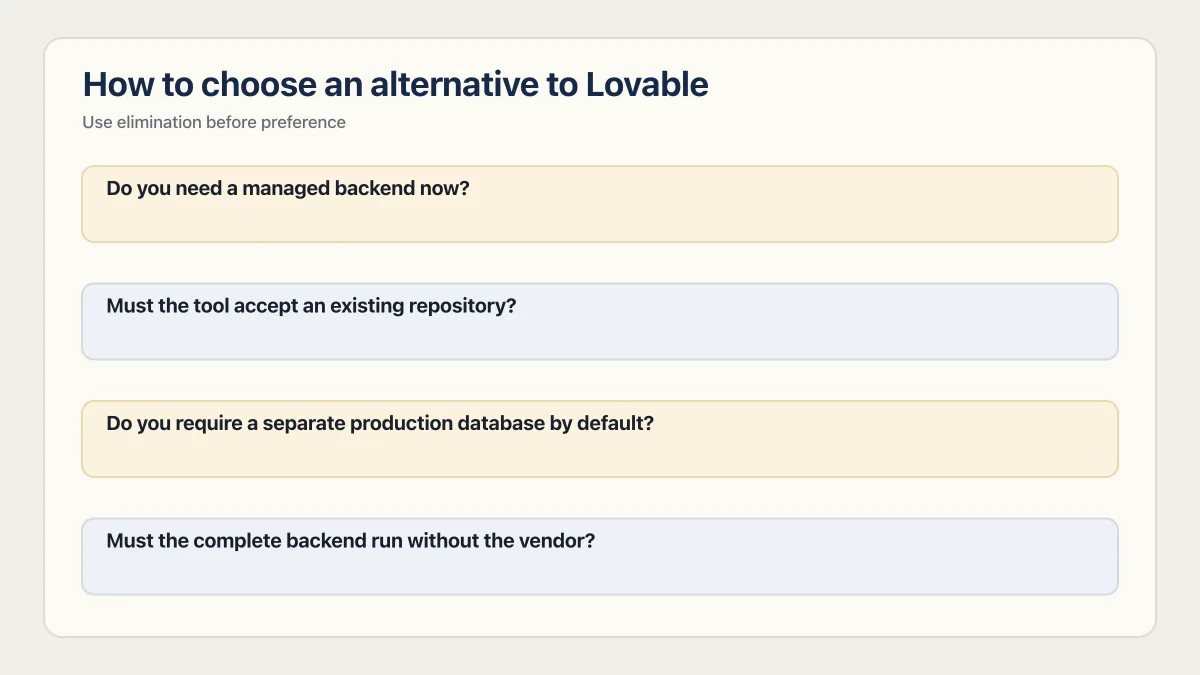
Use elimination before preference. Four questions usually remove most of the list.
- 01 Do you need a managed backend now? Keep Lovable, Bolt.new, Replit, Base44, and the no-code platforms on the list. Cursor, Claude Code, and Dyad supply none, while v0 connects separate providers.
- 02 Must the tool accept an existing repository? Bolt.new, v0, Cursor, and Claude Code document repo-first workflows. Lovable says an existing external GitHub repository cannot be imported as a new project.
- 03 Do you require a separate production database by default? Replit documents that boundary explicitly. Verify the exact environment model yourself for every other candidate.
- 04 Must the complete backend run without the vendor? Inspect code, schema, identity, storage, functions, secrets, scheduled work, and data export separately. A GitHub button answers only the code part.
If one requirement is mandatory, treat it as a disqualifier. That produces a more honest result than assigning arbitrary points to features with different importance for each app.
Lovable: the baseline you may not need to leave
Best for: a founder who wants one vendor to supply the app, the database, the login and the hosting, and who is fine paying for that convenience.
Current Lovable Cloud documentation describes a managed platform with database, authentication, storage, Edge Functions, secrets, logs, and AI. New Cloud projects can be regioned in the Americas, Europe, or Asia Pacific, and Lovable can generate schemas and access policies through its agent. Whether to keep that managed layer or run your own Supabase is the Lovable Cloud vs Supabase decision, settled on its own page.
Code ownership is stronger than a closed visual builder. Lovable’s GitHub documentation describes two-way synchronization on one active branch at a time, with the repository’s default branch selected initially and options to switch or create branches. It also covers local work and deployment outside Lovable, while stating that an existing GitHub repository cannot be imported to start a Lovable project.
Backend portability requires a second reading. Lovable documents self-hosting through the open-source Supabase stack, including migrations, auth, storage, realtime, and functions. Its own guide says a standalone PostgreSQL database is insufficient and that the operator becomes responsible for backups, patches, scaling, monitoring, and incident response. Moving off Lovable Cloud is therefore an infrastructure migration as well as a code export.
Stay when the current app works, the managed stack fits, and the reason for leaving is vague frustration. Move when a documented requirement such as infrastructure control, existing-repository import, provider policy, or production isolation cannot be met without fighting the platform.
Bottom line: most people shopping for a Lovable alternative have a workflow problem, not a platform problem, and switching does not fix that.
Lovable vs Bolt.new
Best for: a builder who wants the same prompt-to-full-stack loop but needs to start from a repository that already exists.
Bolt.new is the closest alternative here for a founder who still wants prompt-to-full-stack development. Bolt’s current database documentation describes Bolt Database with authentication management, server functions, secrets, user management, and storage. Bolt hosting publishes to a .bolt.host domain, with custom domains on paid plans, while Netlify remains optional. The separate Netlify safety guide covers that deployment choice.
Repository handling is a meaningful difference. Bolt’s GitHub documentation says you can import an existing repository, create one from a Bolt project, use branches, and sync valid changes automatically. Bolt does not merge branches inside the app; the current workflow sends that step to GitHub.
Bolt also documents a database security screen and automatic security review during publishing. Treat those as useful detection layers. They do not replace behavioral tests for row ownership, payment state, or route authorization.
Choose Bolt.new over Lovable when existing-repository import or the Bolt hosting and database combination is a deciding requirement. Switching for a general hope that one generator writes safer business rules has no supporting comparison test in this article.
Bolt-specific safety claims deserve deeper testing than a ten-product decision guide can give them, so they are left to a dedicated review.
Bottom line: pick Bolt.new for the repository import, not for a vague promise of better output.
Lovable vs Replit
Best for: a founder who wants a hosted workspace where development data and production data are separate by default.
Replit’s strongest documented difference is its development and production database model. Every current Replit App gets a development database, and publishing creates a separate production database. Agent can change the development database but cannot directly modify production data. Schema changes are still applied at publish time, and Replit warns that destructive or incompatible changes require planning.
That is useful separation with a clear limit. It reduces the chance that ordinary agent experimentation changes live rows, while a bad schema migration can still affect production during a release. Replit also documents isolated deployment previews for testing application and database changes.
Choose Replit when a hosted workspace, integrated deployment, and default development-versus-production data boundary matter more than provider-neutral infrastructure. Before moving, verify the auth model, outbound data path, backup and recovery needs, deployment type, and the Git workflow for your specific project.
This page owns the choice between tools. The condition of an app already running on Replit is a separate examination.
Bottom line: Replit is the only tool here whose documentation puts a wall between your test data and your live data before you ask for one.
Lovable vs v0 by Vercel
Best for: a team that already lives in Next.js, GitHub and pull requests, and wants generation to enter through that door.
v0 by Vercel now fits a repository-first Next.js workflow. Its GitHub documentation says each connected chat receives a branch from main, every code change creates a commit, and v0 opens a pull request rather than pushing directly to main. Once connected, GitHub is the source of truth.
The backend is assembled from integrations. v0’s database documentation lists one-click connections for providers including Neon, Supabase, Upstash, and Vercel Blob. Authentication and ownership rules therefore depend on the provider and the generated application code rather than one v0-wide backend default.
Choose v0 when Next.js, Vercel, pull requests, and an owned GitHub repository match the team’s existing operating model. The tradeoff is explicit technical ownership: framework updates, provider configuration, database policy, tests, monitoring, and rollback remain part of the application.
How those responsibilities play out in one deployed v0 stack is a story for another page; here the scope stays at tool selection.
Bottom line: v0 is the cheapest switch if you already own the repository and the deployment pipeline, and the most expensive one if you do not.
Lovable vs Cursor, Claude Code and Devin Desktop
Best for: a technical owner, or a founder willing to become one, who already controls the repository and wants an agent inside it rather than a platform around it.
Cursor is an editor and coding-agent environment. It does not supply a database, authentication service, or production host. Its 2026 Cloud Agents run in isolated virtual machines, can exercise the changed software, and produce merge-ready pull requests with screenshots, video, and logs. The product provides a code-change workflow inside an engineering system.
Claude Code belongs in the same branch and is the cheapest serious entry point in this whole comparison. It is a terminal agent that works against the repository already on your machine, and Anthropic’s pricing page includes it in Claude Pro at $20 a month, with Max plans from $100 buying 5x or 20x the usage. It bundles no database, no login, and no host, so everything the managed builders hand you stays your job. Two things follow from that. The migration is not a migration, because there is nothing to export. And the honesty is brutal: if the app was never production-ready, a terminal agent will not notice, it will just help you build faster in the same direction.
Windsurf was renamed Devin Desktop on 2 June 2026. Cognition’s announcement describes it as a full IDE with local and cloud agent management. It belongs in the same repo-first branch of this decision, although Cursor and Devin Desktop differ in models, agent orchestration, plans, and integrations.
Choose an editor-based option when a capable technical owner already controls the repository, backend, deployment environments, secrets, observability, and incident response. A founder who wants those decisions handled by the builder will lose most of the convenience that made Lovable attractive.
Cursor’s exposure model depends on local, cloud, and repository settings, questions that sit outside a tool comparison.
Bottom line: these are the strongest options for people who already own their stack, and the weakest for people who wanted the stack handled.
Base44 as a Lovable alternative
Best for: a team building an internal business app where entities, roles, workflows and connectors matter more than portability.
Base44 provides an integrated business-app platform with entities, authentication, functions, agents, connectors, and hosting. Wix has owned it since June 2025, after an acquisition of roughly $80 million in initial consideration plus earn-outs running through 2029. Its current developer documentation is more open than older comparisons often suggest.
Base44’s GitHub integration supports two-way sync on the Builder plan and above, and a locally run frontend still uses a Base44 app ID and backend URL, so owning those files does not automatically create a vendor-independent runtime. Choose it when the integrated entities, workflows and administration are the reason for moving, and prove the exit before committing if future portability is mandatory.
The export question splits this field cleanly. v0 hands you a repository you already control. Base44 hands you code that keeps calling a backend you can’t take with you.
The Base44 safety analysis covers application permissions and platform boundaries without turning the comparison into a universal verdict.
The two-platform head-to-head, including what each export actually contains, is at Base44 vs Lovable.
Bottom line: Base44 is a good platform and a hard exit, so choose it for what it does today rather than for where you might move later.
Free and open-source Lovable alternatives
Best for: someone who wants no subscription, no credit meter, and no vendor holding the code.
Dyad is the answer to “free Lovable alternative” and it is a real one, not a trial. It is an open-source desktop app for macOS and Windows, it runs the build loop on your own machine, and on the free tier you bring your own model API key instead of buying credits. Paid tiers exist (Dyad Pro at $20 a month adds 200 AI credits, Max at $79 adds 900), but the free version is the product, not a crippled preview.
On the four axes, Dyad is the mirror image of Lovable. Backend ownership: nothing is supplied, so whatever database and auth you connect are yours from day one. Environment separation: only what you set up. Repository control: total, because the project stays on your disk, although the code you ask a model about is sent to that model provider with each request. Exit work: none, because there is nothing to exit. The cost of all that is that the operational decisions Lovable makes for you are now yours, and the model bill arrives from your provider rather than from Dyad.
The second free path is self-hosting. Lovable itself documents running the open-source Supabase stack yourself, and its own guide is honest that this makes you responsible for backups, patches, scaling, monitoring, and incident response. That is not free in the sense people mean when they search for free. It is free of subscription and expensive in attention.
Free tiers of the paid tools are a third option, and they are for evaluation rather than production:
| Tool | Free tier (checked August 2026) | What it is good for |
|---|---|---|
| Lovable | 5 build credits a day, up to 30 a month, plus 20 Cloud credits a month | Testing the generation loop and the GitHub sync before paying |
| Bolt.new | 300K tokens a day, 1M a month | One small project, or a serious look at the repo import |
| v0 by Vercel | $5 of monthly credits, 7 messages a day | Checking whether the pull-request workflow fits your team |
| Replit | Starter plan with daily Agent credits and 1 published project | Seeing the development-and-production database split first hand |
| Cursor | Hobby plan with limited Agent requests | Deciding whether you want an editor rather than a builder |
| Base44 | 25 message credits a month | Judging whether the entity model matches your business |
Bottom line: Dyad is the honest answer for free and open source, and every free tier from a managed builder is an evaluation budget, not a plan.
No-code alternatives if you do not want a repository at all
Best for: a founder who is never going to open a code editor and would rather trade portability for that.
Every tool above assumes you eventually care about code. If you do not, the decision changes shape. Four platforms cover this branch, and they differ mostly in where your data lives and whether anything can be taken out.
Bubble runs everything: its own database, its own workflow engine, its own hosting. Pricing meters workload units (page loads, queries, workflow steps) rather than seats, and the Starter plan is $32 a month for web only, $49 for mobile only, and $69 for both. There is no repository and no code export, so the exit is a rebuild. In exchange you get the deepest no-code application model in this list.
Softr is an interface layer over data you already keep somewhere else. It connects to Airtable, Google Sheets, Notion, HubSpot, Postgres, MySQL, Supabase, Xano and generic REST APIs, which makes the exit asymmetric in a useful way: the data was never captive, only the interface is. For an internal tool or a client portal on top of an existing system, that is often the whole requirement.
WeWeb is the portability answer in this group. It is a visual front-end builder that talks to a backend you choose, and its docs put code export and self-hosting on the Essential seat plan and above, with paid seat plans starting at $20 a month. Hosting is a separate plan from seats, which is easy to miss when you budget.
Webflow is the one to pick when the thing you are building is closer to a site than an app. The Basic site plan is $25 a month billed monthly and $15 billed yearly, and code export lives on a paid Workspace plan rather than a Site plan. What the export gives you is HTML, CSS, JavaScript and assets, so you get a front end back, not the CMS and forms running behind it.
The pattern across all four: no-code buys you speed at the front and costs you the most at the exit. That is a fair trade when the app is a tool for a team you control, and a bad one when the app is the business.
Bottom line: Softr and WeWeb leave you the most when you leave, Bubble leaves you the least, and Webflow is only in the conversation if the project is a site.
Which alternatives can build a mobile app
Which builders actually build a store file, tool by tool, is a full comparison of its own, with Lovable’s mobile answer and Base44’s covered per tool.
Bottom line: if a store listing is a requirement rather than a maybe, read the tool-by-tool store comparison first, and the app store account is your job either way.
What the 26-app audit cohort supports
The fixed June to July 2026 AxonBuild cohort contained 26 AI-built apps from several workflows and tools. Twenty-two had at least one confirmed-critical finding, none received a green band, and at least 23 had no working automated tests. The corpus contains no balanced number of apps per builder and was not designed as a head-to-head product test.
My own five production apps are in that cohort. They went through the identical audit and scored 36 to 63, all red, and that stung more than the third-party results did, because I picked my tools knowing exactly what I was looking for.
It therefore cannot establish that Lovable, Bolt.new, Replit, v0, Cursor, Claude Code, or Base44 produces safer apps. It can supply platform-neutral acceptance tests for any choice: two-account access, server-verified payments, route limits, observable failures, a restored backup, and a deployment blocked by a real regression. The AI-built app launch guide owns that full test.
This limitation changes the switching decision. A missing ownership check in a database policy survives an editor change. So does a payment route that trusts the browser. Choose a new tool for a documented product boundary, then test the migrated app as its own system.
Twenty-six apps in the AxonBuild corpus, several generators, scores from 29 to 81 and 22 of them red. Switching builders changes what building feels like. Nothing in that record says it changes the score.
Should you switch from Lovable?
Switch when a required capability or ownership boundary is unavailable, too expensive, or too difficult to operate in the current setup. Good reasons include importing an established repository, requiring default production-data separation, standardizing on a Next.js and pull-request workflow, or controlling the backend infrastructure directly.
Do not start with a rewrite when the actual problem is unmeasured credit use, one missing control, or uncertainty about what the export contains. Lovable credit costs separates build credits from deployed usage. Exporting a Lovable database covers the data path. Lovable production readiness keeps a platform decision separate from the condition of the app already running on it.
Before moving, produce a one-page exit inventory:
- 01 Source repository and branch history
- 02 Database schema, data, roles, policies, and extensions
- 03 Users, identity providers, sessions, and password migration limits
- 04 Files and storage access rules
- 05 Server functions, schedules, webhooks, secrets, and provider accounts
- 06 Domains, email, analytics, logs, and rollback
- 07 A test for each business-critical workflow before and after migration
The winning alternative is the one that meets the non-negotiable boundary with an exit cost you understand.
Common questions about Lovable alternatives
Is there anything better than Lovable?
Yes, for specific constraints. Replit documents separate development and production databases plus a native mobile path. v0, Cursor and Claude Code fit repository-first workflows. Bolt.new can import an existing GitHub repository while retaining a hosted builder, Dyad is free and runs locally, and Bubble covers people who want no repository at all. Lovable remains a strong fit when its managed Cloud stack and two-way GitHub sync meet the requirement.
Is there a free version of Lovable?
Yes. Lovable’s free tier grants 5 build credits a day, capped at 30 a month, plus 20 Cloud credits a month for hosting and backend use, checked August 2026. Unused daily grants do not roll over, so the free tier suits evaluation and small experiments rather than continuous building. Paid plans start at $25 a month.
What is the best free Lovable alternative?
Dyad. It is open source, runs as a desktop app on your own machine, and works on the free tier with your own model API key instead of a credit balance, so no builder holds your project, although the code you include in a prompt is sent to the model provider you chose. The trade is that Dyad supplies no database, no authentication and no hosting, so you assemble and operate that part yourself. Every other free option here is an evaluation tier on a paid product.
Is there an open-source Lovable alternative?
Dyad is the open-source builder in this comparison: local-first, community-developed, and free to run with your own API key. On the backend side, Lovable documents self-hosting the open-source Supabase stack, which gives you an open replacement for the database, auth, storage and functions layer. Both routes trade a subscription for operational work you now own, including backups, patching and monitoring.
Which is cheaper, Bolt.new or Lovable?
Their entry paid plans are the same price, $25 a month each as of August 2026, so the answer depends on what you burn. Bolt meters tokens, with 10M a month on Pro and unused tokens rolling over. Lovable uses one credit balance for Build and deployed Run usage, although some workspaces still see its older balance layout during rollout. Heavy editing over large files favors Bolt’s rollover, and a small app with steady hosting usually favours Lovable’s bundle. Their free tiers differ too: Bolt gives 300K tokens a day, Lovable gives 5 build credits a day.
Is Lovable worth paying for?
It is worth paying for if the managed backend is doing work you would otherwise do yourself, and it is not if you already own a repository, a database and a host. At $25 a month, the subscription is rarely the real cost. The real cost is what the exit looks like later, because moving off Lovable Cloud is an infrastructure migration and not just a code export.
Which Lovable alternative is best for non-technical users?
Bubble if you never intend to touch code and can accept that leaving later means a rebuild, Softr if the data already lives in Airtable, Sheets, Postgres or a similar system you control. Both remove the repository from the decision entirely, which is the actual blocker for most non-technical founders. The cost is portability: Bubble in particular has no code export, so leaving means rebuilding.
Which Lovable alternatives can build mobile apps?
Replit, Bubble, Base44 and Bolt.new. Replit and Bolt.new document Expo-based paths to iOS and Android stores, Bubble sells mobile publishing as a plan tier that covers TestFlight and Google Play, and Base44 builds store files around a published app as a web view. Lovable, v0, WeWeb and Webflow produce web apps that need a separate native wrapper for a store listing. In every case you still need the relevant developer account and must complete the store review.
Which is better, Cursor, Devin Desktop, or Lovable?
Cursor and Devin Desktop fit teams that already own the repository and technical stack, and Claude Code sits in the same branch at $20 a month. Lovable fits builders who want the platform to supply more of the backend and hosting. The deciding question is whether you want an agent inside your engineering system or a managed system around the app.
Does switching builders make an app production-ready?
No. A migration can improve repository control, environment separation, or infrastructure ownership. The migrated application’s authorization, payments, rate limits, recovery, errors, tests, and deployment gate still need direct verification.
Thinking about moving off the platform?
I check what has to move, what can stay, and what breaks on the way. You get a plain answer and a fixed quote if you want it done.
Talk about your app →  Free 20-minute video call with me.