Lovable at lovable.dev turns a typed description into a running web application, and this page is about that product rather than the ordinary English word. The phrase that puts the ordinary word in front of the word product means something else entirely, and it has its own page.
Lovable is a full-stack AI development platform, in its own words: it builds and hosts a web app from a typed description. What comes back is a project inside a shared workspace, a codebase that syncs to GitHub or GitLab, and a published snapshot Lovable serves until you publish again.
Everything about the product on this page comes from Lovable’s own documentation and changelog, opened and dated on 2 September 2026, with the page each fact came from named beside it. The people quoted are builders describing their own projects in their own words. The questions that have their own pages here are linked rather than answered a second time. Ratings sites and scored reviews that rank alongside this page are named where they matter and are used as evidence about the search results, never as evidence about the product. No account was opened and nothing here describes what using Lovable feels like.
That last sentence matters more than it looks, because of what the search results for this question contain. Five of the eight organic results on the definitional query are Lovable’s own properties or a reference entry about the company: two app-store listings, the documentation, the company profile, the encyclopedia entry. The three editorial slots belong to nocode.mba, which sells courses, to uibakery.io, which sells an internal-tools builder, and to a personal blog at mikelundahl.com published in April 2025. Widen the query to the review phrasing and the whole page turns into scored verdicts, with the ratings aggregator trustpilot.com holding the top organic slot. Every one of those pages was published or last updated between April 2025 and August 2026. Lovable’s changelog moved on 21 separate days in August 2026 alone. So the useful thing to publish here is a dated record of what the product is now, and a map of where the questions that follow are already answered.
What Lovable at lovable.dev is
Lovable’s documentation home opens with its own definition, and it is worth reading closely because it claims four things at once. Read on 2 September 2026, the welcome page says Lovable is “a full-stack AI development platform for building, iterating on, and deploying web applications using natural language, with real code, security, and enterprise governance”. The next line narrows it to who it is aimed at: “Lovable lets individuals and teams build production-grade web applications using natural language.”
Underneath the marketing register there is a concrete product shape, and it comes down to three words the documentation says come up everywhere.
| Term | What Lovable’s welcome page says it is |
|---|---|
| Account | Your personal identity, used across every workspace you belong to |
| Workspace | Where a team works. It holds projects, members, billing, and a shared pool of credits |
| Project | One app, holding its chat, preview, code, and version history, in exactly one workspace |
That structure is the answer to what Lovable dev projects are, and it explains a thing people get wrong when they first arrive. Applications are built inside shared workspaces, “where a group of people builds from one plan and a shared pool of credits, each working on one or more of their own projects”. Billing sits on the workspace, not on the app. The welcome page states the same thing from the other end: “You can start for free, and plans are priced by credits, not by projects or seats.” Read against that sentence, a second app draws on the same pool rather than opening a second bill.
The output is the part that decides everything later. Lovable’s welcome page says each project “represents a single application and produces a codebase that can be synced to GitHub or GitLab with Git sync and integrated into existing engineering workflows”. Two things follow from that sentence. The code exists as ordinary repository files rather than as rows in a builder’s database, and Git sync is the door it comes out of. Whether a builder can produce the particular app you have in mind, sorted by what the app itself demands of it, is answered on the can-it-build-it page.
The welcome page also sets out the loop the product is built around, and it reads as four steps rather than as a feature list. Describe what you want built. Review the result and iterate on it. Publish it to a live address. Then, when you want the code in your own pipeline, sync it to GitHub or GitLab and deploy, operate and govern it to your own standards. That fourth step is optional and most people never take it, which is the whole reason the ownership question comes up later rather than at the start.
The last piece of the definition is newer than most explainers on this search. Lovable no longer lives only in a browser tab. The welcome page, read the same day, says it “also works beyond the browser: build from the desktop app or the mobile app, chat with Lovable in Slack or Telegram, start projects from ChatGPT, and drive Lovable from your own AI tools with the Lovable MCP server”. Lovable’s changelog dates its ChatGPT app to 23 December 2025, its desktop app to 24 April 2026, its mobile app and its MCP server to 18 May 2026, and its Slack presence to 26 August 2026, so anything written about Lovable before December 2025 describes a product with none of those five.
So what Lovable dev is, stated plainly: a place where you describe an app in chat, watch it appear, and end up with a repository and a live address, with the meter running against a workspace balance rather than against a project.
What happens when you publish, and what Lovable is holding
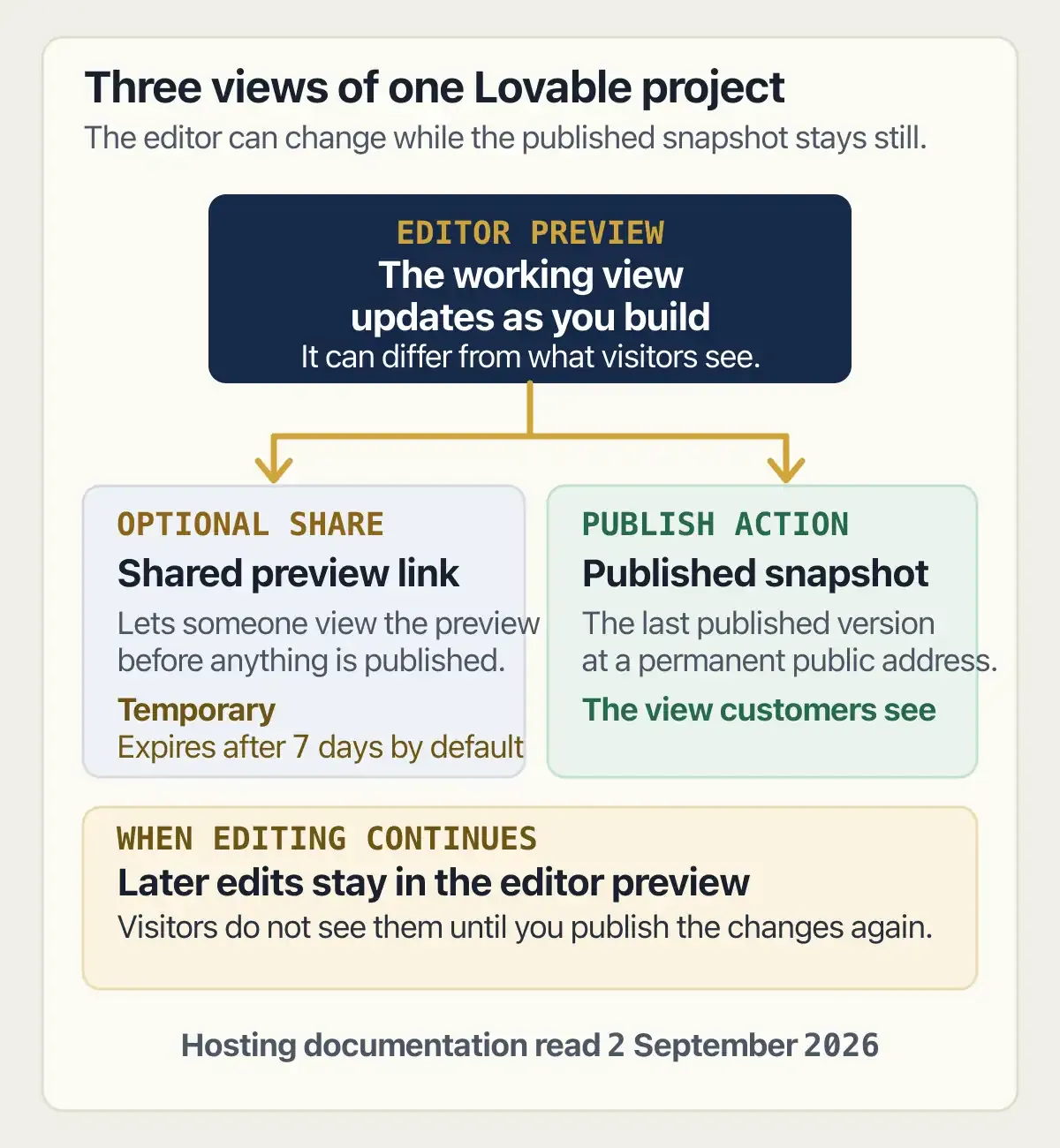
The moment that confuses people is publishing, because the word does less than it sounds like it does. Lovable’s hosting page, read 2 September 2026, is direct about it: “Publishing takes a snapshot of your project and puts it live.” The live site is that snapshot and nothing more. Keep building afterwards and visitors see none of the frontend changes until you open the publish dialog and publish again; changes to the shared backend, its schema, data and functions, take effect where they are made, whether or not you publish. Two people can therefore be looking at the same Lovable project and describing two different applications, one in the editor and one on the internet, and both of them are right.
What the publish step hands over is a public address with HTTPS already arranged. The same page splits the addresses by plan without touching the money: “Publishing to a lovable.app URL is free and available on all plans. Custom domains require a paid plan, and branded workspace URLs are available on Business and Enterprise plans.” That is a gate on which address you get, not on whether the app runs.
Where the app runs is worth separating from where its data sits, because the hosting page separates them and almost nothing else does. Published apps are served from locations around the world. The region setting is a different control: it decides where the built-in backend keeps its database and storage, and the page states that it “does not restrict where your site itself is delivered: the frontend is always served globally”. So a project regioned for its data is not a project served from one place.
There is a third view of the same app that the documentation is careful to separate from both. The preview inside the editor is the working view, it updates as you build, and the hosting page states plainly that it can differ from what visitors see on the published site. Links to that preview can be shared with somebody before anything is published, and the same page, read 2 September 2026, says those links expire after 7 days by default. Neither the preview nor a shared link is hosting. Only publishing puts the app on a permanent public address. Three views of one project, then, and only one of them is the thing a customer ever sees.
One mechanism belongs here because people assume the opposite. The hosting page states that “A live site does not consume credits on its own”, and puts the meter on the work the app does while running, such as backend activity and AI calls. That is a statement about what is counted, not a statement about what anything costs. What a credit buys, what the meter counts as building against running, and what a spike usually turns out to be, are kept current on the page that tracks Lovable’s credit model.
What the documentation says you keep, and where its own pages disagree
This is the section the explainers on this search do not have, and it exists because two pages of Lovable’s own documentation describe the same applications differently. Both were read on 2 September 2026 and both are quoted as they stand.
Lovable’s ownership page, under a heading about the platform being built on open source technologies, states: “Applications are standard Vite + React projects that can run on major cloud providers (AWS, GCP, Azure), managed hosting platforms, or self-hosted infrastructure. No proprietary frameworks, no hidden dependencies.” The page repeats the Vite and React description a second time further down, in its compatibility section, when it lists the infrastructure a frontend can be deployed to.
Lovable’s hosting page, read the same day, sorts the same applications by the date each one was created. Anything made from 13 May 2026 renders on the server for everybody who asks for a page. Anything older is rendered that way only for the crawlers the platform recognises, and not for ordinary visitors. The page then offers a way out of the older shape: “You can upgrade an older project to TanStack Start to get server-side rendering for every visitor.”
One page says every Lovable application is a standard Vite and React project. Another says apps built since May run on TanStack Start, which is itself a React framework on Vite, so the two descriptions differ on the runtime rather than the stack: an older project is a static frontend, a newer one renders on a server. Both were read on 2 September 2026.
The ownership page does not mention TanStack Start or server-side rendering anywhere in its body copy, checked against the raw HTML of that page on 2 September 2026. Both phrases do appear in that file, but only inside the site-wide search payload every page on the documentation site carries, which describes other pages. That is a documented absence in the body copy of one named page, not a claim about the whole documentation site, and it is exactly why the two descriptions can sit side by side without either one being retracted.
Why a reader should care, in one paragraph. The two stacks are not interchangeable once the app leaves the builder. A build that renders in the browser and a build that renders on the server want different hosts, different build commands and different assumptions about what a crawler sees. Somebody reading the ownership page alone, deciding they will move the frontend to a static host later, could be reading about a project shape they do not have. The fix is small and boring: check which of the two a given project actually is before planning anything around it, and check it against the project rather than against a page.
The rest of the ownership question splits cleanly into two other subjects. Whether to keep the built-in backend or run your own database is a decision with its own page. What arrives when each builder hands the code over, item by item, is compared on the export page.
One more thing the ownership page states, and it is the honest half of the no-lock-in argument. Under a heading about what changes if you stop using Lovable entirely, it lists eight areas that become the owner’s responsibility, among them development environments, release pipelines, production infrastructure and certificates, databases and backups, authentication and data isolation, OAuth flows and secrets, AI provider accounts, and security monitoring. The page calls that the operational boundary of moving off a fully managed platform. Read the other way round, the same list describes the managed infrastructure the subscription covers while you stay; the parts of it that are your configuration or your application’s own behaviour, data isolation rules, OAuth secrets and what gets monitored, are still yours to set up correctly on the platform.
What changed in 2026 that the ranking explainers were written before
Lovable’s changelog is the fastest-moving page in this whole subject. Read on 2 September 2026, its most recent entry is dated 31 August 2026, and August 2026 carries entries on 21 separate days. Anyone assessing Lovable dev history from an article published last year is assessing a product that has since grown a Slack presence, a GitLab connector, a goal command and custom connectors.
Six entries from 25 to 31 August 2026, quoted as the changelog states them:
| Changelog date | What the entry records | What it changes for somebody deciding |
|---|---|---|
| 25 August 2026 | ”Enterprise audit logs now record which app each action came from: Web, Desktop app, iOS app, or Android app.” | The product is now used from four clients |
| 26 August 2026 | ”Lovable now works on every build message for up to 10 hours before it wraps up, so a large task is more likely to finish in a single message.” | A build is no longer a short turn you supervise |
| 26 August 2026 | ”You can now chat with Lovable without leaving Slack.” Work happens in the same workspace, with the same projects under the same permissions | The tool reaches people who never open the editor |
| 28 August 2026 | ”You can now connect your Lovable app to GitLab API to list projects, branches, commits, and repository files, create and update issues and merge requests, and read pipelines” | Apps can now be built against a second Git host |
| 30 August 2026 | Type /goal at the start of a build message and Lovable “works on that one message until the goal is achieved, for up to 10 hours, without pausing to ask you questions” | Unattended work becomes a named feature |
| 31 August 2026 | Workspace admins and owners “on any plan” can now build their own connector by describing an API: where its requests go and how it expects credentials | Integration stops being a fixed catalogue |
The Slack entry deserves one more line, because it is the change most likely to alter who touches a project. The changelog says a workspace admin connects Slack once, that teammates are recognised automatically the first time they talk to it, and that the integration is available on Free, Pro and Business plans. Work started in Slack continues in Lovable, on the same projects, under the same permissions, and messages draw on the workspace balance counted against whoever sent them. A tool that used to require opening an editor now answers a mention in a channel.
Read those together and the direction is obvious. Lovable spent August making the tool work for longer without a person in front of it, and making it reachable from places that are not the editor. What the build mode decides on its own once you set it going is the feature page’s subject.
That pace is not universally welcome, which is worth saying on a page that otherwise reads the vendor’s own words. One thread on the subject in August was titled “Lovable on the decline? Why are they changing so much for the worse”. Nothing here settles whether that is right. It records that the rate of change is itself a thing people react to, and that a product moving on 21 days in one month will produce that reaction whatever the changes are.
The oldest of the editorial results Google returns for this search describes a product with no desktop client, no mobile client, no Slack, no GitLab, no goal command and no custom connectors. Each of those articles is accurate about the version it described, which is not this one.
What the people who have lived with it say
Documentation says what a product is meant to do. It does not say what living with it for a long time feels like, and the corpus behind this site has voices on both halves.
One builder said both halves of it out loud: that it is very good at getting a first interface and a first version in front of you, and that the code it writes gets things wrong often enough to be worth saying plainly. That pairing turns up constantly, and it is a more useful summary than any score, because it tells you which part of the job to check rather than how many stars to expect.
Somebody else, setting up their own comparison among people who had stayed with the tool, drew a line about who counted before they would listen to any answer:
So I am putting an arbitrary minimum baseline of 5,000 tokens used, so people creating apps and landing pages for 100 tokens are not included. I want to hear from people who have been using Lovable for months, not days.
That is a builder doing, in a forum thread, the thing every ranking review skips. The opening days with an AI builder are evidence about the demo. Everything after that is evidence about the product, and it lives with the people who stayed.
Which leads to the question most people are really carrying when they read about a builder at all, put here by somebody weighing an AI route against an ordinary website builder rather than naming Lovable:
I’ve tried playing around with both and the AI route is obviously much faster, but I’m wondering whether flexibility and control becomes an issue once you’ve been running the site for 6-12 months.
This page does not answer that. Whether the reason to leave is a real trigger or a bad week is settled by the five triggers on the moving-off page.
Who Lovable’s own documentation says it is for, and what that list cannot settle
The welcome page carries an audience list, and it is a vendor claim rather than a finding. Read on 2 September 2026, it names four groups: individual builders, which it breaks into founders launching first products, students and educators, and independent makers; product, design and go-to-market teams, meaning product managers building prototypes, designers moving past static mockups, and marketers building landing pages and campaign sites; technical teams and agencies, including engineering teams reviewing and extending generated code through GitHub or GitLab; and enterprises building internal tools and business-critical applications with compliance requirements. The same page lists what it says you can build with it, from subscription products and dashboards to marketplaces, internal tools, marketing sites, educational tools and simple web games.
The same page states four reasons it thinks people pick it, and they are worth reading as claims rather than as findings: faster iteration, meaning moving from an idea to working software through natural language instead of a blank codebase; collaboration when it is wanted, through shared workspaces; code ownership and flexibility, meaning keeping the code and fitting it into workflows that already exist; and enterprise needs built in from the start. Three of those four are checkable against the documentation on this page. The fourth is a judgement about a particular organisation and its own requirements.
Alongside that list the welcome page names its certifications and standards: SOC 2 Type II, ISO 27001:2022, AIUC-1, which it describes as the security, safety and reliability standard for AI agents, and GDPR compliance.
One person in the corpus described running a single shared internal tool built entirely inside the builder for a large group of colleagues, and being the only person looking after it. That is one account rather than a pattern, and it is the kind of thing an audience list cannot capture in either direction.
Here is the limit worth being blunt about. An audience list is a statement about who a product is aimed at. It settles nothing about whether one particular app, built by one particular person, is ready for strangers to use unsupervised. Those are different questions with different evidence, and the second one is answered by behaviour rather than by a documentation page. The behavioural tests a published app has to pass before strangers use it are set out on the readiness page.
Where every other Lovable question is answered
This page is the product record. Every question that follows from it already has a page here, and none of them is answered twice.
On money and metering. What a credit buys and what the meter counts are on the credit page linked above. How much you get before paying anything, and which of the paid-only features stop you first, are counted on the free-plan page.
On condition and repair. Telling the four kinds of broken apart, and knowing which of them the builder can still fix, belongs to the repair page. Readiness and safety are linked in their own sections above.
On leaving and choosing. Which tool to use instead, and the four questions that eliminate most of the field before preference gets involved, are worked through on the alternatives page. The head-to-head against the nearest platform, decided on what each one’s export actually contains, has its own page. What the exit costs once the code is already out is followed on the migration-cost page.
On people. There comes a point in most projects where the next piece of work needs somebody who writes code for a living, and the thing that decides what that costs is the state of the app rather than the name of the builder that produced it. What somebody charges to take a Lovable app the rest of the way, and which gates decide that figure, is worked out on the hiring-cost page.
Common questions about Lovable
Is the Lovable app legit?
Yes, in the plain sense of the question. Lovable is a real company with a real product, a public documentation site, app-store listings, an encyclopedia entry, and a named set of certifications on its own welcome page as of 2 September 2026: SOC 2 Type II, ISO 27001:2022, AIUC-1 and GDPR compliance. Nothing about the company is in doubt.
The question people usually mean underneath it is whether an app built with it is safe to put in front of customers, and it is settled by different evidence. What the platform’s own controls cover, and what your app’s access rules still decide on their own, are separated on the safety page.
How reliable is Lovable dev?
Reliability splits into the platform and your app, and only the first has published evidence. Lovable’s hosting page states that published apps are served from locations around the world, that plans do not cap visitors, requests or bandwidth, and that running out of credits stops building without removing the published site. Whether your particular app stays up under real use is decided by its own code and its own backend, not by the hosting.
What is Lovable AI best used for?
The vendor’s own pages name prototypes a team can click through, internal tools, landing and campaign pages, dashboards and first versions of subscription products among what it is for. One of the builders this page draws on describes using it for that kind of work, and reports the pairing a list of uses leaves out: the first interface arrives quickly, and the code underneath it comes back with mistakes in it.
What can you build with Lovable?
Lovable’s welcome page, read 2 September 2026, lists seven categories: SaaS and business applications, consumer-facing web applications, marketplaces and online commerce, internal tools, websites and marketing pages, educational tools, and simple web-based games and interactive content. That is the vendor’s own list of what the product supports.
Whether your specific idea sits inside that list is a narrower question, and the things that settle it are the demands the app itself makes rather than the name on the builder.
What are the limitations of Lovable AI?
The documented ones are the ones worth planning around. The published site is a snapshot that does not update until you publish again. Its built-in backend keeps data in one chosen region while the frontend is served globally. And the same documentation describes applications two different ways depending on which page you read, which means the shape of the code you get out depends on when the project was created.
Does Lovable AI have a limit?
There are limits, and as of 2 September 2026 the interesting ones are about time rather than traffic. The changelog entry dated 26 August 2026 says Lovable works on a build message for up to 10 hours before it wraps up, and the goal feature added on 30 August 2026 runs to the same ceiling. On the other side, the hosting page states that your plan does not cap visitors, requests or bandwidth.
What are the disadvantages of using Lovable?
The ones builders raise themselves, rather than the ones a documentation page would list, cluster around two things: code quality underneath a good-looking first version, and the pace of change. Builders describe the generated code getting things wrong often enough to matter, and a public thread in August 2026 asked whether the product was declining because of how much was changing. Neither of those is a verdict, and both are things the people who stayed keep raising.
What are the pros and cons of Lovable?
Set what the vendor commits to against what stays yours and the shape is clear. Lovable commits to generating the app, hosting it with HTTPS, serving it globally, syncing the code to GitHub or GitLab, and running the built-in backend. What stays yours is everything the documentation lists under stopping: environments, pipelines, infrastructure and certificates, databases and backups, authentication and data isolation, secrets, AI provider accounts, and monitoring.
What is Lovable Cloud?
Lovable Cloud is the built-in backend a project can use: the database, authentication, storage and functions that the app’s pages talk to. Lovable’s hosting page separates it from hosting deliberately, noting that every published app is hosted whether or not it uses a backend, and that pausing the backend affects the app’s data and logic rather than the serving of its pages.
If you have a working app built with these tools and need it ready for real customers, this is what we do.
Built it with AI. Now it has to hold up for real customers.
The Production Hardening Sprint takes the app you already have and builds the production foundation underneath it. Authentication and access rules, payments that stay consistent, error handling, monitoring, backups, automated tests and a documented handover. Our engineers work inside your existing codebase for ten working days. All 123 deliverables are included, and you get the evidence for each one.
See the Production Hardening Sprint →  $2,500 fixed price · 10 working days · One codebase