Base44, the Wix-owned AI app builder (not to be confused with Base64, the text encoding), is safe at the platform level: SOC 2 Type II and ISO 27001 certification, encryption at rest and in transit, row-level data permissions, secrets management, security scanning, and a bug bounty program. Its public incident record also includes serious authorization flaws that Base44 and Wix patched after responsible disclosure.
Is Base44 safe? The short answer
- The platform is safe in the way a certification reviewer means it. SOC 2 Type II and ISO 27001, encryption at rest and in transit, penetration testing on OWASP methodologies, and an invite-only bug bounty program.
- Your app is a separate question, and no Base44 control answers it. Table permissions, backend functions, and integrations are yours to configure. The two-account test below is how you settle it in about an hour.
- The complaints examined below are about credits, not breaches. They describe credits that do not roll over and a stuck app that keeps spending them. That is a cost problem, not verified breach evidence, and it has its own section below.
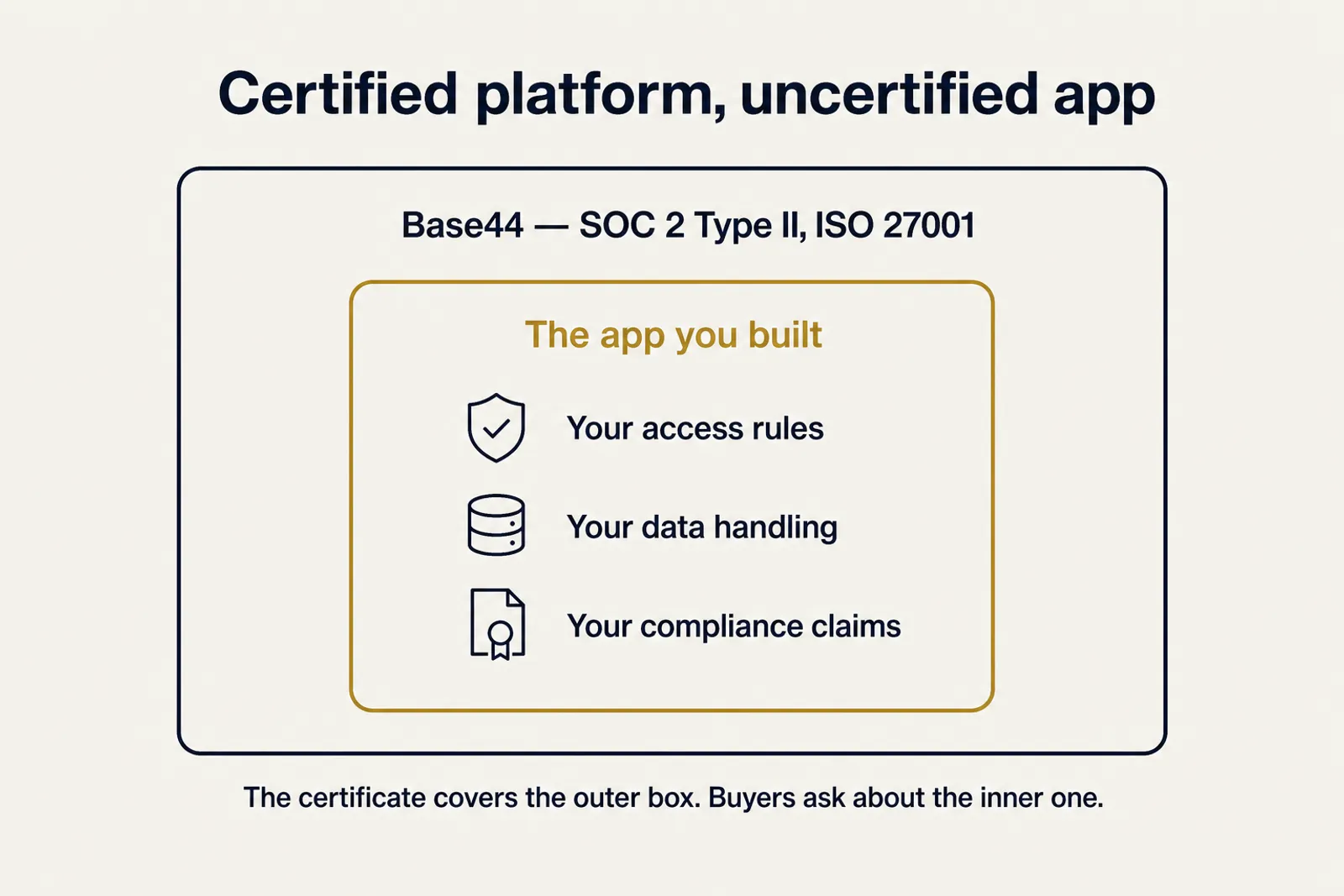
That evidence supports a qualified answer. Base44 is a legitimate platform with real security controls. It cannot establish that an app built on Base44 has correct permissions, safe integrations, or adequate operational controls. Base44’s own security overview makes the same boundary explicit: the platform provides the tools, while the app owner remains responsible for reviewing permissions and running the security scan before publishing.
No Base44 app appears in the fixed June–July 2026 AxonBuild audit cohort. The corpus numbers below describe failure classes found in apps built with other AI-assisted tools. They are useful as a test plan, not a Base44 breach rate.
Is Base44 legit? The security reading
Yes. Base44 is a legitimate AI app builder owned by Wix, with published documentation, a security trust center, third-party certifications, and an active security program. Wix’s own acquisition announcement puts the deal at initial consideration of about $80 million plus earn-out payments through 2029, and Base44 now runs with the security infrastructure Wix brought along. The current Base44 trust center lists SOC 2 Type II and ISO 27001 certification, granular CRUD permissions, data encryption, internal and third-party penetration testing based on OWASP methodologies, and a responsible-disclosure program.
Certifications describe the design and operation of Base44’s own control environment. They do not certify each customer’s app or guarantee that a table contains the right read, update, and delete rules. Base44’s compliance scope owns the detailed SOC 2, GDPR, data-residency, and HIPAA questions.
That is legitimacy in the narrow security sense: a real company, real controls, a real disclosure channel. The other thing people mean by “is Base44 legit” is whether the product delivers what it advertises and whether the money buys a working app, and that is a review question rather than a security one. This page stays on the first reading. The full review of what Base44 actually produces is a separate piece of work.
What security problems has Base44 had?
Base44’s disclosed security history is two vulnerability reports from 2025, one from Imperva in March and one from Wiz in July. Both were fixed before the researchers published, the Wiz-reported registration bypass within 24 hours, and Wiz independently verified that fix.
Both show why the platform and app layers need separate evidence:
| Disclosure | What the original research established |
|---|---|
| Imperva, reported March 2025 | Four platform flaws included token exposure through an open redirect, stored XSS on a trusted Base44 origin, a JWT passed to user apps in the URL, and premium features enforced in the client |
| Imperva, remediation March–April 2025 | Base44 deployed fixes and architectural changes before Imperva's August public disclosure |
| Wiz, reported July 9, 2025 | Registration and OTP verification endpoints accepted a public app ID, allowing a verified account to be created for private SSO-only apps |
| Wiz, fix verified July 10, 2025 | Base44 and Wix fixed the registration bypass within 24 hours; Wix reported no evidence of prior abuse, and Wiz independently verified the fix |
Read the Imperva findings as a chain, not a list. Premium features were enforced only in the browser, which let an attacker unlock the ability to change app code, run their own JavaScript on a trusted Base44 origin, and turn a UI-level shortcut into a full account takeover. A check that lives only in the rendered page is not a check, and that is the part worth carrying into your own app.
Imperva’s own writeup, published in August 2025 once fixes had landed, says Base44 fixed the four issues before publication. Wiz’s disclosure says the affected platform path is resolved and requires no customer-side patch for that specific flaw. It recommends reviewing app analytics for unfamiliar visits or registrations before the fix. The old incidents remain relevant history, while current safety decisions should use current controls and an app-specific test.
A separate editor-side authorization regression affected public Lovable project code and chat history in April 2026. The Lovable incident record owns that scope and response rather than serving as evidence about Base44. The pattern reaches past any one vendor: the same certified-platform, unverified-app split runs through whether Lovable is safe too.
Is Base44 a scam? What the complaints are actually about
No. Base44 is a real product owned by Wix. One Reddit thread calls Base44 “a scam to make you buy credits.” The Base44 Trustpilot profile carried 835 reviews when checked August 17, 2026. These are user complaints, not verified breach evidence. Read them as such.
Base44 meters two separate things. Message credits are spent when you prompt the editor to build or change the app. Integration credits are spent when your published app performs a paid action, such as sending an email or calling a model. Unused credits do not carry into the next cycle on any plan.
| Plan | Monthly | Annual, per month | Message credits/mo | Integration credits/mo |
|---|---|---|---|---|
| Free | $0 | $0 | 25 | 100 |
| Starter | $20 | $16 | 100 | 2,000 |
| Builder | $50 | $40 | 250 | 10,000 |
| Pro | $100 | $80 | 500 | 20,000 |
| Elite | $200 | $160 | 1,200 | 50,000 |
Prices and both credit columns come from Base44’s own cost explainer, checked 5 August 2026. Annual billing is a flat 20 percent off.
That structure is what the scam accusation is really about. A bug the AI cannot fix costs message credits every time you ask again, so an app that is stuck keeps charging you while it stays broken, and nothing rolls over at the end of the month to soften it. Base44 pricing, plan by plan, works through the credit arithmetic in full.
Refunds are where that argument gets sharpest, and Base44’s own Terms of Service answer it directly. Credits can be spent even when the platform or the output it generates does not meet expectations, and section 10.4 says credits burned that way “will not be restored, re-credited, or refunded.” Section 10.1 makes the fees themselves “non-cancelable and non-refundable” unless local law says otherwise, and section 11.2 applies the same rule to renewal charges once a renewal term begins. Canceling means switching off auto-renewal, and it takes effect at the end of the term already paid for. The section carrying all this is called “Fees and Chargebacks” and it treats a card dispute as a breach of contract: a decline or chargeback means “your use of the Platform may be automatically disabled or terminated,” and coming back means resubscribing, clearing the fees owed, and covering the chargeback’s processing costs. Read that before the annual plan, not after. Checked against Base44’s Terms of Service on 16 August 2026.
A related question lands here in a different shape: what happened to Base44? Two things, and neither was a shutdown. Wix acquired the company in June 2025, roughly six months after launch. Imperva published four platform vulnerabilities in August 2025, after Base44 had already fixed them. The product is still shipping under Wix ownership, which is why the complaint mass is about billing rather than about a company that disappeared.
Keep the two meanings of safe apart. A billing model you dislike is not a security risk. A clean invoice is not evidence your permissions are correct. Everything below is about the second one.
What Base44 currently secures
Base44’s current product is more capable than a simple hosted frontend. It provides authentication, data entities, backend functions, secrets, integrations, hosting, logs, and access controls. Its security scan is available on every plan and reports six issue types:
- data tables with missing or overly broad permissions;
- credentials placed where app visitors could find them;
- backend paths that return data without verifying login;
- packages with known vulnerabilities;
- exploitable patterns in app code;
- missing browser security headers.
Code vulnerability scanning is limited to Builder plans and above, and a workspace can connect its own Wiz tenant for additional SCA and SAST findings. The scan shows recommendations but does not apply them automatically. Base44 tells owners to review each proposed change and rerun the scan after adding tables, changing permissions, or connecting integrations.
The trust center also runs a bug bounty program, and its shape is worth knowing before you count on it. It is invite-only: researchers ask for an invitation by email, submissions go through Wix’s bug bounty address rather than a public platform, and Base44 says its security team reviews and validates every report, then prioritizes confirmed vulnerabilities by severity and fixes them. As of 16 August 2026 the page names no reward amounts, so read it as a staffed disclosure channel rather than a public paid program. Both 2025 disclosures above arrived that way, through researchers who went to the vendor first and published after the fixes landed.
The same current documentation names limits that matter for higher-risk apps:
- Tokens sit in browser
localStorage, and HttpOnly cookies are not available. - There is no per-app CORS configuration; Base44 manages CORS at the platform layer.
- Content Security Policy and HSTS have no app-level control; those headers are not yours to set.
X-Frame-OptionsandPermissions-Policycan be enabled through the scan, which is the header control you do get.- The visual dashboard permission editor applies rules to whole entities, while the developer Backend entity-schema surface separately documents field-level read and write rules.
- Public endpoints are rate-limited by default, per Base44’s documentation. Endpoints your own backend functions add are a separate question.
These constraints are not proof that an app is exploitable, but they belong in a threat-model decision involving sensitive data or strict browser and session controls.
| Base44 control | App decision that still needs verification |
|---|---|
| SOC 2 Type II, ISO 27001, encryption, platform access controls | Whether your data classification, retention, admin access, and contractual requirements fit the platform and selected plan |
| Automatic data permissions plus editable CRUD rules | Whether each table rule matches the users, roles, tenants, and actions in your actual business model |
| Security scan for permission gaps, credentials, login checks, packages, and headers | Whether a permitted user can change an object ID and reach another user’s record through a valid-looking request |
| Encrypted secrets and backend integrations | Whether every third-party call stays in a backend function and applies authorization, validation, rate limits, and cost controls |
Which security features come with which Base44 plan
| Security capability | Where it is available |
|---|---|
| Security scan for permissions, exposed credentials, unauthenticated endpoints, packages, and headers | Every plan, including Free |
| Code vulnerability scanning | Builder plan and above |
| ZIP export and two-way GitHub sync | Builder plan and above |
| Extra SCA and SAST findings from a connected Wiz tenant | Requires your own Wiz tenant |
| IP allowlist, customer-managed SSO IdPs, Application Security Center | Enterprise governance controls |
Scan tiers come from Base44’s security scan documentation and the enterprise control names from the Base44 trust center, both checked 5 August 2026. No competing review of Base44 publishes this breakdown, which matters because the plan you pick decides how much of the checking is automated for you.
Base44 data security: who touches your data
Base44 publishes its subprocessor list, which is the part of a vendor review most people cannot find. The trust center names MongoDB, SendGrid, Render, Google Cloud, OpenAI, Anthropic, Wix, Datadog, Langfuse, and Logfire. Two of those are model providers, which is the entry founders usually miss on a vendor list: prompts and app content pass through OpenAI and Anthropic in the course of building.
Base44’s AI service providers page names Anthropic, Google, and OpenAI as the providers it may use, and tells owners to read each provider’s terms and usage policy before using the platform. Its trust center documents an Enterprise control that lets a workspace opt its data out of AI model training. The page does not state the default training behavior for other plans. If that is a blocking question for your buyer or your board, get the other-plan answer from the Terms of Service and the DPA in writing, not from a line in a product review.
Two more facts belong in the same decision. Base44’s documentation says data is not end-to-end encrypted, so Base44 administrators can access it when needed. And app visibility is a platform-level control with three settings, Private, Workspace-only, and Public, which decides who can reach the app at all before any table rule is consulted. Set that first, because a table permission cannot protect an app that should never have been public.
Base44 permissions: what to inspect
Base44’s data-permission documentation calls the setting “Row Level Security (RLS) rules and permissions,” a term borrowed from Postgres, where whether Supabase is safe turns on the same ownership check. The docs define four rule types for each table action:
All Users: anyone can perform the action, including people who are not signed in;Creator Only: a signed-in person can access records they created;Entity-User Field Comparison: a field on the record must match a property on the signed-in person’s account;User Property Check: the account must carry a required property or role.
Create, Read, Update, and Delete are configured separately. If a person matches any one rule attached to an action, access is granted for that action. That OR behavior matters when creator, field-comparison, and role rules are combined. All Users is mutually exclusive with those narrower rules for the same action: enabling it clears the specific rules, and enabling a specific rule removes All Users.
Base44 automatically creates permissions and displays a “Permission risks detected” warning when it finds a likely problem. The dashboard also exposes generated JSON so a developer can verify the actual configuration. For a simple personal portal, Creator Only may be correct. A multi-tenant SaaS normally needs an entity-to-user comparison such as matching company_id on the record to company_id on the signed-in account.
The failure a wrong rule produces has a name, and knowing the name helps when you go looking for more. When a signed-in user changes an ID in a request and gets back someone else’s record, security people call it IDOR (insecure direct object reference) or BOLA (broken object level authorization). A scan can tell you a rule exists. Only a test can tell you the rule matches your business model.
In the historical AxonBuild cohort, 7 of 21 third-party apps had a confirmed cross-user or cross-tenant access path, and broader RLS gaps appeared in 9 of 21. Those apps were not Base44 apps. The statistic explains why a two-account test belongs beside the platform scan.
The rule lives somewhere different on each platform. Who has to write it does not change:
| Build path | Where the permission rule lives | Who writes it |
|---|---|---|
| Base44 | Row Level Security rules on each entity, set in the app dashboard | You, per table and per action |
| Lovable | Postgres RLS policies in the connected Supabase project, plus whatever checks the generated code happens to contain | You, in SQL and in the code, and the two can disagree |
| Supabase-backed builds | Postgres RLS policies on each table | You, in SQL |
Base44’s own name for the setting is Row Level Security. Whether the level on your entity is Creator Only or All Users isn’t something a publish banner scopes for you.
One audit outside Base44 entirely shows what a permissive default turns into in practice. A patient-records API I checked had two maintenance endpoints that would mint a working access token for any account the moment a caller typed that account’s name, no password checked at all. Nobody had decided to leave the door open. The endpoints were built to solve a real internal problem, and nobody went back afterward to ask who else could call them once they shipped. A permissive All Users rule on a Base44 table fails the same way, quietly, until someone who isn’t you asks it a question it was never told to refuse.
The two-account Base44 safety test
- 01 Run Dashboard → Security → Run Security Scan. Review every finding before applying a suggested fix, then rerun the scan.
- 02 Open each data table’s Permissions page. Check Create, Read, Update, and Delete separately, including every All Users rule and every rule based on a user property.
- 03 Create account A and account B with the same role. With account A, create a private order, message, file record, or profile entry and record its ID.
- 04 Sign in as account B. Try to read, update, and delete account A’s record through every UI or request path that accepts the record ID. Each operation should be denied without revealing private fields.
- 05 Repeat the test for each role, especially admin, manager, customer, and invited workspace roles. Base44’s docs recommend signing in as different roles after permission changes.
- 06 Review backend functions and third-party integrations. Confirm each function verifies the caller, checks object or tenant ownership, validates inputs, and keeps service credentials in Base44 Secrets.
- 07 Re-validate every input on the server. Send a request from outside the UI with a missing field, a wrong type, and an out-of-range number, and confirm the backend function rejects it instead of trusting the form that normally sends it.
- 08 Restrict file uploads by size and by real MIME type rather than by the filename extension, regenerate the stored filename on save so a visitor cannot choose where their file lands, and confirm the download path checks who is asking.
- 09 Trigger a failure in production and read what comes back. The response should be a generic message with no stack trace, table name, or query text in the body.
- 10 Confirm rate limits apply to login, OTP, and any expensive or AI-backed endpoint. Base44 rate-limits its public endpoints by default; the routes your own backend functions add are yours to limit.
- 11 Check Dashboard analytics, logs, and session data for unfamiliar access or repeated expensive operations. A correct permission response should also produce enough evidence to investigate failures.
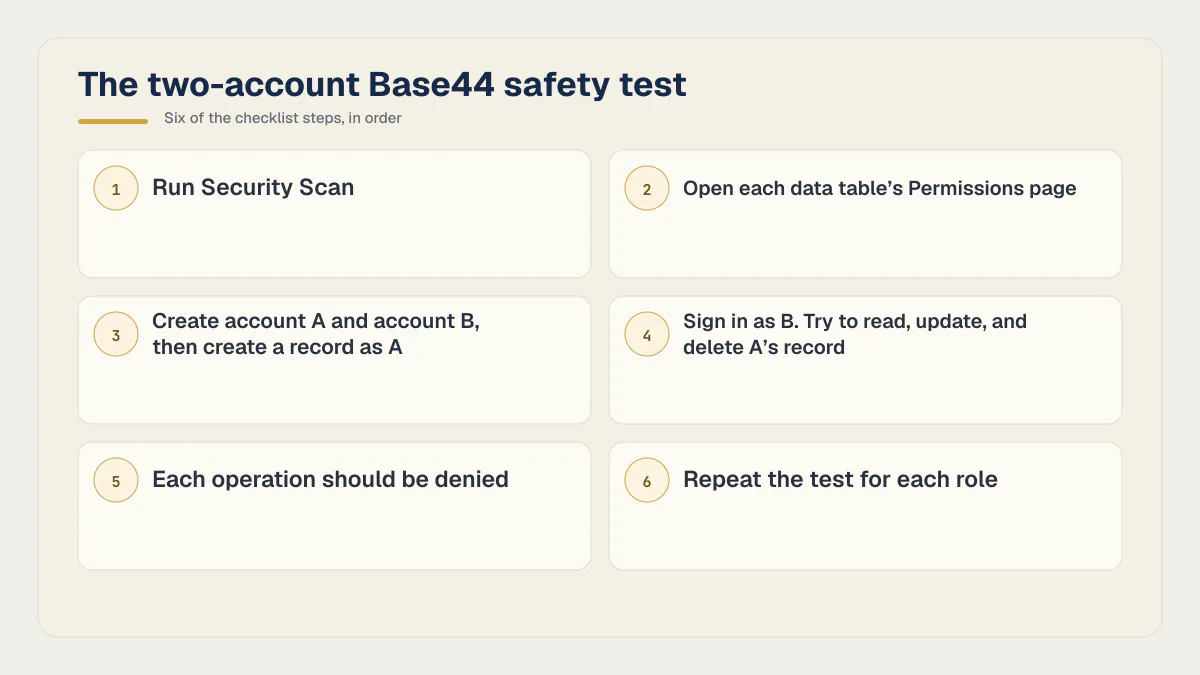
This test checks authorization after login. A successful login proves identity. It does not prove that the signed-in account owns the requested record.
One more check, specific to Base44’s own 2025 history: if a feature is supposed to require a paid plan, confirm the check happens on a call the server verifies, not a UI class hidden in the rendered page. That exact gap, premium features enforced only client-side, was one of the four flaws Imperva reported in March 2025. Base44 fixed its own version. Whether a feature you built the same way still has it is a five-minute look at the network tab, not the marketing page.
What you can export from Base44
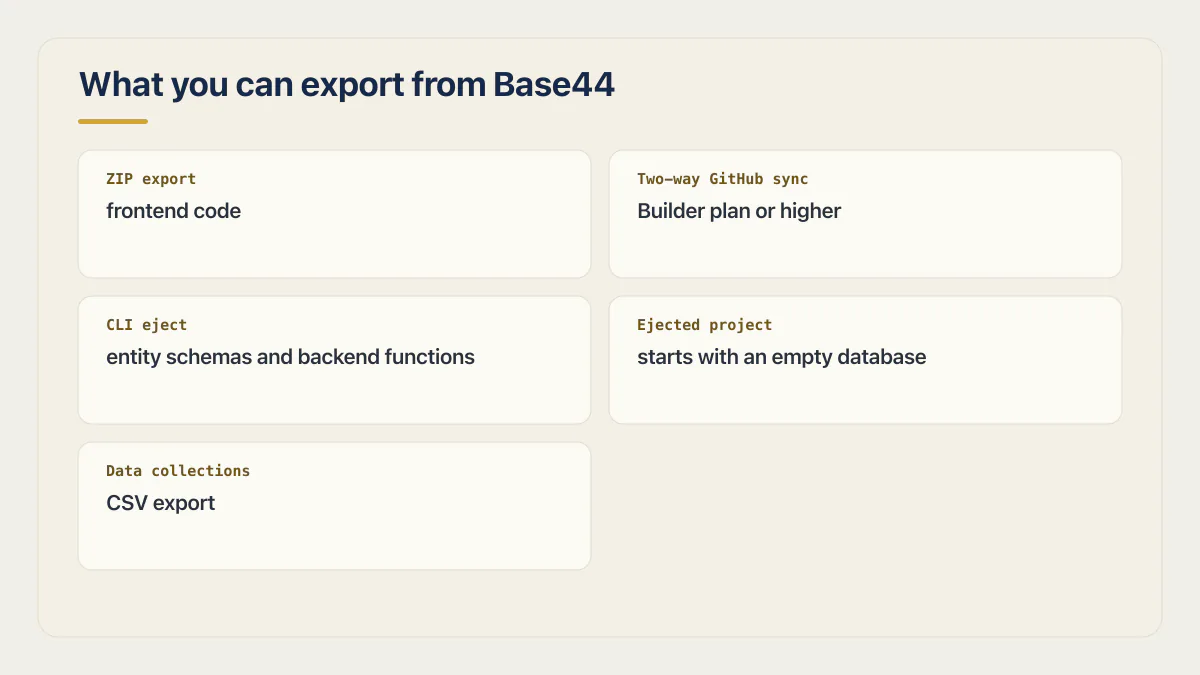
Older descriptions of Base44 as a frontend-only export are now stale. Base44 documents ZIP export and two-way GitHub sync on the Builder plan or higher, which is also the tier what each Base44 plan costs per month turns on, and its CLI eject command downloads frontend code, entity schemas, functions and other backend resources into a local project that starts with an empty database, so the data is a separate job through CSV export. Checked against Base44’s documentation on 5 August 2026: two-way GitHub sync still requires the Builder plan or higher. What lands in that export file by file, and what has to be rebuilt afterwards, is a longer job than a safety decision needs, so this page stops at the boundary: export exists, it reaches the backend, and it does not carry the data. How it compares with what Lovable hands back is in Base44 vs Lovable, and what 778 real Base44 exports actually contain is in the Base44 review.
What the 2026 reviews get wrong about Base44
Two of the review pages ranking for this query carry stale facts, and both are load-bearing if you are using them to decide.
“Base44 has no SOC 2 or ISO 27001.” Wrong as of 5 August 2026. The Base44 trust center lists SOC 2 Type II and ISO 27001 alongside its GDPR commitments. A review published in January 2026 that says otherwise was either written before the certifications landed or never rechecked.
“The backend and database cannot be exported.” Also wrong. Base44 documents ZIP export, two-way GitHub sync on the Builder plan or higher, a CLI eject command that pulls frontend code, entity schemas, and backend functions into a local project, and CSV export for data collections. What remains true is that the ejected project starts with an empty database, so migrating the data is still a separate job.
Neither correction makes Base44 the right platform for your app. It means the reasons to say no should be current ones.
Common questions about Base44 safety
Is Base44 safe to use?
Yes for the platform, unproven for your app. Base44 holds SOC 2 Type II and ISO 27001, encrypts data in transit and at rest, and includes a security scan on every plan including Free. None of that checks whether the permission rules on your own tables let one customer read another customer’s records, which is what the two-account test above settles.
Is Base44 production ready?
Base44 supplies production-oriented controls, including private and workspace visibility, data permissions, a security scan, backend functions, secrets, logs, and GitHub workflows. Production readiness still depends on the app. Pass the security scan, run the two-account authorization test, test payment and integration failure paths, set monitoring, and confirm recovery before real customers rely on it.
Is Base44 safe for customer data?
Base44 encrypts data at rest and in transit and provides table-level permissions. Its documentation says data is not end-to-end encrypted, so Base44 administrators can access it when needed. Whether the product fits customer data depends on sensitivity, permissions, residency, retention, contracts, and the results of app-specific access tests. Why AI coding tools ship security holes by default covers why the ownership gap shows up regardless of which tool built the app, and whether it’s worth paying someone to check yours is a separate, smaller decision once you know what the two-account test turned up. The same seven questions any AI-built app has to answer before real users arrive are covered in full in whether your app is ready to launch.
Does Base44 train AI models on my app data?
Base44’s trust center documents an Enterprise control that lets a workspace opt its data out of AI model training. Its AI service providers page names Anthropic, Google, and OpenAI as the model providers it may use. The public pages do not state the default training behavior for other plans. If that is a blocking question, get the other-plan answer from Base44’s Terms of Service and its DPA in writing rather than from a third-party review.
Is Base44 HIPAA compliant?
Base44’s public materials do not support an unconditional yes. Its Terms allow protected health information onto the platform only after prior written agreement, and no public standard Business Associate Agreement or HIPAA service scope was found as of August 2026. If real PHI is in scope, get the BAA executed and the covered services confirmed in writing before anything is uploaded. Base44’s compliance scope covers the detail.
Is Base44 safe for payments?
Base44 states that payment processing uses PCI DSS-certified providers and provides Secrets plus backend functions for integrations. Your app still has to verify payment events on the server, derive prices from a trusted catalog, and grant access idempotently. A browser success screen should never be the source of truth for payment.
Is Base44 safe for children to use?
Base44 is not built for young children, and its Terms of Service say so: customers who are individuals must be at least 13, or 16 inside the European Union, and the platform “is not intended for individuals under the age of thirteen (13).” That is the rule for who signs in and builds. If the app you build is aimed at children, the harder question is yours rather than Base44’s, because children’s data carries its own consent, retention, and age-verification duties that no platform certificate answers, and Base44’s terms say nothing about apps directed at children. Checked against Base44’s Terms of Service on 16 August 2026.
Are file uploads safe in Base44?
Uploads are exactly as safe as the rules you put on them. Check the size limit, validate the real MIME type rather than the filename extension, regenerate the stored filename on save so a visitor cannot choose where their file lands, and confirm the download path checks who is asking. Base44’s security scan does not decide any of that for you.
Who owns Base44?
Wix. It acquired Base44 in June 2025 for initial consideration of about $80 million plus earn-out payments through 2029, per Wix’s own announcement, roughly six months after launch, and Base44 now runs inside Wix’s security and compliance program. On the question people ask next, whether Base44 is an Israeli company: it started as one. TechCrunch describes founder Maor Shlomo as an Israeli developer already known in the Israeli startup community, and Base44 was demonstrating at an AWS event in Tel Aviv in the month before the sale. Since June 2025 it has been a Wix subsidiary rather than an independent company. Ownership of the apps you build is a separate question: Base44’s privacy and security documentation says customers own the code and applications the platform generates from their prompts and data.
Do you own your Base44 app?
Base44 supports ZIP export, two-way GitHub sync, backend-function export, entity-schema export through its CLI, and separate CSV data exports. The exact migration effort depends on hosted services and SDK dependencies. Test the exported project and a data restore before treating it as a complete exit path.
Does Base44 really work?
Base44 can produce and host full applications with data, auth, functions, integrations, and custom domains. “Works” only answers the happy path. The safety evidence comes from the scan, the permission configuration, two-account tests, logs, and recovery tests on the specific app.
Not sure your app is actually locked down?
I test it the way a stranger would, then fix what is open. Fixed quote after I have looked.
Talk about your app →  Free 20-minute video call with me.