The best AI code reviewer is an unsettled question. Three vendors each published a post in 2026 crowning themselves number one on the same independent benchmark, and one printed CodeRabbit at 51.2% while another printed the same tool at 30.3%. Start with what you can connect a reviewer to.
Search for the best AI code review tool and you get roundups. Search for the best AI for code review and you get the same roundups. Every one of them ranks eight to thirteen products, attaches a feature grid and a per-seat price to each, and puts a number at the top. What none of them says on the way in is who paid for the page.
Two things are worth knowing before you compare features. The first is that on these searches, every ranked list is written by a company that sells one of the products on it, and in most of them that product wins. The second matters more if your app came out of Lovable, Base44, Bolt or Replit: most of these tools need a Git host connection, a repository, and an open pull request before they can read a single line, and a builder-hosted app frequently has none of the three. Price is the last question, not the first.
Nothing here was installed, connected to a repository, or run. Every product fact comes from the vendor’s own documentation or pricing page, read on 16 August 2026, and every score is quoted with the date and the post it was printed in. The corpus numbers later on come from 26 AI-built apps AxonBuild audited over June and July 2026.
Every “best AI code reviewer” list is published by someone selling one of the tools
Two searches on 16 August 2026, at depth ten, returned five pages that rank AI code review products. All five are published by a company that sells one of the products in its own list. In four of the five, that product is the recommendation.
| Ranked page (read 16 August 2026) | Publisher sells | Who it puts first |
|---|---|---|
deepsource.com/resources/ai-code-review-tools | DeepSource | DeepSource, at 84.51% F1 against the OpenSSF CVE Benchmark, “the highest of any tool tested” |
codeant.ai/blogs/best-ai-code-review-tools | CodeAnt AI | CodeAnt AI, “best overall for enterprises that want one tool”, while conceding the independent benchmark it cites “doesn’t include CodeAnt AI” |
linearb.io/blog/best-ai-code-review-tool-benchmark-linearb | LinearB | LinearB, which “produced the best signal-to-noise ratio” across 16 bug types |
augmentcode.com/tools/open-source-ai-code-review-tools-worth-trying | Augment Code | ten open-source tools ranked, then Augment Cosmos put above all of them |
sourcegraph.com/blog/automated-code-review-tools | Sourcegraph | includes Sourcegraph among the AI reviewers without crowning it |
The one page in either search written by a company with nothing to sell in this category is Cloudflare’s engineering post about its own internal reviewer, and that is a report rather than a ranking. As of 16 August 2026, on those two searches at depth ten, there was no independent roundup. That is an observation about two pulls on one day, not a claim that nobody has ever written one.
The most honest sentence on the subject comes from a vendor. CodeRabbit’s own benchmark post of 3 March 2026 opens by naming the problem it is about to participate in.
AI code review benchmarks have mostly been published by other code review vendors (whose tools always seem to come out on top in their benchmarks).
That sentence appears at coderabbit.ai/blog/coderabbit-tops-martian-code-review-benchmark, on a post announcing that CodeRabbit came out on top. It is accurate about the category and accurate about the page it is printed on, which is the whole difficulty with this search.
One more note on how this page is built. Every company named in these tables sells code review as a product. Naming them is fair. Sending you to their sales pages from an article arguing that vendor pages are unreliable would not be, so they are cited by path and not linked. The three links here go to a benchmark’s source code, an engineering post from a company with no reviewer to sell, and Anthropic’s product documentation.
Three companies, one leaderboard, three number ones
There is one benchmark in this category that no reviewer vendor owns: Code Review Bench, run by Martian, whose company sells model routing rather than code review. Three competing vendors have each published a post declaring themselves first on it. Their three posts print three different scores for CodeRabbit.
| Post (read 16 August 2026) | What it claims | Its own F1 | CodeRabbit’s F1, as printed there |
|---|---|---|---|
| CodeRabbit, 3 March 2026 | ”ranks #1 in F1 score (harmonic mean of precision and recall) among all 10 tools included” | 51.2% | 51.2%, first |
| cubic, the review tool, 25 March 2026 | ”cubic is the #1 AI code reviewer on Code Review Bench” | 61.8% | 30.3%, seventeenth |
| Greptile, 30 July 2026 | ”Greptile is the top-performing AI code reviewer overall as of July 30, 2026” | 60.8% | 57.5%, fifth |
Those posts live at coderabbit.ai/blog/coderabbit-tops-martian-code-review-benchmark, cubic.dev/blog/cubic-is-the-best-ai-code-reviewer-on-martian-s-benchmark and greptile.com/content-library/greptile-martian-code-review-benchmark. One tool, three competitors, three published scores between 30.3% and 57.5%, all inside five months.
All three are probably telling the truth. The benchmark has two arms and they are built to disagree. CodeRabbit says so in the same post: its own offline score was lower than its online one, and the two are “designed to disagree.” It also says the gold set is incomplete, because the offline comparison started from a dataset of known bugs curated by two other review vendors, and some comments scored as false positives turned out to be real issues the gold set had missed.
Add the dates and the picture settles. Each vendor published on a day it was leading, on an arm and a snapshot that favoured it. A leaderboard that moves week to week will hand somebody a number-one banner most weeks. That is a fact about leaderboards, not about which tool reads your code best.
Anyone can check the method: the benchmark’s source code is public under the MIT licence. The live leaderboard at codereview.withmartian.com renders in the browser and returned nothing to a plain fetch on 16 August 2026, so nothing on this page is quoted from it.
What a 61% F1 score means if you do not write code
An F1 score around 60% describes a reviewer that is right most of the time it speaks and silent about half of what matters. Greptile’s own published pair on 30 July 2026 was 76.2% precision and 50.6% recall at the top of the leaderboard. Roughly one comment in four is noise, and about half the real problems never mentioned.
Precision answers: when the tool leaves a comment, how often is it a real problem? Recall answers: of the real problems in the change, how many did it mention? F1 mashes the two into one number so tools can be ranked in a single column, which is convenient for a table and lossy for a decision.
Read Greptile’s pair as a person rather than a percentage. At 76.2% precision, about one comment in four did not correspond to anything the developer went on to change. At 50.6% recall, about half of what the developer did fix was never flagged. That is the best-performing entry on the leaderboard on the day it was measured. Anything with lower precision talks over you more; anything with lower recall misses more.
The offline arm sharpens the point further. Its source code describes “50 PRs from 5 major open-source projects, each with human-verified golden comments.” The five are Sentry, Grafana, Cal.com, Discourse and Keycloak: large team codebases with years of history, established conventions, and reviewers already in place. The online arm samples “fresh real-world PRs from GitHub where code review bots left comments,” which keeps the material recent but keeps it the same shape. A one-owner app assembled by prompting in a browser is not in either arm, and nothing in these scores was measured on one.
None of this makes the numbers useless. It makes them a measure of one narrow skill, judged on projects unlike yours, and no substitute for what a person actually does when they read your code.
What each tool needs before it can read a single line
Most AI code review tools need three things before they work: a Git host connection, a repository, and an open pull request. An app built inside Lovable, Base44 or Bolt often has none of them, which disqualifies most of the “best” list before price is a question at all.
This is the part the roundups skip, because every page in that search was written for an engineering team that already has a pull request workflow. If you are searching for an AI code review bot for GitHub and you already push branches, the requirement is invisible. If your app lives inside a builder, it is the only requirement that matters.
| Product | Connects to | Needs an open pull request | Reads code without one |
|---|---|---|---|
| CodeRabbit | ”your existing GitHub, GitLab, Azure DevOps, Bitbucket Cloud, or Bitbucket Data Center account” | For the pull request reviews, yes | Yes: documented review of uncommitted changes in VS Code, Cursor, Windsurf, or from the command line |
| Greptile | A connected Git host repository | Yes, one credit per standard review | Not documented on the pricing page |
| Qodo | Git integration on every plan, alongside IDE integration | For the pull request reviews, yes | IDE integration is listed on every plan |
| Claude Code Review | GitHub, via the Claude GitHub App on Team and Enterprise subscriptions | Yes for the managed service | Yes on other plans, via a local command |
CodeRabbit’s quickstart at docs.coderabbit.ai/getting-started/quickstart asks first for “your existing GitHub, GitLab, Azure DevOps, Bitbucket Cloud, or Bitbucket Data Center account,” then documents a second route: “Review uncommitted changes in VS Code, Cursor, Windsurf, or from the command line.” That second route is the one that matters for an app with a repository but no branch discipline.
Anthropic documents the same split more explicitly. Claude Code’s Code Review “is in research preview, available for Team and Enterprise subscriptions,” analyzes GitHub pull requests, and posts findings as inline comments tagged by severity. On other plans, the same documentation offers a /code-review command that “reviews your branch’s commits ahead of its upstream plus any uncommitted changes.” A Git branch, then, but no pull request and no GitHub App.
Two more products belong in the shortlist without belonging in that table, because their requirements sit inside an editor you may already be paying for and their pricing and connection details were not re-verified for this page. Cursor’s Bugbot reviews pull requests and also runs over branch changes inside the editor, and Cognition ships a separate reviewer alongside Devin; both are covered in more detail in the pull request reviewer Cognition sells separately, which owns those two. If you are working the same question from the terminal instead, the same shortlist from the command line side covers the generation tools that also review.
For a builder-hosted app the first question is upstream of all of this: whether you can get your code out at all. Until there is a repository somewhere you control, none of these products has anything to connect to, and the comparison below is theoretical.
What they cost, and what the free tiers leave out
Published prices for AI code review run from free to $48 per user per month, plus credit systems where one credit buys one review. The best free AI code review tools are the free tiers of the paid ones, and every one of them is bounded: public repositories only, one developer, or a fourteen-day trial.
| Product | Published price | What the unit is | Free tier |
|---|---|---|---|
| CodeRabbit | Pro “$24/mo/user”, Pro Plus “$48/mo/user”, both billed annually; CodeRabbit Security “$40/mo/user” | Per seat, per month | ”free reviews forever for public repositories”; 14-day trial on paid plans |
| Greptile | Pro “$30/seat/month” with “50 credits included per seat” and “$1 per additional credit” | Per seat plus per review, where “1 credit = 1 standard review” | Starter, free, “1 active developer” |
| Qodo | Pro Team from “$30”, credit packs at “$.012/credit, pooled across the team” | Per credit, pooled: packs listed at “~18 Reviews/Mo”, “~36 Reviews/Mo” and “~144 Reviews/Mo" | "Free 14 Day Trial no credit card” |
| Claude Code Review | ”Each review averages $15-25 in cost”, billed through usage credits, separate from plan usage | Per review, scaling with change size | None; the local /code-review command on other plans |
Prices checked 16 August 2026 at coderabbit.ai/pricing, greptile.com/pricing, qodo.ai/pricing/ and Anthropic’s documentation. All four move.
Read down that table and the units stop matching. A seat price assumes a team with seats. Credit pricing assumes you can guess how many reviews a month you will run, and the per-review average assumes your changes are the size the vendor’s customers ship. If you own one app and touch it in bursts, none of those units describes your year.
The free tiers are worth naming precisely, because “free” carries a lot of weight in this search and covers very little. CodeRabbit’s is free forever for public repositories, which is generous and useless for a private app with customer data in it. Greptile’s Starter is free for one active developer. Qodo’s free window is fourteen days. There is no free tier that reviews a private commercial app indefinitely.
The one published figure on this search that says what a review actually costs to run comes from someone not selling one. Cloudflare’s post about its own AI reviewer reports that across 78,611 full reviews the average cost was $1.68, the median $1.47, and the 95th percentile $3.35, while 24,529 trivial reviews averaged $0.20 per scan. Set that next to the $15-25 Anthropic publishes and the range in this category is more than tenfold, which tells you these products are doing different amounts of work under the same words.
What none of them can see in an app nobody reviewed while it was being written
An AI reviewer reads a change. An app built by prompting has no history of changes, so the things most likely to be wrong in it were never in a diff for anything to read. That gap is where the audit numbers land: of 26 AI-built apps AxonBuild audited in June and July 2026, none came out green.
The corpus is specific about what was missing rather than broken. At least 23 of those 26 apps had zero working automated tests, including one whose checkout test suite never executed the actual checkout code. Twenty-two of the 26 had at least one confirmed critical finding, and scores ran from 29 to 81 out of 100. The full telling of what those audits found covers the cohorts and the method.
Notice what a pull request reviewer would have done with those apps. It would have had nothing to review, because there were no pull requests. And where there was code to read, the missing test suite is not visible in any single change: the absence of a thing never appears in a diff. A clean report is not the same as a working app, and a reviewer that only ever sees one change at a time cannot tell you the difference. How to verify AI generated code before production lists the evidence you can collect without reading the code yourself.
Cloudflare is unusually direct about the limit on its own numbers. Its post states plainly: “This isn’t a replacement for human code review, at least not yet with today’s models.” It then names three things its reviewers struggle with. Architectural awareness: “the reviewers see the diff and surrounding code, but they don’t have the full context of why a system was designed.” Cross-system impact: “A change to an API contract might break three downstream consumers.” And subtle concurrency bugs: “Race conditions that depend on specific timing or ordering are hard to catch from a static diff.” That is a company naming the limits of its own tool after a first month of 131,246 runs, over 48,095 merge requests, spread across 5,169 repositories, from 10 March to 9 April 2026.
Which raises the question the roundups never ask, and this page will not settle either: whether an AI can review its own work at all.
So which one should you actually use?
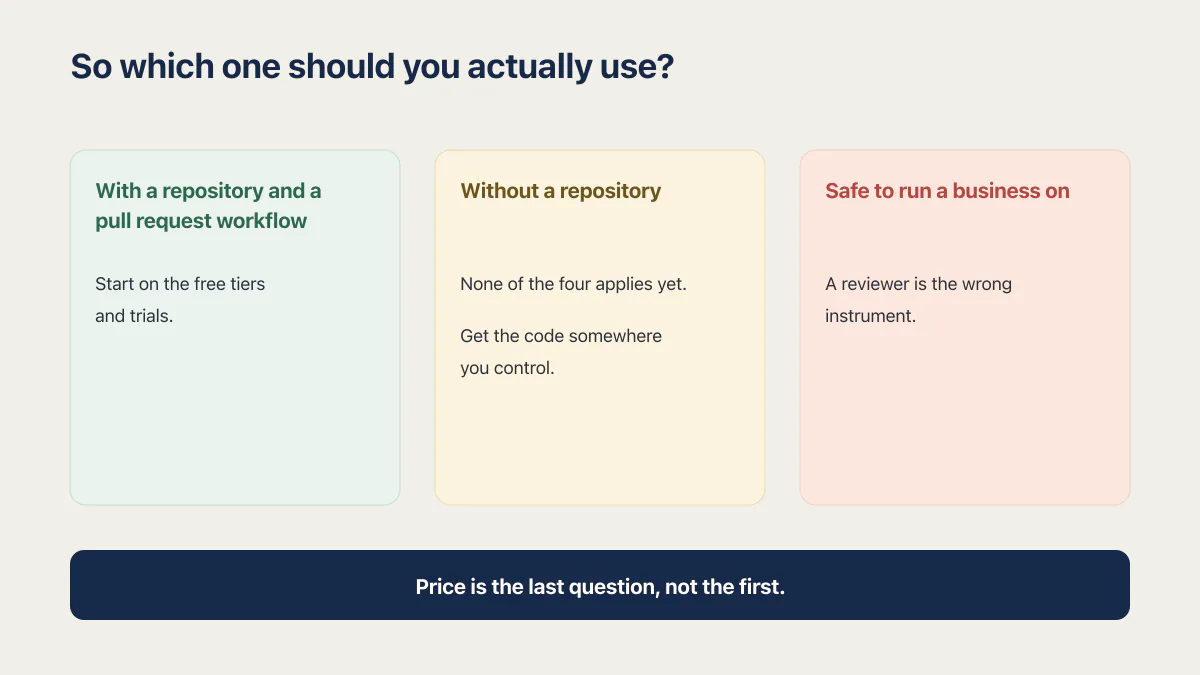
No single product wins this comparison, and the honest sort has three branches. With a repository and a pull request workflow, start on the free tiers and trials. Without a repository, none of the four applies yet. And if the question is whether the app is safe to run a business on, a reviewer is the wrong instrument.
Take the first branch if you have a repository and you open pull requests. Run the free tiers and the trials before paying anyone. CodeRabbit is free forever on public repositories, Greptile’s Starter is free for one developer, Qodo gives you fourteen days, and Claude Code’s local /code-review command works on plans below Team. A fortnight of real changes through two of them tells you more about noise and usefulness on your codebase than any of the leaderboards will, because the leaderboards were measured on Sentry and Grafana.
The second branch is an app that lives inside a builder with no repository. None of this applies yet, and the first job is getting the code somewhere you control. That is also true if somebody else built the app and handed it over; you cannot review what you cannot open. How to hand over an app to a client covers what the client should hold afterwards, from ownership and access to documentation.
The third branch is the one people usually mean when they start searching. If the question is really whether this app is safe to run a business on, a reviewer that reads one change is answering something narrower than what you asked. Two other things are worth doing first and both are cheaper. The free scanners worth running before you pay anyone will tell you what known vulnerabilities are sitting in your dependencies. A scanner matches your code against a list of known patterns; a reviewer reads a change and forms an opinion about it. Neither one reads the whole app the way a person would, which is a separate question with its own price: what it costs to have a person read the whole thing. For the scanner side, what a code scan is covers the four kinds, the free tool for each language, and how to prove a scan runs.
I do not recommend a product here. Every page that does, on this search, was written by one of the vendors.
Common questions about AI code review tools
What is the best code reviewer?
It depends on what you can connect it to. Among tools that need a Git host and a pull request, three vendors published competing number-one claims on the same benchmark in 2026, with scores that disagree by more than 25 percentage points on the same tool, so the leaderboard will not decide it for you. Start by checking which products can reach your code at all, then run two free tiers on real changes for a fortnight.
Is there a free AI code reviewer?
Yes, with limits worth reading. CodeRabbit offers “free reviews forever for public repositories”, which excludes private commercial apps. Greptile’s Starter plan is free for “1 active developer”. Qodo offers a “Free 14 Day Trial no credit card”. Claude Code includes a local /code-review command on plans below Team. Prices and tiers checked 16 August 2026.
Can an AI code review replace a human one?
No, and the clearest statement of that comes from a company running one at scale. Cloudflare’s engineering post says: “This isn’t a replacement for human code review, at least not yet with today’s models.” It names architectural awareness, cross-system impact, and subtle concurrency bugs as the classes its reviewers struggle with, after 131,246 review runs in the first 30 days.
Do I need GitHub to use an AI code review bot?
Not always: the managed pull-request reviews need a Git host, while the local routes need only a repository on your machine (CodeRabbit’s uncommitted-change review; Claude Code’s /code-review command, which needs a Git branch but no pull request and no GitHub App). CodeRabbit’s quickstart lists GitHub, GitLab, Azure DevOps, Bitbucket Cloud, and Bitbucket Data Center, and separately documents reviewing uncommitted changes in VS Code, Cursor, Windsurf, or from the command line. Claude Code’s managed reviews are GitHub-only; its local command works on any branch. An app with no repository anywhere cannot use any of them.
How much does an AI code review cost per pull request?
Published figures range from about $0.20 to $25 per review depending on the product and the size of the change. Anthropic publishes “Each review averages $15-25 in cost” for Claude Code Review. Cloudflare reports $1.68 average and $1.47 median across 78,611 full reviews of its own, with trivial ones at $0.20. Seat-based products like CodeRabbit at “$24/mo/user” do not price per review at all.
Are the AI code review benchmark scores trustworthy?
Treat them as dated snapshots, not rankings. On Code Review Bench, three vendors each published a post naming themselves first, and each printed a different score for CodeRabbit: 51.2% on 3 March 2026, 30.3% on 25 March 2026, and 57.5% on 30 July 2026. The benchmark has an offline arm and an online arm that CodeRabbit itself describes as “designed to disagree”, and the leaderboard moves.
Will an AI reviewer find security holes in my vibe coded app?
Some of them, and not the ones most likely to be there. An AI assistant that reviews code reads a change, so it cannot see what was never written: of 26 AI-built apps AxonBuild audited over June and July 2026, 23 or more shipped without a single automated test that ran, and a missing test suite never appears in a diff. Checking whether your app actually works under real use is a separate job from reviewing a change.
If you have a working app built with these tools and need it ready for real customers, this is what we do.
Built it with AI. Now it has to hold up for real customers.
The Production Hardening Sprint takes the app you already have and builds the production foundation underneath it. Authentication and access rules, payments that stay consistent, error handling, monitoring, backups, automated tests and a documented handover. Our engineers work inside your existing codebase for ten working days. All 123 deliverables are included, and you get the evidence for each one.
See the Production Hardening Sprint →  $2,500 fixed price · 10 working days · One codebase