Base44 alternatives split into three groups: tools that give you a backend account, tools that leave the backend to you, and platforms with no repository to hand back. The database behind each one separates them further: on Base44, 1,401 of the 1,405 Base44 repositories in a 2,392-row queue record Base44 itself as the backend, and on Lovable, Bolt.new, v0 and Replit the rows record a third-party backend such as Supabase or Neon, or no managed backend at all, and never the builder itself. Whether that backend sits in your own name depends on a setup choice each vendor documents, described tool by tool below.
Nothing on this page was built or tested by me. Capabilities, plan gates and prices come from each vendor’s own documentation and pricing pages, read on 17 August 2026, and the ownership finding is derived from a fixed snapshot of public repositories that AxonBuild keeps as an audit-candidate queue for its code review work. Two of the pages currently ranking for this query use the word tested in their titles without publishing a repository, a count or a date, so it seems worth saying plainly which kind of page this is.
Base44 alternatives at a glance
The ten Base44 alternatives below split into three groups: four where the backend can be an account in your own name, three that supply no backend at all, and three with no repository to hand over. Vendor documentation and pricing pages were read on 17 August 2026.
| Tool | What it is | Who runs the database | What you still hold if you stop paying | Where the price starts |
|---|---|---|---|---|
| Lovable | Prompt to a React project | Lovable Cloud by default, built on Supabase’s open-source foundation, or an external Supabase project you connect | The GitHub repository, plus the Supabase project if that account is yours | Free tier; Pro from $25 a month |
| Bolt.new | Prompt to an app, with repository import | Bolt’s own database service, or Supabase if you choose it at setup | The repository, which can be one you already had | Free tier; Pro $25 a month |
| v0 by Vercel | Generation that commits to your repository | Whichever provider you connect: Neon, Supabase, Upstash, Vercel Blob | The repository and the provider accounts, both yours from day one | Free tier; Plus $30 per user a month |
| Replit | Hosted place to build and run the app | Replit, on PostgreSQL 16, with development and production kept apart | Whatever you pushed to Git. The managed database is a separate move | Free Starter; Core $20 a month, checked 6 September 2026 |
| Cursor | An editor with an agent in it | Nobody. Cursor supplies no database, no identity service and no host | Everything, because Cursor never took custody of anything | Free Hobby; Pro $20 a month |
| Claude Code | A terminal agent working your repository | Nobody, for the same reason | Everything | Claude Pro $20 a month |
| Firebase Studio | Browser workspace, closed to new users | Google, through Cloud Firestore and Firebase Authentication | The code and the Firebase project. The workspace itself shuts on 22 March 2027 | No cost, but new signup is disabled |
| Bubble | Full no-code application platform | Bubble | Your data by export. No repository exists to hold | Starter $32 a month, web only |
| Glide | No-code apps over a Glide database | Glide. A connected sheet is copied in rather than written back | Your original source data. No repository | Free tier; Solo $25 a month |
| Softr | Interface layer over data you already keep | Whoever already runs it: Airtable, Postgres, Supabase, Xano and others | The data, which was never inside Softr | Free plan; Basic $25 a month |
Base44 belongs at one end of that table. It runs the database, the authentication, the functions and the hosting, and it does hand back a real React repository on the Builder plan, which its pricing page put at $40 a month billed annually when I read it on 17 August 2026 and which is the first tier with GitHub integration. Nothing in the ten rows above makes any of them a better product than Base44. They differ in who holds the account when you leave, and that is the only thing this comparison measures.
The question every Base44 alternatives list skips: who runs the backend
Across 2,392 audit-candidate repositories, 1,401 of the 1,405 rows naming Base44 as the builder record Base44 itself as the backend, and no other builder’s rows do that. The Lovable, Bolt.new, v0, Replit, Kiro and Antigravity rows record Supabase, Neon or plain PostgreSQL. The Claude Code and Cursor rows mostly record no managed backend at all.
Here is where those rows came from, because it changes what they mean. AxonBuild keeps a queue of public AI-built repositories as candidates for code review work, and after a cleanup pass on 27 July 2026 it held 2,392 kept rows. Every row arrived through a builder-specific search, and those searches were nowhere near equal in depth, so a short lane below means shallow searching rather than a rare tool. None of the counts is a market-share figure and none of them should be read as one.
Base44 got the deepest treatment. Sixteen separate searches feed that lane, several of them paginated until they ran out, and a few examples give the flavour: a code search for filename:base44Client.js, a repository search for the description string "Base44 App" in:description, and five passes over the @base44/sdk package. Firebase Studio got one content fingerprint worked the same way, a search for "Style Guidelines" filename:blueprint.md path:docs, and that single fingerprint accounts for 323 of its rows. The agent tools came in through commit metadata instead: the author address cursoragent@cursor.com, and Co-authored-by: Claude and Co-authored-by: Codex trailers.
Lovable and Bolt.new were searched too, and barely. Thirteen of the 29 Lovable rows trace to nine separate Lovable-named queries, one or two rows apiece, and the other sixteen surfaced while the pipeline was busy with something else. Both Bolt.new rows trace to Bolt-specific searches, one on the topic:bolt-new tag. So the gap between 1,405 Base44 rows and two Bolt.new rows is mostly a gap in how hard each lane was worked.
I re-derived the whole distribution from the snapshot on 17 August 2026. A row sits in a lane only when its claimed-builder field names exactly one tool. Twenty-two rows name two or more and sit in no lane. Eight further rows sit outside the table below: two are blank, one names only a model version, and five name tools this comparison does not cover. That leaves 2,362 rows in the lanes.
| Builder named in the row | Rows | What the backend field records |
|---|---|---|
| Base44 | 1,405 | Base44 itself in 1,401 of them, written fifteen different ways. Zero rows record no backend |
| Claude Code | 419 | No managed backend in 358. The rest are Node, Rust, Go, Supabase or browser-local |
| Firebase Studio | 334 | A Google service in 317: Genkit, Cloud Firestore, or Firebase generally |
| Cursor | 85 | No managed backend in 44. The rest are FastAPI, Node, Python, MySQL, Supabase |
| Codex CLI | 44 | No managed backend in 32 |
| GitHub Copilot | 29 | No managed backend in 16 |
| Lovable | 29 | Supabase in 24, several of them written as Lovable Cloud / Supabase |
| Replit | 10 | Seven Node, Express or bare api-server. One Neon PostgreSQL, one browser-side only, one an embedding service behind Clerk. None records Replit itself |
| Bolt.new | 2 | Supabase in both |
| Windsurf | 2 | Express with PostgreSQL and Drizzle; FastAPI with SQLite |
| v0, Kiro, Antigravity | 1 each | Supabase in all three |
Read the small numbers as small. Two Bolt.new rows are two rows. One v0 row is one row. I am not putting a percentage on any denominator under a hundred, and the finding does not need one, because the finding is about kind rather than count: the Base44 rows name the vendor as the backend, and every other lane names either a third-party account or nothing.
The four Base44 rows that break the pattern are the most interesting rows in the set. One records Supabase migrated from Base44. One records Supabase. One records Neon Postgres with Prisma and Auth.js, on a repository whose own summary describes it as a product that grew out of a Base44 export. One records browser localStorage with the Gemini API. All four read as apps that left, which is a small piece of evidence that leaving is a thing some people actually finish.
Two limits belong in the same breath. These are candidates for review, not audited apps, and nothing here says anything about whether any of them is secure, correct or well built. And they are public repositories, so what they describe is the subset of owners who switched GitHub sync on and then never hid the output, which is a slice of each platform’s users and never the whole population.
The conclusion is narrow and it is the whole page. On the tools people recommend as Base44 alternatives, the rows record a third-party database or none at all, and the vendor sections above and below say which setup choice puts that database in your own name. On Base44 the rows record the vendor itself.
What Base44 leaves inside the repository it hands you
Base44 leaves four separate traces of itself in the repository: a base44/config.jsonc file, an src/api/base44Client.js SDK entry point, an @base44/sdk dependency, and a repository description reading Base44 App: <name>. Each one is a wire back to the platform. The agent tools leave a different kind of mark, and the difference is the whole answer to who owns the code.
I can compare the marks because the queue was built by searching for them. Each lane is a fingerprint, and they fall into two families.
Base44’s four are configuration and wiring. base44/config.jsonc is where the platform’s own resource definitions live, alongside the .app.jsonc file that links a local checkout back to a specific Base44 app, per Base44’s project-structure documentation read on 17 August 2026. src/api/base44Client.js is the module every screen calls to reach the backend. @base44/sdk is the package that module imports. The Base44 App: description is what the platform writes on the repository when it syncs. Firebase Studio’s trace is the same family: a docs/blueprint.md file describing the app to Google’s agent, which is why 317 of the 334 Firebase Studio rows record a Google service as the backend.
Cursor’s trace is a commit author address, cursoragent@cursor.com. Claude Code’s and Codex’s are commit trailers, Co-authored-by: Claude and Co-authored-by: Codex. Those are in the git history. They are not in the running code, and removing them would change nothing about whether the app works.
The marks Cursor and Claude Code leave in a repository say who wrote the code. The four marks Base44 leaves say who still runs it.
This is also the honest answer to people searching for a Base44 alternative on GitHub. That query is usually about getting code out, not about finding a GitHub-hosted rival, and the code does come out. Base44’s quick-start guide, read on 17 August 2026, says a Builder plan or above opens two ways out: download the code as a ZIP, or send it straight to GitHub. Base44’s GitHub integration page, read the same day, confirms two-way sync starts at the Builder plan and that changes travel back by committing to the branch, with no manual push available. The base44 eject command, read 17 August 2026, pulls down two things and stops there: the chosen app’s front end, plus the backend definitions, entity schemas among them. Your rows are excluded by name.
What comes out is real. What comes out still calls Base44. A locally run copy needs the app’s ID and its backend URL to reach anything, and the ejected project arrives with the schemas copied and the rows absent. The file-by-file contents of a Base44 export, and what 778 confirmed Base44 exports checked on 14 August 2026 actually contain, are each a longer read than this comparison needs.
Alternatives that give you a backend account in your own name
These four are the group the ownership argument favours, and they are not equal inside it. Three of them run a managed backend for you by default. One never touches the database at all.
Lovable
Lovable generates a React and TypeScript project and syncs it to GitHub. Lovable’s GitHub documentation, read 17 August 2026, describes sync in both directions on a single active branch, defaulting to the repository’s default branch, and lists importing an existing GitHub repository under its limitations: export runs from Lovable to GitHub, not the other way.
The backend is the part people skim. Lovable Cloud, read the same day, is the built-in option and covers database, authentication, storage, realtime, edge functions, secrets, logs, AI and scheduled jobs, and it is built on Supabase’s open-source foundation. The document’s phrasing is that you get this “without needing to set up Supabase separately”, which is convenient and is also the sentence that decides how much of an exit you have: a Cloud project is a Supabase-shaped backend that Lovable provisioned, and an external Supabase project you connected yourself is an account in your name. Lovable’s subscription plans, read the same day, start Pro at $25 a month. Twenty-four of the 29 Lovable rows in the queue record Supabase, several of them written as Lovable Cloud / Supabase, so both shapes show up in the wild. Whether Lovable Cloud and your own Supabase project are the same thing for exit purposes is a real question, and it is not this page’s.
Anyone shopping Base44 and Lovable together is asking a third question, not this one. The two-platform comparison of Base44 and Lovable, decided on what each hands back, is its own piece of work. So is the same question asked from the Lovable side, which starts from a different reader: someone leaving Lovable, for whom Base44 is one of the places they might go.
Bolt.new
Bolt supplies its own managed database service. Bolt’s database documentation, read 17 August 2026, lists built-in authentication, server functions, secrets, file storage and user management, and states that Supabase can be selected instead at project creation. It also imports an existing repository, which Lovable’s documentation lists under its limitations.
That combination makes Bolt the odd one in this group. Take the default and the database is Bolt’s. Choose Supabase at setup and the database is yours from the first prompt. The repository is yours either way, including one you brought with you.
v0 by Vercel
v0 is the cleanest example of the thesis on this page, because it never takes custody of anything. v0’s GitHub documentation, read 17 August 2026, says v0 creates a dedicated branch for each chat, commits generated changes to that working branch instead of pushing to its base branch, and opens a pull request when you publish. v0’s database documentation, read the same day, covers Neon, Supabase, Upstash and Vercel Blob, and spells out what connecting one does: the service opens an account belonging to you, and the credentials for reaching it land in your project as environment variables.
An account on Neon, in your name, with your billing details, reached through environment variables in your repository. There is no v0 database to leave. The only thing you stop paying for is the generation.
Replit
Replit runs the app as well as building it. Replit’s development and production documentation, read 17 August 2026, says a published app “gets its own production database, separate from the development database you use while building”, that the Agent cannot modify the production database, and that schema changes reach production only when you publish. The infrastructure runs PostgreSQL 16.
That separation is genuinely rare among AI builders and it is worth choosing on. It is also managed hosting, so the database is Replit’s until you move it, which is a dump and a restore between two PostgreSQL databases. Ten Replit rows sit in the queue and not one of them records Replit itself as the backend. Seven read as Node, Express or a bare api-server. One records Neon PostgreSQL. One records an embedding-model service with Clerk handling sign-in. The last names no server at all, only browser-side calls out to public data feeds. Ten is ten, and the lane was never a systematic sweep, so read that as a hint rather than a rate.
Alternatives with no backend of their own
Cursor and Claude Code differ from Base44 in kind: they write code into a repository you already have, against infrastructure you already pay for, which is why the exit question does not apply to them at all.
Cursor
Cursor is a code editor with an agent in it. Its pricing page, read 17 August 2026, lists a free Hobby plan and Individual Pro at $20 a month, with Teams Standard at $40 per user. There is no bundled database, no identity service and no host, and 44 of the 85 Cursor rows in the queue record no managed backend at all, with the rest recording stacks their authors stood up themselves: FastAPI, Node, Python, MySQL, Supabase.
One counterweight belongs right next to that. An agent will not notice that the app was never ready. It will help you build faster in the direction you are already going, including into the wall.
Claude Code
Claude Code is a terminal agent that works the repository in front of it. Claude’s pricing page, read 17 August 2026, includes Claude Code with Pro at $20 a month billed monthly, with Max plans from $100. The same absence applies: no database, no auth, no host, and 358 of the 419 Claude Code rows in the queue record no managed backend.
A null in that field means the pipeline found no managed backend to record, which for a terminal agent is the finding rather than a gap. Nothing was taken, so nothing has to be given back.
Firebase Studio
Firebase Studio is the counter-example inside its own section, and as of today it is also a documented dead end. Google’s Firebase Studio sunset and migration page, read 17 August 2026, says new workspace creation and new user signup were disabled on 22 June 2026, that projects must be migrated before 22 March 2027, and that remaining data is permanently deleted after that. Existing workspaces keep working until then. Google points people at Google AI Studio and Google Antigravity instead.
It earns a row here anyway, because it is on incumbent rosters and because of what it shows about the pattern. Firebase Studio was never a no-backend tool: it sets up Cloud Firestore and Firebase Authentication when the app needs a database, and 317 of the 334 Firebase Studio rows in the queue record a Google service. That is a different vendor holding the backend rather than no vendor. It is also the clearest illustration of why the ownership question is worth asking before you pick: the tool closed, and the apps built on it survive only because the Firebase project underneath was always a separate, portable thing.
Alternatives with no repository at all
The no-code branch is the one the vendor-written pages on this query push hardest, and it splits on a line those pages rarely draw: whether the platform also holds the data.
Bubble
Bubble owns the whole stack: the data store, the logic engine, the servers it all runs on. Nothing is committed anywhere and nothing comes out as code, so leaving means constructing the app a second time somewhere else. That is a trade nobody can miss, and what you buy with it is the most capable no-code application model named on this page. Its pricing page, read 17 August 2026, puts Starter at $32 a month billed monthly for web only, $49 for mobile only and $69 for both, with a 14-day free trial for new apps and no free plan listed.
Glide
Glide reads as the friendly option and holds the data more tightly than people expect. Glide’s data documentation, read 17 August 2026, says every project has one database that can include tables from one or more sources, and is explicit about what happens to a connected spreadsheet: “GlideOS does not write back to Google Sheets. It creates a database table and pulls the sheet’s data into this table.” External Postgres-compatible databases can be connected read-only or read-write. Pricing starts free, with Solo at $25 a month.
So the sheet stays where it was and stops being the live copy. That is a fine arrangement and not the one most people assume when they hear that Glide connects to their spreadsheet.
Softr
Softr is the interesting one, because it has no repository and also no data lock-in. Softr’s data-source documentation, read 17 August 2026, lists Airtable, HubSpot, Salesforce, Notion, Coda, Google Sheets, monday.com, SmartSuite, ClickUp, Xano, Supabase, BigQuery, PostgreSQL, MySQL, SQL Server, MariaDB and generic REST APIs. Its plans documentation, read the same day, lists a free plan, Basic at $25 a month billed monthly, Pro at $119 and Business at $395.
The interface is captive and the data never was. Put a client portal, or a tool your staff use internally, on top of a system you already operate, and that arrangement is frequently all the project ever needed. It is the exact inverse of Base44: Base44 gives you the code and keeps the data, Softr keeps the interface and never touches it.
Free and open-source Base44 alternatives
There is no open-source Base44. Nothing published as of 17 August 2026 self-hosts an equivalent of Base44’s entities, agents, connectors and hosted runtime as one package. What does exist is two real open-source build loops that leave the backend entirely to you, plus free tiers on the managed tools that are evaluation budgets rather than plans.
Dyad is the closest thing to a free answer that is not a trial. Its site, read 17 August 2026, describes it as an open-source AI app builder that runs on your desktop, works with OpenAI, Google and Anthropic models, and lets you bring your own API key on the free tier. Paid tiers exist at $20 and $79 a month for bundled credits. The model bill arrives from your provider instead, which is a cost you control directly, and one that does not disappear.
bolt.diy is the second one: the official open-source version of Bolt.new, MIT licensed, letting you choose the model per prompt across a long provider list. Same shape, same trade. You get the build loop and none of the managed database, authentication or hosting that make Bolt.new and Base44 quick.
Free tiers on the paid tools, all read on 17 August 2026, with Lovable’s grants taken from its credits documentation:
| Tool | Free tier | Where it gets you |
|---|---|---|
| Base44 | 25 message credits a month | Far enough to find out whether your business bends into entities |
| Lovable | 5 build credits a day, up to 30 a month, plus 20 Cloud credits and 4 AI credits a month | You watch a project generate, then watch it land in a repository |
| Bolt.new | 300K tokens a day, 1M a month | Enough tokens for one modest build, and enough to put repository import through its paces |
| v0 by Vercel | $5 of monthly credits, 7 messages a day | Long enough to judge whether pull requests suit how your people already work |
| Replit | Starter plan | You get to see the two databases stay apart |
| Cursor | Hobby plan, no card required | Settles the editor question before you pay to answer it |
| Glide | Free tier | A first look at no-code, taken before any data moves |
| Softr | Free plan | One source, one interface, wired together end to end |
None of those free tiers changes the ownership answer. A free Lovable project still puts the database on Lovable Cloud unless you connect Supabase yourself, and a free Bolt project still uses Bolt’s database unless you pick Supabase at setup. Free changes what you pay this month, not who holds the account.
What the Base44 alternatives cost to start
Entry paid plans across the ten range from $20 a month for Cursor and Claude Code to $32 for Bubble, with most of the managed builders at $25. Prices checked: 17 August 2026, each from the vendor’s own page.
The subscription line is only the first of the numbers you will operate on. Managed platforms meter different combinations of generation, runtime compute, app users and workload, while the two cheapest rows here belong to tools that hand you no backend and push database and hosting bills onto separate invoices. Plans on this list move, sometimes quarterly. Open the vendor’s own page again on the day you decide.
| Tool | Entry paid plan, billed monthly | What the plan counts |
|---|---|---|
| Cursor | Pro $20 | Agent requests |
| Claude Code | Claude Pro $20, Max from $100 | How far you get before a session hits its cap |
| Lovable | Pro from $25 | Three balances kept apart: build, Cloud and AI |
| Bolt.new | Pro $25, Teams $30 per member | Tokens. Pro opens at 10M a month and lifts the daily ceiling |
| Replit | Core $20, or $17 a month billed annually; Pro $100, or $95 billed annually | One balance a month, drawn down by Agent work and by compute |
| Glide | Solo $25, Team $125 | Seats and app usage |
| Softr | Basic $25, Pro $119, Business $395 | App users and workspace features |
| v0 by Vercel | Plus $30 per user, Business $100 per user | Credits, refilled each month |
| Bubble | Starter $32 for web, $49 for mobile, $69 for both | Workload units. Page views, database queries and workflow steps all draw on the same pool |
| Firebase Studio | No paid tier to start. New signup is disabled | Not applicable |
Each figure above comes from the vendor’s own page, read on 17 August 2026: Cursor, Claude, Bolt, Replit, Glide, v0 and Bubble. Two rows come from somewhere else: Softr’s and Lovable’s public pricing pages render client-side and gave up no figures on the day, so both were read from the vendor’s own help documentation instead.
Base44’s own ladder is not repeated here, on purpose. Its pricing page put Builder at $40 a month billed annually on 17 August 2026, and Builder is the first tier with GitHub integration, which is the only Base44 price this comparison needs. What each Base44 plan costs per month, tier by tier, with what the credits actually buy, is a separate piece.
Two of the rows above hold more than a column can carry. What a Bolt.new month actually costs depends on how many tokens a long chat over large files burns, which is not knowable from the plan name. How Lovable meters credits matters more than the $25, because build credits, Cloud credits and AI credits run down at different speeds on the same working day.
What switching off Base44 actually involves
Moving a Base44 app to any tool on this page is a backend rebuild with a frontend transplant attached. The React and Vite frontend moves with modest work. The entity schemas, the permission rules, the connectors, the functions and the rows do not, because there is nothing on the other side shaped like them.
Start with what the export gives you. The front end, the entity schemas, the rest of the backend definitions, and a project that arrives with those schemas in place and nothing stored behind them. That is what Base44’s own eject documentation describes, and it is more than the older reviews credit. Then look at what the schemas describe. Base44’s entities documentation, read 17 August 2026, says: “Each entity is a schema that defines the structure for documents in a collection, stored in Base44’s NoSQL database. The database is MongoDB-compatible, so you can use MongoDB operators when querying through the SDK.”
Documents in a collection, queried with MongoDB operators. The alternatives in the first group are relational: Replit runs PostgreSQL 16, v0 connects you to Neon or Supabase, and Lovable Cloud is Supabase underneath. Nested documents become tables and foreign keys, and every query the app makes gets rewritten to match. That is the work, and it is why a CSV export of your rows is the start of the job rather than the end of it.
The rules are the sharper problem, because they are the part that looks portable and is not. Base44 permissions travel out as declarations, and the thing that reads those declarations and refuses the request stays on Base44. Who enforces a Base44 app’s permission rules, and what changes about that the moment the app runs somewhere else, is worth understanding before the migration rather than after. On Supabase the enforcement is row-level security policies you write and test yourself. On a Node service it is code in every handler. Either way somebody re-implements the rules, and nobody gets to skip the step.
I am deliberately not writing the procedure here. How to move a Base44 app off Base44, step by step, is its own guide, and moving a Base44 app to Supabase and Vercel specifically is a different guide again, because the destination changes the order of operations. What belongs on this page is the honest size of it: a whole migration is a project with several results in it rather than a single fix, and anyone quoting you a one-line price for it has not looked at your entities yet.
Why every Base44 alternatives list names different tools
Six publisher pages hold the front page between base44 alternatives and base44 competitors, and their rosters barely overlap, because most of them rank themselves first. Below is what each one names and what its Base44 facts say, with the date each page displays, all read on 17 August 2026.
| Page | Displayed date | Roster it names | Where its Base44 facts stand today |
|---|---|---|---|
zite.com | Jan 30, 2026 | Zite, Lovable, v0, Cursor, Replit, Bubble, Claude Code | Says Base44 has “limited code export, and the backend remains proprietary” and answers whether you can export a Base44 app to host elsewhere with “No”. Base44’s own documentation now describes ZIP export, two-way GitHub sync on Builder and a CLI eject. Half right: the backend claim holds, the export claim does not |
nocode.mba | Updated Jun 18, 2026 | Bolt.new, Lovable, Vercel v0, Cursor, monday.com | Describes Base44 code export as “currently in beta”. Base44 documents it as generally available on Builder and above |
codegen.com | Updated Jun 22, 2026 | Lovable, Bolt.new, Replit, v0, Bubble, Cursor | States that “Code ownership carried the most weight because a locked backend is the breaking point most people hit first”, then evidences Lovable with “Every project creates a GitHub repository you can fork, edit in Cursor or VS Code, and deploy anywhere”, which is Lovable’s own promise restated. The repository is not the locked part |
monday.com | May 12, 2026 | monday vibe, Lovable, v0, Cursor, Replit | Ranks its own product first. Does not discuss Base44’s export at all, and generalises that “In most cases, no direct app export is available” among app builders |
glideapps.com | undated | Glide | A vendor comparison page, spelled Base 44 in its own URL, positioning Glide as the no-code Base44 alternative |
playcode.io | Aug 1, 2026 | Playcode | A vendor landing page, and the only competitor on this SERP that separates a migration into distinct streams rather than treating a GitHub repository as the whole exit |
Four of the six rank their own product first, and a fifth sells engineering agents for existing codebases, which is a stake of a different shape. Two of the six carry a Base44 export claim that Base44’s own documentation contradicts today, which is what happens when a roundup dated January is still ranking in August. And the one page on the front that has genuinely noticed the backend problem is a landing page for a migration product.
That pattern is worth a reader’s suspicion in both directions, including toward this page: I sell code review work, which is why the only new evidence here is a public dataset with its method printed, its limits stated and no verdict attached.
Which Base44 alternative fits which reason for leaving
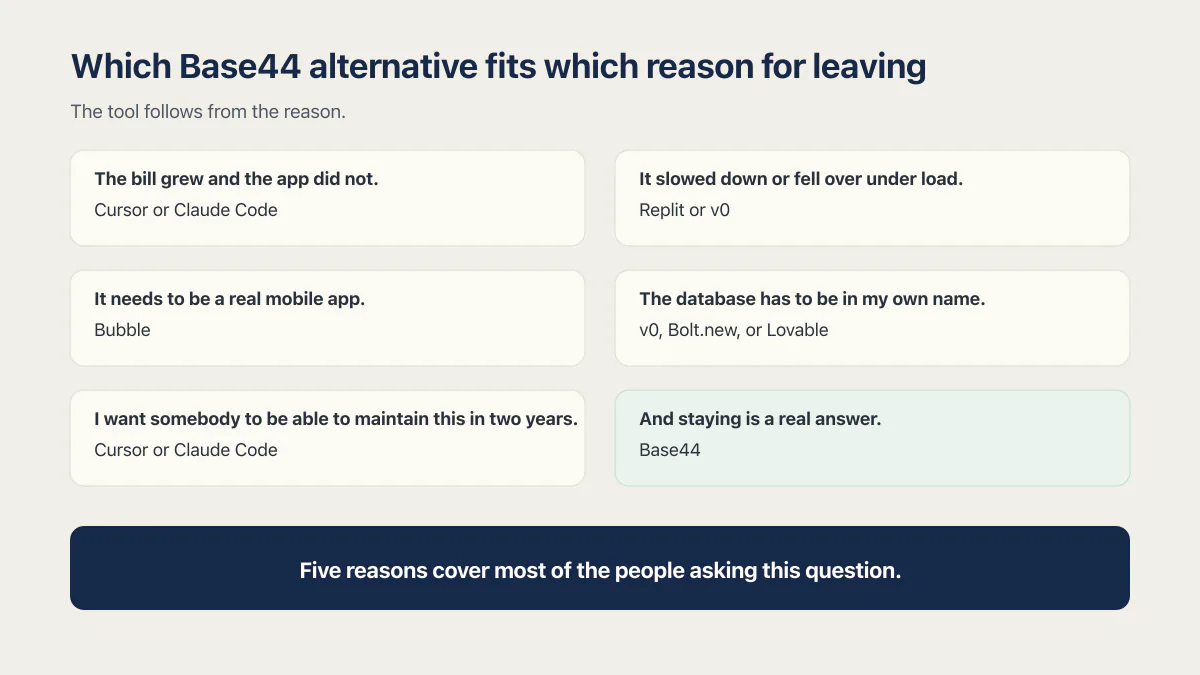
The tool follows from the reason. Five reasons cover most of the people asking this question, and one of the honest answers is to stay.
The bill grew and the app did not. These platforms meter building and running in different ways, so switching can move both costs rather than only the cost of generation. Cursor at $20 or Claude Code with Claude Pro at $20 moves the meter to your own model usage and your own host, which is cheaper only if you are willing to run the host.
It slowed down or fell over under load. This is a backend question and the builder is mostly irrelevant to it. Replit is the one platform here that ships a documented development and production database split, and v0 puts you on Neon or Supabase directly, which is where the tuning knobs live. Neither of them makes a slow app fast on its own.
It needs to be a real mobile app. Bubble is the only tool in this comparison whose own plans price mobile explicitly, at $49 a month for mobile only and $69 for both. Replit is the one builder here whose documentation describes generating a React Native app through Expo and uploading the iOS build for you, and what Replit does on iOS and Android is its own page. Everything else on the list produces a web app first, and getting that into a store is a separate packaging and submission job.
The database has to be in my own name, starting now. v0 by Vercel is the cleanest answer, because the provider account is provisioned in your name on day one. Bolt.new with Supabase chosen at setup is the second. Lovable qualifies only if you connect an external Supabase project instead of taking Cloud.
I want somebody to be able to maintain this in two years. Cursor and Claude Code, working a repository you already own. That is the only branch where nothing was ever taken custody of, and it is also the branch with the least help: an agent will not tell you the app was never ready.
And staying is a real answer. If the app is an internal business tool, if the people using it are people you already employ, and if you would rather the platform ran the backend than run it yourself, Base44 is doing exactly what you hired it for. Every row of evidence on this page says Base44 holds the database. None of it says holding the database is wrong. It says know that it does before you build the thing your business runs on.
Common questions about Base44 alternatives
What are some alternatives to Base44?
The ten covered here are Lovable, Bolt.new, v0 by Vercel, Replit, Cursor, Claude Code, Firebase Studio, Bubble, Glide and Softr. They split into three groups: tools where the database can sit in an account you own, tools that supply no backend at all, and no-code platforms with no repository. Which group you want depends on what you plan to hold after the app is generated.
What is the best free Base44 alternative?
Dyad, if free means no subscription. It is an open-source desktop app that runs the build loop on your machine and lets you bring your own model API key on the free tier, checked 17 August 2026. Every other free option here is a free tier on a paid tool: Lovable, Bolt.new, v0, Replit, Cursor, Glide and Softr all have one, and they exist so you can try the tool before paying.
Is there an open-source alternative to Base44?
Not an equivalent one. As of 17 August 2026 no open-source project self-hosts Base44’s combination of entities, agents, connectors, authentication and hosted runtime in one package. What is open source is the build loop: Dyad, and bolt.diy, which is the official open-source version of Bolt.new under an MIT licence. Both leave the entire backend for you to choose and run.
Can I move my Base44 app to one of these alternatives?
Yes, and it is a backend rebuild rather than an import. The React frontend moves with modest work. Base44 entities, data, queries and permission rules have to be mapped into whichever database or managed data model the destination uses. Your rows come out by CSV export, and that is the first step of the job.
Which Base44 alternative gives me the most control over my code?
Cursor and Claude Code, because neither one ever takes custody. They work a repository you already own, against a host and a database you already pay for, and the only mark they leave is in the git history: a cursoragent@cursor.com commit author, or a Co-authored-by trailer. Among the builders that generate a project for you, v0 by Vercel goes furthest, committing to a branch in your repository and opening a pull request.
Which Base44 alternatives can build a mobile app?
Bubble is the only one on this list that prices mobile as its own product line, at $49 a month for mobile only and $69 a month for web plus mobile, checked 17 August 2026. Replit generates a React Native app through Expo and can upload the iOS build for you, which its own mobile page walks through. The rest generate web apps, and getting one of those into an app store is a packaging and submission job that happens after the builder is finished.
Is Base44 or Lovable better for a non-technical founder?
Neither is better in general, and they fail differently. Base44 asks fewer questions because it runs the whole backend, which suits an internal business tool. Lovable asks which backend, and taking its Cloud default gets you a Supabase-shaped environment that Lovable provisioned instead of one in your own name. A non-technical founder who will never hire a developer is better served by the platform that decides more; one who expects to hand the code over is not.
Do any Base44 alternatives let me keep my data if I stop paying?
Yes, three ways. v0 by Vercel provisions the database on Neon, Supabase or Upstash under your own account, so the data was never the builder’s. Softr never stores the data at all: it is an interface over Airtable, Postgres, Supabase, Xano and others that you already run. Lovable and Bolt.new both qualify if you connect Supabase yourself instead of taking their built-in backend. Everyone else hands you an export, which is not the same as an account.
Is switching away from Base44 worth it?
It is worth it when the reason is who holds the database and the app has years left in it. It is rarely worth it for speed, cost or reliability alone, because those follow from how the app was built rather than which builder built it. Switching platforms on its own makes an app no safer, no more correct and no readier for load than it was; the permission rules, the database mapping and the queries all have to be rebuilt and checked again, as the migration section above describes. What changes for certain is who you would have to ask for permission to leave next time.
One thing this page cannot tell you, and I looked. Nothing in a public repository records whether the owner ever tried to leave and gave up. The four Base44 rows that record a different backend are the ones who finished. The ones who started and stopped look identical to the ones who never tried.
Built it with AI. Can’t get the last part right?
That’s the normal state of an AI-built app, and it’s fixable. I trace what the app actually does, explain what needs changing, and build it if you want me to.
Talk about your app →  Free 20-minute video call with Bilal.