Somebody has told you to rebuild the app, and the number attached to that advice is usually somebody else’s guess. What you have runs, customers touch it, and it took months and money to get this far.
This page is about software. The rebuild here is an application that already exists, half works, and would be written again from an empty folder, rather than a house, an engine, or a laptop that a repair shop quotes for.
Published rebuild prices for an app that already exists start at A$20,000 on one Australian seller’s ladder and reach £200,000 and above on a British one, both read on 31 August 2026. Both of those sellers also publish a repair price on the same page, and on both pages the repair price is the smaller number by a wide margin.
Every figure on this page comes from a seller’s own published page, read on 31 August 2026: two sellers that publish a rebuild ladder and a repair ladder side by side, one that publishes a starting figure with no date on the page, one that publishes a from-scratch column against a no-code one, and four rescue sellers whose pages publish a process and no price. Nothing here is averaged, converted between currencies, or carried across from another page.
Advice on how to rebuild an app is easy to find. What rebuilding an app costs to buy, from people who sell it, is not, and that gap is what the rest of this page fills.
What sellers publish for rebuilding an app that already exists
The cost to rebuild an app from scratch is published by exactly four sellers found for this page, read on 31 August 2026, in four currencies: Suffescom in Australian dollars, Foresight Mobile in pounds, Cotora in euros, and Ptolemay in US dollars for a from-scratch build set against a no-code one. Nothing here is converted.
| Seller | What the figure prices | Published figure | Read |
|---|---|---|---|
| Suffescom | ”Basic MVP App” rebuild | A$20,000 to A$50,000 | 31 Aug 2026 |
| Suffescom | ”Medium Complexity App” rebuild | A$50,000 to A$120,000 | 31 Aug 2026 |
| Suffescom | ”Enterprise App” rebuild | A$120,000 to A$300,000+ | 31 Aug 2026 |
| Foresight Mobile | ”Stabilise and patch” | £2,000 to £8,000 | 31 Aug 2026 |
| Foresight Mobile | ”incremental modernisation” | £8,000 to £40,000 | 31 Aug 2026 |
| Foresight Mobile | ”Substantial phased rebuild” | £25,000 to £80,000 | 31 Aug 2026 |
| Foresight Mobile | ”Full ground-up rebuild” | £65,000 to £200,000 and up | 31 Aug 2026 |
| Cotora | A full rescue, its stated starting figure | €50k, no date shown on the page | 31 Aug 2026 |
| Ptolemay | Custom code for basic features, its “Basic Features” row, stated as “Starting at” | $16,000 to $20,000 | 31 Aug 2026 |
| Ptolemay | A whole basic app from a no-code team, the figure its article opens with | $3,000 to $20,000 | 31 Aug 2026 |
All ten figures above were read on 31 August 2026. The source pages, in table order, are suffescom.com.au/blog/cost-to-fix-build-broken-app-project, foresightmobile.com/blog/how-much-does-it-cost-to-rebuild-a-mobile-app, cotora.eu/vibe-coding-rescue and ptolemay.com/post/diy-vs-professional-development-how-much-should-you-spend-on-an-app. None of the four is linked. Each sells build, rescue or rebuild work to the readers this page is for, so the credit here is a name and an address rather than a link.
Two of the four ladders are dated on the page itself. Suffescom’s is stamped 15 May 2026 and prices in Australian dollars, with the column headed “Estimated Cost (AUD)”. Foresight Mobile’s rebuild guide is stamped 27 June 2026 and prices in pounds. Cotora’s rescue page carries no date anywhere on it, which is why its €50k sits above with a read date and no publication date beside it. Ptolemay’s page is stamped 1 August 2025, the oldest source here by ten months, and its two rows are not a matched pair. The first is the custom-code cell of its “Basic Features” comparison row, which the page writes as starting at that figure. The second comes from the article’s opening paragraph and prices a whole basic app bought from a no-code team, which is a different unit again. They are printed here as two separate readings from one page rather than as two halves of one comparison.
The Foresight ladder is worth reading downward, because it is the only one that prices the decision rather than the outcome: its cheapest row buys time on the app you have, its middle rows replace parts of it while the old one keeps running, and only its top row is what most people mean by starting again. That top row opens at more than thirty times the bottom one.
Suffescom’s ladder is built on complexity instead, and the practical consequence is that the buyer has to decide which of the three words describes their own app before the page tells them anything. The seller does not define the boundary between medium and enterprise, so how much does it cost to rebuild an app depends on which row the seller puts you in, and that judgement is not published. The cost to rebuild an existing app, on this ladder, is a function of a word somebody else chooses. Rebuilding down to a first sellable version, rather than to everything the old app did, is costed differently again, and no row above tells you which of the two it assumes.
What the same sellers charge to repair the one you have
Both dated sellers print a repair ladder on the same page as their rebuild ladder, which makes the two sides at least internally comparable. The figures below come from the same two companies as the table above, read the same day.
| Seller | What the figure prices | Published figure | Read |
|---|---|---|---|
| Suffescom | ”Minor bug fixes” | A$1,500 to A$8,000 | 31 Aug 2026 |
| Suffescom | ”Security fixes” | A$10,000 to A$30,000 | 31 Aug 2026 |
| Suffescom | ”Full app rescue project” | A$25,000 to A$80,000+ | 31 Aug 2026 |
| Foresight Mobile | ”Targeted fixes”, the figure it opens on | £5,000 | 31 Aug 2026 |
| Foresight Mobile | ”full rescues”, its published range | £15,000 to £40,000+ | 31 Aug 2026 |
| Foresight Mobile | Its own four-week planning service, fixed price | £3,500 | 31 Aug 2026 |
All six figures above were read on 31 August 2026. The two source pages are suffescom.com.au/blog/cost-to-fix-build-broken-app-project and foresightmobile.com/services/app-rescue, neither linked for the reason given above. Foresight Mobile’s rescue page carries no date of its own, so its three figures are recorded by read date only. The £3,500 is that company’s own charge for its own named four-week planning service, which its page says is credited against your first development sprint.
Setting a rebuild cost against a repair cost from the same seller is the only comparison on this page that holds, and the gap is the whole argument. Suffescom’s smallest repair row and its smallest rebuild row are separated by a factor of about thirteen at the low end. Foresight Mobile’s targeted fixes open at £5,000 while its full ground-up rebuild opens at £65,000. Neither page claims the repair produces the same app; both claim it produces a working one.
The two sides are also priced by different units. A repair row prices a named thing that is broken, while a rebuild row prices a whole application sized by a word the seller chose, and only the first of those can be checked by a buyer before they agree to it.
One named broken thing in an app that otherwise works is a far smaller purchase, and it is priced on its own. Getting an app fit to take real customers, without replacing it, is priced against its own list of blockers. Neither of those is what the rebuild ladders above are selling.
Two boundaries belong here. Who you pay, and what each kind of seller charges by the hour, is published separately, and no rate of any kind appears on this page. The published market for tidying an app that stays where it is has its own sellers, its own bands and its own page of prices for cleaning up an app that stays put.
Why a second build is quoted higher than the first one
Sellers who publish both figures say the second build costs more than the first, and they give a reason: somebody has to understand the old application before anybody can write the new one. Foresight Mobile puts a multiple on it and a percentage uplift beside it, both read on 31 August 2026.
The sentence itself, from that company’s rebuild guide dated 27 June 2026:
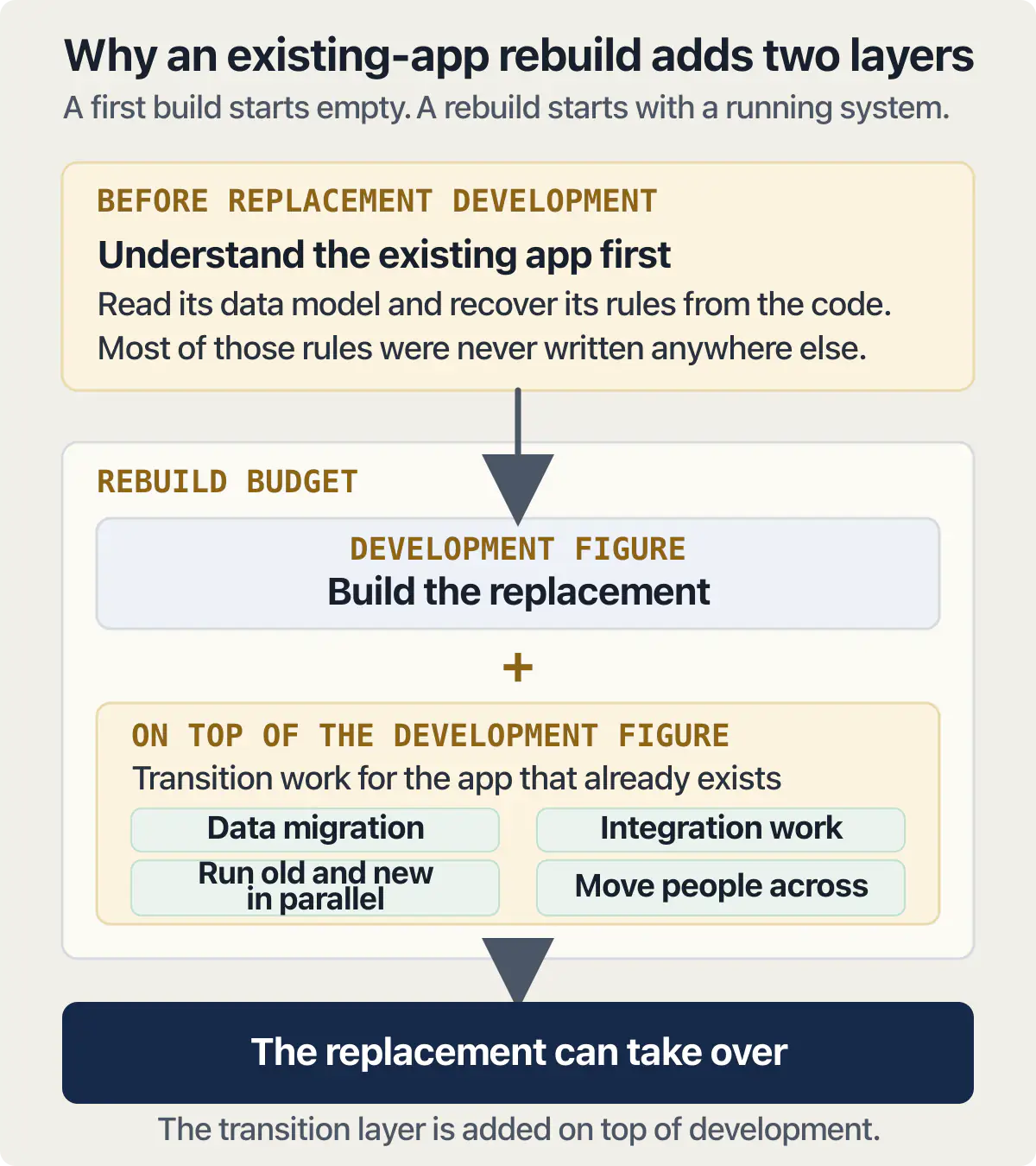
A full rebuild typically costs more than the original build, because you’re paying to understand the existing app as well as build the replacement.
That is the part a first-build guide cannot model, because it assumes there is nothing to read. The rules the app enforces today live in its code, most of them were never written down anywhere else, and the person about to replace it has to go and find them.
The same page puts a ratio on the distance between its own rows, saying that “a full rebuild costs roughly six to ten times a lighter modernisation”. It also states one named case: “one UK fintech replatformed for around £85,000, while a competing bid to fully rebuild the same thing came in at £450,000 over 18 months”. Two companies priced the same application and landed more than five times apart, because the two bids disagreed about how much of the existing thing was worth keeping.
Then there is the part that never appears in the headline row. That page tells its readers to “Budget another 30 to 45% on top of the development figure for the things that don’t show up in a demo: data migration, integration work, running old and new in parallel, and getting people moved across”, read 31 August 2026. Applied anywhere on that ladder, the uplift lands before anybody writes a line of the new app, and the page is unusual in printing it at all.
The same guide states a pattern about applications that started as prototypes: “A £60,000-equivalent proof of concept routinely becomes a £250,000 production system, roughly a four-fold jump.” That is the seller’s own generalisation rather than a case it names, and it is recorded here as such.
The bill that keeps arriving once the new version is live is counted separately, and none of the ladders above includes it. Keeping the new version alive after it ships, one month at a time, is a different arrangement again from paying to write it.
Why two published rebuild figures are not comparable
Four sellers price this job in four currencies and four markets. Two of their pages carry no publication date at all and one is a year old, so the read date is the only thing every figure here shares. Nothing on this page has been converted between currencies.
A band published for one country’s buyers is not a quote you can hold anybody to in yours. Start with the currencies, because they are the easiest thing to get wrong. Suffescom prices in Australian dollars and says so in its own column header. Foresight Mobile prices in pounds and writes about UK buyers. Cotora prices in euros. Ptolemay prices in US dollars. Any two of those four numbers can be made to look close or far apart depending on the day somebody converts them.
Then the dates. Suffescom’s page is stamped 15 May 2026 and Foresight Mobile’s rebuild guide 27 June 2026, so both were published within roughly three months of this reading. Cotora’s page and Foresight Mobile’s rescue page show no date at all, so the only honest thing to attach to their figures is the day somebody read them. Ptolemay’s page is stamped 1 August 2025, and a price that has sat untouched for a year is a price nobody has had to defend recently.
Then the markets. Rebuilding a consumer mobile app, rescuing a project that has already failed once, and building a first version in code rather than in a no-code tool are three different jobs wearing one word, and only the first two answer the question this page asks.
One system built for a single company’s own staff is quoted from a different market again, with its own publishers and its own bands, and none of the four sellers here is writing for that buyer.
Three nearby purchases have their own published prices and are not restated here. Moving the same app rather than writing it again is quoted by the sellers who do that specific job, and what moving an app onto different foundations is quoted at is set out with their figures. The fixed figures published for coming off one builder onto code you own are a narrower version of the same move. And what leaving one named builder costs end to end is set out with its own fetched prices, on both sides of the move.
The rescue sellers who publish no figure at all
Four companies that sell exactly this work publish a process and no price. Each of the four opened to a plain read on 31 August 2026 and rendered no figure of any kind.
- As of 31 August 2026, the app rescue and takeover page at KodingKlouds does not render a figure to an automated read.
- As of 31 August 2026, JustSolve’s vibe-coding rescue page does not render a figure to an automated read.
- As of 31 August 2026, Outsourcify’s vibe-coding rescue page does not render a figure to an automated read.
- As of 31 August 2026, Symilars’ guide to taking over an abandoned software project, published 14 July 2026, does not render a figure to an automated read.
The pages are kodingklouds.com/app-rescue-and-takeover, justsolve.solutions/services/ai-data-automation/vibe-coding-rescue/, outsourcify.net/vibe-coding-rescue/ and symilars.com/blog/how-to-take-over-a-failed-or-abandoned-software-project/, none of them linked, all of them sellers of the work this page prices.
What they publish instead is a sequence. KodingKlouds lists a repository and store access step, a written assessment it says takes three to five days, a fixed-scope plan, and a launch or relaunch. JustSolve publishes a phased model rather than a price and says “Most rescue engagements range from a few weeks to a few months”. Outsourcify publishes a two-phase framing in which the AI-built version proves the idea and the second phase turns that into a business. Symilars publishes a guide rather than a service page, and says a competent team should give “a recommendation on whether to continue building on the existing codebase or, in rare cases, rebuild specific modules that are beyond reasonable repair”.
Read those four absences honestly and they say the number does not exist yet, rather than that somebody is hiding it. The price gets set once a person has read the code, which is also why every band in the first two tables is wide enough to drive a second project through.
Every band on this page is wide because the price gets set after somebody reads the code, and not one of these sellers has read yours.
That also puts a floor under the cheapest useful thing a buyer can do here. Reading the application is a separate, much smaller purchase than either the repair or the rebuild, and what a seller charges just to read a codebase somebody else wrote is published by companies who do only that. The one published rescue ladder for an app somebody else built with AI sits on the page that already cites it, with its own figures.
Buying a rebuild as hours against buying it as one agreed number moves the risk of an overrun from one side of the table to the other, and the ladders above are all written in the second shape.
Why a search for rebuild cost returns build cost instead
Searching for what a rebuild costs returns pages about what a first build costs. On 31 August 2026, two search pulls for this question returned seventeen organic results between them, and sixteen priced building an application that does not exist yet. Adding the words “from scratch” made the results more about the first build, not less.
Two pulls on 31 August 2026, both US desktop and both for the natural phrasings of this question, made up the method. The first returned eight organic results, of which one, Suffescom’s page, prices repair against rebuild for an app that already exists. The second returned nine, and every one of the nine prices a first build. That single genuinely on-topic result from the first pull did not appear in the second at all.
A first-build guide prices an empty folder, and you do not have an empty folder. You have a data model somebody has to read, customers whose records have to arrive in the new shape, a set of rules that only exist inside the running code, and an old application that keeps taking money while the new one is written. None of those four appear as a line in a build guide, because none of them exist on a first build.
One person in the corpus described a rebuild that is exactly this shape, driven by a reason rather than by code quality:
i run membership ops for a wellness creator, paid tier, and were rebuilding the whole thing as one no-code app instead of the three tools it lives across now. the on demand video library is the bit im stuck on.
That is a rebuild of something that works today, with paying members inside it, and the hard part named at the end has nothing to do with how the original was written.
What a first build of the same idea would be quoted at today, as one number, is published in its own right, and it is a useful sanity check as long as nobody treats it as a rebuild figure. Where the money actually sits inside a build quote, row by row, is published on its own, and that breakdown is the more useful of the two here, because it shows which parts you have already paid for once.
Two adjacent products are priced from their own sources and are worth keeping separate from an app rebuild. A brochure site whose only job is to describe a business gets its price from a different set of published sources again. Something people sign up to in a browser, holding their own accounts, carries its own published bands, closer to this page’s subject but still priced as a first build.
Does the price of a second build buy an app with nothing wrong in it?
No published rebuild figure promises an application with nothing wrong in it, and the audit evidence says paying for a second one does not deliver it either. Paying developer money for a second application buys a new application that still needs its checks decided and shown working, because nothing in the audit evidence says a rebuild ships clean on its own.
The corpus row that started this page is somebody in exactly the position the ladders are written for:
I’m not a developer. I previously had a technical co-founder, but we recently went separate ways, so I’m currently rebuilding the product with a lot of help from AI.
They have no way to check any of the numbers above, no developer beside them, and a product that already exists. That is the reader every one of these ladders is quoting at.
The part that is easy to assume away sits in the audit data. The same audit method was run on five of AxonBuild’s own production applications in June and July 2026, put through the identical process as the third-party apps. Those five added 11 confirmed criticals and 100 confirmed medium findings to the corpus, and none of the 26 applications audited across the three cohorts came out clean. What 26 audited applications had in common is set out with the method and the cohort rules on the page that owns them. Those five are the founder’s own projects cohort inside a fixed historical set, and they are not a sample of anything larger.
The point is narrow and it is about the money. A rebuild is sold as the version without the problems, and the cohort audited by the people who wrote the audit still produced confirmed criticals of its own. Whatever the second build buys, it does not buy that.
Whether the app should be written again at all is a judgement about what is in the code, and it is worked through step by step on the page that owns that decision, with a break-even sum rather than a band. If the symptom pushing you toward a rebuild is that every change takes longer than the last one, why an AI-built app gets slower to change as it grows is explained where that pattern is diagnosed, without a price attached.
What AxonBuild does when somebody wants a rebuild
The 20-minute video call is free and needs no code. Show Bilal what the app does and what has convinced you it needs rebuilding. He will help you work out what needs checking before you decide. If the answer is a set of changes rather than a rewrite, and you want him to make them, he checks the app and gives you a fixed quote, and you pay after you see them working. AxonBuild does not write applications from scratch.
So nothing in the two tables above is an AxonBuild price. They are other companies’ published figures, read on one day, and they are here because a buyer choosing between a repair and a second build should be able to see both sides of the same seller’s page before anybody quotes them anything.
Common questions about the cost of rebuilding an app
Why do rebuild quotes differ so much between sellers?
Because the word covers at least four different jobs and no seller defines which one it is quoting. On the two dated ladders read 31 August 2026, one seller sizes rebuilds by complexity in Australian dollars, from A$20,000 to A$300,000+, while the other sizes them by how much of the old app survives, from £2,000 for patching to £65,000 and up for starting again. Two quotes for “a rebuild” can be pricing different amounts of the same application.
Ask which of the two shapes any quote in your hand is using before you compare it with anything.
Does a rebuild cost more than the original build?
On the one page that answers this directly, yes. Foresight Mobile’s rebuild guide, dated 27 June 2026, states that “A full rebuild typically costs more than the original build, because you’re paying to understand the existing app as well as build the replacement”. Reading the existing application is work the first build never had to pay for, and it happens before anybody writes anything.
The same page also tells buyers to add 30 to 45 per cent on top of the development figure for data migration, integration work, running both versions at once and moving people across.
Do sellers publish a price for rebuilding an app that already exists?
Four of the eight companies whose pages were opened on 31 August 2026 print a figure; the other four print a process and stop. The four that publish are Suffescom, Foresight Mobile, Cotora and Ptolemay, in four different currencies, and three of the four carry a date on the page.
That ratio is the most useful fact here: the market this question is about mostly does not publish, which is why the search results fill up with first-build guides instead.
Is a rebuild figure in one currency comparable with one in another?
No, and not only because of the exchange rate. A figure in Australian dollars, one in pounds, one in euros and one in US dollars describe four markets with different wage bases, different buyers and different ideas of what the word rebuild includes. None of the figures on this page has been converted, deliberately.
Treat a foreign band as evidence that somebody publishes a number for this job, not as a number you can hold a local seller to.
What does a published rebuild band assume about the app being replaced?
Usually nothing you can check, because no seller has seen your application when it writes the band. The complexity ladder read 31 August 2026 asks the buyer to place their own app in one of three rows, without publishing where the boundaries sit. The other ladder asks a different question, how much of the existing app survives, which at least maps onto something a buyer can see.
The one thing every band assumes is that somebody will read the existing code first, and that reading is where the real number comes from.
Does paying more for a rebuild get a better result?
Not on its own. Across the 26 applications audited in June and July 2026, none came out clean, including five of AxonBuild’s own production applications, run through the same audit as a separate cohort, which added 11 confirmed criticals and 100 confirmed medium findings to that corpus. Spending more on the writing does not automatically buy the tests, the error records and the deploy checks that decide how the second version behaves.
Both routes need those three things, and what it costs to add them to the app you have today depends on how it is built and what it connects to, which is priced after somebody reads it.
Is a fixed price or an hourly rate normal for a rebuild?
Every published rebuild figure found for this page on 31 August 2026 is a fixed band rather than a rate, including both dated ladders and Cotora’s single starting figure. Foresight Mobile’s rescue page publishes fixed figures for targeted fixes and full rescues rather than an hourly rate, and its four-week planning service carries one fixed price of £3,500.
A published band still stops short of being a fixed price. It marks the range a seller will put in public before seeing your code, and the number inside it gets agreed afterwards.
Will AxonBuild rebuild my app?
No. AxonBuild changes apps that already exist: fixing what keeps breaking, finishing what stopped short, adding what customers asked for. The 20-minute video call is free, and if you want changes made they are quoted after the app has been checked, paid after you see them working.
Any set of changes to the app you already have is quoted after Bilal has checked the code, not off a published band.
Built it with AI. Can’t get the last part right?
That’s the normal state of an AI-built app, and it’s fixable. I trace what the app actually does, explain what needs changing, and build it if you want me to.
Talk about your app →  Free 20-minute video call with Bilal.