This page is about one system built for one company’s own staff: customer records, quotes, invoices, job scheduling, client files, the screens your own people open every morning. An app built for a store listing or a public audience is priced from a different set of published sources than a system built for one company’s staff.
Search the price of that internal system and you get a wall of bands. Read the pages behind them on the same day, as this one did, and they do not agree with each other by anything close to a factor of two. One CRM guide opens its cheapest tier at $24,000. One software house opens its cheapest tier at $100,000 for the same words. Neither is lying. They are pricing different amounts of work under labels nobody standardised.
There is a second problem, and it is bigger. Every page on this search prices the build. Not one of them prices the thing the build would replace. You are almost certainly already paying a monthly subscription that does most of this job badly, and that subscription publishes its price on its own website. Until those two numbers sit next to each other, the question cannot be answered at all.
Custom software for one company’s staff is published between $24,000 and more than $1,000,000 by the sellers who rank for this search, read on 30 August 2026. The subscription that system would replace publishes a price too, and over one year at five seats it is a much smaller number than any of them.
The cost of developing a software system, according to the pages that publish a number
Six sellers on this search publish a figure of their own rather than a form. Their floors sit between $24,000 and $100,000, and five of the six carry a ceiling between $200,000 and more than $1,000,000, which is a spread of more than ten times on the same three words.
Every build figure below was read on 30 August 2026 from a page that ranks for this exact search and publishes a number of its own, and every subscription figure from the vendor’s own pricing page the same day; each one is printed with the seller’s name and the label that seller puts on it, nothing is averaged across sources, and where a page would not show a price to an automated read that is said rather than filled in.
| Seller and page date | What they call it | Published figure |
|---|---|---|
| RaftLabs, 26 March 2026 | ”Basic CRM”, 8 to 12 weeks | $24,000 to $45,000 |
| APPWRK, 10 July 2025 | ”Startups/SMBs”, 3 to 4 months | $25,000 to $45,000 |
| Purrweb, 30 April 2026 | ”Basic CRM (small sales team)“ | $30,000 to $60,000 |
| Saritasa, 5 June 2025 | ”Basic MVP / Internal Tool” | $50,000 to $100,000 |
| SOLTECH, no date shown to a reader | ”Small business software” | $75,000 to $100,000 |
| SOLTECH, no date shown to a reader | ”Small applications” | $100,000 to $200,000 |
| ScienceSoft, no date rendered | ”Operations management software”, average complexity | about $200,000 to $400,000 |
| RaftLabs, 26 March 2026 | ”Enterprise CRM”, 20 to 40 weeks | $150,000 to $360,000+ |
Prices checked 30 August 2026. The eight rows come from raftlabs.com/blog/crm-development-cost, appwrk.com/insights/crm-software-development-cost-guide, purrweb.com/blog/crm-development-cost/, saritasa.com/insights/how-much-does-custom-software-development-cost, soltech.net/how-much-does-custom-software-development-cost/ and scnsoft.com/software-development/costs. None of the six is linked: every one of them sells the building work this page is about, so each appears here as a name and an address with no link on it. Two of them, SOLTECH and ScienceSoft, show a reader no publication date at all, so their bands could have moved silently at any point and you have no way to tell.
Above those tiers, the headline numbers go higher. Saritasa puts “most projects” at $50,000 to $250,000 and says the figure “can exceed $1 million for complex enterprise systems”. ScienceSoft puts a medium or large application at $50,000 to $1,000,000. SOLTECH puts enterprise-level software at “$400,000 or more”. Purrweb puts a custom CRM at $30,000 to $200,000. Enterprise app development cost, in the vocabulary these pages share, simply means the top band with no upper limit written down.
So what is the average software development cost? There is no honest answer, and any page that gives you one has averaged numbers that were never measuring the same thing. What does exist is a distribution, which is worth more than a band. FullStack Labs, updated 27 August 2026, republishes a GoodFirms breakdown of where real projects actually land: 14.1 percent under $30,000, 65.7 percent between $30,000 and $100,000, 14.1 percent between $100,000 and $200,000, and 6.3 percent at $200,000 and over. Two thirds of the market sits in one band that no headline on this search leads with. On the same page, Clutch’s verified reviews put a typical project between $10,000 and $49,000 with an average of roughly $132,480 over about 13 months, which tells you how far one long project drags an average away from the middle. That page is fullstack.com/labs/resources/blog/software-development-price-guide-hourly-rate-comparison, named rather than linked for the same reason as the six above.
Choosing which kind of seller to ask in the first place is a different decision from working out what they will charge. Which line inside a build quote holds which part of the money is set out feature by feature elsewhere. Turning a shape into a number for one specific project, without a form to fill in, is a separate piece of arithmetic. This page is doing something narrower: putting the published custom software development costs next to the published price of the thing you are already renting.
How a quote gets to six figures
Most of a six-figure quote is hours multiplied by a rate, with hosting, third-party services and the seller’s risk margin on top where the quote names them. The rates most sellers publish are not six-figure rates, so the money is mostly in the hours. Once you can see both halves, the cost of custom software development stops being mysterious and starts being a question about what those hours are for.
ScienceSoft, on the page read for this article, states its effort in hours before it states anything in money: a simple system takes about 500 to 700 hours, a medium one about 700 to 1,200, and a complex one more than 1,200. That is the only honest unit on this whole search, because it survives every argument about which country the work happens in.
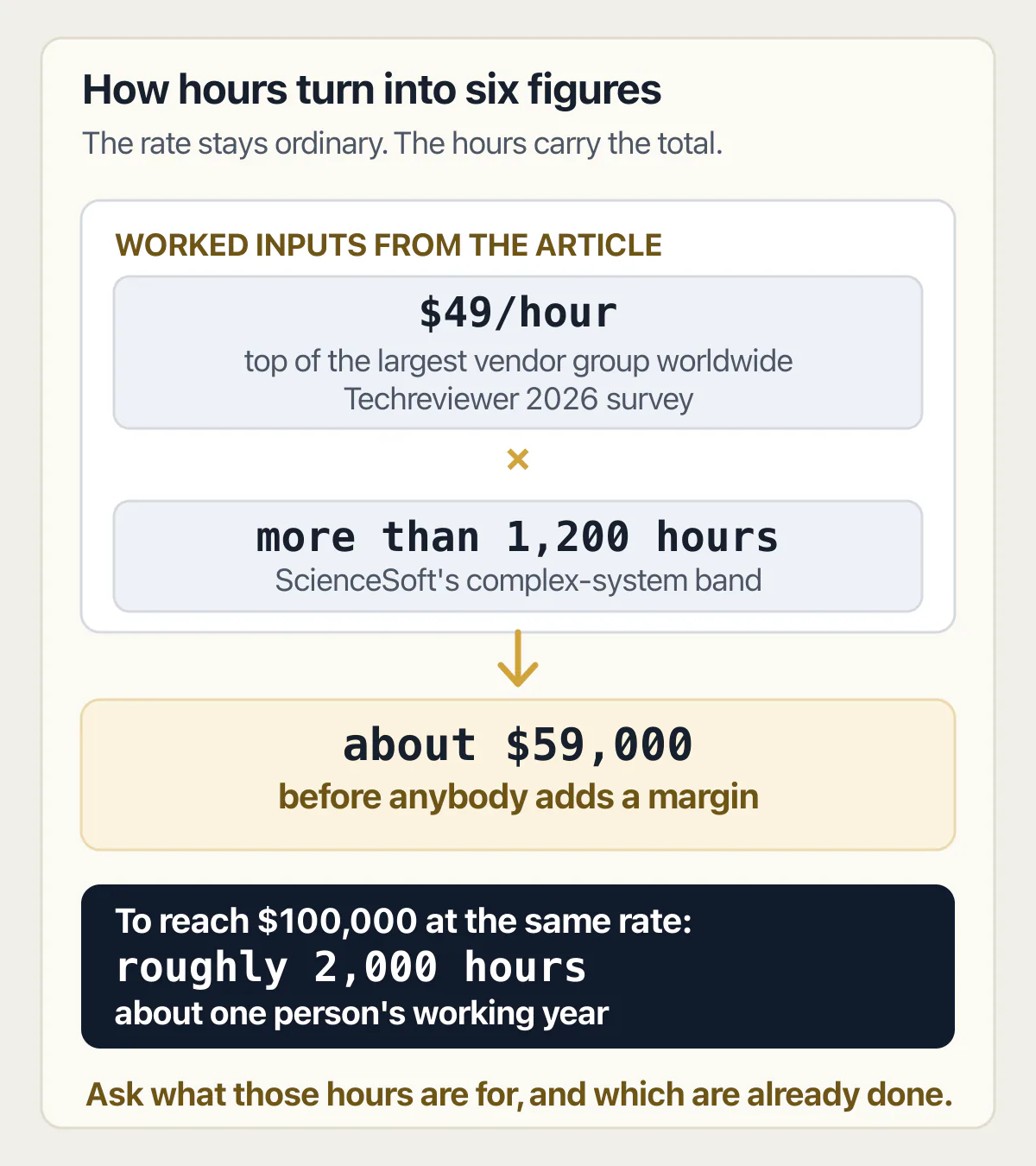
Now the rate. FullStack Labs, updated 27 August 2026, cites the Techreviewer 2026 survey of software development providers and reports that the largest single group of vendors worldwide bills $30 to $49 an hour, and that roughly 90.5 percent of firms in that dataset bill under $100 an hour. Software development price is not the reason quotes reach six figures. Software development pricing at those levels is a statement about volume.
Do the arithmetic on the seller’s own inputs. As an illustration, since the rate and the hours come from different sources: at the top of that largest group, $49 an hour, ScienceSoft’s complex band of more than 1,200 hours is about $59,000 before anybody adds a margin. To reach $100,000 at the same rate you need roughly 2,000 hours, which is about a year of one person’s working life. That is the question to take into the next call: not “why is it so expensive”, but “what are the two thousand hours for, and which of them have already been done”.
For what one person or one firm charges per hour rather than what a whole system is quoted at, the published rates individuals and agencies actually charge collects the published rate sources in one place. How many people a seller puts on the work, and what that group is called, is decided before any total is agreed.
What you already pay to rent the same job
The products that do this job publish their prices. Read on 30 August 2026, they run from free at two users to HubSpot’s $150 per seat a month at its Enterprise tier, and the plans in the table below land, at five seats over one year, between about $1,200 and $7,500.
Somebody in a public thread described the state most buyers are in before they ask for a build price at all:
… custom fields everywhere, weird automations, Zapier/Make duct tape, spreadsheets on the side, and reporting that nobody fully trusts.
That was posted in public and is reproduced here word for word, from the set of posts collected for this blog, with no name attached and nothing linked. The tools they name are theirs, not a recommendation here. What matters is that the person writing it is already paying for something. The subscription has a published price, and that price is the number the build has to beat.
Here is what the products that do this job publish, read on 30 August 2026. The last column multiplies out at five seats over one year, because a seat count hidden inside a comparison is how these arguments get won dishonestly.
| Product and plan | Published price | What the price counts | Five seats, one year |
|---|---|---|---|
| HubSpot CRM, Free | $0/mo | ”Free for up to 2 users” | $0, capped at 2 |
| HubSpot Sales Hub, Starter | $20/mo/seat monthly, $7/mo/seat annual | per seat | $1,200 monthly billing |
| HubSpot Sales Hub, Professional | $100/mo/seat monthly, $90/mo/seat annual, plus a one-time onboarding fee of $1,500 | per seat, onboarding required | $7,500 first year |
| Jobber, Core | $49 a month, 1 user included, extra users $29 a month each | per company plus seats | $1,980 |
| Jobber, Grow | $199 a month, 5 users included | per company | $2,388 |
| SimplePractice, Starter and Essential | $49 and $79 a month | per practitioner | $588 or $948 for one |
| Zoho CRM Plus | ”Starts at $20/user/month” | per user, bundled apps | $1,200 |
Prices checked 30 August 2026. HubSpot’s figures come from HubSpot’s Sales Hub pricing page and HubSpot’s CRM pricing page, SimplePractice’s from SimplePractice’s pricing page, and Zoho’s from Zoho’s CRM pricing page. Jobber’s figures come from getjobber.com/pricing/ and that page is named rather than linked, because it is one of the two products the buyer quoted further down this page named as what they replaced. The monthly, no-commitment figure is the one printed for every plan here: each of these pages was also running a discounted rate on the day it was read, and a promotional price is not what the software costs.
HubSpot’s Enterprise tier is published at $150/mo/seat with a one-time onboarding fee of $3,500. Zoho’s Free Edition is free forever for up to 3 users. As of 30 August 2026, Zoho’s CRM pricing page does not render a US dollar figure for its individual editions to an automated read.
Salesforce belongs in any list like this one, and people do search salesforce app development cost when they are pricing a system to sit alongside it. As of 30 August 2026, Salesforce’s sales pricing page does not return a page to an automated read. The address read twice on the day, and refused twice, was salesforce.com/sales/pricing/. That is a documented refusal on the day, not a claim about what Salesforce charges, and no figure of theirs appears anywhere here.
Regulated records are the same shape with a different label. The cost of EHR software for a small practice is published: SimplePractice lists Starter at $49 a month and Essential at $79, with a higher tier above them, and an ePrescribe add-on at a standard $49 a month plus a one-time setup fee of $89, all read on 30 August 2026. Telemedicine software cost and telehealth software cost sit inside those same plans rather than beside them, which is why a practice comparing a build against a subscription is comparing against a few hundred dollars a month, not a few thousand.
One buyer was quoted an annual licence for a property management system that was, on its own, one line of a much larger number. That is the other half of the rent side: the licence is often not the whole rent. A product with public sign-ups and its own customer accounts prices differently from a system only your own staff will ever open.
Renting against building: custom CRM development cost against the subscription it replaces
At five seats, every published build band on this search is worth between five and forty-two years of the subscription it would replace, depending on which pair you match. As of 30 August 2026, six sellers ranking here put a custom business system between $24,000 and more than $1,000,000, while the products those systems replace publish $20 to $150 per seat a month.
A person on a public forum described exactly this system, in their own words:
I used base44 as a small construction business owner to build my own/vibe code a CRM and custom quote and invoice software with project management and job costing.
Another post from the same collection, printed exactly as written, again with no name attached and nothing linked. The lower-case tool name and the wording are theirs. It is worth reading twice, because it names the whole system in one breath: customer records, quotes, invoices, project management and job costing, for one small business, built by the owner.
Take that as the worked example. A five-person service business wants those five things in one place. It currently runs on a field service subscription. Small business app development cost, as a search, is people asking what the alternative to that subscription costs.
| What five seats cost you now, one year | What the published build bands say | Years of subscription that build equals |
|---|---|---|
| Jobber Grow, $199 a month, 5 users included: $2,388 | RaftLabs “Basic CRM”, $24,000 to $45,000 | about 10 to 19 |
| Same, $2,388 | APPWRK “Startups/SMBs”, $25,000 to $45,000 | about 10 to 19 |
| Same, $2,388 | Purrweb “Basic CRM”, $30,000 to $60,000 | about 13 to 25 |
| Same, $2,388 | Saritasa “Basic MVP / Internal Tool”, $50,000 to $100,000 | about 21 to 42 |
| HubSpot Sales Hub Professional, 5 seats at $100/mo/seat monthly billing plus $1,500 onboarding: $7,500 first year, $6,000 after | Purrweb “Basic CRM”, $30,000 to $60,000 | about 5 to 10 |
| HubSpot Sales Hub Starter, 5 seats at $20/mo/seat monthly billing: $1,200 | RaftLabs “Basic CRM”, $24,000 to $45,000 | about 20 to 38 |
Every input in that table is visible: the seat count is five, the year is twelve months of the no-commitment monthly price, and the build figures are the sellers’ own from the table further up. Nothing here is a number for your project, and there is no form to produce one. If your seat count or your plan is different, the two numbers you need are on the same two pages this table read.
That arithmetic is why “How much does it cost to build your own CRM?” is a question a real person typed into a public forum this month rather than a marketing headline. At the published bands, buying the build outright is a decision to prepay somewhere between five years and four decades of software. One owner rented a customer system for their own small team for years and now calls that absurd, which is the same sum run in the other direction.
Two honest caveats sit under the comparison. The subscription price rises and the build price does not, so the crossover moves toward the build over time; and the build has a second bill under it that the subscription hides, which is the subject of the last section here. Comparing another year of a subscription against paying somebody once has its own worked comparison.
What the AI builders changed about the floor, and what they did not
The published floors on this search describe a market that no longer starts where they say it starts. A first working version of an internal system now stands up in days, by the owner, without a seller involved. What did not change is everything after the first version.
Only one page on either of these searches concedes the shift with a number of its own. SOLTECH says AI “can reduce development effort by roughly 20-30% compared to traditional approaches”, read 30 August 2026 with no date shown to a reader. That is the honest ceiling of what an agency will admit in public, and it is measured against their own process rather than against what a business owner can now do alone in a weekend.
The people doing it, in public posts collected for this blog, describe something further out than 30 percent. An accounting firm owner built the system their firm runs on over a weekend without writing code, in place of the kind of rollout consultants normally sell. One agency owner said the software they had paid to build over years could now be recreated for a small fraction of the labour. Another owner posted publicly that big-ticket enterprise rollouts were finished, and the firm that had sold them their last one got in touch within days. A large group of owner operators describe the same move in public: a monthly or yearly subscription cancelled and replaced by something they built themselves.
None of those people are quoted here with a figure, because their figures were not published on a pricing page and would be worth nothing next to the ones that were. What their accounts do establish is direction. The floor for “a working first version of an internal system” has collapsed toward the price of a tool subscription and the owner’s own weekend, while the published floor on this search stayed between $24,000 and $100,000.
What the tools themselves charge before anybody is hired is counted separately. Swapping the builder you already pay for, rather than commissioning a build, is a shortlist question with its own table.
What did not move is the part the demo never shows: who may do what inside the system, what happens to the data when somebody leaves, and what breaks silently when two people use it at once. That part is where the remaining money is, and it is worth being precise about it.
Where the money still goes once the first version works
The first version of an internal system is now cheap and the last part of it is not. The last part is the one that decides who can see whose records, who can change a price, who can delete a customer, and whether the answer holds when nobody is watching.
That is not a theoretical worry. In an audit of 26 real applications built with AI tools between June and July 2026, 11 of the 21 third-party applications in the confirmed-finding ledger had endpoints doing privileged work with nobody signed in at all, counted from that ledger of adversarially checked findings rather than from a scanner’s raw output. That is what twenty six audited applications had in common, and it is the single most expensive thing missing from a working first version of a system built for staff.
One application in that cohort was a CRM dashboard that kept its whole customer record set in the browser’s local storage. Every contact, every note, every value the staff had typed, held on the machine of whoever happened to be looking at it, one “clear data” away from gone and never on a server anybody could restore from. It worked perfectly in a demo. It is the exact system this page is about, built to the point where it looks finished.
Three other lines carry real money after the first version works. The data you already have has to get into the new system, and it is never as clean as anybody remembers. The meter under it keeps running: if the system calls a model to summarise a job or draft a message, what one AI feature costs per customer once people use it is worked out per user elsewhere, and it is a bill that scales with use rather than with seats. And somebody has to be reachable when it breaks at nine on a Monday. What sellers publish for cleaning up a system that already exists, rather than for commissioning a new one, sits on a page of its own.
AxonBuild changes systems people have already built with AI tools. If a system like this already runs and something in it is broken or missing, show Bilal what happens and what you have tried on a free 20-minute video call. If you want him to make the change, he checks the system and gives you a fixed quote, and you pay after you see it working. Building a whole custom system for a business from nothing is not what AxonBuild does, and this page exists to tell you what other people charge for it rather than to sell it to you.
What it costs to take a working internal system from a first version to something staff depend on every day is counted separately.
What published software development costs leave out
Every band on this search excludes at least one line that the same page names further down. Add the excluded lines back and the honest total is meaningfully above the headline, on the sellers’ own arithmetic.
| The excluded line | Who publishes a figure for it | The published figure |
|---|---|---|
| Moving your existing data in | Purrweb, 30 April 2026 | $3,000 to $15,000 |
| Significant integrations and data migration | FullStack Labs, 27 August 2026 | 20 to 30 percent on top |
| Annual maintenance | Saritasa, 5 June 2025 | 15 to 20 percent of initial development cost per year |
| Yearly support | ScienceSoft, no date rendered | about 15 to 20 percent of the original development cost |
| Annual maintenance | FullStack Labs citing GoodFirms, 27 August 2026 | 10 to 20 percent of build cost annually |
| Running the thing after launch | RaftLabs, 26 March 2026 | $200 to $1,500 a month |
| Infrastructure and hosting inside the build | Saritasa, 5 June 2025 | 5 to 15 percent of the initial build, plus monthly fees |
Prices checked 30 August 2026. Read that table as one sentence: on the sellers’ own numbers, a $50,000 build is a $60,000 build once migration and integrations land, and it carries $5,000 to $10,000 a year afterwards before anybody adds a feature. Against a subscription at a few thousand a year, that changes the comparison materially, and none of the pages that publish the band puts the two together on the same screen.
Compliance work is the line nobody prices at all. If the system holds patient records, card details or anybody else’s personal data, the work of proving that in writing sits outside every band on this search, and it does not get cheaper because an AI tool wrote the first version.
Two things are worth handing off cleanly rather than half-answering here. The bill that arrives every month whether or not anybody opens the code is a different sum with different inputs. Paying a person to keep the system working month after month is a separate arrangement from the price of building it. Starting the same system again from nothing, after a first attempt did not hold, is priced on its own terms. And before any of that, what sellers charge simply to read code somebody else wrote is published separately, which is the cheapest way to find out whether what you have is worth finishing. Who holds the copyright in software you paid to have written is settled in the contract, not in the price.
Common questions about the cost of custom software
How much does custom software development cost?
Between $24,000 and more than $1,000,000, depending entirely on which seller you ask. Read on 30 August 2026, RaftLabs opens at $24,000 for a basic CRM, APPWRK at $25,000, Purrweb at $30,000, Saritasa at $50,000 for a basic internal tool and SOLTECH at $75,000 for small business software, while Saritasa and ScienceSoft both put complex systems above $1,000,000. The useful number is the distribution rather than the band: FullStack Labs, citing GoodFirms, puts 65.7 percent of real projects between $30,000 and $100,000.
Why do quotes for the same system differ by ten times?
Because none of the words in the request are standardised, and the hours are what is really being quoted. ScienceSoft publishes its effort in hours before money: about 500 to 700 for a simple system, 700 to 1,200 for a medium one, more than 1,200 for a complex one, read 30 August 2026. Two sellers can hear the same description and count 600 hours or 2,000 hours of it, which is more than three times the money at the same rate; the rest of a tenfold spread comes from the rate itself, the risk margin and what each seller counts as inside the scope.
Is it cheaper to build your own system or keep paying the subscription?
At five seats, the subscription is cheaper for at least five years on every published band, and for a decade or more on most. Jobber’s Grow plan is $199 a month with five users included, which is $2,388 a year, and HubSpot Sales Hub Professional at five seats on monthly billing is $6,000 a year plus a one-time onboarding fee of $1,500, both read 30 August 2026. Against build bands whose floor is $24,000, that is roughly five to forty-two years of subscription. The build wins on control, on data you own, and on the things the product will never do, not on price.
How much does a custom CRM cost to build?
Three sellers who rank for this exact search publish a tier, read 30 August 2026: RaftLabs puts a basic CRM at $24,000 to $45,000 over 8 to 12 weeks and an enterprise one at $150,000 to $360,000+ over 20 to 40 weeks, APPWRK says custom CRM work “typically starts at $15,000” and puts a startup or small business build at $25,000 to $45,000 over 3 to 4 months, and Purrweb puts the whole category at $30,000 to $200,000 with a basic system at $30,000 to $60,000. None of the three publishes what the CRM subscription it replaces costs.
What does it cost to develop a software product for internal use only?
Saritasa is the only page on this search that names the internal case as its own tier, at $50,000 to $100,000 for a “Basic MVP / Internal Tool”, published 5 June 2025 and read 30 August 2026. SOLTECH’s nearest equivalent, small business software, is $75,000 to $100,000 with no date shown to a reader. Internal-only work removes the store, the public sign-up flow and most of the design budget, and it adds the part that decides who inside the company is allowed to do what.
What does electronic health record software cost?
For a small practice, the published rent is a few hundred dollars a month, not a few thousand. SimplePractice lists Starter at $49 a month and Essential at $79, with a higher tier above them, and an ePrescribe add-on at a standard $49 a month plus a one-time setup fee of $89, read on 30 August 2026. Building the equivalent lands in the same bands as any other custom system, with the added work of proving how records are handled, which none of the build pages on this search prices.
Can a business get custom software without hiring a developer?
A first working version, yes, and business owners are doing it every week. A public forum comment from a construction business owner describes building a CRM with quoting, invoicing, project management and job costing on an AI builder, alone. What that route does not produce on its own is the part that decides who can see whose records and what happens when the data has to be recovered, which is where the remaining cost sits.
What is the lowest published price for custom software development?
$15,000 as a stated floor, from APPWRK’s CRM guide dated 10 July 2025, which says custom CRM work “typically starts at $15,000”. The lowest tier price actually published on either search is RaftLabs at $24,000. Anything below that is either a different product, a different definition of finished, or a number produced by a form. Read all three pages on 30 August 2026.
Do you still need a developer after the software is built?
Yes, and the sellers who publish bands say so themselves in their own small print. Saritasa puts annual maintenance at 15 to 20 percent of the initial development cost, ScienceSoft at about 15 to 20 percent yearly, and FullStack Labs, citing GoodFirms, at 10 to 20 percent of build cost annually, all read 30 August 2026. RaftLabs separately publishes $200 to $1,500 a month for hosting and infrastructure after launch. On a $50,000 build, that is $5,000 to $10,000 a year before any new work is asked for.
Built it with AI. Can’t get the last part right?
That’s the normal state of an AI-built app, and it’s fixable. I trace what the app actually does, explain what needs changing, and build it if you want me to.
Talk about your app →  Free 20-minute video call with Bilal.