Search app development cost calculator and every result on the page is a form. Nine of nine, on 30 August 2026, and there is no editorial result anywhere on that search: every page ranking on it is published by a company that sells the work being priced, or in one case sells the estimator itself.
Somebody asking for help online in July 2026 opened with this: “I’m looking for some advice on the estimated cost and feasibility of building a cu…” That is the person these tools are built to catch, and it is the person they serve worst, because the honest answer to what a piece of software will cost depends on things no dropdown can see.
The nine calculators named below are the nine results Google returned for app development cost calculator on 30 August 2026. Each page was read that day, down to the questions it puts to a visitor and the contact fields it collects, and not one of them was filled in or submitted. Every price quoted here is a range its publisher prints in ordinary text on the page itself, read that same day; no number produced by a calculator appears anywhere on this page, and none of these figures is a price for your app.
App development cost calculators are lead forms with arithmetic attached. All nine on this search ask what you plan to build, six collect contact details somewhere in the flow, and none of the seven whose questions could be read has an input for an application that already exists and already runs; the other two did not disclose their questions.
What a mobile app development cost calculator actually asks you for
Every one of the nine asks the same underlying question in a different order: what do you intend to build. The differences that matter to you are which of them shows a figure before it wants your details, and how many questions it puts between you and that figure.
| Publisher | What it asks first | A number before contact details? | Contact fields |
|---|---|---|---|
| EstimateMyApp | Which items describe your app, platform first: web, iOS or Android | Yes, a running total | None; an optional newsletter box |
| Trango Tech | Business domain | Yes, one range in prose | Full name, telephone, email |
| Sommo | Authentication types | Yes, one line in prose | Name, email, app name, after the estimate |
| AppDevelopmentCost.com | A questionnaire it times at under three minutes | Yes, a full set of ranges in prose | None stated for the questionnaire |
| Agicent | Platforms to target first | Yes, four figures in its own answers | Name and email; phone optional |
| ScienceSoft | App type, from a list of fourteen | No | Full name and work email |
| Digitalya | Not disclosed to an automated read | No | A form opens before anything happens |
| Simpalm | Platform | No | First name, last name, email, phone |
| AppCost.AI | Not disclosed to an automated read | Only its own product prices | Not stated on the landing page |
The nine pages behind that table, all read on 30 August 2026, are estimatemyapp.com, application.trangotech.com/app-development-cost-calculator/, www.sommo.io/calculator, www.appdevelopmentcost.com, www.agicent.com/app-development-cost-calculator, www.scnsoft.com/application/mobile/development/calculator, digitalya.co/app-cost-calculator/index/, www.simpalm.com/app-cost-calculator and appcost.ai. Not one of those addresses is a link here. Every publisher on that list either sells the build it is pricing or sells an estimate of it, aimed squarely at the reader who typed the search, so each is credited by address and left unlinked.
The length of the questionnaire varies more than the questions do. Simpalm runs five groups: platform, then design quality, app features, backend admin features and post-production support. Sommo runs twelve, opening on which authentication types the product will support and working through design complexity, user roles, functionality, extra features, third-party integrations, an admin panel, support level, security level, analytics level, whether you need Android and iOS apps, and which native features. Trango Tech groups its questions by business domain, platform, target audience, features, integrations, revenue and security. Agicent opens on platforms and closes on a contact form headed with a line about filling in a little information. ScienceSoft branches: pick your app type from a list of fourteen that starts at telehealth and runs through ride hailing to an AI assistant app, and the questions that follow depend on which one you picked, taking in company type, specific features, compliance needs, platform, design status and deadline.
EstimateMyApp is the outlier and worth naming for it. It is the only one of the nine that shows a running total with nothing asked of you at all, and the only one that lets you edit the rates the arithmetic uses: it offers editable Design Day Rate, Developer Day Rate and Project Manager Day Rate fields, so you can see the number move when you change what a person’s day is worth. That is closer to an honest tool than anything else on the search. Its only date is a footer reading ”© 2020 OOZOU”.
Two of the nine did not disclose their questions. As of 30 August 2026, digitalya.co’s calculator landing page does not disclose its questions to an automated read; it states that the tool asks “only five short questions” without listing them, and a form has to be opened before anything happens. As of 30 August 2026, appcost.ai’s landing page does not disclose its estimator’s questions to an automated read either; it describes the tool as letting you “Fine-tune project parameters, features and team composition with manual controls or AI assistance …”.
What happens at the end is where the seven diverge from the two. ScienceSoft shows nothing and asks for a full name and a work email, and its confirmation reads: “Thank you for your request! We will analyze your case and get back to you within a business day to share a ballpark estimate.” Simpalm shows a heading that says the estimated cost of your project is, then the instruction “Please submit the information below to see the estimated cost”, with first name, last name, email address and phone number all marked required. Trango Tech asks for a full name, a telephone number and an email under a line about getting a detailed breakdown of your app cost. Agicent requires a name and an email, marks the phone number optional, and states plainly that it never calls and can only contact you by email; it says the answers arrive as a manual quote range rather than an instant number. Sommo asks for your name, your email and the name of your application, but only after the estimate has already appeared.
Here is the finding the table exists to carry. Every input on the seven calculators whose questions could be read describes something that has not been built. Platform, design level, feature counts, user roles, integrations, admin panels, compliance regimes: all of them are choices you make before anybody writes code. There is no field on any of the seven for “it already runs”, no field for “sign-in works but I do not know if it holds”, and no field for “a builder wrote most of this and I cannot read it”. An app cost calculator is a pricing tool for a decision you have not made yet, and the moment you have made it, the tool stops applying to you.
What those same pages print in ordinary text, before any form
Four of the nine print build prices in plain prose on the page, outside the calculator, where anybody can read them without giving anything up. Those figures are the useful part of this search, and they are the only figures reproduced here.
| Publisher and page | What the band is for, in the page’s own words | Figure |
|---|---|---|
| Sommo, calculator page | ”basic apps” | $10,000 to $50,000 |
| Sommo, same page | ”medium-complexity apps” | $50,000 to $150,000 |
| Sommo, same page | ”advanced apps with custom features and integrations” | $150,000 and up |
| Trango Tech, calculator page | ”the average cost of developing a mobile application in the USA” | $20,000 to $150,000 |
| Agicent, calculator page answers | an MVP app | $10,000 to $20,000 |
| Agicent, same page | a very simple app, stated as a minimum | $10,000 |
| AppDevelopmentCost.com, home page | making an app, the headline spread | $10K to $150K and up |
| AppDevelopmentCost.com, same page | iOS | $10,000 to $15,000 |
| AppDevelopmentCost.com, same page | Android | $10,000 to $13,000 |
| AppDevelopmentCost.com, same page | ”Web Mobile App” | $8,000 to $14,000 |
| AppDevelopmentCost.com, same page | ”Hybrid App” | $15,000 to $18,500 |
| AppDevelopmentCost.com, same page | ”App Design Template” | $1,200 to $2,400 |
| AppDevelopmentCost.com, same page | ”Custom App Design” | $2,400 to $4,800 |
Each row above came off the publisher’s own page on 30 August 2026, with the band described in whatever words that publisher chose for it. Nothing here is averaged, added or reconciled across the four sellers, because they are not measuring the same thing and treating them as one dataset would invent a number none of them published.
The comparison the table does allow is between the spreads themselves. Sommo’s floor for a basic app is $10,000 and Trango Tech’s floor for the average American mobile application is $20,000: two bands measuring different things, whose lower bounds still sit a factor of two apart. AppDevelopmentCost.com prices a whole iOS app at $10,000 to $15,000 while Sommo’s basic band tops out at $50,000, which is more than three times the top of the first. Agicent’s floor for a very simple app, Sommo’s floor for a basic one and AppDevelopmentCost.com’s floor for an iOS build are all $10,000, which is the only floor these pages share. If you had filled in one of the calculators instead of reading the prose, you would have had no way to see how far the next seller’s spread sat from the number it handed back, or whether that number even sat inside the spread its own page prints.
Dates make it worse rather than better. Trango Tech, Agicent and Digitalya all carry 2026 in the footer, but AppDevelopmentCost.com’s page is titled “App Development Cost in 2025: How much do apps cost?” with a copyright line reading 2025, AppCost.AI’s footer reads 2025, and EstimateMyApp’s only date anywhere is that 2020 footer. Sommo and Simpalm carry no publication date this read could find. So most of these numbers have no stated age, and a cost guide that revises silently is indistinguishable from one that has not been touched in three years.
The sharpest single fact on this search belongs to AppCost.AI, which ranks alongside eight free tools and sells its own estimator. Its Free tier is $0 and covers two basic project estimates, with additional ones at $4.99 each; its Advanced tier is a one-time $19, shown struck through from $35 and labelled “Limited Offer”; its Enterprise tier is custom, with no figure attached. Read 30 August 2026. Somebody has looked at this search, seen nine free tools that are all lead forms, and built a paid one. That is a fair read of the market.
How cost estimation for software development actually works
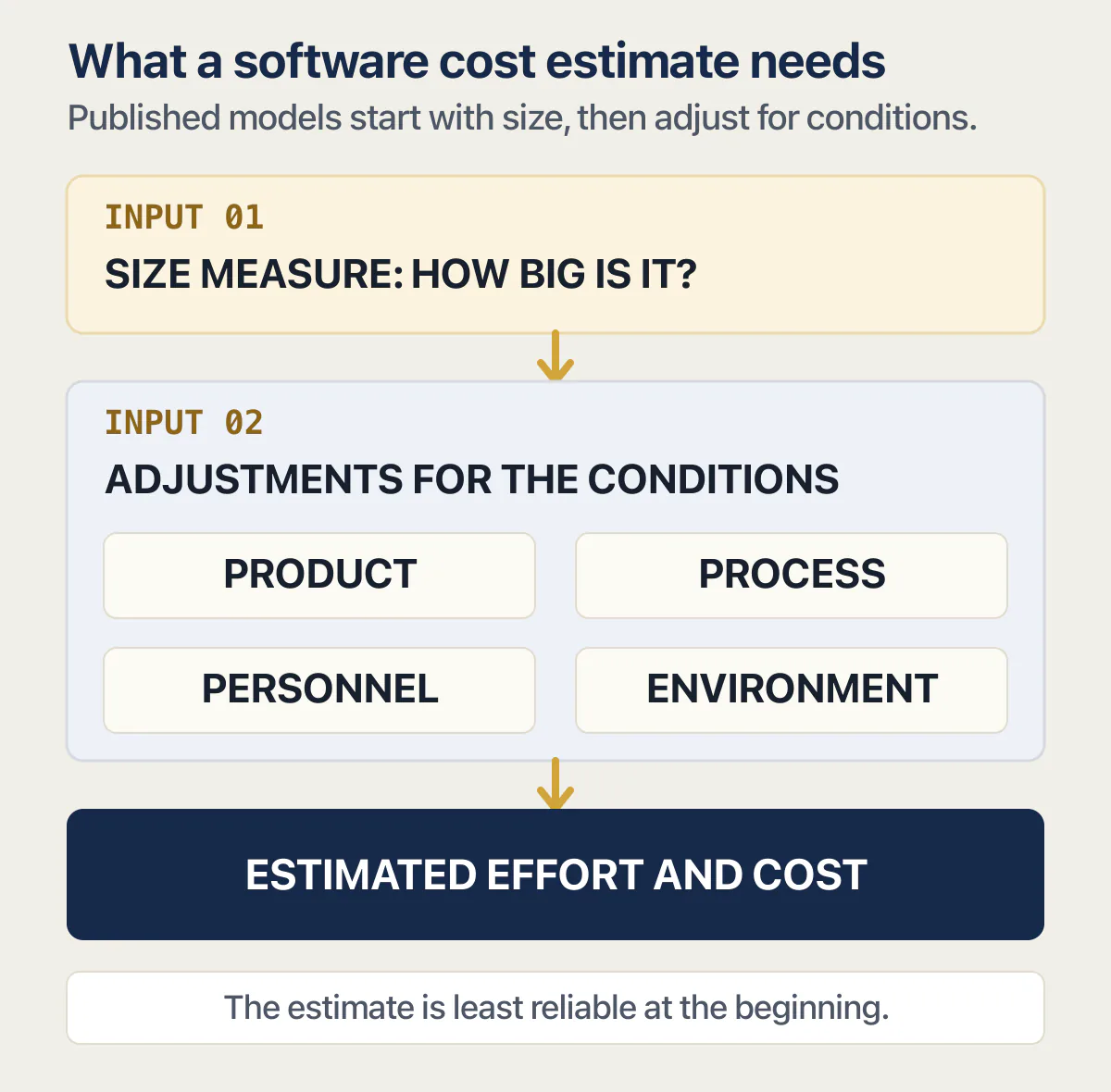
Software cost estimation is an old field with published models in it, and none of the nine pages above says it uses one. The real models all need the same two things: a measure of how big the thing is, and a set of adjustments for the conditions the work happens under.
The Software Engineering Institute at Carnegie Mellon publishes an explainer on this, written by Anandi Hira and published 17 June 2024, read here on 30 August 2026. It is worth reading in full because it is the only source in this entire search that is not selling the work it is pricing. The Software Engineering Institute’s explainer on software cost estimation sets out three models and what each one needs.
COCOMO II is the open one. Its effort formula takes a size measure in thousands of source lines of code, multiplies it by a set of effort multipliers, and raises the size to an exponent built from scale factors. SEER-SEM, published by Galorath, accepts either source lines or function points as its size input and applies cost drivers covering things like platform and complexity. TruePlanning, published by Unison Software, multiplies size by a baseline productivity and then by productivity adjustments. Three different formulas, three different vendors, and all three start at the same place: how big is it.
The adjustments fall into four groups: product, process, personnel and environment. What the software has to do, how the work is run, who is doing it, and what they are doing it on. A calculator that asks you to tick “high security” and “user roles” is gesturing at the product group and ignoring the other three, which is why two teams can quote the same feature list at very different prices and both be telling the truth about their own costs.
Two things the SEI page says are worth carrying away from it. The first is the cone of uncertainty, which is the observation that the error in estimating size, effort and cost is at its widest at the beginning of a project and narrows as the work goes on. The estimate is least reliable exactly when you most want it. The second is the page’s own caution about its own subject: “All models are wrong, but some are useful”. It also names a limitation that applies directly to anything AI builders touch, warning that “A new project might not be well represented in the data that underlies a given cost estimation model (due to small statistical samples available in the underlying data).”
Put those together and the shape of the problem is clear. Every serious model needs a size measure you do not have before the work starts, every serious model widens its own answer at the point you are standing, and every serious model knows its data may not cover what you are building. A form with twelve toggles shows none of that machinery, and none of the nine says what its arithmetic is. The visible inputs and the ranges printed on the same pages are all a reader can check; what happens in between is undisclosed.
Why an app that already runs cannot be priced from a form
An app that already exists cannot be priced from a list of features, because those features are the part that is finished. What is left sits in the code, and no form asks about code.
The middle application in AxonBuild’s audit set scored 51 out of 100. Those are the 26 AI-built applications reviewed in June and July 2026 against a fixed list of production-readiness checks, and the individual scores ran from 29 to 81. Two applications that both load and both work can sit fifty points apart on what is still missing, and nothing on any of the nine pages above asks about a single one of those checks. How those scores were produced and what the cohort is is set out separately.
That gap is the whole problem with software development budgeting for an app that runs. Two founders describe the same product in the same words. One of them has sign-in that holds when a stranger pushes on it and one does not. One has payments that cannot be edited on the way through and one does not. Both would tick the same boxes on Sommo’s twelve groups and both would get the same number back, and one of them is a great deal further from being safe to launch than the other. The difference is invisible to the form because it is invisible to the description.
Two things people wrote publicly this year show what the gap sounds like from inside it. One owner described the missing part of their app as sign-in rules, safety, the awkward cases and the work of making it fit to run in public, then asked what a fair price for that would be. Another wrote that a developer had put a two-week timeline on a single lead-capture form. Neither of those is a feature-list question. The first is asking to be told the size of something they cannot see, and the second is watching a number arrive with no explanation of what made it that size.
The practical consequence is that anybody who gives you a firm number for an existing app without looking at it is guessing, and the guess has to be padded to survive being wrong. That padding is why the same job comes back at wildly different prices from different sellers: the price covers their own uncertainty about your app as much as the work. A better calculator does not help with any of this. What helps is giving somebody enough to look at that they can price the work rather than the risk.
Getting an app development quotation you can check
Whether an app development quotation is one you can check is settled before the number exists, by how much of the job the request pinned down. What a checkable one has to name is answered in the common questions further down.
The message you send so that a person can put a number on your job has a shape of its own, and getting that shape right is what turns a range into a price. Almost everything that separates an answerable reply from an unanswerable one was decided before the reply was written, in what you sent.
Four questions sit right next to this one and none of them is answered on this page. The bands a finished build actually sells for, taken from sources that publish them, are gathered in one place. Where the money inside a build number goes, line by line, is a different reading of the same total and it is set out separately. Whether the kind of app you are describing moves the number at all, and which two or three features inside each kind actually do, is worked through separately. Whether the number arrives as a rate per hour or as one agreed figure changes who carries the risk when the work runs long, and that is a choice with its own answer.
What a developer charges once an app exists is a separate set of numbers with separate sources. Tidying up an app an AI tool already wrote is priced by a different market, and what that market publishes per item is set out with the sellers named. Access, accounts and passwords belong to the stage after somebody has said yes, and what that stage needs is listed separately.
One last test, and it costs nothing. Take whatever number you have been given and ask the person what would have to be true for it to double. If they can answer in one sentence, they priced your job. If they cannot, they priced a category.
How AxonBuild prices work, and why there is no calculator on it
AxonBuild publishes no price and no bands. The 20-minute video call with Bilal is free and needs no code: show him the app, what should happen and what happens instead, and he will talk through what needs checking. If you want him to make the change, he checks the code and gives you a fixed quote, you agree what the app should do, and you pay after you see it working.
Finishing an unfinished app, rebuilding one, moving it off a builder, making it hold up under real traffic and adding payments are all quoted the same way, after the code has been checked rather than off a description, and none of them has a published figure here for the same reason none of them can be priced from a form.
There is no calculator on this site and there is no table of hourly rates, because both would be dishonest for the work described above. A calculator would have to guess the two things that decide the price of an existing app, which are what is actually wrong and how hard the code makes it to reach. The call works out what needs checking from what you describe and what the screen shows. Both often need Bilal to look at the code afterwards, and he will say so on the call if they do. Neither produces a document, a written assessment or anything to sign. What they produce is a conversation in which somebody names the one thing worth fixing first.
Common questions about app development cost estimates
Is there an accurate app development cost calculator?
No, and the nine on page one of this search are not trying to be. All nine were read on 30 August 2026 and every one of them is published by a company that sells development work or sells an estimate; six collect contact details somewhere in the flow. None of them says how it computes its figure; what a reader can check is the questions it asks and the ranges the same publisher prints elsewhere on its own site. The published cost-estimation models used by people who do this seriously need a size measure and dozens of adjustment factors, and no browser form collects either.
How much does it typically cost to develop an app?
Nobody can tell you without looking at the work, and the sellers on this search do not agree with each other. Read on 30 August 2026, Sommo puts basic apps at $10,000 to $50,000 and advanced ones at $150,000 and up; Trango Tech gives $20,000 to $150,000 for the average cost of developing a mobile application in the USA; Agicent puts an MVP at $10,000 to $20,000 and a very simple app at $10,000 as a minimum. Those are four different definitions as much as four different prices, and the whole-build number has its own page of published sources.
How do you calculate the cost of software development?
Properly, you measure size and then adjust it. The Software Engineering Institute at Carnegie Mellon describes three published models: COCOMO II, which takes thousands of source lines of code and applies effort multipliers and scale factors; SEER-SEM from Galorath, which takes source lines or function points plus cost drivers; and TruePlanning from Unison Software, which multiplies size by a baseline productivity and then by productivity adjustments. All three then adjust for four groups of cost drivers: product, process, personnel and environment. That page was published 17 June 2024 and read here on 30 August 2026.
Why does the same app get two very different estimates?
Because the two people read your description as two different jobs, or because one of them padded for what they could not see. A written description says nothing about how the existing code is built, so a seller pricing an app they have not looked at is pricing their own uncertainty alongside the work. The published seller ranges on this search show the same effect at the market level: three of them start their lowest band at $10,000 while a fourth, describing an average rather than a simplest job, starts at $20,000, all read 30 August 2026.
What should an app development cost estimate include?
The one job named in a sentence, the finish line stated as the thing that will be working at the end, and an explicit list of what still has to be looked at before the figure is firm. A figure attached to “the app” with none of those three is not comparable against anything. If you want to see the difference in the wild, the tables above show what nine sellers ask for and what four of them publish, which is as close to a worked example as this search offers.
Is an app development cost estimate template worth using?
Not for pricing an app that already exists. A template collects a list of features, and those features are the part you have already finished; what is left sits in the code, where no template reaches. Nothing here is offered as a file to fill in, and nothing on this page is meant to be printed out. What a template would claim to do for you is already done above, with the sellers named and the read date attached to every figure.
Can I develop my own app for free?
You can build something that runs without paying anybody, and people do it every week with the current AI builders. The cost arrives later and in a different shape: the meter on the tool once you are iterating hard, the monthly bill from hosting and the services the app calls, and the human work of making the thing safe to point at real customers. That last one is where most of the money in this whole subject actually sits, and it is the one no free tier covers.
Should you pay for a cost estimate?
Only if you know exactly what you are buying. One of the nine tools on this search sells its own estimator at the one-time price named above, which is a reasonable business but does not change what an estimate is: a guess about work nobody has inspected. Money spent on somebody actually reading your code buys a different thing, because at the end of it a person can tell you what is wrong rather than what a category costs.
Can anyone price an app that has already been built?
Yes, but not from a form. It takes somebody opening the code and the running app, finding the specific thing that is missing or broken, and pricing that named thing. Two applications that both load and both work can be a long way apart in what they still need, and that distance lives in the code rather than in the description, which is why none of the nine tools on this search can reach it. It is also why a price for an existing app arrives after somebody has looked, never before.
Built it with AI. Can’t get the last part right?
That’s the normal state of an AI-built app, and it’s fixable. I trace what the app actually does, explain what needs changing, and build it if you want me to.
Talk about your app →  Free 20-minute video call with Bilal.