Six pages that rank for mvp development cost and its longer phrasing publish a price ladder for a minimum viable product, the first version of a piece of software, and the cheapest rung on those ladders starts at $5,000 on one page and at $15,000 on another, while one of the six opens its own smallest package at $25,000. The top rung reaches $250,000 and up. Every one of those figures was read on 1 September 2026 on the page that publishes it.
So the published answer to what an MVP costs spans fifty times its own floor. What the six ladders have in common matters more than that spread. Each one prices a build that starts from an empty repository. Each one was checked for a tier, a row or a sentence that puts a price on continuing an application that already runs, and the count came back zero.
That matters because a large share of the people typing this question already have something running. It came out of Replit, Base44, Cursor, Bolt or Lovable across two or three evenings, it demos to a friend, and the part they need a price for is everything after that. None of the ladders below is measuring that.
This page is a reading of the search itself. On 1 September 2026 the results Google put on page one for mvp development cost, and for the longer way the same question gets typed, how much does it cost to build an mvp, were requested in turn. Six seller pages answered and are set out below under the tier names their own publishers use. Two returned a refusal and are named as refusals with that date. One further seller page answered and is left out because its figures are already counted elsewhere on this site. The rest are community threads and a syndicated post, none of which publishes a ladder. No band here is blended with any other.
MVP development cost has no single figure. Across the six pages read on 1 September 2026, published tiers run from a $5,000 floor to $250,000 and up, and every rung on all six is priced in one unit, hours spent making something that does not yet exist. Nothing published prices an app that already works.
What an MVP costs in 2026, according to the pages that rank for the question
Here is the whole set, one row per rung, each row carrying the publisher’s own name for that rung. Where a page attaches a duration to a rung, the duration is that page’s, in that page’s own unit: Helpware gives 2 to 4 months, 3 to 6 months and 6 to 12 months for its three rungs; Ideas2IT gives 2 to 4 weeks, 3 to 6 weeks and 6 to 12+ weeks; URLAUNCHED gives 4 to 8 weeks, 2 to 4 months, 4 to 8 months and 6 to 12+ months for its four; Omega Solution gives 6 to 10 weeks, 10 to 16 weeks and 16 to 24 weeks; Sthenos Technologies and Mactavis attach no duration to any rung.
| Publisher | Figure, read 1 Sep 2026 | The rung, as the page names it |
|---|---|---|
| Helpware | $10,000 to $40,000 | Simple MVP |
| Helpware | $40,000 to $100,000 | Medium MVP |
| Helpware | $100,000 to $200,000+ | Complex MVP |
| Ideas2IT | $5,000 to $15,000+ | Simple MVP |
| Ideas2IT | $15,000 to $50,000+ | Standard MVP |
| Ideas2IT | $50,000 to $150,000+ | Complex MVP |
| URLAUNCHED | $15,000 to $30,000 | Simple MVP |
| URLAUNCHED | $30,000 to $80,000 | Standard MVP |
| URLAUNCHED | $80,000 to $250,000+ | Complex MVP |
| URLAUNCHED | $250,000+ | Enterprise MVP |
| Omega Solution | $15,000 to $50,000 | Tier 1: Simple MVP |
| Omega Solution | $40,000 to $100,000 | Tier 2: Moderate Complexity MVP |
| Omega Solution | $100,000 to $250,000+ | Tier 3: Complex MVP |
| Sthenos Technologies | $5,000 to $25,000 | Lean MVP |
| Sthenos Technologies | $25,000 to $60,000 | Standard MVP |
| Sthenos Technologies | $60,000 to $100,000+ | Regulated or AI MVP |
| Mactavis | $6,000 to $15,000 | Basic MVP (Core Feature Only) |
| Mactavis | $15,000 to $40,000 | Mid-Level MVP (Multiple Core Features) |
| Mactavis | $40,000 to $200,000+ | Advanced MVP (Scalable Architecture from Day One) |
All six open with a headline figure before the ladder starts. Helpware’s summary line gives $10,000 to $200,000 and up. URLAUNCHED answers its own title with $15,000 to $250,000 and up. Omega Solution puts most startup builds at $15,000 to $150,000. Sthenos Technologies calls the realistic 2026 range $5,000 to $100,000 and up. Ideas2IT’s own summary, written in its shorthand, gives $10K to $50K for basic apps and $100K and up for complex, AI-enabled ones. Mactavis opens by saying small MVPs with basic features can start from around $5,000 to $15,000.
Those addresses, deliberately unlinked because every one of them is a company selling the work it is pricing and a link from a buying query drops you into somebody’s contact form rather than a citation: helpware.com/blog/tech/mvp-cost, ideas2it.com/blogs/mvp-development-cost, urlaunched.com/blog/development-cost-for-startups, solution.omega.ac/mvp-development-cost/, sthenostechnologies.com/blogs/mvp-development-cost/ and mactavis.com/blog/how-much-does-it-cost-to-build-an-mvp.
Two of the results on those searches refused an automated read on 1 September 2026. softteco.com/blog/mvp-development-cost and newagesysit.com/blog/how-much-does-it-cost-to-build-an-mvp/ both returned an HTTP 403 to a plain fetch and to a raw read with a browser user agent, on two separate attempts that day. They are counted here as refusals. No figure is inferred for either, in either direction.
Four of the six carry a visible publication date: 28 February 2026 on Mactavis, 13 March 2026 on Helpware, 10 April 2026 on URLAUNCHED, and 24 June 2026 with an update stamp of 20 August 2026 on Sthenos Technologies. Omega Solution renders no date on the page itself, though the page metadata dates it 10 May 2026 and last changed on 2 July 2026. Ideas2IT renders no date anywhere, in the article or in its page metadata, which is worth knowing about a page whose title says 2026.
Read one after another, the six pages are close to the same page. Each opens with a headline range. Each then publishes a ladder of three or four rungs. Four of the six attach a duration to every rung; Sthenos Technologies and Mactavis attach none. Each follows the ladder with a list of what moves the figure, and the lists overlap without agreeing. How much there is to build is on all of them. How the team is put together and where it sits are not: Helpware names both, Mactavis names the team and not its location, and Sthenos Technologies names neither. Four of them end by inviting the reader into a conversation before any real number exists, which is the only honest thing any of them can do, because none of them has seen the reader’s product. Two of those four label their own published figures as provisional in writing: Sthenos Technologies calls its ranges expectation-setting, and Omega Solution says every price it gives follows a conversation rather than preceding one.
That shared shape is worth noticing before the figures, because it tells you what kind of object a published band is: a company’s opening position on an unseen job, printed to attract the enquiry that produces the real figure. Each of the seven floors below is one company saying where it would rather begin, which is why they sit so far apart while none of them is wrong.
MVP cost and MVP pricing, as phrases, mean one thing here: what somebody charges to build the first version of a product, the version that exists to find out whether anyone wants it, as distinct from the price of the finished product or the bill for running one.
How much should an MVP cost, and why is there no average worth printing?
An MVP should cost whatever the work in front of somebody actually is, which is why no average cost from the table above is worth having. The smallest rung across the six pages starts at $5,000 on one and at $15,000 on another, and the seventh floor in the table below, a publisher’s own package price rather than a market estimate, starts at $25,000. Averaging those seven produces a number no seller on the list would honour.
Line up only the cheapest rung from each page, and the disagreement is easier to see than in the full grid.
| Publisher | Its name for the smallest rung | Where that rung starts |
|---|---|---|
| Ideas2IT | Simple MVP | $5,000 |
| Sthenos Technologies | Lean MVP | $5,000 |
| Mactavis | Basic MVP (Core Feature Only) | $6,000 |
| Helpware | Simple MVP | $10,000 |
| URLAUNCHED | Simple MVP | $15,000 |
| Omega Solution | Tier 1: Simple MVP | $15,000 |
| Helpware, on its own price list | Basic MVP | $25,000 |
Seven rungs, five different words, and a floor that moves by five times across them. Helpware appears twice on purpose: the market ladder in its article and the price list for its own work sit on the same page, and its own Basic MVP opens where three other publishers’ entire smallest tier has already ended.
The publishers disagree about the floor in writing, too. Helpware’s own FAQ asks whether an MVP can be built for under $10,000 in 2026 and answers that even the most basic ones built with no-code and low-code tools run at least $10,000. URLAUNCHED asks whether one can be built for under $20,000 and answers yes, with a tight enough feature set, naming no-code products, AI wrappers and internal tools as what fits. Sthenos Technologies goes further and says the floor has already moved into the low single-digit thousands, and that several firms ranking for this query still quote $40,000 as a starting point, which it calls an enterprise number rather than a current market one. All three were read on 1 September 2026.
So one seller on page one is publicly telling you the other sellers on page one are quoting stale figures. That is unusual and it is worth taking seriously, because it points at what these ladders are actually made of.
Every rung on every one of the six is priced the same way underneath: hours of somebody building something that does not exist yet. The rung names are a proxy for how many hours, nothing more. “Simple” means few, “complex” means many, and because no two companies staff a week the same way or count the same features into a rung, the same adjective lands five times apart. An average across them averages six different companies’ guesses about how big an unseen job is, and the guess is the only content in the number.
There is a second reason the published figure and the real one drift apart, and it shows up in what buyers say afterwards rather than in what sellers publish. One person compared what a developer had quoted them for a small internal tool against what the same tool cost them to assemble with an assistant instead. Another was quoted a build price for a customer portal and put the thing together themselves in a few days with an assistant instead. Neither of them concluded the quote was dishonest. They concluded the quote was for a different job than the one that turned out to be in front of them.
What a person costs per unit of their time is a separate market with its own published grids, and what one developer charges for their time is counted there rather than here. Every rate row on every page above is left out for that reason.
The figure for a whole application, with no first-version qualifier on it at all, is counted from its own group of sellers. Where the money inside a build actually goes, item by item, is itemised on the page that does that. Why the same first version quotes at one figure in one country and several times that in another is followed where geography is the subject. And software written for one business to run on, rather than a first version put in front of strangers, is priced against a different group of sellers again.
What every one of these ladders assumes about your app
Here is the check that produced this page. Six pages answered a read on 1 September 2026. Each was searched for a tier, a row, a table cell or a sentence that puts a price on continuing, finishing or taking over an application that already runs. The count came back zero.
One page comes close. Sthenos Technologies names the route in prose and again in its own FAQ, which asks whether an MVP can be built from an existing prototype and answers: “Turning a prototype, including an AI-built one, into a secure, working MVP is a defined path that can save time and money.” It attaches no figure to that path anywhere on the page, and its three published rungs price a build from nothing exactly like everybody else’s. A second page brushes past it: Helpware lists carrying an MVP on into a full product among the things it sells, and attaches no figure to that either. The two pages that refused a read are not evidence either way and are not counted.
Zero out of six describes the market rather than criticising it. The reason sits in how the rungs are built. A rung’s price is set by how much there is to make, counted from nothing. There is no term anywhere in that arithmetic for what already exists, because what already exists was assumed to be nothing. Hand any of these ladders an application with working screens, real users and a payment flow that half works, and the ladder has no way to price it down, or up, or at all. It can only ask which adjective the whole job would have deserved if it were starting today.
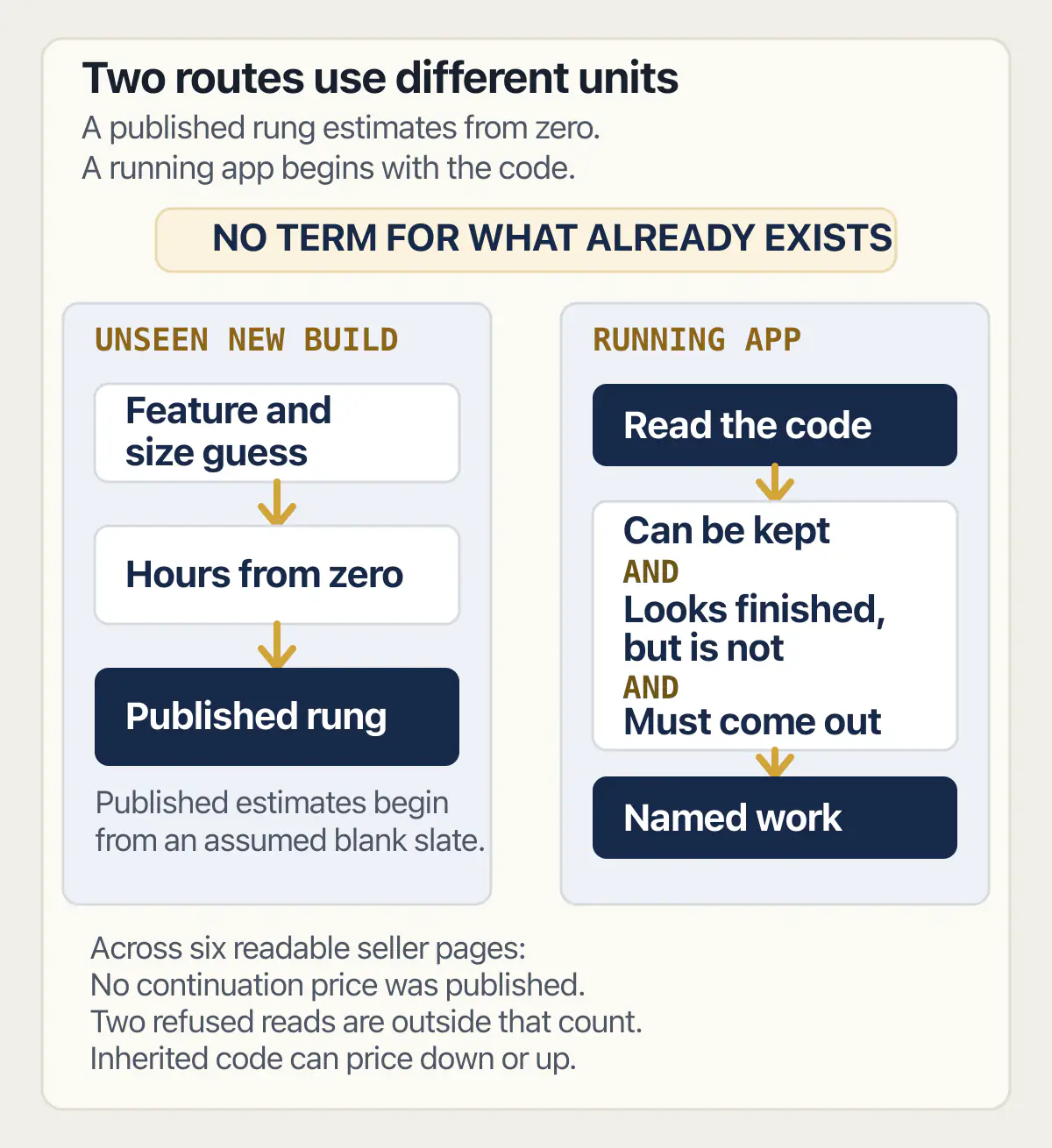
That is a different observation from the obvious one, that the bands are for new builds. The bands being for new builds is a labelling problem and could be fixed with a sentence. The unit being hours-from-zero is a measurement problem, and it cannot be fixed by relabelling anything.
What the missing row would have to cover is a job with a different shape, not a smaller version of a build. Somebody who has read the code has to work out which of the existing parts can be kept, which look finished and are not, and which will have to come out before anything new can go on top. That last category is the one nobody can estimate from a description, and it is the one that decides the number.
The size of that category is set by decisions that were already made, usually by a generator, usually without anybody choosing them. How the data is laid out, what the app assumes about who is asking, whether the same value is written in three places. A build from nothing gets to make those decisions once, correctly, at the cheapest possible moment. A build that inherits them either lives with them or pays to undo them, and undoing them is the part with no rung.
This is also why two apps that look identical from the outside quote so differently. Two founders with the same screens, the same users and the same demo can be holding jobs whose real size differs tenfold, and nothing visible on either screen says which is which. Across the 26 AI-built applications AxonBuild audited in June and July 2026, in a fixed cohort of 11 third-party apps taken deep, 10 more held out as a blind check and 5 of the founder’s own, the findings that decided whether an application could take money from strangers had to be established by reading the code, because nothing on a screen reported them. A ladder priced by feature count cannot see them either.
The buyers who get furthest with this arrive already knowing the answer to half of it. One of them had already worked out which slice of the build was still outstanding and could say what sat inside it. The only thing missing was a number they could weigh as reasonable.
A named seller has published a figure for that fraction and dated it, and how far the builders get before a person takes over is set out on the page that quotes them. Nothing here restates it as an independent finding.
Three neighbouring purchases have published figures of their own and none of them is the one above. Building your own first version inside an AI builder has a bill with more than one part to it, and the total sits on the page that works it out. Getting a working app fit for paying strangers is a separate purchase with sellers who advertise exactly that, and what they charge for it is set out on the page that reads them. Starting the whole thing again, instead of paying for the part that was never finished, is a different question with a different set of published figures behind it.
How do you work out your own number without handing over an email address?
Your own number comes from a count rather than a calculator: write down what already works, write down what does not, and take both lists to somebody who has read the code. That count beats all nineteen published rungs, because a rung guesses at an app nobody has opened and your count describes the one you own.
The query mvp cost calculator exists because the alternative is unappealing. None of the six pages that answered a read on 1 September 2026 renders a calculator of its own. The tools that do live behind a form on other sites, and the form is the point of them: the number that comes back is an opening position from a seller who has not seen your code, priced off eight or ten answers you typed about a product you have not finished describing to yourself yet.
The count is more useful and it takes an afternoon. Open the app and write down every screen a stranger could complete end to end today. Write down every screen that looks finished and stops working the moment you use a second account, an empty state or a real card. Write down what has never been started, including the parts that are not screens: what happens when a payment fails, where errors are recorded, what stops one customer reading another’s rows, what happens on the day somebody asks for their data back.
That third list is the one that never appears in a quote, because it never appears in a demo. It is also the list that moves a figure most, since each item on it is work with a definite end that somebody can look at and size, rather than a feature to be imagined. A seller pricing from your paragraph has to guess at all three lists at once and pad the guess. A person pricing from your three lists is doing arithmetic.
Take the lists to somebody who can read the code, and the conversation changes shape. They stop estimating a product from a description and start pricing named items in a repository they can open, which is the only circumstance in which a fixed figure is safe for either side. If the answer that comes back is still a wide band after they have read the code, that is worth asking about, because the reading was supposed to be what narrowed it.
Price and time are the same question asked twice, and the durations attached to the rungs in the first table are the sellers’ own answers to the second half of it. How long the same job takes, split between the first working version and everything after it, is counted on the page that answers the other half of this question. Turning this into a figure for your own project, without handing an email address to a form to get it, is done on the page built for exactly that.
What you are buying when most of the thing already runs
Every figure on this page belongs to somebody else.
Paying somebody to close out a first version that nearly works is bought differently again, and one page here is about nothing else. Who sells this work, what the buying looks like from the other side of the table, and which questions to ask before agreeing any figure are set out on the page about buying it. And what a minimum viable product is, who builds one and in what order it gets built, is the wider subject this page prices one corner of.
Common questions about MVP development cost
How much does it cost to build an MVP?
Published rungs on the six pages that answered a read on 1 September 2026 run from a $5,000 floor to $250,000 and up. The six middle rungs, the ones each publisher calls standard, medium, moderate or mid-level, together span $15,000 to $100,000, which is the narrowest honest answer the search supports. Every one of those figures prices a build starting from nothing, so if an app of yours already runs, none of them is measuring your job.
How much does MVP cost?
The published set runs from five thousand dollars at the bottom to a quarter of a million and up at the top. Ideas2IT and Sthenos Technologies both open their smallest rung at $5,000. URLAUNCHED puts its Enterprise MVP at $250,000 and up, and Omega Solution’s top tier reaches $250,000 and up as well. All four pages were read on 1 September 2026, and the fifty-fold gap between the bottom and the top is the honest answer.
How much does an MVP app cost?
Helpware is the one page of the six that prices by platform as well as by complexity, and on 1 September 2026 it put a web MVP at $15,000 to $80,000 over 2 to 4 months, a mobile one at $25,000 to $120,000 over 3 to 5 months and a cross-platform one at $40,000 to $150,000 and up over 3 to 6 months. The other five price by how much there is to build rather than by where it runs. What reliably changes for a phone app is the work after the build, because a second platform and two store reviews arrive at the end.
How much does it cost to develop an AI MVP?
Sthenos Technologies is the only one of the six whose price ladder, as read for this page, gives an AI product its own rung, and it prices Regulated or AI MVP at $60,000 to $100,000 and up, read on 1 September 2026. Omega Solution calls AI-powered MVPs the fastest-growing category on its page without giving them a separate rung. Both figures still assume a build from nothing.
Building it on an AI builder yourself has a separate bill made of three parts, and that total is added up on its own page.
Why is one MVP quote several times another?
Because the rung names are guesses about size, not definitions. Nothing forces two companies to count the same features into the word “simple”, and the table above shows what that does: a floor of $5,000 on one page and $25,000 on another, for tiers described in almost the same words. A quote is a company’s estimate of how many hours a job it has not seen will take, multiplied by what that company charges for an hour.
Is a cheap MVP quote a warning sign?
Not on its own. Sthenos Technologies argues in writing on 1 September 2026 that the floor has genuinely moved into the low single-digit thousands, while Helpware’s FAQ says even a no-code build runs at least $10,000. Both are ranking sellers and both are stating a real position. What matters is whether the low figure comes with a named list of what is included, and whether the person quoting has opened the code.
Does it cost less if most of the app already works?
Sometimes, and not one of the six pages read on 1 September 2026 has a row for it. A part-built application can be cheaper to finish than to start, and it can also be more expensive, because the person taking it on has to establish what survives before any of it can be priced. The answer depends entirely on that reading, which is why nobody publishes a band for it.
What is not included in an MVP price?
Everything after the build. None of the six figures above includes what the app costs to run each month once it is live, what the two app stores want before they will list it, or paying a person to keep it working afterwards. Several of the pages read on 1 September 2026 publish annual upkeep as a percentage of the build figure, which is not reproduced here, because a percentage of an estimate is still an estimate.
Fixing the bug in this guide gets you past today. If you would rather have the whole foundation checked and built in one go, that is what the sprint below is for.
Built it with AI. Now it has to hold up for real customers.
The Production Hardening Sprint takes the app you already have and builds the production foundation underneath it. Authentication and access rules, payments that stay consistent, error handling, monitoring, backups, automated tests and a documented handover. Our engineers work inside your existing codebase for ten working days. All 123 deliverables are included, and you get the evidence for each one.
See the Production Hardening Sprint →  $2,500 fixed price · 10 working days · One codebase