MVP here means a first version of a piece of software, built in an AI tool, that runs and is not finished. The same three letters belong to a sports award, a health plan and a fitness subscription, and all three outrank the software meaning on this exact search.
If you are the person typing this phrase, you already have something. It opens, it does the thing, you have shown it to somebody. What you cannot do is get it out, and every time you try to buy your way to the end, the answers come back at wildly different prices for what sounds like the same job.
Finishing is not one condition. Owners use the word for five different end states, and each one buys a different piece of work, so any quote given before you have named yours is priced against somebody else’s ending.
This page puts no price on finishing anything. The seller pages named here were opened on 1 September 2026 and read in their raw page source, and everything taken from them is dated where it appears. Nobody was contacted for a quote, no application was executed or rebuilt for it, and the audit numbers are AxonBuild’s own, from 26 applications reviewed in June and July 2026.
What “finish my MVP” usually means
Five end conditions sit behind the phrase. Each one names a different moment where the owner would agree the work is over, and just one of the five is reliably a single thing anybody can buy. Naming yours takes about a minute and changes every conversation that follows.
The word points at an ending rather than at an amount of work. That is why two owners can both say they are nearly done and mean jobs that differ by an order of magnitude: one of them means the app stops crashing while they use it, and the other means strangers can sign up and pay. Both are true uses of the word. Neither of them tells a seller anything.
The five below are the endings owners actually name, in the order they tend to arrive at them. They are not stages and you do not have to pass through them in sequence. Most people want one or two and are surprised to discover the others exist at all, which is exactly why the first quote comes back at a number that seems to have nothing to do with the question.
| The line an owner names | What that line is actually asking for | The condition that ends it |
|---|---|---|
| It stops breaking while I use it | Somebody changing the code on purpose, which is a different activity from asking the tool again | A week of your own use goes by without the same failure coming back |
| Somebody who is not me can use it | Everything that only starts mattering once a stranger arrives | A person you have never met gets through the thing unaided |
| It can take money | A path from a customer’s card into your account that nobody can change in transit | Somebody else’s money has arrived with you and stayed there |
| People can find it | A permanent address, and for a store, a listing the store accepts | Other people reach it at the address, and any store involved has said yes |
| It keeps working next month without me | Not a finish line at all, a second thing to buy | Nothing. This line has no over, which is what makes it a different purchase |
Row one is the most common arrival point and the least understood. When prompting has stopped making the application better, more prompting is no longer the lever, and the work turns into reading rather than asking. Reading somebody else’s generated code well enough to change it deliberately is real work with a real cost, and it almost never resolves into one item, because the reason the app breaks in three places is usually one habit repeated in thirty.
Row two is where most of the disagreement about price lives, because the honest answer depends entirely on whether those parts were started at all. If sign-in exists and is patchy, finishing it is a job with an ending. If it does not exist, the same request is a first build with a different word on it, and the person quoting cannot tell which of the two you are holding from your description. This row is also the one people underestimate hardest, because everything inside it is invisible while the only user is somebody who already knows the password.
Row three earns its own line because money is the end condition owners name last and need most. It is also the cleanest purchase on the page: a payment path either moves money into your account intact or it does not, and both of you can watch it happen.
Row four surprises people, because an address and a store listing have almost nothing to do with the code. Nothing about the application changes. What changes is that a second organisation now has an opinion about it, and can say no for reasons that were never in anybody’s estimate. It is bought separately for that reason.
Row five is the row that is not a finish line at all. It is worth pulling out and looking at on its own, because folding it into the others is how owners end up paying every month for a job that had an ending.
Why nobody can price it until you name the line
Pricing this work is impossible while the ending is unnamed, and the clearest evidence is that the sellers cannot do it either. The one company that has turned this exact phrase into a named product cannot state a single length for it on its own page.
Afterbuild Labs sells a fixed package it has named after this search term, aimed at owners taking an application built in an AI tool through to a launched product. On 1 September 2026, read in the page’s raw source, that page gives two different lengths for the same package. Its headline, a large figure printed on its own, its turnaround field, its comparison table, its meta description, its one-sentence description of the package, a line of its body copy and one of its own answers all say 3 to 4 weeks. Two further answers, one of them under its own question about how long the work takes, and the structured data the page ships to search engines all say 4 to 6 weeks. Counted as places on the page rather than as strings in a file, that is eight against three.
The company is not being careless there. Both numbers are plausible, and having two of them on one page is the whole finding. A seller who has productized finishing, priced it and named it after the buyer’s own words still cannot commit to one length, because the length moves with the application in front of them, and the application is the thing nobody has looked at yet.
There is a use for this the next time somebody quotes you. Ask which of the two numbers on their own page applies to you, and why. A seller who can answer that has already thought about what varies between one application and the next, which is the thinking you are actually paying for. A seller who cannot is quoting a shape rather than your job, and the difference will show up later as the work either running long or stopping short of the ending you had in mind.
The same shape shows up in AxonBuild’s own audit data. Across the 26 applications audited in June and July 2026, the lowest readiness verdict was 29 and the highest 81, on a scale that tops out at 100, and none of the 26 came back with an empty list. Even at the top of that fixed set, finishing was still a real purchase for somebody, and no price attached to the word would have described it.
The percentage owners reach for, and why it stops being useful the moment somebody has to put a number on the work, is argued on its own page. What sits inside that last stretch, item by item and with counts against each item, is written out in full elsewhere and is not repeated here.
Who finishes MVPs, and what each one actually sells
Five kinds of seller compete for this work, and they are selling five different things. Only two of them are shaped like the job of finishing something that already runs, and the nearest thing to a guide on these results sells building a first version from zero.
Before the five, it is worth saying what the search itself looks like, because it explains why this is hard to shop for. Two searches on 1 September 2026, for this phrase and the nearest way people type it, returned eight results each. Of those sixteen, one was a seller’s page about finishing an application, one was a guide to building a first version from zero, and one was a forum thread weighing a first version against a finished product, which is close to the opposite question. The remaining thirteen belonged to the sports award, a health plan, a veterans’ health research programme, a fitness subscription and a song. There is no established set of answers to read through, because for this exact phrase there is barely a market of pages at all.
The first shape is the seller who has turned finishing into a named, off-the-shelf package. Afterbuild Labs is the clearest example, because it named its package after the exact phrase you searched. A package is genuinely useful when your line matches its line, and it is the only shape here that tells you the price before anybody looks at anything. The trade is that a package’s boundaries were decided before your application existed. If the thing that turns out to be missing sits outside them, you find that out partway through, and the conversation you are then having is about what the package included rather than about your application.
The second shape is the company whose MVP page answers building from zero and then sells building from zero. ScienceSoft’s MVP guide was the only page across those sixteen results that sets out how to make one at all. Read on 1 September 2026, its first half teaches the job of getting to a first version from nothing, and its second half is the company: its own sourcing models, its partnerships and recognitions, its own success stories and its own team roles. Its visible page carries no publication date anywhere, and the structured data it ships records it as first published in December 2020 and last changed on 29 August 2026. It is a competent guide to a job you are not doing.
Neither company is linked from here, and both are named with their address in plain text instead, for one reason: each of them sells finishing or building work to whoever is reading this. The pages are afterbuildlabs.com/services/finish-my-mvp and scnsoft.com/software-development/mvp.
The third shape is one person for a few weeks, and for a nearly finished application it is usually the honest answer. One owner had only a handful of items left, hit the busiest stretch of their working year, and went looking for somebody who would simply close them out. That is a person-sized job, not a company-sized one, and buying a company for it means paying for coordination the work does not need.
The fourth shape is the tool you are already paying for. The builder that produced the application, Lovable or whichever one it was, is still the cheapest route for one narrow class of change: something you can point at on a screen that already exists. A new column on a list, a second filter, a heading in different words. Keep doing those yourself and pay nobody. Builders are the wrong tool for any rule that must hold everywhere at once, which is most of what row two of the table above contains. Prompting works on the place you aimed it and leaves the other forty files exactly as they were.
The fifth shape is a monthly arrangement, which is not finishing at all and gets its own section below. It is on this list because it is what owners are often sold when they ask for finishing, and because it is easy to agree to. Nothing about a monthly arrangement is dishonest. It is simply a different product, and it is the one product on this list with no ending in it.
Buyers routinely ask for more than one of these in the same sentence. Somebody shopping for help described their own app as most of the way there, with people already waiting to try it, and asked for a developer or a firm who would take it the rest of the distance. That is two of the five shapes above, asked for in one breath, and the answers would have come back at completely different prices for reasons that had nothing to do with their application.
Choosing and hiring the person who actually does the work is a separate step with its own traps, and it is set out where hiring is the subject. Hiring someone to finish a half-built AI app starts from where the application is now; this page starts from where its owner wants it to end. Buying this kind of work from a company, and reading what those companies are actually selling underneath the words, is its own subject.
Finishing is one purchase, keeping it running is another
An end date is the whole difference. Finishing has one; looking after an application does not, and the moment those two get bought together the finishing work loses the only thing that made it priceable.
Here is the shape from the inside. One owner, posting in public about an application they had been building since the previous September, wrote: ”… I’m working on an app but its taking me too long to finally roll it. Started last September and I feel like it’s still not at its best state.”
Read that again for what is missing. There is no ending in it. No date, no condition, no moment where somebody would say the thing is done. What the post does contain is a start date, an application that exists, and a sense that it is still short of where it should be, which is the most common state anybody arrives at this search in.
Draw the line and the purchase changes shape immediately. A named end condition can be agreed, watched and paid for. An unnamed one becomes an arrangement, and an arrangement bills by the month whether or not anything is closing.
There is a short test for which of the two you have actually agreed to, and you can run it on any quote in front of you right now. Read it and ask what has to be true for this to be over. If the answer is a sentence about the application, you have bought a finish. If the answer is a date, a number of hours or a renewal, you have bought upkeep, whatever the first paragraph called it. Both are legitimate purchases and plenty of owners genuinely want the second one. The failure is buying the second while believing you bought the first, then wondering in month four why nothing has closed.
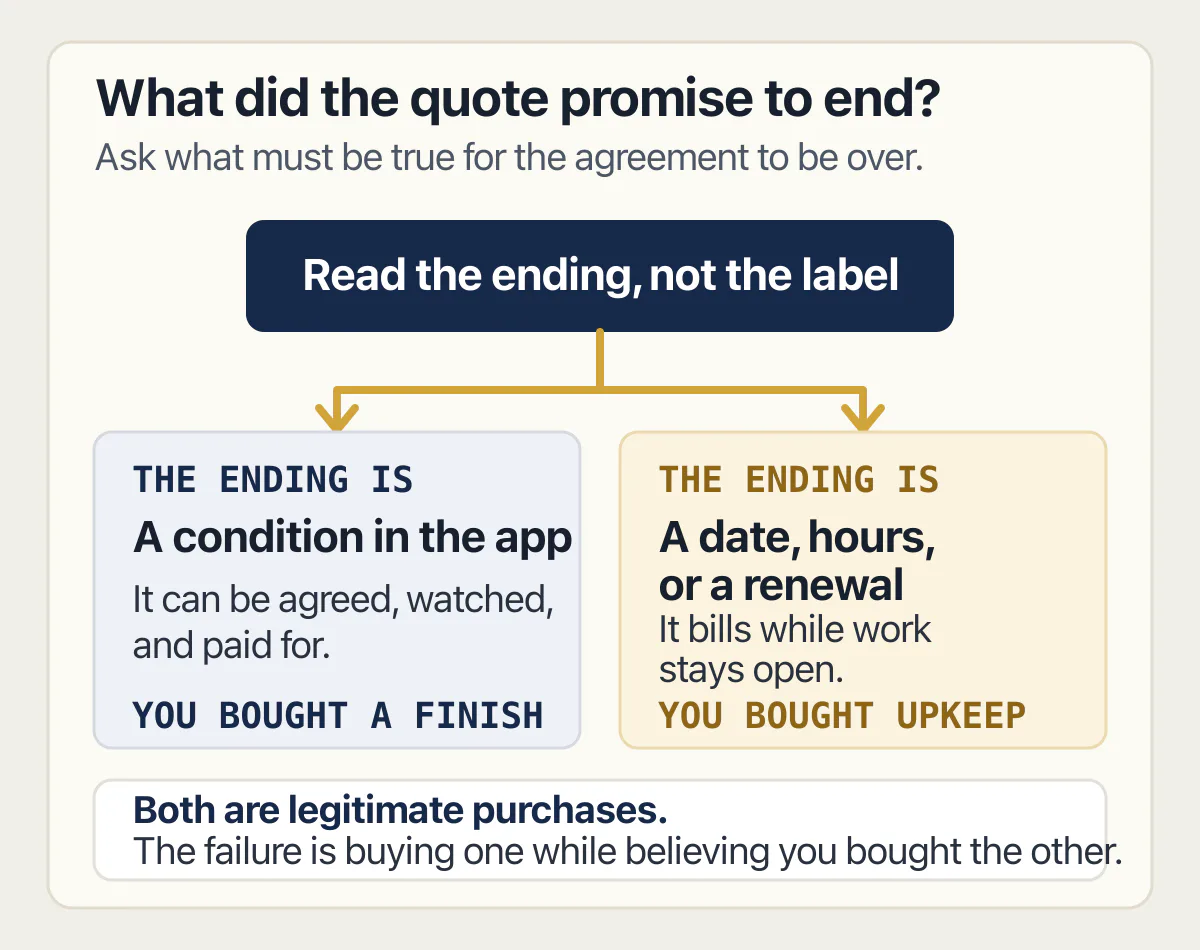
Who looks after the application once it is finished is a different thing to buy, decided after this one, and the ways of buying it are compared option by option. Giving the whole application to somebody else to run from then on is a different move again, and it is decided on its own terms.
What a seller needs from you before they can answer
Three things, all of them writable by somebody who cannot read code. The named line, one sentence saying what has to be true when it is reached, and who the strangers are that the application has to survive. A seller holding those three can price the work on one call.
The named line is the row from the table above. Write it in your own words, not in the seller’s.
The sentence about what has to be true is the part owners skip, and it is the part that ends the job cleanly. “Somebody who is not me signs up on their own phone and never sees a single row that belongs to me” is something the two of you can check together on a call, with nobody opening a file. “It works properly” is checkable by nobody.
Who the strangers are matters because it decides how much of row two you are buying. Ten people you know is a different application from a public sign-up form, and the difference is not visible on any screen. Ten known users forgive a slow page and email you when something goes wrong. A public form brings people who type the wrong thing, share a link they should not have, and leave without telling you anything. The work that stands between those two situations is the largest single variable in any quote for finishing, and it is decided by a fact about your plans rather than by anything in the code.
None of the three needs to be right first time. They need to be written down, because the alternative is that the seller supplies their own answers to all three and prices those instead, and their answers are not visible to you until the invoice is.
What buyers are quoted for work like this, and what changes about the number when most of the application already exists, is priced on its own page. What it costs to hire a person for work of this kind is set out rate by rate elsewhere, and none of those numbers is repeated here.
What to do next, depending on which line you named
Five lines, five different next steps, and four of the five are answered somewhere other than this page. Pick the row you named and go to the thing that answers it, rather than shopping for a general finish.
If you named more than one, order them by which one blocks the others and treat only the first as live. Nothing here needs doing in parallel, and the second line prices better once the first one is finished and you have watched somebody do it.
If your line is that it stops breaking while you use it, the next question is whether the AI route has run out of road on this application or whether you have hit one bad stretch. How far the AI route actually carries an application before a person has to take over is mapped in one place.
If your line is that somebody who is not you can use it, the first move costs nothing. Whether the application is fit for strangers at all is a check you can run before any of this, and the answer decides whether you are buying a finish or a first build.
If your line is that it can take money, the sequence matters more than the shopping. The order in which one application goes from a working demo to taking real money from real customers is worked through separately, and it is the one row where doing things out of order costs the most.
If your line is that people can find it, treat it as two jobs. An address is straightforward and cheap. A store adds a second organisation with rules of its own. An app store can still refuse a finished application, and why AI-built apps get turned down there is a separate wall.
If your line is that it keeps working next month without you, you are not shopping for a finish at all, and the section above says why. Worth asking at the same time: whether what you are holding is still a first version. The moment a first version quietly stopped being one, and the tell that gives it away, is answered on a page of its own.
Where AxonBuild fits when a first version is unfinished
Nothing here carries a published price, because the figure depends on what the running application already does. That is why naming the line comes before anybody talks about money.
Common questions about finishing an MVP
What does finishing an MVP actually mean?
It means whatever end condition the owner has in mind, which is why it means five different things in practice: that it stops breaking in your own hands, that a stranger can use it, that it can take money, that people can find it, or that it keeps working without you. Only the third is reliably one purchase. The rest depend on whether the parts in question were ever started.
The practical version of this answer is to pick one of the five and write it down before you talk to anybody. Whichever you pick, it will be a shorter and stranger sentence than you expect, and that shortness is the point: a seller can price a short specific sentence and cannot price the word finish.
Is an MVP finished when it works for me?
No, and this is the gap that costs owners the most time. Everything that fails once other people arrive is invisible while you are the only user, because you know the password, you never type the wrong thing, and you are one person rather than a hundred. Working for you is a real milestone. It is not the same milestone as working for somebody who has never seen it.
Can I charge people for an MVP that is not finished?
You can, and plenty of people do, but taking money changes what counts as finished. A checkout that silently takes the wrong figure does more damage than one that was never built, because the person who discovers it is a paying customer. If money is the line you have named, buy it as a job in its own right with its own ending, rather than as a feature folded inside a general finish.
Who finishes an MVP that an AI tool started?
Five different kinds of business will offer to take it on: a company selling a fixed finishing package, a company that mostly builds first versions from zero, one individual working alone, the AI tool you already pay for, and somebody on a monthly arrangement. For an app that runs today with named things absent, the third is usually the right size, and the second is usually the wrong product sold convincingly.
Telling the second apart from the first takes one question: ask what they do differently when the application already exists. A company that finishes things will answer with something about reading what is there first. A company that builds from zero will answer with its process, because its process is the product and your existing application is an inconvenience inside it.
What is the difference between finishing an MVP and keeping it running?
Finishing has an end date and upkeep does not. That single difference decides how each one can be bought, because a job with an ending can be agreed and paid for against that ending, while an open arrangement bills by the month regardless of what closes. Buying them as one item is common and it is where the finishing half loses its shape.
Does finishing an MVP mean the same thing to every seller?
No, and the sellers themselves show it. One company has productized this exact phrase as a fixed package with a fixed price, and its own page gave two different lengths for that package on 1 September 2026. Another company’s MVP page answers building from zero. Both are honest pages. They are answering different questions, and neither is answering yours until you say which ending you want.
Is finishing my MVP the same as making it production ready?
They overlap, and they are settled by different people. Production ready is a verdict somebody else’s checks produce. Finishing is whatever ending you named, which might be smaller than that or, in the case of taking money, in some ways larger. The two can disagree in both directions: an application can be finished by your own definition and still fail a readiness check.
The order that saves money is to run the readiness questions first and let them tell you which of the five lines you are actually on. That part costs nothing and needs nobody hired, and it stops you buying a finish for a problem that turned out to be somewhere else entirely.
What if more than one thing needs finishing?
Then it is not one purchase and pretending otherwise is what makes prices unreliable. Order the lines by which one blocks the others, buy the first one on its own, watch it land, and only then agree the next. Buying four end conditions as a single item hands the seller the job of deciding what each of them meant.
Do I need to finish my MVP before putting it in an app store?
Yes, in the sense that a store reviews what you submit and can refuse it for reasons that have nothing to do with whether the application works. Store submission is separate work with its own account, its own rules and its own rejections, so it belongs on your list as its own line rather than as the last step of a general finish.
Budget attention for it rather than only money. Much of a store submission is waiting on somebody else’s review and then answering it, which is a different kind of effort from anything else on this page and is not something paying more can speed up.
Fixing the bug in this guide gets you past today. If you would rather have the whole foundation checked and built in one go, that is what the sprint below is for.
Built it with AI. Now it has to hold up for real customers.
The Production Hardening Sprint takes the app you already have and builds the production foundation underneath it. Authentication and access rules, payments that stay consistent, error handling, monitoring, backups, automated tests and a documented handover. Our engineers work inside your existing codebase for ten working days. All 123 deliverables are included, and you get the evidence for each one.
See the Production Hardening Sprint →  $2,500 fixed price · 10 working days · One codebase