Every one of these searches starts with a label: a delivery app, a dating app, a marketplace. The label stands for a bundle of features, and the bundle is what gets built and billed. Eleven sellers who each publish a cost page for one kind of app were read on a single day for this article, and their own figures show how little the label decides.
App type moves the price by changing the feature list, and almost nothing else. Eleven sellers’ published pages, read on 30 August 2026, put a first version anywhere from RaftLabs’s $15,000 to $35,000 for a booking app to Simpalm’s $50,000 to $100,000 for a delivery one, and their bands for one type overlap most other types.
On 30 August 2026 the eleven highest-ranking cost pages for these kinds of app were opened, and only the figures each seller prints on its own page were copied out, under that seller’s own label; nothing here is averaged across pages, and where two sellers price the same feature differently, both figures are printed as they were published.
The first table below sets each type’s cheapest published band against its dearest, one named seller per type. The second takes six features nearly every app on the list contains and puts the lowest published figure next to the highest. Then each type gets the features that genuinely move its number.
What nine sellers publish for nine kinds of app
| App type | Lowest band | Top band | Seller |
|---|---|---|---|
| Food delivery | $50,000 to $100,000 | $200,000+ | Simpalm |
| Dating | $60K to $150K | $200K to $400K | Appinventiv |
| Marketplace | $25,000 to $60,000 | $100,000 to $300,000+ | Appscrip |
| Fintech | $40K to $100K | $250K to $500K+ | Saigon Technology |
| Telemedicine | $40,000 to $70,000 | $100,000 to $300,000+ | Cleveroad |
| Fitness | $40,000 to $75,000 | $250,000 to $400,000+ | Topflight Apps |
| Social | $40,000 to $90,000 | $150,000 to $400,000+ | AgileEngine |
| Hotel booking | $15,000 to $35,000 | $65,000 to $120,000+ | RaftLabs |
| Ecommerce | $40,000 to $80,000 | $150,000 to $250,000+ | Groovy Web |
Each pair is the cheapest and the dearest band that seller prints on its own page for that kind of app, all read on 30 August 2026. The labels are theirs: Simpalm calls its cheapest tier an MVP and its dearest Enterprise, Appscrip calls the same two Custom MVP and Custom Enterprise, Topflight splits its by archetype so the cheapest is a tracker’s first build and the dearest is the connected-hardware version, and AgileEngine numbers its three as phases rather than tiers.
Read the columns down and the overlap is what stands out. Eight of the nine cheapest bands start at $50,000 or below. The gap inside a single seller’s page is usually larger than the gap between one type and the next: Cleveroad’s telemedicine page runs from $40,000 at the bottom to $300,000 and up at the top without ever leaving the subject of telemedicine.
Compare across the rows instead and the spread shrinks. RaftLabs’s dearest hotel booking app starts at $65,000, which sits inside Appinventiv’s cheapest dating band and below AgileEngine’s second phase. A hotel booking app and a dating app are supposed to be different purchases, and at those two points on the two pages they are priced as the same one.
On the delivery search read on 30 August 2026 a discussion thread outranked every seller named here; on the dating search only one of them beat it. Nothing from those threads is quoted here; the ranking is worth noting only because it is what people do when five cost pages give five answers.
Every one of those eleven companies sells the build the reader is pricing, so each page below is named and given by address with no link: simpalm.com/blog/food-delivery-app-development-guide, jotform.com/blog/food-delivery-app-development-cost/, appinventiv.com/blog/cost-to-build-a-dating-app/, purrweb.com/blog/how-much-does-it-cost-to-create-a-dating-app/, appscrip.com/blog/cost-to-build-a-marketplace-app/, saigontechnology.com/blog/cost-to-build-a-fintech-app/, cleveroad.com/blog/telemedicine-app-development-cost/, topflightapps.com/ideas/fitness-app-development-cost/, agileengine.com/social-media-app-development-features-tech-stack-and-cost-breakdown/, raftlabs.com/blog/hotel-booking-app-development-cost and groovyweb.co/blog/ecommerce-app-development-cost-2026. What a whole app costs as one figure, before anybody splits it up by what kind of app it is, has a page of its own.
The same feature, priced very differently page to page
| Feature | Lowest published figure | Highest published figure |
|---|---|---|
| Sign-up and profiles | $500 and $750, Cleveroad telemedicine | $8,000 to $15,000, Groovy Web ecommerce |
| Taking a payment | $1,000, Cleveroad telemedicine | $10,000 to $20,000, Appscrip marketplace |
| Chat or messaging | $2,000, Cleveroad telemedicine | $8,000 to $15,000, Appscrip marketplace |
| Video | $3,500, Cleveroad telemedicine | $7,500, Purrweb dating |
| Push notifications | $3,000 to $7,000, Appscrip marketplace | $5,000 to $10,000, Groovy Web ecommerce |
| Admin dashboard | $4,500, Cleveroad telemedicine | $10,000 to $20,000, Groovy Web ecommerce |
Every figure in that table came from the seller named in its own cell, read on 30 August 2026, under that seller’s own label for the feature. Cleveroad’s page splits sign-up into registration at $500 and profile management at $750; Groovy Web’s bundles user authentication, profiles and onboarding into one line at $8,000 to $15,000. Similar names, and the two pages are a long way apart on them, partly because the labels do not describe the same amount of work. Taking a payment is the widest row: Cleveroad prices payment details at $1,000, Appscrip prices a payment gateway with split payouts at $10,000 to $20,000, and Saigon Technology puts payment gateway integration at $5,000 to $20,000 on its fintech page. Twenty times apart, for the thing every one of these apps has to do.
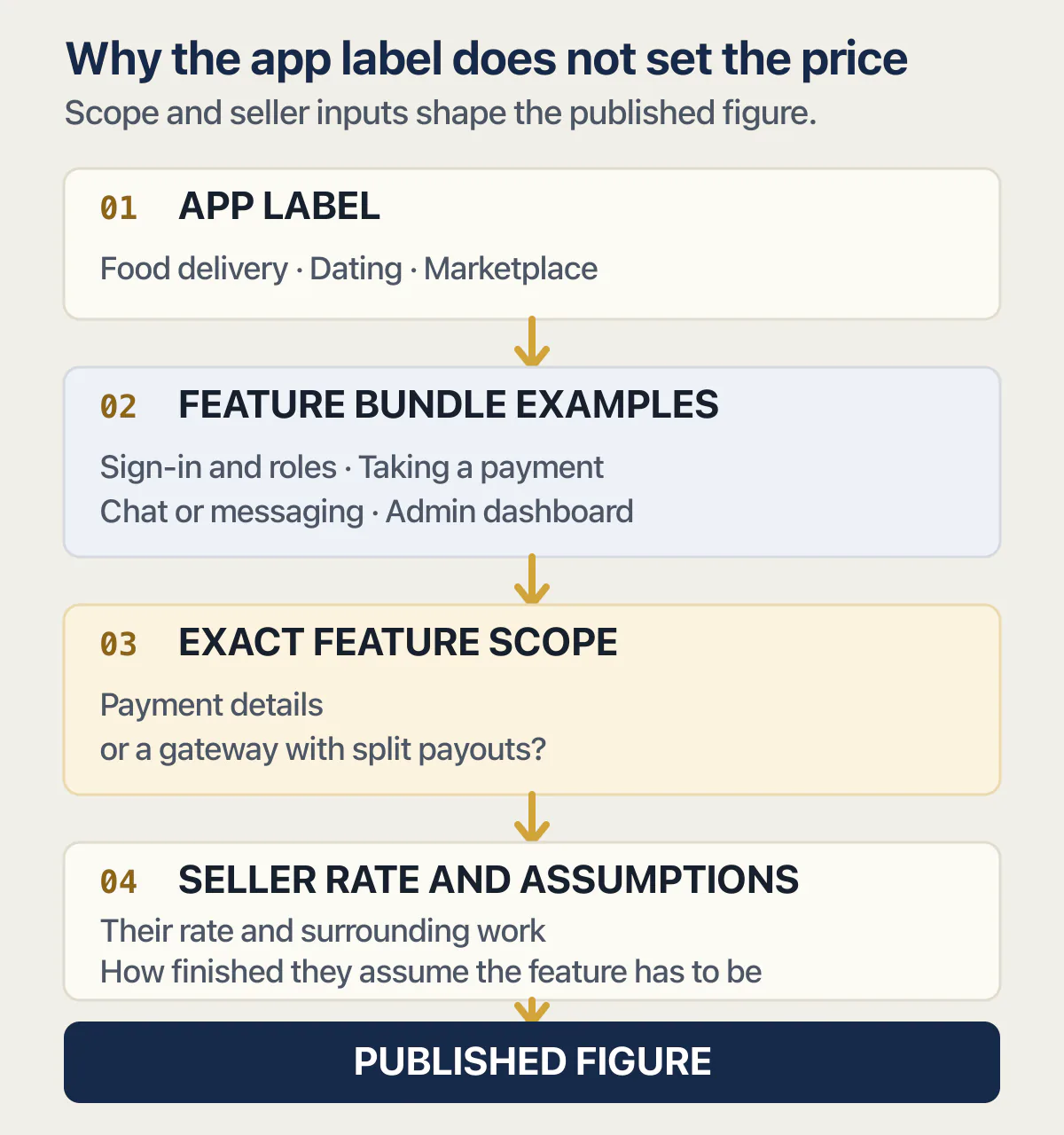
Notice that Cleveroad holds the low end of five of the six rows. That is the useful signal in the table. A per-feature price list is mostly a statement about the seller who published it: their rate, their assumptions about how finished a feature has to be, and how much surrounding work they fold into the line.
One seller’s own page makes the same point without leaving the same app. Appinventiv’s dating page prints $60K to $150K for an iOS native build and $30K to $90K for a responsive web app, for the same product, on the same page, dated 30 July 2026. The build target moved that number more than the choice between an event-based dating app and a swipe-based one moved it further down the page. What changes when the same app is a web app instead is worth settling before the type question: whether the same idea is a web app or something installed from a store changes what is built before it changes what is billed, and the two are compared directly.
The features that carry a real published price, one anybody can check without asking a seller, are the metered ones, and they cost the same regardless of what kind of app they sit in. Google Maps Platform’s pricing page, read on 30 August 2026, lists a Starter plan at $100 a month covering 50,000 monthly calls, Essentials at $275 a month for 100,000, and Pro at $1,200 a month for 250,000, with a $300 trial credit for new customers. As of 30 August 2026, that page does not publish per-call rates for individual products; it points to a separate core services pricing list, so no per-call rate is stated here. Stripe’s pricing page, read the same day, states 2.9% plus 30 cents per successful transaction for domestic cards, plus 1.5% for international cards, plus 1% where a currency conversion is needed, and $1.50 per local bank payout. A map costs a delivery app exactly what it costs a real estate app. Where the money inside any one of these figures actually goes, line by line, is set out separately.
Food delivery and ride hailing apps
Three things make this bundle expensive, and none of them is the menu. The first is live location shown to two people at once, which means a map with a paid meter behind it and a server keeping two moving positions in agreement. The second is a second app, because the driver needs their own screen, their own login and their own rules about what they can see. The third is paying somebody who is not you, which is different work from taking a card.
Simpalm, on a page updated 24 August 2026, prices a delivery MVP at $50,000 to $100,000 and its Enterprise tier at $200,000 and up, and prices a white-label approach, meaning somebody else’s finished software with your name on it, at $15,000 to $50,000. That last figure is the honest floor of this category and it buys a different thing: a product you configure rather than a product built for you. The same page puts AI-powered recommendations at $15,000 to $40,000 as an added feature.
Jotform, on a page last updated 25 June 2026, publishes the widest single range read for this article: $10,000 and $500,000 for hiring a developer to build a food delivery app. A fifty-fold range concedes that the category name narrows the question hardly at all, and it comes from a company whose own business is a builder rather than an agency. The same page prices fixing bugs and glitches after launch at $1,000 to $2,000.
Taxi, ride-sharing, grocery, courier, laundry and on-demand service apps sit in this bundle too, because they are the same three features with different words on the buttons. A car wash app and a pharmacy delivery app share a dispatcher, a map and a payout.
Dating apps
Matching, media in the chat, and the reporting and blocking work that arrives the day real strangers start using it: those are the three that move a dating app’s number. The third one surprises people. A report button is cheap; deciding what happens after somebody presses it, and building the screen where a human reads the queue, is not.
Purrweb, on a page published 14 August 2024 and updated 30 April 2026, is the only seller read for this article that publishes a per-feature list for dating. Its figures: a secure registration form at $3,100, a person’s profile at $6,000, geolocation at $4,500, audio and video chatting at $7,500, a partner search algorithm at $4,000, and in-app purchases at $4,500. It puts a dating MVP at $55,000 to $75,000. Its partner search algorithm at $4,000 sits below the person’s profile at $6,000 and well below audio and video chatting at $7,500, which is odd for the feature the whole product is named after and says something about what “matching” means in a first version.
Appinventiv, dated 30 July 2026, works from the other end: $40K to $400K overall, then $60K to $150K for an event-based dating app up to $200K to $400K for AI-driven matchmaking. That page publishes no per-feature figures at all, which was checked on 30 August 2026.
The searches asking what an app like a famous one costs land here, and Purrweb answers them. It prices a Tinder-like app at $157,000 to $200,000 and a Bumble-like app at $161,000 to $250,000, against its own $55,000 to $75,000 for an MVP.
Marketplace and shopping apps
A marketplace has two kinds of account that see different things, listings that have to be searchable, and one payment that has to be split between two parties who both care about the split. Ecommerce apps and real estate apps are the same bundle with the second party changed: a shop instead of a seller, a listing agent instead of a host.
Appscrip, dated 13 June 2026, publishes both tiers and features. Its Custom MVP is $25,000 to $60,000 and its Custom Enterprise is $100,000 to $300,000 and up. By kind, a rental and booking marketplace is $60,000 to $150,000 and a freelance services marketplace is $50,000 to $130,000. Per feature: user authentication $3,000 to $6,000, seller onboarding $5,000 to $10,000, listings and search $8,000 to $15,000, payment gateway with split payouts $10,000 to $20,000, and in-app messaging $8,000 to $15,000.
Groovy Web, on a page last updated 26 August 2026 and the most recently refreshed source read here, prices an ecommerce app in the same shape: basic MVP at $40,000 to $80,000 covering product listings, cart, checkout and user accounts, and advanced at $150,000 to $250,000 and up. Per feature it puts product catalogue and search at $12,000 to $25,000, shopping cart and checkout at $10,000 to $20,000, AI product recommendations at $20,000 to $40,000, and an admin dashboard with analytics at $10,000 to $20,000.
That same page prints a second column beside every one of those figures, which it labels an AI-first team: $30,000 to $45,000 for the basic MVP against the $40,000 to $80,000 in its agency column. That is one seller’s own two-column comparison on its own page, presented as that seller presents it, and nothing more general should be read into it. What it costs to build with the AI tools themselves, before you hire anybody at all, is counted separately.
Three things sit next to this section rather than in it. A shop that only needs a page people can buy from, with nothing to install from either store, is priced from a different set of sellers again. And the six ways a checkout that works still leaks money matter here more than in any other bundle: taking a card and showing a tick is not the same as being paid, and each of those six is a build cost somebody either paid or did not. On the AI recommendations line, the build figure is only half of it, because what the model calls behind an AI feature cost once real people are using them is worked out separately and per user.
Fintech and payment apps
Checking that a person is who they say they are, keeping a ledger that balances, and meeting a compliance line that is a cost before it is a feature: that is what makes this bundle the dearest one on the list.
Saigon Technology, on a page updated 24 July 2026, puts fintech overall at $50,000 to $500,000 and up. By kind, splitting each into a first version and a full platform: a digital wallet or payment app at $40K to $100K then $150K to $350K, a lending platform at $50K to $120K then $150K to $400K, an investment or wealth app at $70K to $180K then $250K to $500K and up, and an insurance app at $40K to $100K then $150K to $350K.
The interesting figures on that page are the ones that are not features. PCI DSS compliance, initial implementation, is $15,000 to $50,000. Open banking APIs are $10,000 to $30,000. Payment gateway integration is $5,000 to $20,000. The compliance line alone tops out above the entire lowest band RaftLabs publishes for a hotel booking app, nothing on it is visible to a user, and it cannot be postponed until version two. That is the actual reason a wallet costs more than a marketplace.
Banking, e-wallet, trading, BNPL and insurance searches all land in this bundle. Whether the app is ready to take somebody’s card at all is a check that comes before the price of building the checkout, and it is worth running first. Adding the paying part to an app that already exists is bought on its own, and it is not a slice of any figure above.
Healthcare and telemedicine apps
A video visit, records that belong to somebody else, and the rules attached to both. Those rules are what separate a healthcare app from a video-calling app with a calendar in it.
Cleveroad, on a page updated 30 May 2026, publishes the lowest per-feature figures read for this article. On the patient side: registration $500, profile management $750, a unified patient interface $3,000, video conferencing $3,500, text chat $2,000, scheduling and alerts $1,750, payment details $1,000, and prescription and medical history $1,500. That page totals the patient side at $14,000. On the doctor side, a physician dashboard is $4,500 and a patient interaction suite is $7,500, totalling $12,000 on that page. Its own worked estimate for the whole first version is $64,800 to $113,400.
Set those next to the tiers on the same page and something useful shows up. Cleveroad’s basic telemedicine MVP is $40,000 to $70,000, its medium tier $70,000 to $100,000, and its advanced or enterprise tier $100,000 to $300,000 and up. Its own two feature totals, $14,000 and $12,000, both sit well under the $40,000 floor of its cheapest tier. Whatever fills that gap is work with no feature name on it, which is the honest part of that page and the part most cost guides leave out.
What the rules actually require of a health app’s backend is settled elsewhere, and it decides some of the cost above.
Fitness apps
Reading a wearable, running a subscription, and finding somewhere for the content to come from. The third is the one nobody budgets: a workout app with no workouts in it is a shell, and the exercises, the videos and the plans are either licensed, filmed or written by somebody.
Topflight Apps publishes by archetype rather than by tier, on a page dated 22 September 2025, which makes it the oldest source read for this article and its figures are quoted with that date attached. A tracker app is $40,000 to $75,000 for the first build and $90,000 to $150,000 for the version after it. A coaching platform is $60,000 to $100,000 then $130,000 to $200,000. A connected-hardware app, meaning one that talks to a physical device, is $100,000 to $180,000 then $250,000 to $400,000 and up.
The same page prices feature packages as increments rather than as parts of a whole: a basic features package at $30K to $60K cross-platform, premium features at an incremental $45K to $95K, and AI and ML features at an incremental $55K to $140K. That last figure is the largest single feature increment anywhere in these eleven pages, and it belongs to the category most often described as a small addition in a first conversation.
A tracker at $40,000 and a connected-hardware app at $400,000 are both fitness apps, and both would be quoted from the same search.
Social media apps
The feed, video, and moderation. A feed that shows posts in the order they arrived is cheap. A feed that decides what to show is a different product, and video is the line that turns a hosting bill into a real one.
AgileEngine splits its social media page into three phases rather than tiers. Phase one, which it describes as auth and profiles, a chronological feed, text and image posting, likes and comments, follows, push, basic search, report and block, an admin dashboard and one-to-one messaging, is $40,000 to $90,000 over three to five months. Phase two, adding feed ranking, video upload and playback, stories, group chat, creator analytics and advanced search, is $80,000 to $150,000 over four to six months. Phase three, a full-scale platform with live streaming, recommendations, automated moderation, tipping and subscriptions, is $150,000 to $400,000 and up.
As of 30 August 2026, AgileEngine’s page does not render a published or updated date to an automated read, so those three figures are stated with the date they were read and no publication date at all.
What that phasing shows better than any tier table is where the money sits. Report and block is in phase one; automated moderation is in phase three. Streaming, live video, chat and news apps sit somewhere on that same ladder, and which rung they need is a product decision made long before anybody quotes it.
Booking and travel apps
Real-time availability, a calendar that two systems agree on, and somebody else’s inventory. The third is what makes travel apps different from everything above: the rooms, the seats and the tables belong to other companies, and getting at them means an integration you do not control.
RaftLabs, on a page dated 23 December 2025, publishes the cheapest bands in this whole comparison. An MVP booking app is $15,000 to $35,000, a mid-scale one is $30,000 to $65,000, and an advanced or enterprise one is $65,000 to $120,000 and up. Its own short answer for the search is $20,000 to $120,000 and up. By build target it puts iOS at $30,000 to $100,000 and Android at $25,000 to $90,000.
Hotel, flight, restaurant, salon, education and appointment booking searches all land on that bundle. This type is cheapest here because a booking app can genuinely ship with one calendar, one payment and no second app for a driver, and the sellers who publish these pages know it.
What every one of these figures leaves out
Four things sit outside every figure above, and three of them keep arriving after the build is finished.
The first is the two stores. Apple and Google both charge before anybody can download the finished thing, and neither charge appears in any band on this page. What the two stores charge to put it in front of anyone is counted on its own page, and it is not inside any figure above.
The second is the monthly bill. Every one of these apps runs on a host, a database and a set of metered services, and several of the pages read for this article publish monthly figures that were deliberately left out of the tables above, because a build figure and a running figure are two different purchases. What the finished thing then costs every month, once hosting, a database and the metered services are all billing, is added up on its own page.
The third is paying a person once the app exists. Every figure above prices a build starting from nothing. What each way of hiring a person costs, once there is an app to work on, is compared route by route on its own page.
The fourth is keeping it working. Several of these sellers publish an annual maintenance figure as a percentage of the build, and none of those percentages appears here, because a percentage of a made-up number is a made-up number. Paying a person to keep the thing working after launch is a different bill from building it, and it gets its own page.
There is a fifth thing. Turning bands like these into one number for one specific app is a different job with a method of its own. None of the figures above is a quote. They are what eleven companies published about work they had not seen.
If you already built a first version with an AI builder
A meaningful share of the people searching these terms already have something running. They built it with Lovable, Base44, Bolt, Replit or Cursor over a couple of weekends, it demos, and the question is what the rest costs. For that reader the tables above are the wrong shape, because what is missing from an AI-built first version is a feature list rather than a category.
Across the 26 real applications AxonBuild audited in June and July 2026, the 21 third-party ones share a single findings ledger, and in 11 of those 21 something that did privileged work answered a caller who had never signed in at all. The fixed cohort and how it was audited is described on the page that owns it, denominators included. That one line is worth holding next to the two tables above, because sign-in and roles is the feature every single type on this page contains, and in that cohort it was the feature most often left half-finished by the builders those 21 apps were made with; no count across all builders or all features was taken. A delivery app, a dating app and a telemedicine app all need a stranger to be stopped at the same door.
The sellers who fix an app that already runs are a separate market with its own published prices. The prices that market puts on cleaning up a running app are collected in one place, and cleaning up something already built and already misbehaving does not price like a build.
AxonBuild’s own terms are short enough to state in a sentence. The first conversation is a free 20-minute video call where you show Bilal the app and the feature that is half-finished, and he talks through what needs checking. If you want him to finish it, add payments to it or fix the door that lets strangers in, he checks the code and gives you a fixed quote rather than a band off a description, and you pay after you see the change working. No figure in the seller tables above is a price AxonBuild charges.
Common questions about app development cost by app type
Does the kind of app really change what it costs to build?
It changes which features are in the bundle, and the features change the price. Read across eleven sellers’ own pages on 30 August 2026, the cheapest published band was RaftLabs’s $15,000 to $35,000 for a hotel booking MVP and the dearest was Saigon Technology’s $250K to $500K and up for a full investment platform. But the spread inside one seller’s page for one type is usually wider than the gap between two types, so the category name narrows the question much less than it looks like it should.
How much does a food delivery app cost to build?
Two sellers publish figures for exactly this and they disagree enormously. Simpalm, updated 24 August 2026, prices a delivery MVP at $50,000 to $100,000 and its Enterprise tier at $200,000 and up. Jotform, last updated 25 June 2026, publishes $10,000 and $500,000 for the same question. Simpalm also prices a white-label approach at $15,000 to $50,000, which is the cheapest honest route in that category.
How much does it cost to make a dating app?
Purrweb, published 14 August 2024 and updated 30 April 2026, puts a dating MVP at $55,000 to $75,000 and publishes a per-feature list: registration $3,100, a profile $6,000, geolocation $4,500, audio and video chatting $7,500, and the partner search algorithm $4,000. Appinventiv, dated 30 July 2026, works in wider bands, from $60K to $150K for an event-based app up to $200K to $400K for AI-driven matchmaking.
How much does an ecommerce app cost to build?
Groovy Web, last updated 26 August 2026, prices a basic ecommerce MVP at $40,000 to $80,000, describing it as product listings, cart, checkout and user accounts, and an advanced build at $150,000 to $250,000 and up. Appscrip, dated 13 June 2026, prices a product marketplace at $40,000 to $120,000. A shop that only needs a page people can buy from, with nothing to install from either store, is a different purchase with its own sellers and its own bands.
Why do published cost guides disagree by so much?
Because each page is one seller describing its own business, and the label they share does not mean the same amount of work to any two of them. Jotform’s food delivery range spans $10,000 and $500,000 on a single page. Cleveroad’s telemedicine list sits at the low end of five of the six features compared here while another seller’s list for the same features sits at the top. The number encodes the seller’s rate and their assumptions, and neither is stated on the page.
Which features cost the most, whatever the app is?
Money and identity. Across the pages read on 30 August 2026, taking a payment ran from Cleveroad’s $1,000 for payment details up to Appscrip’s $10,000 to $20,000 for a gateway with split payouts, and Saigon Technology prices PCI DSS compliance alone, before any feature, at $15,000 to $50,000. Anything involving live video, a ranked feed or moderation sits in the same band: AgileEngine puts automated moderation two whole phases above a report button.
Is a copy of a well known app cheaper to build than an original one?
No, and one seller publishes the figures that show it. Purrweb prices an app like the best-known swipe product at $157,000 to $200,000 and one like its closest competitor at $161,000 to $250,000, against its own $55,000 to $75,000 for a dating MVP. Copying a mature product means copying years of features added after that product found its audience, which is a much bigger job than a first version.
Does building for one store instead of both halve the price?
It does not. RaftLabs, dated 23 December 2025, puts an iOS booking app at $30,000 to $100,000 and an Android one at $25,000 to $90,000, and Appinventiv prices a Flutter dating build at $45K to $110K against $60K to $150K for iOS native. Choosing one store saves some of the front end and none of the server, the payments, the roles or the data, which is where most of the work in every one of these bundles sits.
What does a published app cost figure usually leave out?
The store charges, the monthly bill after launch, paying a person once the app exists, and keeping it working. Cleveroad’s telemedicine page is unusually honest about a fifth gap: it prints feature totals of $14,000 for the patient app and $12,000 for the doctor app, then a cheapest tier whose floor is $40,000, and whatever fills that gap is real work with no feature name attached to it. Most pages never show the gap at all.
Built it with AI. Can’t get the last part right?
That’s the normal state of an AI-built app, and it’s fixable. I trace what the app actually does, explain what needs changing, and build it if you want me to.
Talk about your app →  Free 20-minute video call with Bilal.