Your app works. Nobody is building on it any more. And something still has to be paid, or one day it stops.
Somebody on an AI-builder forum asked it in the plainest words anybody has used for the problem:
so I am done building my app, and I m trying to conserve funds while I work on other components. can I downgrade my package and still operate my app at its full potential.
That is the real question under app maintenance cost. Where is the floor, now that the building has stopped. Search for the answer and every page that comes back starts in the same place: what the app cost to build. They take that number and charge a slice of it every year, forever. Somebody whose application came out of a builder subscription and a few hundred prompts has no such number. The invoice they are being asked to take a slice of was never written. So this page starts from the bill instead, line by line, and prices only the line that buys a person.
Keeping an app alive is four bills, not one: the machines, the model calls, the store fees, and a person’s attention. Three of them arrive on a clock whether or not anybody touches the code. The fourth is the only lumpy one, and it is the only one priced here.
How much does it cost to maintain an app?
Sellers who look after other people’s applications publish monthly tiers, and one of them publishes an hourly rate for the same work on the same page. Both are read below with the seller named and dated. What one working app actually consumes is a small number of paid events in a year, not a subscription.
| The line | Who bills it | How it is charged | Where it is priced |
|---|---|---|---|
| The machines it runs on | the vendors underneath it | plan fees plus meters | its own page |
| The model or API calls | the model provider | per call | its own page |
| Store listing and build floors | the two stores | yearly and one time | its own page |
| A person’s attention | whoever you pay | by the hour or by the month | this page, from here down |
Every figure below was read on 1 September 2026 off the page of the company that wants the money, and those pages fall into two piles that stay separate here: sellers who publish what they charge to look after somebody else’s application, and platforms that publish the dates an application has to meet whether anybody is being paid or not.
Three of those four rows are already priced properly somewhere else, and repeating them here would only produce a worse version. The plan fees and the meters underneath them are added up vendor by vendor, at ten users and at a thousand, on the page that does nothing else, and not one of those lines is counted again here. For the model row, OpenAI’s API pricing page, read 1 September 2026, prices standard input on its current gpt-5.6 models between $0.20 per million tokens for gpt-5.6-luna and $4.00 per million for gpt-5.6-sol, and that is the whole of the range this page needs; turning a per-call rate into a number per paying customer is a different sum with a different denominator, and it has its own method. For the store row, what the two stores charge to keep a listing alive runs on a yearly clock plus a single joining charge, not on a monthly invoice.
What is left is the person, and it is the only line on the whole bill that nobody can put a plan price on in advance.
What a month actually costs
The companies who sell this work publish a monthly number. Here is what four of them published, read on 1 September 2026, each with the date on its own page.
| Seller and page date, all read 1 September 2026 | The tier or unit, as the page names it | Published figure |
|---|---|---|
| Bolder Apps, published 3 August 2026, updated 4 August 2026 | ”Basic Maintenance”, its cheapest named tier | $2,000 to $5,000/month |
| Bolder Apps, same page | ”Break-Fix (Hourly)”, the same work sold by the hour | $150 to $300/hour |
| Appinventiv, page data last updated 25 November 2025 | its general monthly band | $500 to $4,000 per month |
| Imaginovation, dated 1 April 2026 | its typical monthly range | $2,500 to $5,000 per month |
| Simpalm, updated 8 May 2026 | hourly support, developer based in the United States | $60 to $150 per hour |
Prices checked 1 September 2026. Those pages are bolderapps.com/blog-posts/mobile-app-maintenance-services-2026, appinventiv.com/blog/what-is-the-cost-to-maintain-an-app/, imaginovation.net/blog/importance-mobile-app-maintenance-cost/ and simpalm.com/blog/app-maintenance-what-is-it-and-how-much-it-cost. All four addresses are printed without a link on them, deliberately. Each of those companies would happily take on the upkeep this page is teaching you to price, so they are cited by name and address and nothing more. Bolder Apps and Simpalm print their two ends with a dash between them, and Appinventiv and Imaginovation write theirs out in words; the figures above are unchanged and only the separator is.
Read those rows for what they are. An app maintenance fee charged by the month is the price of a company being available to you, staffed and answering, whether or not your application asks anything of them in a given month. It is not a measurement of what one app consumes. Bolder Apps says so itself by publishing both units side by side: the same page that sells a ladder of monthly tiers also sells the same work by the hour, and it files that hourly option under applications whose change needs are minimal, which is another way of saying they do not generate a month’s worth of work in a month. That seller’s higher tiers, and the package contents behind each one, are compared seller by seller elsewhere; what this page needs from the ladder is its floor.
Simpalm’s row is the other honest unit on this market. It sells the same support by the hour instead, at $60 to $150 an hour for a developer based in the United States, updated 8 May 2026, which is a rate for hours actually worked rather than for availability held open. Two sellers, two units, and the gap between them is the whole argument of this page.
The spread between the sellers deserves a moment on its own. Appinventiv’s floor for what it calls most apps is $500 per month, and Bolder Apps’ floor for its cheapest named tier is $2,000 per month, both read 1 September 2026, and the two pages are describing the same category in almost the same words. Imaginovation, dated 1 April 2026, sits above both at $2,500 to $5,000 per month for what it calls typical. Nobody here is being dishonest. They are selling different amounts of standing availability under one label, and the label is doing all the work. That is also why no average app maintenance cost is printed here: an average taken across rows that mean different things describes none of them.
A job somebody can describe in a sentence has a price, because the thing being bought is on the table and both sides can see the same object. A month does not, because the month has not happened yet, and whoever prices it has to assume the busy version of it.
What a year adds up to
An annual number for the human line is the sum of the dates the application has to meet plus the days something breaks, rather than twelve of anything, and the dates are published years in advance by people who are not you.
Here is one, read 1 September 2026. Google Play’s target API level requirements page states that from 31 August 2026 anything newly submitted “must target Android 16 (API level 36) or higher”. Apps that stay published without updating sit on a lower floor of their own, below which they stop reaching new users on newer devices, and anybody needing longer can “request an extension to November 1, 2026”. That is one paid event with a date on it, set by somebody else, arriving whether or not a single user complained. How far in advance that floor gets published, and what an upload has to clear, is worked through where it belongs.
Two more of the same kind sit on other pages of this site rather than here, because those pages already carry the exact numbers. There is a minimum build toolchain an upload has to clear before an Apple reviewer sees anything, and what an upload has to clear before review starts states the current one with its date. And the certificate that renews itself until the renewal job stops renews on a cycle measured in weeks rather than years, on the page that carries those numbers with their source.
Now the arithmetic that nobody selling a monthly tier puts on their own page, using two figures from one seller’s one page. Bolder Apps publishes “Basic Maintenance” at $2,000 to $5,000/month and “Break-Fix (Hourly)” at $150 to $300/hour on the same article, published 3 August 2026 and updated 4 August 2026, read 1 September 2026. Twelve months at the floor of that monthly tier is twelve times $2,000, which is $24,000 for the year. At the same seller’s own break-fix rates, $24,000 buys 80 hours of work at $300 an hour, or 160 hours at $150. For an application with a change list that has an end, 80 to 160 hours is not a year of work. It is a year of somebody being ready in case.
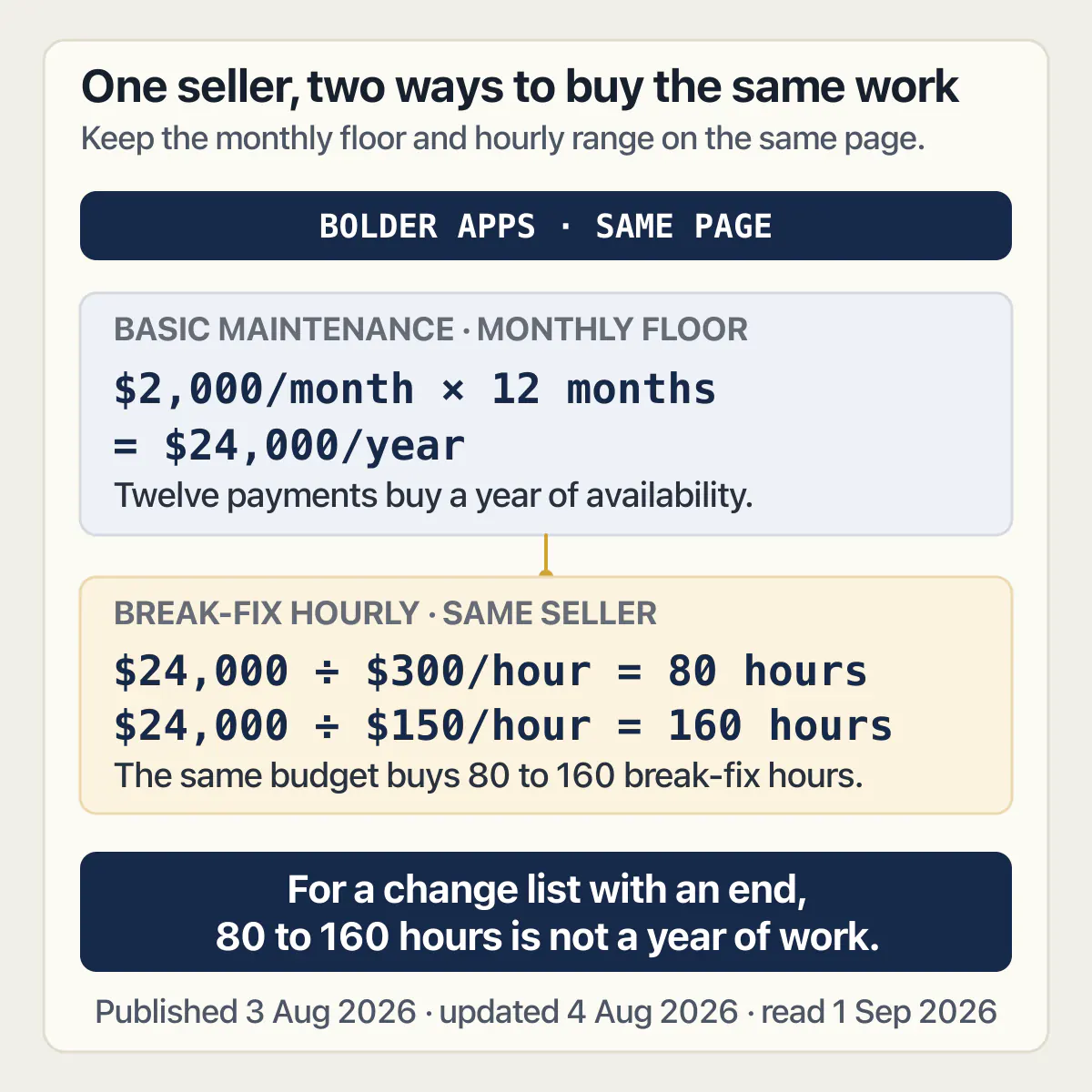
There is a second way to reach an annual number, and it is the one nearly every ranked page reaches for first: take what the application cost to build and charge a slice of it every year. Leave aside whether the slice is the right size, because for this reader the trouble arrives one step earlier. An application prompted into existence over a few weekends has no build invoice. There is no first term to take a slice of. Somebody who paid a builder subscription and their own evenings can run that formula as often as they like and it will keep returning nothing, which is exactly why the tools ranking on this question open by asking for a number the person searching does not have.
Add up your own four lines
You can produce a real number for the first three lines of your own application in about twenty minutes, and a count with amounts beside it for the fourth, and none of it requires a seller. Read the first three lines off invoices you already receive, and count the fourth.
| The line | Where your own number is | What it is charged on |
|---|---|---|
| The machines | last month’s invoice from each vendor underneath the app | plan fees plus meters |
| The model calls | the model provider’s own usage screen | per call |
| The stores | the renewal notice and the joining fee | a yearly clock and a one-time one |
| The person | how many times in the last twelve months somebody had to be paid to touch the app, and what each of those jobs cost | per job, or per month |
Most owners skip that fourth row, and it is the row that decides the answer. The row ignores what you were quoted and what an agency says the category costs. It asks how many times, in the last twelve months, somebody had to be paid to open your code, and what each of those jobs came to. The count gives the shape of the year and the amounts give its size; a count of past paid jobs says nothing about upkeep nobody has done yet, so the dated floors in the sections above still go on the list. Whatever your own answer is, it is better evidence than any published band, and no typical figure is printed here because nobody has measured one.
Search the calculator phrasing on 1 September 2026 and most of what ranks is a form rather than a calculator: you give a seller your details and a seller decides what to send back. The ones whose method is visible on the results page ask the same opening question, which is what the app cost to build. That is the one number the reader of this page does not have, which is why the worksheet above starts from invoices instead of from a build price.
What changes when it is a web app
Everything priced above is mobile app maintenance cost: an application that lives in a phone store, on that store’s calendar. Strip out the store and a good deal of the calendar goes with it. There is no review queue, no listing to keep alive, no build floor that has to be cleared before a person at a platform company looks at anything. What replaces them is quieter and easier to miss.
A certificate renews on a cycle until the job that renews it stops running, and the first anybody hears about it is a browser warning. A runtime version goes out of support, and the platform that hosts the app decides when it stops running that version rather than you. Dependency alerts open themselves, a machine files them, and a person has to read and close each one, because the update that had to happen can break the thing it was meant to protect. None of those three has a store deadline attached, so none of them arrives with a warning email addressed to the owner.
The practical difference on the human line is who tells you. A store sends a notice with a date on it. A dependency alert files itself in a repository nobody has opened in months. When a certificate job fails quietly, the first anybody hears of it is somebody who cannot sign in. The annual count for a web app is as large as for a store app and harder to see coming, which is why the fourth row of the worksheet above is the only honest way to find out what yours was.
Web applications also drift in a way that costs money on the human line specifically. Why the same change costs more this year than it did last year is its own subject, and it is the reason a maintenance figure quoted against a fresh application stops describing the same application two years later.
Why two apps the same size cost different amounts to look after
Every seller page on this search sorts price by size: simple app, medium app, complex app. Size on its own is not enough to price it, and AxonBuild’s own audit data shows why.
AxonBuild audited 26 real applications in June and July 2026, in three fixed groups: 11 third-party applications read deeply, 10 more held back as a check on the method, and 5 of the founder’s own. Every one of those audits produced two results that were deliberately kept apart. The first was a yes or no question about whether the application carries a confirmed critical finding, and “confirmed” is a high bar here, because somebody had to attack the claim adversarially in the application’s real code instead of accepting a pattern a scanner recognised. The second measured something else entirely, which is how much remediation work the application is carrying. How both readings were produced, and what each one was scored against, is published in full.
Keeping those two apart is the point, because they move independently. One application can carry a single dangerous thing and almost nothing else, and closing it is one short paid job. Another can carry nothing dangerous in it and a long queue of unfinished things, which is somebody’s attention for a while and none of it urgent. Both applications can look identical from the outside, to the owner as much as to a seller, and the amount of paid attention they need is not remotely the same. What the audit measured is whether a confirmed critical finding exists and how much remediation is queued, and neither reading was scored against size; a monthly figure set by how big an application looks is answering a question the evidence cannot connect to the workload.
The months where the number is zero
Put the two previous sections together and a consequence falls out that no page selling a monthly tier will write down. If the human line fires on published dates and on the days something breaks, and if the amount of paid attention an application needs is set by what it carries rather than by its size alone, then for a small application with a finished change list there are months where the human number is nothing at all.
That is reasoning, not a measurement. AxonBuild has not counted how many such months a typical application has, and neither has anybody else selling you a figure for it. What it means practically is that the comparison to run is “twelve monthly payments against the two or three jobs my own worksheet actually recorded last year”, rather than “monthly tier against monthly tier”.
Three ways to buy the human line
The human line is sold three ways, on three different units. None of them is better in the abstract; they fail in different places.
Pay per job. One repair that has an end you can see is bought by the hour or by the finished job, and the published bands for that purchase sit on the page about paying somebody for one result. The risk you carry is the hour count on code nobody has read yet.
Pay by the month. What a monthly package normally contains, and which parts of it one application can cut without noticing, is compared seller by seller elsewhere; whether to buy a block of somebody’s month at all, and what has to be written into the terms if you do, is a decision with a test of its own. The risk you carry is paying twelve times for availability, monitoring and a response promise in a year whose two jobs may have used little of it.
Pay somebody ongoing. Which of these items arrives on somebody else’s published schedule, and whether a month of availability is worth buying at all, is set out row by row where that decision belongs. The risk you carry is a commitment sized for a product team on an application that is one screen away from finished.
Underneath all three sits a question that has to be settled first. Which person or arrangement ends up doing any of this is settled before a single one of these numbers starts to matter. And which jobs are on the invoice in the first place, named one at a time, is listed apart from what any of them costs.
Two neighbouring numbers are named here only so that nobody hunts for them on this page. What the whole build was worth as a single figure, for anybody who did receive an invoice for it, gets a page to itself. And what a company that builds applications says upkeep is worth once the build is signed off is taken apart where those quotes are read line by line.
Where this leaves AxonBuild
Nothing above is an AxonBuild price, and none of those tables has a row for it. AxonBuild sells no maintenance plan and no monthly arrangement.
What it does is work on apps that AI tools built, one change at a time, as you need them. The 20-minute video call with Bilal is free: show him what is breaking or what customers have asked for, and he will talk through what needs checking. If you want him to make the change, he checks the app and gives you a fixed quote, and you pay after you see it working. Further fixes, features and releases can follow the same way, paid per change rather than per month.
That shape exists because of the argument on this page. A small app with a finished change list may need only a few changes a year rather than a monthly arrangement. If your own worksheet says two jobs last year, set the twelve payments against what the package actually included, such as monitoring, patching and a response promise, and against what those two jobs cost; the package is sold as availability, so counting unused months is not the comparison.
Common questions about app maintenance cost
How expensive is it to maintain an app?
Read on 1 September 2026, the sellers ranking for this question publish monthly figures that start in the hundreds and climb steeply from there: Appinventiv, whose page data records a last update of 25 November 2025, puts most apps between $500 and $4,000 per month; Imaginovation, dated 1 April 2026, calls $2,500 to $5,000 per month typical; and Bolder Apps, published 3 August 2026 and updated 4 August 2026, opens its ladder with “Basic Maintenance” at $2,000 to $5,000/month. Every one of those prices a company staying available to you. What your own application costs is the machines it runs on plus the number of times a year somebody actually has to be paid to open it, and for a small working app those two answers can be a long way apart.
Does it cost more to keep an app on Android?
Not on the invoice, but the calendar is stricter and it is published further ahead. Google Play’s target API level requirements page, read 1 September 2026, sets a target level floor from 31 August 2026 for anything submitted, a lower one for apps that stay published without updating, and an extension window that closes on 1 November 2026. That is a dated piece of paid work whether or not anything is wrong with the app. The equivalent floor on the other store is a build toolchain minimum rather than an API level.
Is the price different in other countries?
Yes, and the unit often changes with it. Talk Think Do, a UK company whose mobile app development cost article is dated 29 July 2026 at talkthinkdo.com/blog/mobile-app-development-cost-uk/, says its managed support services start from £1,590 per month, covering monitoring, patching and store version management, read 1 September 2026. Simpalm, updated 8 May 2026, sells support by the hour at $60 to $150 an hour, for somebody based in the United States. A monthly arrangement and an hourly rate are not comparable until you decide how many hours a year your application actually needs, which is the count the worksheet above asks for.
What does it cost to keep an app in the app stores?
There are two charges and they run on two different clocks: one store bills a membership every year, and the other charges once, at registration. Neither is monthly, neither scales with how many users you have, and both are published by the stores themselves rather than by any seller. The page that prices both stores carries the current figures with their read dates, so they are not restated here. The store cost that actually varies is the work of meeting each store’s next build or API floor on the date it lands, rather than the fee.
What does it cost to maintain an app like Uber?
That question has no useful answer for you, and the honest reason is that the comparison is not about the app. A ride-hailing service pays for round-the-clock staffing, live operations, fraud handling, payments at scale and a permanent product team, and none of those lines exist on an application with a few hundred users and a finished change list. The number that matters for your own app comes from the worksheet above: your vendor invoices, your model usage, your store renewals, and the count of times somebody had to be paid to open your code last year.
Do the same numbers apply if people call it a site?
The four lines apply; the sellers do not. The same four lines for something people reach in a browser and call a site are worked through separately, because the sellers ranking on that search are pricing a different product. If your thing has accounts, a database and money moving through it, the numbers on this page are closer to yours than anything a site plan quotes, whichever word you use for it.
How many times a year does somebody actually have to be paid?
Count it rather than estimate it, because your own last twelve months is better evidence than any published band. The events that force it are the ones with dates on them, such as a store target level deadline, plus the ones that arrive without warning, such as a dependency update that breaks a screen or a certificate renewal that quietly stops working. For a small application with a finished change list, owners who count it often find once or twice a year and sometimes none; nobody has measured a typical figure, and your own count is the number that decides whether a monthly arrangement is worth anything to you.
Why do the calculators ask what the app cost to build?
Because the frame those tools are built on takes the build price as its starting number and charges a slice of it annually, so without a build price the tool has nothing to work with. That works for a company that commissioned a build and holds the invoice. It does not work at all for somebody whose application came out of a builder subscription and their own evenings, because the number the tool is asking for was never written down. Most of the results for the calculator phrasing on 1 September 2026 are also lead-capture forms, so the price you get back is the beginning of a sales conversation rather than a figure you could check.
Nobody has looked at the app since it was built. What does that change?
It moves work from the calendar into a backlog, and backlogs on this line get more expensive rather than less. Missed store floors mean an app that cannot accept an update until it is brought current. Dependency alerts that nobody closed stack up until the update that fixes one breaks another. A certificate that renewed automatically for a year stops one day with no email. Apart from a store deadline or a dependency alert with a known exploit, none of that feels urgent on any single Tuesday, which is exactly why it accumulates, and the first paid job after a long gap is usually the largest one you will buy.
Built it with AI. Can’t get the last part right?
That’s the normal state of an AI-built app, and it’s fixable. I trace what the app actually does, explain what needs changing, and build it if you want me to.
Talk about your app →  Free 20-minute video call with Bilal.