Rate tables for freelance web developers are easy to find and almost impossible to check. Every guide that ranks for this search prints hourly bands. Almost none of them says what its own publisher counted before the number went onto the page, which is the difference between a measurement and an echo, and it is exactly the difference that vanishes when three tables happen to agree with each other.
Four such guides were opened for this page on one day, and the differences between them turned out to matter more than the bands. One says on its own page that its figures were compiled out of other people’s pages, and one of the pages it names is another of the four. A second publishes bands for its own platform and discloses no source, no sample behind the bands and no method at all. Only two of the four state a group of people they actually measured, and one of those two is not measuring web developers in dollars.
Every band on this page was taken on 31 August 2026 from the page that publishes it, and each one is filed under what its publisher says it counted: a survey with a stated number of respondents, a platform reporting its own users, or a guide openly assembled out of other people’s pages. Two addresses would not open to an automated read that day and a third opened without rendering any figure at all, and each of those three is recorded with its date instead of a number. No figure below was converted out of its own currency, blended with another source, or stretched to close a gap, and no seller on this page was contacted.
The addresses are printed rather than linked because every one of those publishers sells developers to the person reading this. You can paste any of them into a browser and check the figure yourself, which is the point of printing it.
Arc’s 2026 rate guide puts a senior freelance developer at $75-$150 an hour worldwide, on a page that reports surveying 5,302 developers. goLance puts senior web developers on its own platform at $95 to $160. Both were read on 31 August 2026. Only one of the two says anywhere on the page what it counted.
How much do freelance web developers charge in 2026?
Arc’s survey guide puts a junior at $20-$50 an hour and goLance’s platform guide at $25 to $50, both read on 31 August 2026. The two part company at the top of the ladder, where Arc stops at $220 an hour and goLance runs on to $275.
| Experience | Arc’s global band | goLance’s platform band |
|---|---|---|
| Junior | $20-$50/hr (1-3 yrs) | $25 to $50/hr (0-2 yrs) |
| Mid-level | $40-$90/hr (3-6 yrs) | $50 to $95/hr (2-5 yrs) |
| Senior | $75-$150/hr (7-10 yrs) | $95 to $160/hr (5-10 yrs) |
| Top tier | $120-$220/hr (10+ yrs) | $160 to $275/hr (10+ yrs) |
The first difference to catch is in the brackets rather than in the money. The two guides do not mean the same thing by the word senior. Arc’s senior starts at seven years, goLance’s at five. Two years of a career sit inside that difference, and they are the two years in which people usually stop being cheap. Before you compare any two rate tables, check whether the labels down the left side were defined the same way. On these two, they were not.
At the junior end the bands are close enough to be the same claim: somewhere between twenty and fifty dollars an hour, on both pages, for somebody with a couple of years behind them. That agreement is the least interesting part of the whole exercise, because it is also the range where the widest variety of people are competing and the one where a published band tells you least about the individual in front of you.
The gap opens further up. goLance’s senior floor sits above Arc’s senior floor, and its top tier ceiling sits well above Arc’s. goLance also publishes two averages inside its own bands, $73 an hour at mid level and about $128 an hour at senior, which is more precision than any other page on this search offers and comes with less disclosed method than any of them. Its page states only that its figures are “typical USD/hr ranges for freelance web developers on goLance, current as of 2026”. It names no external source and describes no research.
Arc is more forthcoming and, read carefully, more qualified. Its page says the company surveyed 5,302 freelance developers worldwide. It also says its ranges “reflect broad market observations across freelance marketplaces, recruiter benchmarks, startup hiring data, and Arc’s historical survey data rather than fixed salary bands”. Those are two different statements. The first is a population. The second says the printed bands are not simply that population’s answers.
A third guide, index.dev/blog/freelance-developer-rates, published 27 May 2026 and read on 31 August 2026, adds the ratios rather than the bands. It puts tech leads and architects with ten or more years at $120-200/hr globally and reaching $250/hr in premium markets, and it states two multipliers: mid-level rates rise by 50-80% over junior rates, and a senior developer commands two to three times the junior rate in their own region. Ratios travel better than absolute numbers, because they survive a change in currency, a change in country and a change in year.
The only figure in this set drawn from a named study population rather than a marketplace’s own book is in euro, and it stays in euro. The Freelancer Study 2026 at freelancermap.com/market-study, based on over 5,400 freelancers surveyed in the DACH region, puts the average hourly rate at €103 in 2026, against €104 in 2025 and €96 in 2022. It also splits by gender: €104 an hour for men, €100 for women, a difference the study describes as “just under 4%” and says has more than halved since 2022, from a €9 gap to a €4 one. No publication date appears anywhere on that page, so the 2026 label is the edition’s name rather than evidence about which month the reading was taken.
None of these bands prices a whole build. That number is assembled from a different set of publishers, in a different unit, and it is worked through where whole-build prices are compared.
Where the rate is quoted from changes the number
The widest axis in the whole set turns out to be where the person sits, ahead of both seniority and technology. Arc publishes a senior band for nine parts of the world, all read on 31 August 2026, and the floor at the top of that list is nearly four times the lowest floor on it.
| Region | Senior hourly band |
|---|---|
| United States and Canada | $82-$130/hr |
| Australia and New Zealand | $80-$125/hr |
| Western Europe | $70-$120/hr |
| Northern Europe | $68-$115/hr |
| Eastern Europe | $40-$85/hr |
| Latin America | $35-$75/hr |
| Southeast Asia | $28-$65/hr |
| Africa | $25-$60/hr |
| South Asia | $22-$55/hr |
Read the columns rather than the rows and the spread inside each band matters as much as the distance between them. Every region on that list is wide, and several are wider than the step up to the region above. A senior developer at the top of the South Asia band and one at the bottom of the Eastern Europe band are quoting almost the same money. Geography sets a floor and a ceiling. It does not tell you where inside them any individual sits.
Push the same data down to countries and the ends stretch further. On Arc’s own list the most expensive country for a senior freelance developer is Switzerland at $100-$160/hr, and the least expensive is Pakistan at $20-$45/hr. Cities stretch it further again: San Francisco at $120-$180/hr, Dhaka at $20-$42/hr. Those four figures are useful as the ends of the axis, not as a shopping list. Nobody hires a country.
There is a second geography effect that is easy to miss because it is not a location at all. goLance’s guide states that freelancers in your own time zone “often charge 15-30% premiums for the convenience of synchronous communication”. That is being charged for overlap rather than for skill. If your work needs somebody available while you are awake, you are already paying inside a narrower part of every band above, and a quote that looks high against a regional table may simply be a quote from somebody who will answer you at two in the afternoon.
Rates by stack, and why the same hour costs more in some of them
This is the axis almost nobody publishes and quite a lot of people search for. Two of the four guides break rates down by the kind of work rather than by the person, and they do it from opposite directions. The middle column below is Arc’s senior specialisation set, from the survey guide at arc.dev/employer-blog/freelance-developers-cost/. The right column is what index.dev/blog/freelance-developer-rates publishes for comparable work, and that page states plainly that its data was “compiled from various sources like Upwork, Ruul, FreelancerMap, etc.” rather than measured. Both read 31 August 2026.
| Kind of work | Arc, senior band | index.dev, compiled |
|---|---|---|
| AI infrastructure and MLOps | $120-$200/hr | Not listed |
| AI and machine learning | $110-$190/hr | $80-180/hr, traditional ML |
| Cybersecurity engineering | $100-$180/hr | +30-50% premium |
| Distributed systems | $100-$180/hr | Not listed |
| Cloud architecture | $95-$175/hr | +35-55% premium |
| DevOps and platform | $90-$170/hr | +25-45% premium |
| Data engineering | $85-$160/hr | Not listed |
| General full-stack | $60-$130/hr | $70-$120/hr, $140-$160 top |
| Frontend | $55-$120/hr | $80-$120/hr senior |
| Back-end | Not listed | $100-$140/hr senior |
| QA automation | $45-$100/hr | Not listed |
| WordPress and CMS | $35-$90/hr | Not listed |
The bottom row is the one most people on this search actually need, and it is the cheapest row on the table. A senior WordPress and CMS specialist sits at $35-$90/hr on Arc’s list, at the opposite end of the same guide from the AI infrastructure row at the top. Nothing about that is a judgement on the work. It is a statement about how many people can do it. Rates fall where supply is deep and rise where it is thin, and the technology name on the job is mostly a proxy for how many people learned it.
That is why the third guide answers the stack question in percentages instead of dollars, and why the percentages are the more portable answer. goLance’s page states it directly: “Niche stacks (Rust, Elixir, Solidity) command 20-40% premiums. Common stacks (React, Python, PHP) sit at category averages.” Read against the table above, that is the same finding in a different unit. index.dev applies the same idea to specialisms rather than languages, publishing premiums of +40-60% for AI and machine learning work, +35-55% for cloud architecture, +30-50% for security, +25-45% for DevOps and +20-40% for blockchain.
A percentage is more useful than a band here for a practical reason. If you already have one quote in hand for ordinary work in a common stack, a premium tells you what the unusual version of the same job should cost you. A band cannot do that, because it has to cover every country and every level of experience at once and ends up wide enough to contain almost any quote you were ever going to receive.
One caution about reading the right-hand column as confirmation of the left. It is not independent of it, because the same index.dev page carries a second source note saying its data was “sourced and compiled from various sites such as Arc, Your Team In India, Techvify, Qubit Labs, etc.” Arc is named. A compiled guide agreeing with the guide it compiled from is not two sources agreeing.
What AI engineers charge, and why those consulting rates run so high
The highest hourly figures in circulation this year are attached to AI work, and nearly all of them trace back to one piece of reporting rather than to a survey. Fortune’s September 2025 report on AI engineers working as consultants, published 14 September 2025 and written by Nino Paoli, states that PromptQL, an enterprise AI platform created by the developer tooling company Hasura, is paying $900-per-hour wages to its engineers tasked with building and deploying AI agents. That is the origin of the number several sellers on this same search now quote without saying where they got it.
The same article carries a second figure that is worth keeping separate from the first. It reports that some students of Rob Howard, whom the article identifies as CEO of Innovating with AI, have sold AI trainings or two-day boot camps that net out to $400 or $500 per hour. That is teaching, priced by the hour after the fact. It is not a rate anybody was quoted for engineering work, and it should not be read alongside the $900 figure as though the two describe the same purchase.
Underneath the headlines, index.dev/blog/freelance-developer-rates publishes a ladder for AI work in 2026 that separates four jobs people routinely lump together. A traditional machine learning engineer sits at $80-180/hr. A retrieval and fine-tuning engineer sits at $130-200/hr. An AI agent developer sits at $180-300/hr. An AI consultant, which that page qualifies as PhD or strategic, sits at $250-500/hr. The same page publishes a $101.50/hr global baseline for freelance developers worldwide, which is the number the ladder is a premium against. Arc’s survey guide, on a different page and with a different method, puts senior AI infrastructure and MLOps at $120-$200/hr and senior AI and machine learning engineering at $110-$190/hr. All read 31 August 2026.
Line those up and the shape of the market is legible. The bottom of the AI ladder overlaps completely with ordinary senior back-end work. The top of it does not overlap with anything, because it is not the same job. What sits at the top is enterprise integration: getting a model to talk to a company’s existing systems, its data, its access rules and its auditors, in an organisation where a bad answer is a legal problem. The buyer is a large company with an internal team already, and the hour is priced against the cost of that company being wrong.
If you have an app a builder tool generated and something in it does not work, none of that is your market. A founder reading a $900 headline and concluding they cannot afford help has read a real number about a different transaction. The work of finding and fixing one broken thing in a small application is priced in the ordinary web and full-stack bands higher up this page, and mostly in the middle of them.
Three rate tables, one measurement problem
Set the four sources beside each other with their methods attached and the apparent agreement between them thins out considerably.
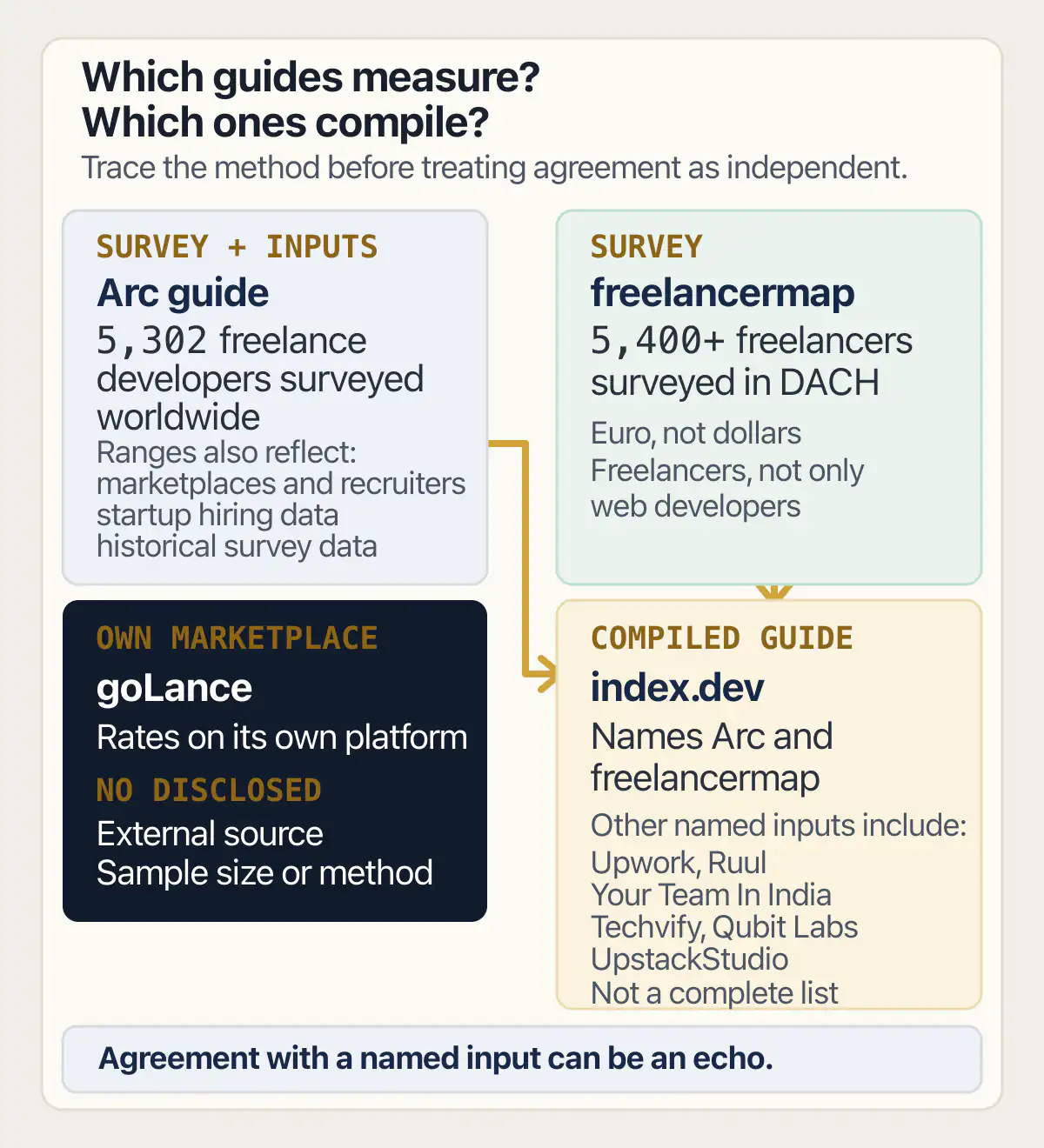
Arc, at arc.dev/employer-blog/freelance-developers-cost/ and dated 26 May 2026, is the only page in the set that puts a counted population behind a dollar band: 5,302 freelance developers surveyed worldwide. It also volunteers, in the same guide, that the published ranges reflect marketplace observations, recruiter benchmarks and startup hiring data as well as its own historical survey. That is a publisher telling you the printed band is broader than the survey behind it, which is more honesty than the rest of this search offers combined.
goLance, at golance.com/hiring/best-freelance-web-developers-hourly-rate, is measuring something real and narrow: what freelance web developers on goLance charge. That is a legitimate thing to publish, and what it measures is the rate on one marketplace, shaped by who joins that marketplace and what its buyers will pay there. The page discloses no external source, no sample size behind those rates and no method, and that absence is a fact about the page rather than a criticism of the number.
index.dev, at index.dev/blog/freelance-developer-rates, is the most useful page in the set precisely because it is the least original. It says outright that its figures were compiled from Upwork, Ruul and FreelancerMap, and separately from Arc, Your Team In India, Techvify and Qubit Labs, with a third note crediting UpstackStudio for one of its tables. Read the two lists and the circle closes: a compiled guide drawing on Arc and on freelancermap, both of which also appear in this article on their own. So the three tables are two independent surveys of different populations, Arc’s and freelancermap’s, plus one compiled guide that draws on both of them, and the guide agreeing with its own ingredients is not a third confirmation.
freelancermap, at freelancermap.com/market-study, is the second real population: over 5,400 freelancers surveyed across the DACH region. It is also the source most easily misread, because it is regional, it is in euro, and it covers freelancers rather than web developers specifically. It answers a narrower question more rigorously than anything else here answers a broad one.
Then there are the two datasets that would settle the question outright, and neither of them opened.
Arc runs a rate explorer at arc.dev/freelance-developer-rates. As of 31 August 2026, that page does not render a figure to an automated read. Its own text is readable and states that the data “is based on the hourly rates of over 20,000 vetted freelance developers on the Codementor platform”. That is by far the largest per-person dataset on this subject that anybody on this search claims to hold, well beyond the population behind either survey above, and the tool that would show it produced no number on the day.
upwork.com/hire/web-developers/cost/ returned HTTP 403 to an automated read on 31 August 2026, on repeated attempts. contractrates.fyi/Web-Developer/hourly-rates, which collects submitted contract rates, returned HTTP 429 the same day, also on repeated attempts. Both refusals are observations about those addresses on that date and nothing more. No figure from either page appears anywhere above, including figures that were visible in search snippets, because a snippet is a report about a page rather than the page.
The shape of the evidence, then, is one broad survey that qualifies its own output, one narrow survey in another currency, one marketplace publishing its own book, one guide assembled from the others, and the three largest or most direct datasets unreadable on the day. Treat the bands as a sanity check on a quote rather than as a price.
What an hourly rate cannot tell you about your job
An hour is a unit of time. It is not a unit of work, and every table above is priced in the first while you are trying to buy the second.
Take one finding out of the fixed 26-application set AxonBuild audited in June and July 2026. In 9 of the 26 (8 of the 21 third-party apps and 1 of the 5 the founder built), the app was still on a framework version whose hole was documented in public and reachable from code the app was actually running, established by reading each codebase rather than by running any of them, and the fix was often a one-line version bump. The rest of the numbers are set out in the corpus writeup that carries the cohort, the denominators and the method. Hold that finding against a rate table. The repair is twenty minutes. A different finding in the same ledger, in an application built the same way, is a week. The two are indistinguishable from outside, they are bought in the same unit, and no published band on this page knows which one you have.
That is what makes rate comparison feel unsatisfying even when the numbers are sound. Somebody in one of the buyer communities worked out what a short agent run had cost them by the hour and set it against what an experienced developer charges for the same hour. It is a fair comparison of two prices and it still does not answer the question, because the two hours were not buying the same amount of progress.
There is a second thing the table cannot see, and it is the one that costs the most money in practice: the hours before anybody writes a line. Somebody who has never seen your application spends real time reading it, and none of the bands above say whether that time is billed, absorbed or quietly padded into the rate. Two developers quoting the same hourly figure can differ by days on the same job for that reason alone.
Every band on this page prices an hour of somebody’s time in general, and what that same hour costs through each route once your app already exists and something in it has stopped working is worked out with its own sources.
Choosing between paying for hours and paying one agreed figure is a decision about who carries the hours nobody can count in advance, and it has an answer of its own. Paying a set amount every month for whatever comes up buys availability rather than hours, and that arrangement is priced on terms of its own.
How AxonBuild prices work, and why it is not an hourly rate
AxonBuild fixes and extends AI-built apps that already run, and it does not sell hours. It starts with a free 20-minute video call with Bilal about the change you need. If you want him to make it, he checks the app and gives you a fixed quote for that change. You agree what the app should do, he builds and tests it, and you pay after you see it working.
That is a different unit from everything in the tables above, which is the reason it sits in its own section rather than in a row. An hourly band is a price for time and it moves with region, seniority and stack. A fixed quote for a named change does not, because the thing being bought is the change working rather than a quantity of somebody’s attention.
The limits are worth stating as plainly as the price. It is not a penetration test and it carries no compliance certification. A fix does the one thing it was agreed to do, and it is never a claim that the application is now safe or free of other issues. Further features and fixes can follow, each quoted the same way.
Common questions about freelance developer rates
What is the typical hourly rate for a freelance web developer?
There is no single typical figure, and the two guides that publish one directly do not agree. Arc’s 2026 guide puts a mid-level freelance developer at $40-$90 an hour globally and a senior at $75-$150, on a page that reports surveying 5,302 developers and says its printed bands are broader than that survey. goLance publishes averages for its own platform instead of a market figure, at $73 an hour mid-level and about $128 an hour senior. Both were read on 31 August 2026. The honest answer is that the useful number is the one that comes back on a quote for your specific job, and the bands are for checking whether that quote is strange.
How much do freelancers charge for websites?
Websites are usually quoted as a whole rather than by the hour, so the rate tables answer this indirectly. What they do tell you is which skills are cheap. Arc’s senior band for WordPress and CMS work is $35-$90 an hour, the lowest specialisation on its list and well below its general full-stack band of $60-$130, though the two bands overlap, both read 31 August 2026. If somebody quotes you a total for a site, ask which of those two kinds of work it assumes, because the same total means something very different depending on the answer.
How much do developers charge per hour?
Across the four guides read for this page on 31 August 2026, the lowest published figure is $20 an hour, at the junior end of Arc’s global survey table. The highest is $500 an hour, at the top of index.dev’s compiled AI consulting ladder. Ordinary professional work sits nowhere near either end: index.dev publishes a $101.50/hr global baseline, and Arc’s senior band of $75-$150 an hour covers most of it. Which end of that you are near depends more on where somebody sits and how scarce their skill is than on how good they are.
What is the average hourly rate for AI developers?
The published figures split by job rather than averaging. index.dev’s 2026 ladder, read 31 August 2026, puts a traditional machine learning engineer at $80-180/hr, a retrieval and fine-tuning engineer at $130-200/hr, an AI agent developer at $180-300/hr and a strategic or PhD-level AI consultant at $250-500/hr. Arc’s survey guide puts senior AI and machine learning engineering at $110-$190/hr. The much-quoted $900 an hour comes from Fortune’s September 2025 reporting on one enterprise AI platform paying its own agent engineers, not from any freelance rate table.
Does a stack like WordPress or React change what somebody charges?
Yes, and the effect is large. Arc’s senior specialisation table, read 31 August 2026, spans $35-$90 an hour for WordPress and CMS work up to $120-$200 an hour for AI infrastructure. goLance describes the same effect as a multiplier rather than a band, stating that niche stacks such as Rust, Elixir and Solidity command 20-40% premiums while common stacks such as React, Python and PHP sit at category averages. Both readings say the same thing: the technology name is mostly a measure of how many people can do the work.
Do freelance rates include the hours somebody spends reading code they have never seen?
None of the four guides read for this page says. That silence matters more on an application somebody else built than on a new one, because reading and understanding an unfamiliar codebase is real work that happens before any change is made. It is worth asking directly whether that time is billed, and worth preferring an answer that names a number of hours over one that says it is included, since the second usually means it has been guessed at inside the rate.
Do rates for a website differ from rates for a web app?
The published tables mostly do not separate them, which is itself the answer: the rate follows the skills required rather than the label on the product. A brochure site built on a common CMS lands in the cheapest specialisation band on Arc’s list at $35-$90 an hour senior, while an application with accounts, payments and a database lands in its general full-stack band at $60-$130, both read 31 August 2026. What a working site with real users lets somebody change, and what they have to ask you for before starting, is a list rather than a number.
How much does a coder cost per hour?
The same bands apply whatever word you use, and the word does not change the price. On the figures read 31 August 2026, a junior sits at $20-$50 an hour on Arc’s global table and $25 to $50 on goLance’s platform table, and a senior at $75-$150 and $95 to $160 respectively. What does change the price is the three things every table on this page agrees on: how long the person has been doing it, where in the world they are, and how many other people can do the specific thing you need.
Built it with AI. Can’t get the last part right?
That’s the normal state of an AI-built app, and it’s fixable. I trace what the app actually does, explain what needs changing, and build it if you want me to.
Talk about your app →  Free 20-minute video call with Bilal.