The phrase arrives from the tool. You built something in Lovable or Replit or Base44, the internet called that vibe coding, and when the app got past the point where another prompt fixed it, “hire a vibe coder” was the obvious thing to type. Nothing about that search is wrong. It is just the one hiring phrase on this subject where the buyer and the seller mean opposite things by the same two words, and the results feel slightly off before you can say why.
A vibe coder is somebody who builds by prompting. If your app already exists and you cannot change it safely, the person you need is somebody who can read what the AI wrote. None of the nine results on page one is written for the owner of an app that already exists, though the staffing sellers among them list maintenance and new features among the things they will sell.
That mismatch has a cost you pay later. An ad written in the buyer’s meaning of the word pulls in people who are very good at producing a first version and have never opened somebody else’s generated code. They will start well and then hit the same wall you hit, because the wall is in the app rather than in the prompting. The rest of this page sorts the word: who answers the search and what each of them is selling, what the two readings actually are, what an app that already exists needs done to it, and which words in your ad decide which of those two people replies.
Who answers when you search hire a vibe coder
Across the three ways people type this search, the results are three forum threads, three staffing sellers, two marketplaces and three job boards. Five of them opened to a plain read on 29 August 2026. Four of the five sell or list people who build things, the fifth is a developer forum thread, and not one result is an article written for an owner.
Everything below about who sells this work comes from reading the sellers themselves on 29 August 2026: three Google result sets for the three ways people type this search, then every distinct page across them that would open to a plain read, which was five of the eleven. The other six are left out rather than guessed at: three answered with an error, two are community pages that do not open to an automated read, and one is a single seller’s own profile.
The three phrasings return almost the same set. hire a vibe coder, hire vibe coder and vibe coder for hire share seven of nine results between them, and the differences are one job board swapping for another. An AI Overview fires on all three, which means the words above the ten blue links are being assembled from exactly these pages.
Two of the nine are people asking the question rather than answering it. A forum thread on Reddit, first in the results, is a company owner with a mostly finished prototype asking where to find somebody. A group post on Facebook asks the same thing from the employer side. Neither opens to an automated read, so nothing in this article rests on what they say.
Three are staffing sellers. AI People Agency, at aipeople.agency/hire-vibe-coders/, describes a service list rather than a definition: custom web development, mobile app development, full stack engineering, front-end work, API integration, SaaS product engineering, performance optimization, and maintenance and feature upgrades. It advertises a “7-day risk-free guarantee” and states “No, we don’t charge any setup fees”. As of 29 August 2026 the page carries no price of any kind. Match.dev, at match.dev/hire-developers/vibe-coders/, sells vetted senior engineers and does define the word, which is where this page’s argument starts. Bacancy Technology’s page for the phrase hire vibe coding developers, at bacancytechnology.com/hire-vibe-coding-developers, refused an automated read on the same day. None of the three is linked here, because all three sell the same buyer the same work.
Two are marketplaces. Upwork holds a category page for that same phrase at upwork.com/hire/vibe-coding-developers/, and Fiverr placed a single seller’s profile on page one. Neither was read: Upwork answered HTTP 403 on 29 August 2026, and the Fiverr result is one seller’s own profile, which is a listing rather than a statement about the market and was not fetched. No figure from either page’s search snippet appears anywhere on this page.
The last two are job boards indexing the phrase from the employment side, and this is where the word starts to come apart. VibeCodeCareers, at vibecodecareers.com, is a job board with career content attached. On 29 August 2026 the six listings in its “Latest Vibe Coding Jobs” section were a junior performance and marketing designer, a global sales internship, an accounting manager, a technical product manager, a go-to-market engineer and a lead brand designer. None of the six is a coding role. Indeed, at indeed.com/q-vibe-coding-jobs.html, returned five listings for the phrase on the same day, one of them a duplicate of another, and the survivors were a Base44 vibe coding role, an integration and API architecture role, a product designer at TikTok, and a course instructor at a college. ZipRecruiter, at ziprecruiter.com/Jobs/Vibe-Coder, answered HTTP 403 on the third phrasing and was not read.
| Who answers | What their own page says a vibe coder is | What they advertise, read 29 August 2026 | Does the page speak to an app that already exists? |
|---|---|---|---|
| An AI staffing seller | no definition, a service list running from custom web work to API integration | no price anywhere on the page, a “7-day risk-free guarantee”, no setup fees | yes, as “Maintenance & Feature Upgrades”, with nothing about who wrote the code |
| A vetted-developer seller | ”Senior engineers who live in Cursor, Windsurf, and Claude all day. They prototype fast, and they review every line the model writes before it merges.” | developer profiles from $50 an hour to $80 an hour, first profiles in 48 hours | no |
| A job board with career content | an AI-fluent developer, described through salary bands | says freelance vibe coders often charge $100 to $300 per hour | no |
| A general job board | whatever matched the words | five listings, one a duplicate, one of them teaching a course | no |
| Three pages that refused | not read | HTTP 403 on 29 August 2026 | unknown, and it stays unknown |
Those three refusals limit this reading and say nothing about the companies behind them. A page that will not open to an automated read has told you nothing, and nothing is what gets reported.
The one number this page will not try to settle is what any of these people should cost. What developers charge for an AI-built app, route by route, is priced on its own page rather than guessed at here.
The same two words mean opposite things on each side of the ad
Buyers use vibe coder to mean the person who prompts. Sellers use it to mean a senior engineer who reads every generated line before it ships. The two readings are opposites, and the gap explains why the replies to an ad written in one meaning arrive from the other.
Start with the buyer’s meaning, in a buyer’s own words. One person marking a year of keeping a tool they had built running wrote publicly:
I am not a developer by trade, I am a vibe coder, and that project was mostly me learning how to get an LLM to prod …
Read that sentence twice. The word is being used as a description of what somebody is not. It marks the absence of a trade, and it names the method that stood in for one. That is the meaning almost every buyer carries into the search box, because it is the meaning the tools taught. It is also the meaning inside an r/vibecoding thread title an alert picked up on 16 August 2026:
A big company wants me to build their portal and apps. I’m a vibe coder.
The whole point of that sentence is the gap between the job and the person. Nobody writes it about a senior engineer.
Now the seller’s meaning. Match.dev’s page for this exact query defines the role in one sentence, read on 29 August 2026:
Senior engineers who live in Cursor, Windsurf, and Claude all day. They prototype fast, and they review every line the model writes before it merges.
The seller’s definition and the buyer’s self-description describe two different people, and the buyer is paying for the one they are not.
Both halves of that definition matter, and the second half is the one carrying the weight. Reviewing every generated line before it merges is a skill you can only exercise if you can read the line. The company is selling engineers who happen to use AI heavily. It has attached the buyer’s word to them because that is the word the buyer types. Its own developer profiles on the day carried hourly rates from $50 an hour to $80 an hour, and it advertises first profiles in 48 hours. On 29 August 2026 the page said nothing about an app that already exists.
Developers reached the same split from their side a year and a half earlier, and they were blunt about it. The Hacker News thread Ask HN: Would you hire a “vibe coder”?, posted on 23 March 2025, runs mostly against the label. The objection in the comments is precise, and it is worth separating from a general dislike of AI: the commenters who explain themselves accept heavy AI use when the person can evaluate what came back, and reject it when the person cannot. What they are refusing is the inability to verify, not the tool. Read as a definition rather than as an opinion, that thread says the same thing Match.dev’s marketing sentence says.
Even the people wearing the label are arguing about it. An alert on 10 August 2026 picked up another r/vibecoding thread, titled:
Why do we even call ourself vibe coders
Paid roles do exist for the second meaning, and they are advertised carefully. Recruiters posting for people who work with these tools every day tend to describe the opening as something other than a conventional developer role, which is a way of saying that the tool fluency is the point and the engineering is assumed.
So the word has two owners and no referee. When you write an ad, you are picking a side without being told that you are picking one. Why the person who prompted the app stopped where they did is explained where the failure patterns are counted, and it is the reason the second meaning is usually the one an existing app needs. Sorting the sellers themselves, rather than the word they advertise under, is a map of its own.
What your app actually needs somebody to do
An app that already runs needs one capability a first version never had to have. Somebody has to be able to make a change and know whether the change broke anything else. That is the difference between an app you own and an app you are hostage to, and it is almost never present when the app arrives.
Across 26 AI-built apps AxonBuild audited in June and July 2026, at least 18 of the 21 apps built by other people had no working test anywhere. That number comes from the finding ledger over those 21 third-party apps, with every finding pinned to a file and a line, and it is a lower bound rather than an estimate. Seventeen of them had literally nothing. The eighteenth had a checkout test suite that never executed the checkout code.
Sit with what that means for a change. With no test anywhere, nothing in the application tells its owner whether the last edit broke the sign-up, the payment, or the part a customer uses on Tuesdays. The only detector is a customer. That is precisely the gap a person who works by prompting cannot close, because closing it means reading code that already exists and deciding what has to be true about it. Prompting produces new code. It does not produce an opinion about old code.
The second cut from the same set says how much old code there usually is to have an opinion about. Of all 26 applications, 22 had at least one confirmed-critical finding, verified against the code rather than pattern-matched, and none of the 26 scored green, including the five the founder wrote. The four without a confirmed critical were exactly the four apps in the amber band, the only four of the 26 outside the red one. The band is not the score: one confirmed critical forces red however well an app scored. A working app and a safe-to-change app turn out to be different states, and every one of the 26 was in the first.
So the job you are actually buying, when the app already runs, has a shape. Somebody reads the code you have. They find out what it does when a second user signs in, when a payment fails halfway, when the model call times out. They put in the checks that were never written, so that the next change has something to fail against. Then, and only then, do they start adding what you wanted added. The order matters, because adding features on top of an app with no way to detect breakage is how owners end up paying twice.
What the person who reads the code actually fixes turns out to be short and repetitive across apps, which is the useful part: the work can be priced in a way the app itself never felt like it could. What the reading turns into, item by item and ranked by how often each item was needed, is the cleanup work itself.
Some owners want the reading and nothing else, at least at first, and that is a legitimate purchase with its own price. Buying the read on its own, with nothing changed afterwards, is a different purchase with a different price.
Two things sit next to this job without being it. Working out whether the code in front of you was generated at all is a separate reading, done on the repository rather than on the person. Whether the app itself was built by prompting shows in signs you can see from the outside, which is a short check of its own. Neither of those is the hire. They are both things you might want to know before you write the ad.
And the hire itself has a name that is not “vibe coder”. What to look for in somebody who does this professionally, once you have decided you want a reader rather than a prompter, is the next search.
Which words in your ad decide who answers it
The job title you type is a filter, and it is the strongest filter you have. Everything else in the ad describes the work. The title decides who reads far enough to see the description.
Write “hire a vibe coder” and you will hear from people whose portfolio is first versions. Some of them are excellent at that, and some of them are three weeks ahead of you on the same tools and nowhere ahead of you on reading code. The word has no seniority signal in it, which is exactly why the staffing sellers had to attach their own definition to it.
Write “developer who can take over an app built with Lovable” and the supply changes. You will hear from fewer people, and the ones who answer have usually done it before, because the sentence describes a job they recognise. Vendor words work harder than any adjective: Lovable, Replit, Base44, Bolt, Bubble, FlutterFlow. Somebody who has taken an app out of one of those knows where the database sits, what the export contains, and what stops working the first time the app runs somewhere the builder does not control. Somebody who has not will find all of that out on your money.
There is a demand-side version of this problem visible in public ads. Somebody posted to r/hiringpakistan on 9 August 2026 looking for staff under a title that hedged both ways:
Looking for a developer / vibe coder to build internal software for a restaurant g…
That slash is the whole difficulty of this market in one character. The buyer does not know which of the two people they need, so they name both and let the replies sort it out. The replies will not sort it out, because both meanings answer.
Three things in the first line of an ad do more filtering than the title:
- The state of the app. “Already live, roughly 400 paying users, built in Replit” tells a reader more than any list of skills. It also tells the wrong applicant to skip.
- The vendor and where the code lives. Name the builder, and say whether you have the code in GitHub or only inside the tool. A reader who knows the export shapes will price differently once they know which one they are dealing with.
- The one thing that must be true afterwards. One sentence about what will be working when the job is done, in the words a customer would use. “A second customer cannot see the first customer’s orders” is a job. “Improve security” is a wish.
Phrasings like hire vibe coders and hire vibe coding engineers return the same supply as the singular, so switching between them changes nothing. The lever is whether your first line describes an app that exists, and the plural changes nothing.
Which hiring job you are buying, once the job title is out of the way, is a longer sort with a list of its own. Checking that somebody can do what they say, when you cannot read a line of it yourself, is its own set of moves, and it is worth having in hand before the first reply arrives.
When a vibe coder is genuinely the right hire
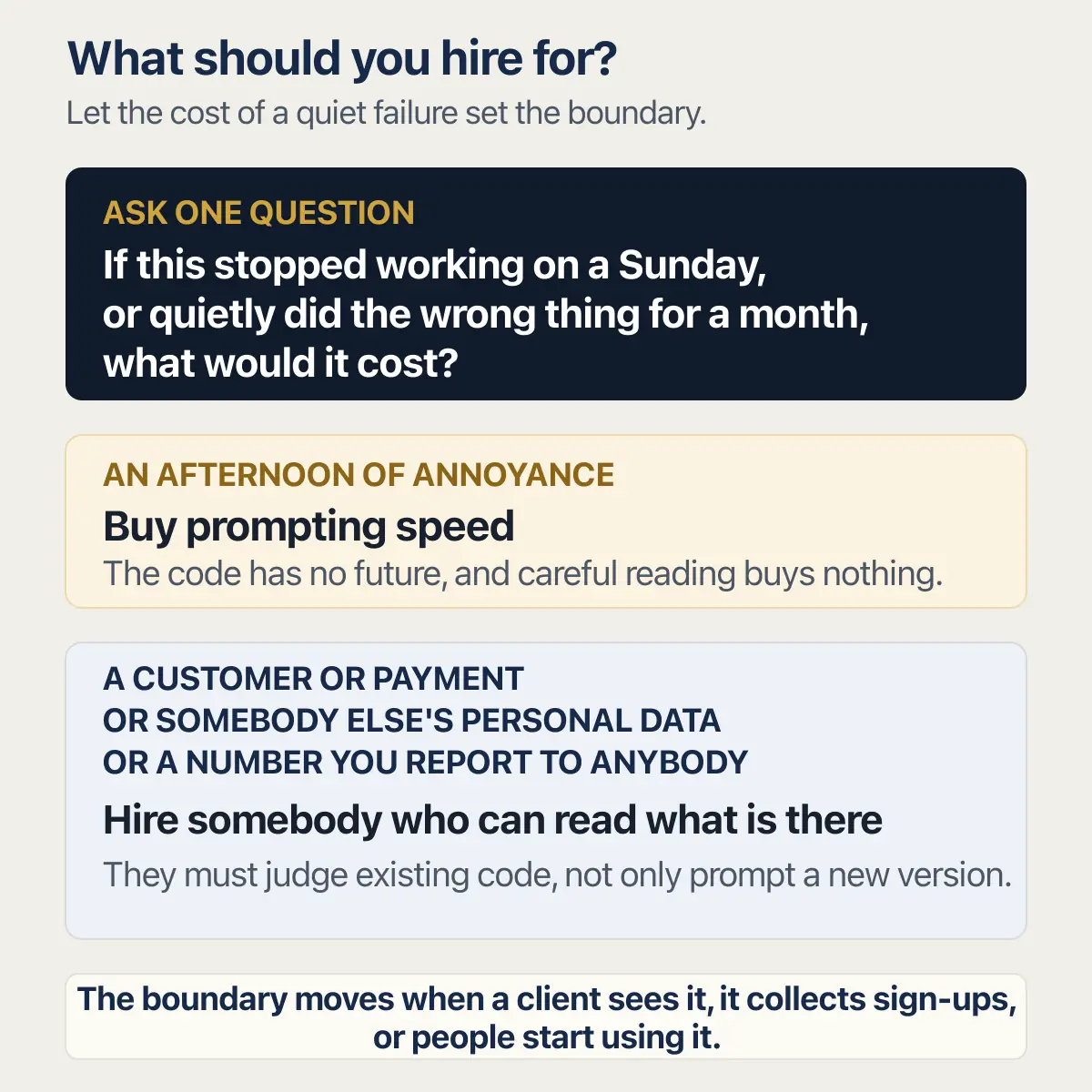
Prompting speed is worth real money on a narrower set of jobs than the search results imply, and the boundary is easy to draw.
Hire for prompting speed when nothing you would mind losing depends on the result. An internal tool three people use to stop doing something by hand. A prototype that exists to show a customer or an investor what you mean, which will be thrown away either way. A second version of one screen, built quickly so you can decide whether the idea is any good before anybody builds it properly. In those jobs, reading the code carefully is overhead that buys nothing, because the code has no future.
The test is one question, and it has nothing to do with technology. If this stopped working on a Sunday, or quietly did the wrong thing for a month, what would it cost? If the answer is “an afternoon of annoyance”, speed is the right thing to buy and a person who prompts is the right person to buy it from. If the answer involves a customer, a payment, somebody else’s personal data, or a number you report to anybody, then somebody has to be able to read what is there.
The awkward part is that the same app often moves from the first answer to the second without anybody noticing. The internal tool gets shown to a client. The prototype gets a signup form. The throwaway screen becomes the one people use. Nothing about the code changes at that moment, but everything about what it needs does, and the person who built it fast is frequently not the person who can tell you that the line has been crossed.
Where AxonBuild fits, and where it does not
Plainly, so you can rule it in or out. AxonBuild fixes and extends AI-built apps that already run. It is neither a staffing seller nor a place to have a first version built.
The way in is a free 20-minute video call with Bilal about the specific thing that is wrong or missing. Show him what happens and what you have tried, and he will help you work out what needs checking. If you want him to make the change, he checks the app and gives you a fixed quote, and you pay after you see it working. Finishing an app or rebuilding a part of it is quoted the same way, after the code has been checked rather than priced in advance on a page like this one.
If what you want is somebody to build the next thing quickly from a prompt, that is a different purchase and this is not the place for it.
Common questions about hiring a vibe coder
Do people actually hire vibe coders?
Yes, in small numbers, and mostly for new builds. On 29 August 2026 the pages answering this search included three staffing sellers who list people under that title, one marketplace category page, one seller profile, and two job boards. The job boards are the tell: one returned five listings for the phrase, one of them a duplicate and one of them a teaching role, and the other showed six current listings that were all marketing, sales, design and finance roles. The small market of people who finish other people’s AI builds has dated reporting behind it and its own numbers.
Is a vibe coder the same as a developer?
No, and the difference is what happens after the first version works. A developer can open code they did not write, work out what it does, change it, and know whether the change broke something else. Somebody working purely by prompting produces new code and has no reliable way to judge old code. Plenty of good developers use AI tools constantly, so the dividing line is whether they can verify the output.
What should I write in the ad if I want somebody who can read the code?
Describe the app instead of the person. Say it already exists, name the builder it came out of, say whether the code is in GitHub or still inside the tool, and give one sentence about what must be working when the job is done. A title like “developer to take over a live Lovable app” filters harder than any skills list, because it describes a job that only one of the two kinds of applicant recognises.
Can somebody who calls themselves a vibe coder fix an app another one built?
Sometimes, and the word will not tell you which. The label covers both a person who has shipped software for a decade and now prompts most of it, and a person whose first program was three months ago. Ask what they did the last time a change broke something they could not see, and listen for whether the answer involves reading code or re-prompting until the symptom went away. That one answer separates the two readings of the word faster than any portfolio.
Does it matter if the developer I hire uses AI to do the work?
By itself, no. Almost everyone does now, including the senior engineers the staffing sellers advertise for this exact query. What matters is whether they check the output before it ships. The developers arguing about this in public make the same distinction: heavy AI use with review is a working method, and generating code nobody understands is the thing they refuse. Ask how they verify rather than whether they use it.
How do I tell whether they can read code when I cannot?
Ask them to explain something about your own app that you already know the answer to, and see whether the explanation matches. If your app has a known bug, describe the symptom and ask what they would look at first. A person who reads code names a place. A person who prompts names a fix. Checking somebody’s claims when you cannot read a line of it yourself has a fuller set of moves than one question, and it is worth doing before money changes hands.
I already have an app from Lovable or Replit. Do I need a vibe coder or a developer?
A developer, and specifically one who has taken an app out of the builder you used. An existing app needs somebody who can read what is there, find out what happens when it fails, and put in the checks that were never written before adding anything new. That is reading work. Prompting produces a new version rather than an opinion about the current one. Who keeps it running after the first job is a decision of its own, and worth settling separately from the repair.
What if I only need a quick internal tool?
Then prompting speed is the right thing to buy and the word works fine. A tool that three colleagues use to stop doing something by hand, with no customer data and nothing you would mind losing, does not need careful reading, because the code has no future. The moment it gets shown to a client or collects somebody’s email address, the job changes even though the code has not, and that is the point to bring in somebody who reads.
Built it with AI. Can’t get the last part right?
That’s the normal state of an AI-built app, and it’s fixable. I trace what the app actually does, explain what needs changing, and build it if you want me to.
Talk about your app →  Free 20-minute video call with Bilal.