An agency here is a company that sells work to its own clients and needs somebody outside it to build the technical part, white-label means that outside team building under the agency’s own name rather than the agency renting a finished product and putting a new badge on it, and a client is the company the agency builds for rather than a piece of software calling an interface.
This page is about somebody writing code for a client who believes the agency wrote it. White-label search reporting, advertising, reputation dashboards and the rebrandable crypto and industry-specific products are a different trade.
The situation is always the same. The work is sold, the client is waiting, and the agency’s own people are spread across three other jobs. One agency, holding work it had already sold to a client, said out loud that it did not much mind whether the answer was one person, a small group or a company, so long as somebody could build the thing.
White label web development is an outside team building or fixing client work under an agency’s own name. Every page that ranks to teach you how to choose one is published by a company that sells it. Five things decide whether it goes well, and those checklists name none of them.
Nothing here was built, bought or arranged. On 3 September 2026 the three searches an agency runs before it picks somebody were pulled, and the twelve seller and editorial pages this page reports on were read whole and raw, site navigation and embedded page data included. Two refused both request shapes, and nothing is claimed about what they publish. Two forum threads served a challenge page instead of a thread, so they stand only as proof that the conversation exists. What a company states is reported as that company’s own wording on that date, nothing here rates anybody, and none of it is advice about an agreement somebody is asking you to sign.
No company named below is linked from this page. Every one of them sells white-label web development to agencies, which is exactly who this page is written for, so each is named with its address printed as plain text instead. The ranked listings and directory pages in these results were not opened at all, and this page reports nothing about their contents. As of 3 September 2026, Swart Digital’s page at swartdigital.com/agency-development-partner and Uplers’ page at uplers.com/white-label-web-design-development/ do not render body copy to an automated read (a plain request and a browser-shaped request both refused with a 403).
What does white label web development mean when the thing being built is software?
An outside firm builds or fixes the work, the agency’s name goes on it, and the client is not told. That is the whole arrangement, as the sellers define it. It is a promise about the client relationship before it is a promise about code, which is why the questions that matter are about what happens when the partner leaves.
Clap Creative, at clapcreative.com/what-is-white-label-development/, defines white-label development as outsourcing website, software or ecommerce work to a third party that completes it without attaching its own branding, with the client-facing company rebranding it and delivering it as its own, and states that the client only interacts with the agency while the partner remains invisible. Spyce Media answers the same question in its own FAQ at spycemedia.com/services/white-label/web-development: development outsourced to a third-party firm that builds under the agency’s brand, so the agency can offer the service without an in-house team. Both were read on 3 September 2026.
The service list is stable across sellers. The White Label Agency, at whitelabelagency.co/service/white-label-web-design, names website design and development, website maintenance and hosting, website management and updates, and migration, and suggests the agency sell its client a monthly maintenance package it handles. Always Fresh, at alwaysfresh.io/white-label-web-design, states that the agency charges its client whatever it likes and passes the design and development on, and offers to handle search work, maintenance and support as well. That is what white label web development services means in practice on a white label web development agency’s own page: a menu the agency resells, with the pricing left to the agency.
Two of those definitions turn on the same sentence, and it is worth reading slowly. The client never learns a third party was involved. Everything difficult here follows from that one promise: the agency is answerable for work it did not do, with people it cannot see, on a system it may not be able to open.
The mechanics of the arrangement itself, meaning who invoices whom, who holds the client contract, and what an agreement between two suppliers actually contains, are a separate subject. Renting somebody else’s finished software under your own name is the other thing this phrase is used for, and it is a different page.
What the pages that rank for this ask you to check, and what none of them mentions
Three searches, on 3 September 2026, returning nine, nine and eight organic results.
The head phrase returned nine organic results: six sellers of white-label web development, two ranked listings, and one forum thread six years old about a platform idea for ordering websites. Zero buyer-side editorial. The phrase an agency uses when it is further along, development partner for agencies, returned six editorial pages, two service pages and one forum thread, and every one of the six editorial pages is published by a company that sells the service its article tells you how to buy. The third phrasing, aimed at mobile work, returned four ranked listings, two vendor product guides and two sellers.
So the whole supply of advice here comes from the supply side. The advice is not wrong, and it stops in a predictable place.
Five of those seller-published pages were read in full. Between them they ask good questions. Leaflet Digital, at leafletdigital.com/blog/white-label-development-partner and dated 12 May 2026 on the page, asks five: how the partner protects the agency’s client relationship, what documentation arrives with the work, whether changes to what the work covers can be absorbed without rebuilding the timeline, what the partner’s actual rather than stated availability is, and how the partner handles a build that is not going well. It also names three warning signs that look like good signs: a detailed quote arriving within an hour of reading a brief, a very large portfolio, and a partner claiming it can handle anything.
Nifty Inc, at niftyinc.com/blog/what-agencies-should-look-for-in-a-development-partner, names five criteria it says never appear on a portfolio page: communication under pressure, technical judgment rather than technical skill, an understanding of agency economics, process compatibility, and a quality baseline. It also names a conflict most lists skip. A partner that also sells design, strategy or client-direct services has an incentive to build a direct relationship with the agency’s client, and it recommends starting with one small defined project and asking for references from other agencies the partner has worked with rather than from the partner’s own direct clients.
The Kestrel Co, at thekestrel.co/agencies-web-development-partnerships-best-practices/, publishes fourteen numbered practices. Among them: involve the partner from the first client meeting, review the designs and the functional requirements with them, define the allowed rounds of revision, be honest about budget and timeline, say early if the arrangement is white-labelled so nobody misrepresents themselves, shield them from unpaid extra work, attend the training session, and hold a post-mortem afterwards. Digiteam, at digiteam.ca/how-to-choose-the-right-development-partner-for-your-agency-without-losing-your-mind/, runs a checklist on technical expertise and track record, communication, understanding of agency work, and long-term support, and under the last of those it names a service level agreement and the process for bugs as against new feature requests. Burder Creative, at burdercreative.com/agency-tip-finding-a-good-development-partner/, publishes five benefit headings and a request to get in touch, and names no question for the agency to ask.
Run that advice. Then read the next paragraph twice.
Across those five checklists, read raw on 3 September 2026 with their site navigation and their embedded page data included, the words repository, source code, hosting account, credentials, uptime, outage, downtime and escrow, and the phrase intellectual property, return zero occurrences on all five.
Two qualifications belong with that count, in the same breath. The word ownership does appear twice on one of the five, and both occurrences sit inside embedded page data written for other articles on the same site, one about naming somebody inside the business who will run the system and one about confirming a domain is registered in the buyer’s own name, not in that page’s partner checklist. And no AI coding tool is named anywhere in the five checklists’ own copy: the only appearance of any tool name across all five is one image file name on one page, and a second page links to an article of its own about AI-assisted development without naming a tool. That count covers those five pages on that date, and nothing beyond them.
The reason is not a conspiracy. An article written by a partner answers the questions a partner answers well, and every item on that missing list is about what happens when the partner is no longer there.
Five things to settle before a partner touches client work
| What the agency settles first | What counts as an answer | Why a generated build makes it worse |
|---|---|---|
| Where the code lives, and who can grant access | The account or organisation holding the repository, and the named person who can add somebody to it | A generated build often has no repository at all until somebody makes one, so the honest answer can be “nowhere yet” |
| Whose name the client’s own accounts are in | Which accounts exist and who sits on each one, settled before anybody is added to anything | A builder opens several accounts on somebody’s behalf during a build, and the fastest route is usually the partner’s own |
| What the client is told, and what happens if the client emails the partner | The written answer on direct contact, and what the partner says if the client reaches them anyway | Nothing tool-specific here: it bites the same either way, and it is the one every checklist half-answers |
| Who answers when it stops working after launch, and until when | A named person, working hours, and an end date rather than a promise of care | A generated build tends to fail first in the places nobody looked at, which is after launch rather than during it |
| What ends on the day the arrangement ends | An action somebody performs on a named date, not an assurance | Access to a builder’s workspace is a switch somebody flips, and if nobody names the date it never gets flipped |
Where the code lives. The answer an agency wants is boring: a repository in an account the agency or the client controls, with the partner invited to it. The answer that causes trouble later is a partner’s own account with a promise of a copy at the end. On a generated build the question comes earlier than that, because a project living inside a builder’s editor is not a repository, and somebody has to create one before there is anything to grant access to. Whether a transfer has actually happened, as opposed to been agreed, comes down to four checks that do not change with the builder.
Whose name the accounts are in. Not a list of accounts, a question about names. Every client build sits on a small pile of paid or free services, and each one is registered to somebody. Which accounts have to be in the client’s own name, one at a time, is itemised in a list that does not change with the builder. The reason to settle it before the work rather than after is that adding a person to an account is a minute’s work and moving an account between owners is a negotiation. One host’s own limits show what putting every client’s site under a single agency account does to the day one of them has a bad month.
What the client is told. Every seller page in these results promises invisibility, so the promise is cheap. The version worth having is the specific one: if the client emails the partner directly, what does the partner do, in writing. The Kestrel Co’s own practice list makes the same point from the other side, which is that a partner told late that the arrangement is white-labelled can misrepresent itself by accident.
Who answers after launch. This is the row that separates a build from a relationship. A partner that says it stands behind its work has said nothing. A partner that names a person, the hours they work, the response time and the date the arrangement ends has answered. What tends to give way in a generated application once real people use it is catalogued separately, and it is a list of things that surface after the launch rather than during the build.
What ends when it ends. Somebody has to remove the partner from the accounts, move the paid plans, and confirm the client can deploy without them. Every one of those is an action with a date, not a sentence in an agreement. What an agency owes its client on the day the work is transferred across, when the thing it shipped was generated, is the far end of the same arrangement.
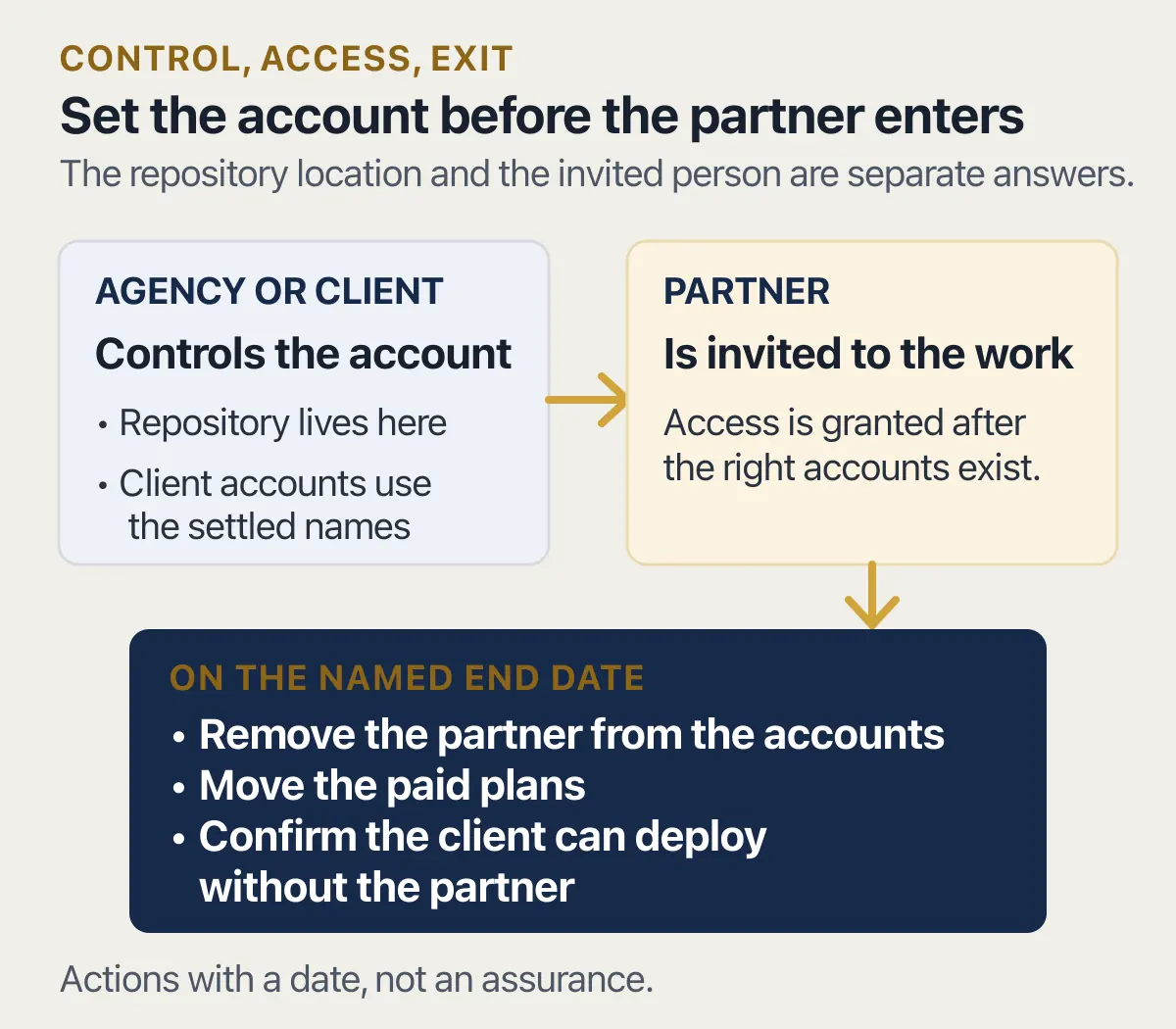
All five answers fit on one line each, written down before any work starts. A partner who would rather discuss them once the project is under way has answered the question anyway. What an owner settles before a shop touches their own working application, on one named builder, is a longer list than this one and it is written from the other side of the table.
What a partner’s own page publishes, and what a published practice is not
The sellers publish more than the checklists do, and the interesting material is on their service pages rather than in their articles.
Leaflet Digital states its own practice: non-disclosure agreements signed as standard, work carried out under the agency’s brand, the agency’s preferred communication channels used, no direct outreach to the agency’s client, and everything given back in the agency’s name. Afteractive, at afteractive.com/services/agency-partnerships, states that it takes full ownership of project management, that the agency manages its clients while it manages the development, and that it will join client meetings as the agency’s development team when asked. Always Fresh puts the money question the same way most of them do, which is that the agency sets the client price and keeps the difference.
E2M publishes the most detail. Its white-label website page at e2msolutions.com/white-label-website-design-development/ refused a plain request and returned the page to a browser-shaped request on 3 September 2026, so this is a split read and is disclosed as one. On that page it states that its work is covered by its own standard non-disclosure agreement, that the agency has full ownership of the websites built for the agency and its clients, that it acts as the agency’s invisible backend team, that it uses email addresses on the agency’s own domain when logging into the agency’s systems, and that it stays off client calls entirely. Its plan table is published on the same domain in the same shape: four named tiers separated by how many hours a month each includes, the largest described as three full-time people, with no minimum, no long contract, and a choice of monthly, quarterly or yearly billing. No figure from that table is printed here.
Here is the part worth being blunt about, without any verdict on the sellers. A statement of practice on a marketing page stays a statement of practice. The thing an agency can hold is the written version of the same sentence, addressed to the agency, before the work starts. The three sentences worth asking for in writing are the three these companies already publish about themselves, which is what makes them cheap to ask for: no direct contact with the client, the agency’s name on everything, and the work belonging to the agency and its client at the end.
Two of the pages that rank for this refused both request shapes, so nothing above describes what they publish. What a builder’s own directory of people to hire is checked against, on the one platform that publishes its answer, is read elsewhere. One builder sells the agency a build environment with a scheduled exit, and what that plan does and does not carry is documented in the vendor’s own words.
When the client work you already shipped was built with an AI tool
One seller on these searches has noticed, and its page is the only one in either result set that addresses that situation directly.
E2M publishes a separate white-label service, reached from its own navigation under a heading its menu calls AI-powered development, at e2msolutions.com/white-label-vibe-coded-website-to-wordpress/. The same split read applies: 403 to a plain request, 200 to a browser-shaped one, on 3 September 2026. The service converts projects generated by AI tools into a content management system, and the page names them one at a time with what each leaves behind. Work generated by Claude arrives as components in a JavaScript framework styled with a utility CSS library, which the page describes as built to look finished rather than built to be edited. Work from ChatGPT usually starts as static markup, a single page with no content management and no way to add content later. Output from v0 is described as production-lean components built for a JavaScript pipeline rather than a content system. Lovable and Bolt builds are described as full-stack applications, one inside the vendor’s own editor and hosting and one built in the browser. Work from Cursor and Replit is called developer-driven and variable enough that the seller says it starts each one with a technical review. Its own summary line is that what an AI tool hands you is a prototype rather than a product.
That is one company’s published description of what it finds, reported here without any rating of the service, and the only description of its kind on either search.
The argument underneath it is worth separating from the sales page. Converting a generated site into a content management system is one answer, and it is a rebuild wearing a gentler name. Whether it is the right answer turns on what the thing actually is. If the client’s build is a website their team will edit, moving it into a content system is a real fix and the client gets something they can run. If it is an application, with sign-in, roles and money moving through it, a content system is the wrong shape for it and the conversion will not touch the parts that break. Whether a generated build is worth continuing with at all has its own arithmetic, and it is better settled before a partner is chosen than after. Whether the client’s application should leave the builder it was made on is a decision with its own conditions. An agency delivering its own client work on one named builder meets the same wall in the same place every time.
Then there is the harder version of the same problem, and it is a buying problem rather than a technical one. A partner taking on a generated build is being asked to price code nobody has read, which is a different purchase from building something new. Every checklist in these results assumes a new build, priced from a design. On an existing generated application the number a partner gives before reading it is a guess with a margin bolted on, and the step that turns it into a real number is somebody reading the thing first. Paying somebody to read a generated codebase before a number is agreed is a purchase in its own right. One paid reading of what is actually inside a client’s application is priced and set out elsewhere. What to send a partner so it can price the work rather than a category is a short list, written for the person who owns the app and just as usable by an agency passing it on.
Why does a search for white label mobile app development companies return a ranked list?
Because the phrase collects two different purchases and the ranked lists serve the other one. On 3 September 2026 that search returned four “top N” listings, two vendor product guides and two sellers, within eight organic results. Judging by their titles and snippets alone, since none was opened, the listings are about renting finished software to rebrand rather than hiring somebody to build.
A white label app development company and a white label app development agency, as those phrases are used on the pages that rank for them, are usually two businesses wearing one name. One sells a product you put your logo on and resell to several clients at once. The other sells people who write code under your brand for one client at a time. Mobile app development white label gets used for both. The two purchases have different failure modes, different prices and different exits, and an agency typing the phrase gets a page of the first kind when it wanted the second.
This page is about the second. Renting a finished product and putting your own name on the front of it is the other purchase this phrase covers, and building one yourself has its own arithmetic. Which shape of seller will take on an application an owner already has, sorted by what each can do with code that exists, is the other side of this market. Companies advertising AI app development sell a catalogue of capabilities for products nobody has written yet, which is a different purchase again.
One question specific to mobile work goes unanswered by the vendor guides and does not appear in the listing titles or snippets, and it is the accounts row above in its app-store form: whose developer account the client’s application is published under. An application published under a partner’s account is a client asset in somebody else’s name, with review history, signing keys and a paid membership attached, and moving it later is a procedure rather than a favour. Hiring named people by the month, and working out how many of them are actually yours, is priced and structured differently from any of this.
Common questions about white-label development partners
How do I check a white-label development partner before I give it client work?
Ask the five questions above in writing before anything starts: where the code will live and who can grant access, whose name the client’s accounts are in, what happens if the client contacts them directly, who answers after launch and until when, and what ends on the last day. The seller checklists cover working style well, touch direct contact and after-launch support in part, and leave the ownership questions and what ends on the last day unanswered.
Who should hold the repository when a partner builds for my client?
An account the agency or the client controls, with the partner invited into it. A partner holding the only copy is a dependency, however good the relationship. On a generated build there may be no repository yet, so creating one in the right account is the first piece of work rather than the last.
What happens if my client emails the partner directly?
Whatever the partner agreed in writing to do, which is why the answer belongs on paper before the first project. Every seller page in these results already promises no direct contact with the agency’s client, so asking for that promise in writing, addressed to you, costs nothing and turns a marketing line into something you can point at.
The partner’s own published sentence is the easiest thing to quote back to them when you ask.
Who answers when the client’s site stops working after launch?
Somebody named, during hours you can state to the client, until a date you both know. A partner that offers care in general terms has not answered the question. This is the row that decides whether a white-label website development agency is a supplier for one build or a partner you can sell continuing work against.
Do white-label development partners publish what they charge?
Some publish a plan shape and some publish nothing. One seller on these searches publishes four tiers separated by monthly hours, with no minimum and no long contract; its figures are its own and are not repeated here. What each route to buying development work charges, with the published figures attached to whoever published them, is collected in one place.
Should I start with a small project or the whole build?
One of the five checklists recommends starting with one small defined project, and the reasoning holds for any agency: a small job tells you how a partner communicates when something goes wrong, which is the only thing you actually need to know and the one thing a portfolio cannot show.
A small first job is also the cheapest way to learn whether the answers you were given in writing survive contact with a real client deadline.
What do I ask a partner about client work that was built with an AI tool?
Ask what they will do before they quote. A number given before anybody has read the code is a guess, and on generated work the gap between the guess and the real number is where the argument happens later. Ask who reads it, what they read, and what you get from that reading.
Ask a second thing too: whether their answer is a conversion into a content system or a repair of the application as it stands, because those are different jobs with different prices.
Is a partner the right answer when only one thing on a client’s app is broken?
Often not. A white-label development agency is sized for builds, and one broken sign-in or one failing payment path is a reading and one change rather than a project. Routing a small failure through a large arrangement is usually paid for in weeks rather than money.
What do the ranked lists of white-label companies actually tell me?
Who published them. On 3 September 2026 the mobile-facing phrase returned four ranked listings inside eight results, and none was opened or is described here. A list of companies is a marketing asset before it is a shortlist, and it answers none of the five questions above.
If you have a working app built with these tools and need it ready for real customers, this is what we do.
Built it with AI. Now it has to hold up for real customers.
The Production Hardening Sprint takes the app you already have and builds the production foundation underneath it. Authentication and access rules, payments that stay consistent, error handling, monitoring, backups, automated tests and a documented handover. Our engineers work inside your existing codebase for ten working days. All 123 deliverables are included, and you get the evidence for each one.
See the Production Hardening Sprint →  $2,500 fixed price · 10 working days · One codebase